


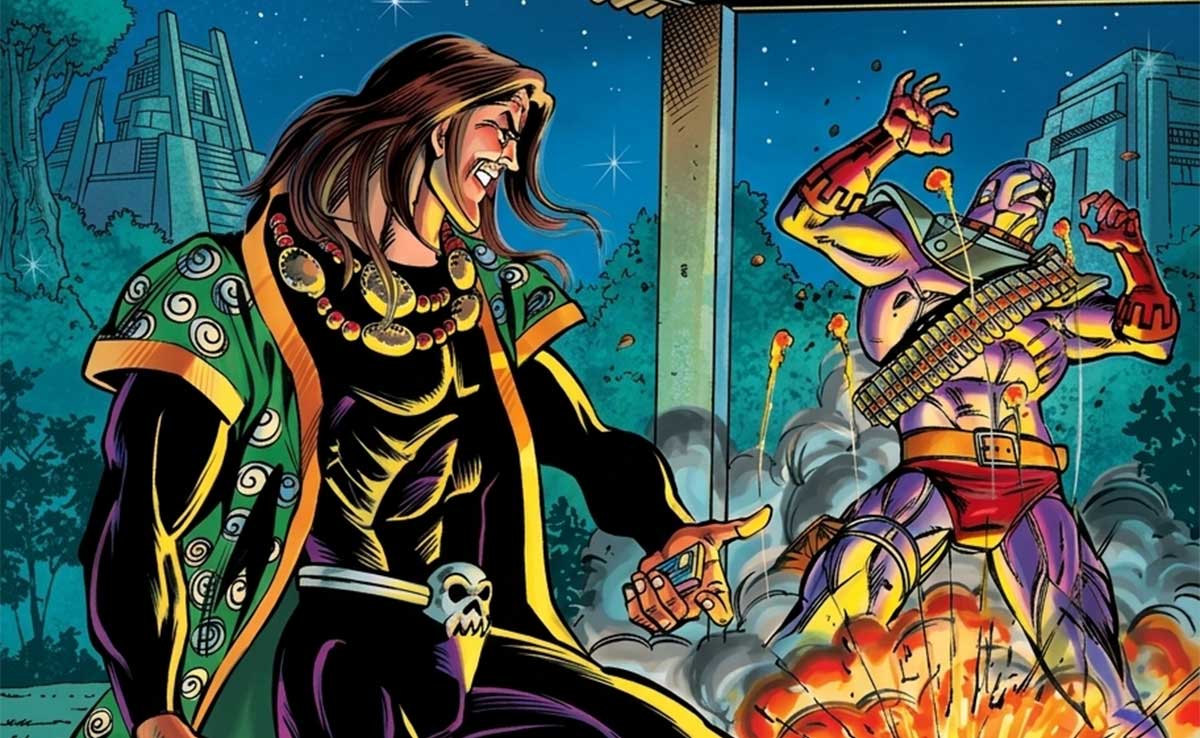
In the vast and exciting world of Raj Comics, ‘Doga’ is a hero who has vowed to go beyond the limits of the law and root out crime. Doga’s list of enemies is very long, but most of them either fall victim to Doga’s bullets or rot behind bars. But in the crowd of these dreaded criminals, there is a face that stands out because of his sharp intelligence, web of puzzles and ability to dodge Doga every time. The name of that criminal is ‘Kaal Paheliya’. Kaal Paheliya is one of the few enemies of Doga who has not only physically challenged Doga but also mentally exhausted him. Based on the presented comics ‘Ding Dong Doga’, ‘Tu Samjha Kyun Nahi Doga’, ‘Kalu 420 Doga 440’, ‘Bloody Puzzles’, ‘Bloody Danger’ and ‘Deadline‘, the personality of Kaal Paheliya comes across as a criminal who sees crime as an art.
The Mysterious Personality and Appearance of Kaal Paheliya

Kaal Paheliya’s real name is Kalu, but his working style made him ‘Kaal Paheliya’. He is not just mighty like the rest of the villains in Doga, but a mastermind. His appearance is extremely different; his hallmark is long black hair, a large yellow or red tilak on his forehead, and often a colorful, peacock-feathered or decorative robe. The black circles around his eyes add a scary depth to his personality. He considers himself an artist who presents his every move like a ‘puzzle’. He believes that if someone does not understand the puzzle he has created, they have no right to live. The biggest strength of Kaal Paheliya is his ‘puzzles’, which confuse a straightforward and clear-minded hero like Doga. He weaponizes his ‘cunning’ in the face of Doga’s ‘cruelty’, and this is what makes him most dangerous.
Bloody Game of Puzzles and Doga’s Challenge

The way Kaal Paheliya works is completely different from other criminals. He never attacks directly. He always leaves a clue, a puzzle that points to his next victim or next move. In stories like ‘Bloody Puzzles’ and ‘Bloody Danger’, we see him putting the lives of innocent people at stake and forcing Doga to solve his puzzles. His puzzles are not just a game of words but messages of death. For example, he writes a word like ‘S.T.O.D.O’, which Doga, in his understanding, thinks is ‘Studio’, or else adds ‘Shara’ and ‘B’ to give a clue like ‘Dharavi’. These puzzles make Doga realize that he cannot stop crime by simply being a ‘fighting machine’; he must also use his intelligence. Kaal Paheliya hits Doga’s pride where Doga believes he can solve every problem with his gun.
Ding Dong Baba: Playing with People’s Emotions

A very vicious form of Kaal Paheliya is seen in the comic ‘Ding Dong Doga’. Here he disguises himself as ‘Ding Dong Baba’ and pretends to be the messiah of the poor. He distributes fake notes among the people, posing as a devotee of Kubera. This was a deliberate move by him whose aim was to destroy India’s economy through fake notes. Here Kaal Paheliya shows that he is not just a petty thief or a murderer but can plan to cause havoc on a large scale. He tried to make Doga a villain in the eyes of the public by taking the help of religion and superstition. When Doga started burning those fake notes, Kaal Paheliya made it look like oppression of the poor. This period was a brilliant example of Kaal Paheliya’s mental trickery, where he used Doga’s power against him.
Maya and Kaal Paheliya: An Incomplete Love Story

The most emotional and important aspect of the character of Kaal Paheliya comes to the fore in the comic ‘Tu Samjha Kyun Nahi Doga’. Here Kaal Paheliya is seen transforming from a criminal into a lover. He falls in love with famous TV host Maya and decides to leave the world of crime for her. He also surrenders to Doga and goes to jail. But fate and time do not leave Kaal Paheliya’s past behind. The riots that break out on the day of his marriage to Maya and the way Maya dies become the biggest turning point in Kaal Paheliya’s life. This incident made him a more dangerous and vindictive person. He attributed Maya’s death to society and Doga’s distrust, which did not give him a chance to reform. This story makes Kaal Paheliya such a villain for whom sympathy also arises in the minds of the readers at one point.
Death Traps and Technological Trickery
Kaal Paheliya is not just a player of words; he is also an expert in laying death traps. In ‘Kalu 420 Doga 440’, he traps Doga between a giant octopus and crocodiles inside the gutter. He knows that Doga’s strength is limited underwater, so he also chooses the place according to his riddles. He also knows the art of controlling dogs using ultrasonic whistles or confusing Doga’s ‘dog commandos’. His puzzles sometimes test both the body and the mind.
In ‘Deadline’, he sends Doga to a building (Everest Towers) where a death trap is laid at every step. This technical knowledge of Kaal Paheliya and his ability to use animals make him more different and dangerous than the rest of Doga’s villains like ‘Infiltrators’ or ‘Ginger Uncle’.
The Complex Ideological Conflict of Doga and Kaal Paheliya
The conflict between Doga and Kaal Paheliya is not just a fight between a criminal and a protector, but it is a clash between ‘rules’ and ‘anarchy’. Doga believes that there is only one end to crime—death. Kaal Paheliya says that he is bringing out the truth of society and its ugliness. He often teases Doga by calling him a ‘fool’ and ‘a man who fights only on the basis of strength’. The riddles of Kaal Paheliya are like a mirror to Doga, showing him that he cannot save everyone every time. Doga is unable to kill Kaal Paheliya even after catching him several times, or Kaal Paheliya escapes from his grip. Doga has a different kind of hatred for Kaal Paheliya because he knows that this man will never get on the straight path. He is like a ‘dog’s tail’ that can never be straight.
An Invincible Criminal Who Is Still Alive Today
The biggest specialty of Kaal Paheliya in the world of Raj Comics is that he is included among those villains who are still alive today. Despite being badly beaten and jailed several times at the hands of Doga, Kaal Paheliya never gave up. He is one of only a handful of Doga’s enemies to have had several bloody battles with Doga and yet managed to escape each time at the end of the story. His survival is a symbol of constant failure and challenge for Doga. Killing Kaal Paheliya might have been easier for Doga, but his web of puzzles and his cunning always put him one step ahead of Doga. He is fully established as Doga’s ‘Recurring Villain’, whose fear of return always looms over the city of Mumbai.
Social Satire Through Puzzles
The character of Kaal Paheliya is not limited to crime only; he also takes a jibe at society through his riddles. He shows how people, out of greed, blindly trust any ‘Baba’ (in the case of Ding Dong Baba). He also shows that by taking advantage of the shortcomings of the law and the police, a criminal can challenge the entire system for years. His riddles often point towards the blindness of society. When he asks Doga, “What erupts on Diwali?” and his answer is a bomb blast, he is actually saying that society is living under the false illusion of security. The character of Kaal Paheliya makes readers think about who the real culprit is—he who asks the puzzle or the society that does not understand him.
The Future of Kaal Paheliya
Finally, Kaal Paheliya comes out as one of the most intelligent and entertaining villains of Raj Comics. His relationship with Doga sounds much like that of Batman and the Joker, where one hero sticks to his principles and the other believes in chaos and mind games. The survival of Kaal Paheliya is proof that in Doga’s world, justice cannot be done with just a bullet; there are some enemies whom Doga has to use parts of his brain that he often ignores in order to defeat.
The puzzles of Kaal Paheliya will continue to create new troubles for Doga in the future as well, because as long as there is crime in Mumbai, criminals with clever minds like Kaal Paheliya will continue to challenge Doga’s justice. He has become such an important part of Doga’s stories that without him, Doga’s bravery seems incomplete. He doesn’t die because puzzles never end; they just keep changing their form.

