


In the 90s, when legends like Nagraj, Super Commando Dhruv, and Doga dominated the world of Indian comics, a hero emerged who made the Indian Tiranga not just his costume, but his strength. That hero was—Tiranga. The comic of the Tiranga series, ‘Kafan’ (issue number 660), is not just an action-filled story, but also a deeply painful and effective tale of emotional conflict, revenge, and patriotism. This comic, also known as ‘Nagraj Varsh’, published in 1996, still holds a special place today due to its strong plot and powerful presentation.
Plot expansion
The story begins with a heart-wrenching incident. Three former freedom fighters are present in the building of Bapu Khadi Village Industries when a massive explosion occurs. In this blast, the bodies of those elderly revolutionaries are torn apart. This is not an accident, but a well-planned conspiracy. Shortly after, another great patriot of the country, ‘Rajan Babu’, is brutally murdered along with his driver. The killer is no ordinary criminal—he uses poisoned arrows and calls himself ‘Shroud’.

Abhay, the protagonist of the story and the true identity of Tiranga, gets involved in this matter when his classmate Saba’s father suddenly goes missing. Saba’s father is a patriotic lyricist whose voice and words inspire and energize people. To the outside world, Abhay appears to be a simple, studious student, but in reality, he protects justice by becoming ‘Tiranga’.
‘Shroud’, the villain, wears a strange and terrifying costume. His outfit is inspired by the colors of the Tiranga, but the skull on his chest clearly reveals the poisonous nature of his thinking. He considers himself an enemy of patriots. He attacks the great freedom fighter Ramanand Sagar, where Tiranga and Shroud come face to face for the first time. In this clash, readers learn that Shroud is not limited to deadly weapons like crossbows and poisoned arrows, but is also highly skilled in hand-to-hand combat.
The most emotional and significant part of the story is Shroud’s background—his origin story. Kafan’s real name is Abraj Khan. His grandfather and father were part of the Azad Hind Fauj. However, due to suspicion, misunderstanding, or alleged betrayal, the revolutionaries themselves accused his father, Shahbaz Khan, of treason. Attempts were made to kill them, leaving them crippled and forcing them to spend the rest of their lives in poverty and humiliation. While dying, Shahbaz Khan makes his son Abraj swear that he will eliminate all those so-called patriots who wronged him. This burning fire of hatred and revenge ultimately turns Abraj into ‘Shroud’.

The comic reaches its climax at a college function where freedom fighters are to be honored. Shroud lays a deadly trap involving a lethal combination of the Ashoka Chakra and sharp arrows. On one side, Tiranga is busy saving the lives of these elders, while on the other side, Shroud’s goons attack Abhay’s house, where his father, Havildar Ramnath, is present. The story ends on a deeply tragic note—Tiranga saves the country but pays a heavy price in his personal life: his father dies, and his home is reduced to ashes.
Characterization

Tiranga (Abhay): The character of Tiranga may appear inspired by ‘Captain America’, but his roots are firmly embedded in Indian soil. Abhay’s calm and simple nature, combined with Tiranga’s fierce and obsessive patriotism, creates a powerful balance. In this comic, his helplessness is clearly visible, as on one hand he wants to save his father, and on the other, the responsibility of stopping the enemies of the nation rests on his shoulders.
Shroud (Abraj): Shroud is not a simple black-and-white villain. He is a tragic antagonist whose hatred originates from the injustice done to his father. He represents a distorted version of Tiranga, showing how disastrous the consequences can be when hatred replaces patriotism. His name, ‘Shroud’, itself suggests that he has arrived as death for patriots.
Havildar Ramnath: Abhay’s father is an honest and conscientious policeman. His relationship with Abhay is deep and emotionally layered. He considers Abhay a coward because he is unaware of his son’s true identity, yet he loves him with all his heart. His sacrifice adds immense emotional depth to the story and continues to shake the reader long after the comic ends.
Writing and dialogue

Hanif Azhar’s writing is sharp and tightly paced. The story moves swiftly, and the reader never feels bored at any point. Patriotism is clearly reflected in the dialogues, yet they never feel heavy or preachy like speeches. Especially Shroud’s dialogues, where he accuses revolutionaries of “fake patriotism,” present a perspective on society that is rarely discussed. These dialogues provoke thought. Manish Gupta’s editing maintains the pace and balance of the narrative, ensuring that the story keeps moving forward without losing momentum.
Art and portraiture

The artwork by Milind and Bittu perfectly reflects the identity of 90s Raj Comics. Shroud’s costume design is highly effective—it looks both frightening and memorable at the same time. The battle scenes, especially those involving the Ashoka Chakra, are beautifully and intelligently executed. The choice of colors, which largely revolves around the hues of the Tiranga, does complete justice to the theme and title of the story. The falling bricks sequence on page 7 and Shroud’s attack on page 9 are excellent examples of visual storytelling, where everything is conveyed clearly without the need for excessive words.
Theme and message

This story of Tiranga effectively presents the age-old conflict between revenge and duty. The character of Shroud symbolizes blind revenge, a fire that erases the boundary between right and wrong. On the other hand, Tiranga’s strong sense of duty does not allow him to deviate from his principles, even in the most difficult circumstances. The story also highlights the bitter truth that misunderstandings formed in childhood and rejection by loved ones can push an innocent person onto the path of crime. Ultimately, the narrative forces readers to reflect on the true meaning of patriotism—is it limited only to slogans and symbols, or does it reside in difficult decisions and selfless actions, where one rises above personal interests to do what is right?
Critical analysis

‘Shroud’ is not just a superhero victory story; it is a story of victory that comes at a great cost. Here, the hero wins, but loses a lot in return. Indian comics often portray heroes as invincible in every situation, but in this story, Tiranga is shown breaking emotionally. This vulnerability is what makes him more human and relatable.
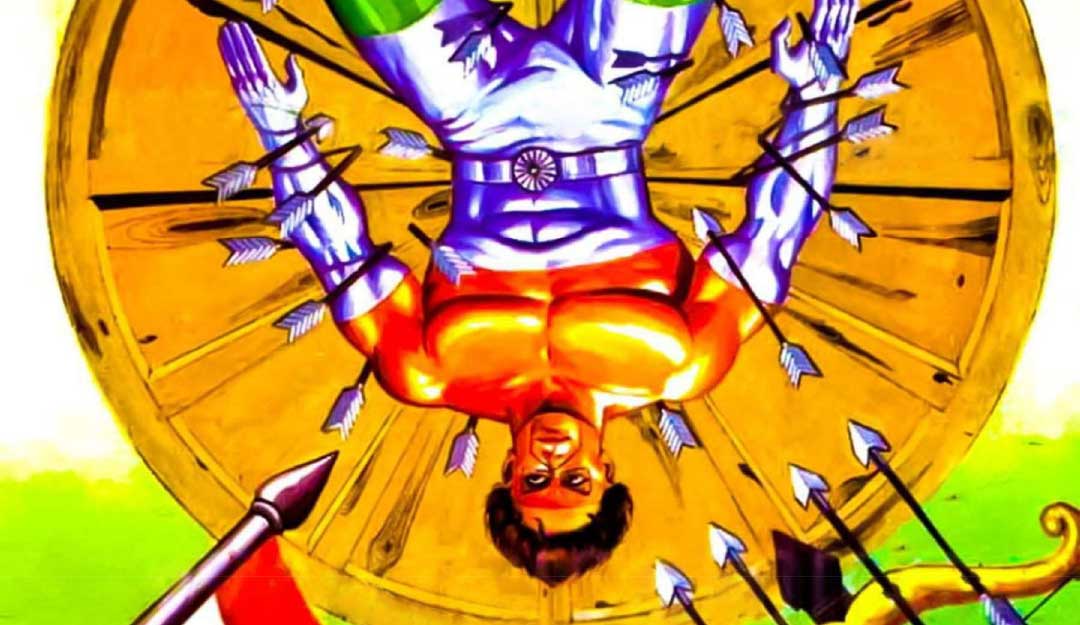
The cover page of the comic, which shows Tiranga pierced with arrows on the Ashoka Chakra, is extremely symbolic. This image evokes memories of Bhishma Pitamah’s ordeal and establishes the seriousness of the story from the very first page.
Although some readers may feel that Shroud’s change of heart or the conclusion of his arc could have been explored a little more, the author has done an excellent job within the limited space of 32 pages.
Conclusion:
Raj Comics’ ‘Shroud’ is a powerful and memorable creation. It compels readers to think about the real price of freedom and security. This comic not only entertains but also shocks the reader to the core. If you are a fan of Indian comics and have not read this Tiranga story, then believe me—you have missed a very important part of 90s comic history.
This story marks the beginning of a new chapter in Abhay’s life, where he ceases to be just a hero and becomes a son who has lost his father. This pain continues to make him stronger. ‘Shroud’ is truly a comic that lingers in the mind long after it is finished.
Rating: 4.5/5
