


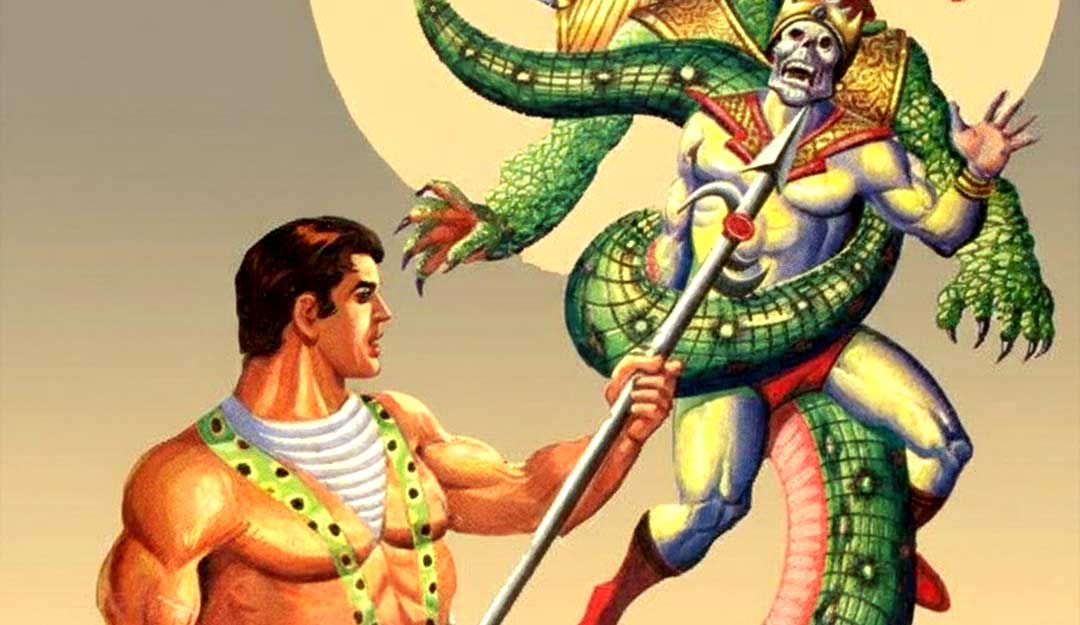
‘Ajgar and King Tongue’ This comic is an important part of the Ajgar series. In this, a tremendous combination of bravery, revenge, magic, and supernatural forces can be seen. The 64-page comic is still considered a classic today because of its fast-paced story and stunning illustrations. The story does not lose anywhere, and a new twist every few pages keeps the reader interested.
Summary of the story
The story begins with a small but happy state ‘Pregnant’ settled within the earth. King ‘Garbraj’ here is a kind ruler, who loves his subjects and his beautiful daughter ‘Princess Haroon’ immensely. Everything in the state seems calm and pleasant, but this peace does not last long. There is a huge and scary state adjacent to the border of the Pregnant state—‘Udder’. The ruler of this kingdom is King ‘Tongue’, who is arrogant, ruthless, and a powerful magician.

King Tongue searches for the most beautiful woman in the world with the help of his magical bumblebee, and his eyes fall on Princess Haroon. Tongue sends a derogatory message to King Garbraj that he wants to marry Princess Haroon, and to be prepared for war if this offer is not accepted. King Garbraj and his gallant commander ‘Garbhast’ reject this arrogant demand and declare war.
War is very terrible. The commander Garbhast, with his bravery and fighting skills, badly pushes the huge army of Tongue back. Seeing the defeat in front, King Tongue gets upset and adopts the path of deceit instead of direct war. He breaks the rules of war with his magic and attacks in the dark of night. In this attack, he kidnaps ‘Hastshoon’, the newborn son of Commander Garbhast and Princess Haroon. Princess Haroon falls into a deep abyss trying to save her husband and child.
This is where the real hero enters the story. Princess Haroon reaches a dense forest, flowing in the strong current of the river. There she meets ‘Mahabali Shera’ and ‘Ajgar’. The dragon is a willful human, who can take the form of a human from a snake. Hearing Haroon’s sad story, the dragon accepts her as his sister and promises that he will end King Tongue and bring her husband and son back safely.

The second part of the story focuses on the entry of the dragon and King Tongue into the ‘Fortress of Death’. The fort is filled with dangerous magic traps and deadly mechanical weapons. The dragon has to constantly contend with flames, sharp spears, giant spinning mills, and the elusive monsters of Tongue. Eventually, a decisive and memorable battle takes place between the dragon and King Tongue, where the dragon completely crushes Tongue’s pride with his willful powers, patience, and understanding.
Characterization
Ajgar (hero):
The dragon is the backbone of this story. He is not only powerful but also very patient and determined. His wishful appearance takes him far above an ordinary hero. He helps Princess Haroon without any selfishness, which reflects his high character and human sensibilities.
King Tongue (villain):
King Tongue is a highly influential and fear-inducing villain. His many heads and his terrifying appearance make him even more dangerous. He is hungry for strength and can go to any extent for his cause, not hesitating to harm even innocent children. His magical knowledge makes him a difficult and dangerous enemy to the dragon.Princess Haroon:
Haroon’s character is a symbol of pain and compassion. She is a mother and wife who is devastated by the fear of losing her family. Even though she does not take part in the war directly, she becomes the inspiration for the entire story and also the reason for the dragon’s struggle.Mahabali Shera:
Although Shera’s role in this comic is limited, his presence connects the story to other stories and characters of Manoj Comics. He comes across as a true and trustworthy partner.Drawing and Art
The portrayal by Vijay Kadam and Atmaram Punj is the biggest strength of this comic. The many-headed scary look of King Tongue and the detail with which his shining eyes are shown truly leave an impact. The dragon’s physical appearance, its strong muscles, and warrior-like posture establish him as a powerful hero.

Even though these comics are from olden times, the selection of colors still looks great. The loud and fiery use of red and yellow colors in battle scenes gives a feeling of violence and devastation, while the scenes of the ‘Fortress of Death’ have an atmosphere of mystery and fear created by dark colors. From a visual storytelling point of view, panels like King Tongue seeing the future in a magical whirlpool and the dragon crossing the abyss of fire feel extremely dynamic and vibrant, completely pulling the reader into the story.
Dialogue and Screenplay
The script written by Sandeep Gupta is very tight and impressive. The story does not slow down anywhere, and every scene remains easily connected to the next scene. The balance of heroism and drama in the dialogues is very right. For example, when King Tongue says, “Dragon, you will not be able to escape from this death trap alive,” and in response the dragon says, “Tongue, after filling the pot of sin, death finds its own way,”—while reading such dialogues, the thrill reaches its peak.

Some scenes of cruelty in the comic are quite scary, such as being shown with amputated limbs. This was a special identity of Manoj Comics of that era, which separates it from common children’s stories and gives it the form of a deep and serious ‘dark fantasy’.
Theme and Message
Three important ideologies are clearly visible in this story of Ajgar. First, it reiterates the eternal truth of the victory of good over evil—that no matter how powerful and magical the enemy may be, he cannot stand before courage and truth. Second, the power of the word is beautifully shown, which reflects the value of Indian culture that “life goes but word does not go.” Here, the hero is ready to risk his life to fulfill the promise given to his sister.

Finally, the use of magical powers in the story as well as King Tongue’s mechanical weapons, such as laser guns, gives it the appearance of an opening ‘sci-fantasy’. From that time point of view, this thinking can be considered very forward and progressive.
Critical Analysis

Pros:
The pace of the story is very fast. Once you start reading, the reader does not want to leave it midway. The ‘Fortress of Death,’ that is, the traps mounted in the Fort of Death, are extremely creative and imaginative. The narration of King Tongue’s weakness by the dragon’s guru (Kulguru) brings a turning point in the story, which gives direction to further events.Deficiencies:
Scenes with severed limbs may be uncomfortable for some readers, especially for younger children.Also, the end of King Tongue feels a little early. Despite having so many powers, his relatively easy defeat in front of the dragon can irritate some readers.
Conclusion:
‘Ajgar and King Tongue’ is not just a comic, but it is a living example of the infinite imagination of that period. It reminds us what a vast and grand world can be created without modern technology and animation, with the help of pen and paper alone.
Manoj Comics gave a superhero in the form of Ajgar, who was down to earth and whose powers were inspired by our folklore, especially the beliefs of the wishful serpent. If you are fond of old Indian comics and want to get lost in the world of mystery, adventure, and magic, then this comic must be in your collection.
Even in today’s digital era, when the pages of these comics are turned, the thrill that is felt is equally special. This story teaches us that the ‘Ajgar’ within us, i.e., courage, is enough to defeat any ‘Tongue,’ i.e., evil, as long as the intentions are clear and the purpose is right.
Rating: 4.5/5
