


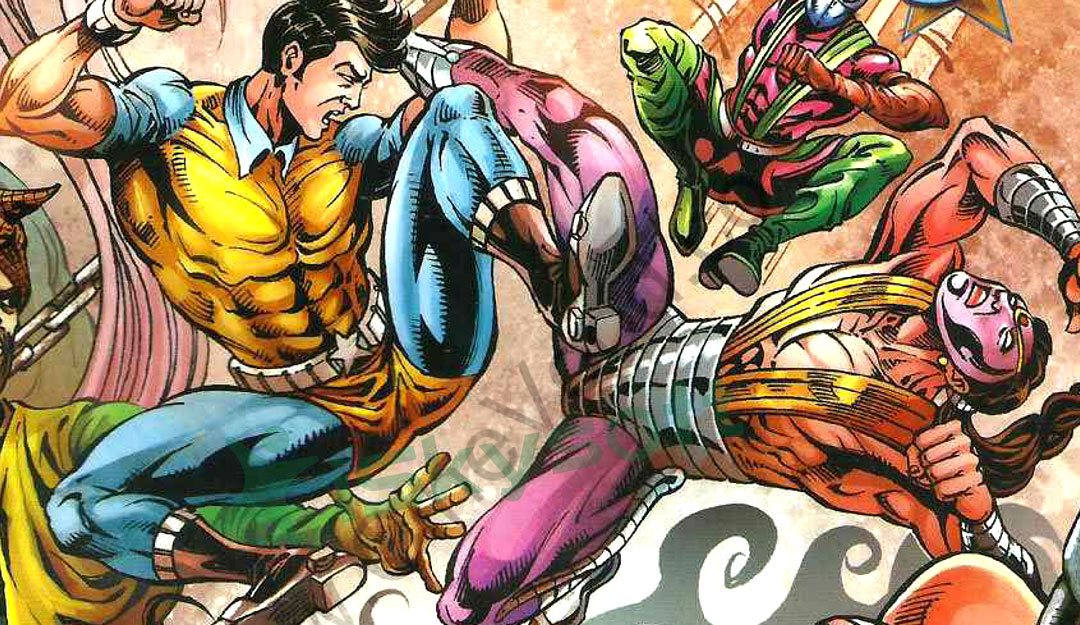
This is a detailed and in-depth review of Super Commando Dhruv’s brilliant comic “No Man’s Land”, created by Anupam Sinha, published under Raj Comics. This comic is a very important part of the ‘Balcharita’ (origin) series and is the sequel to ‘Hunters’ and ‘Flashback’.
Comic Review: No Man’s Land (Super Commando Dhruv), Publisher: Raj Comics,
Series: Balcharitra (origin series) – Part 3, Writer & Illustrator: Anupam Sinha, Inker: Vinod Kumar
Color Decorations: Basant Panda, Abhishek Singh, Sunil
Main Characters: Super Commando Dhruv, Chandika (Shweta), Black Cat (Natasha), Hunters (Gilly-Gilly, Vakra, etc.), Radha and Shyam (in flashback).
Preface
“No Man’s Land” is not just a simple comic, but it is a very big and deep story of the ongoing internal conflict between Dhruv’s past and present. Anupam Sinha, who is called the Bhishma Pitamah of the Indian comics world, has put forward in this story the chapter of Dhruv’s life which the readers always wanted to know but which was never fully exposed till now.
As the name suggests, “No Man’s Land” refers to a place or situation where there is no life, no death — just a blurry situation between memories, pain and forgetting.

The comic is part of the story-series of the 2015 Sarvanayak year. Its story is directly linked to two earlier comics — “Hunters” and “Flashback”. While “Hunters” featured physical battles and “Flashback” featured mental battles, in “No Man’s Land” these two battles reach their full climax.
Plot (The Story)
The story begins with a very powerful and thrill-filled action scene. Dhruv is on a cargo ship in the middle of the ocean. His mission is to preserve the mysterious container that came from Mauritius and which holds old belongings associated with Jupiter Circus — the same circus with which Dhruv’s birth and entire childhood were associated. Perhaps many secrets related to Dhruv’s past are buried in that container which can change his life.
War of the Present
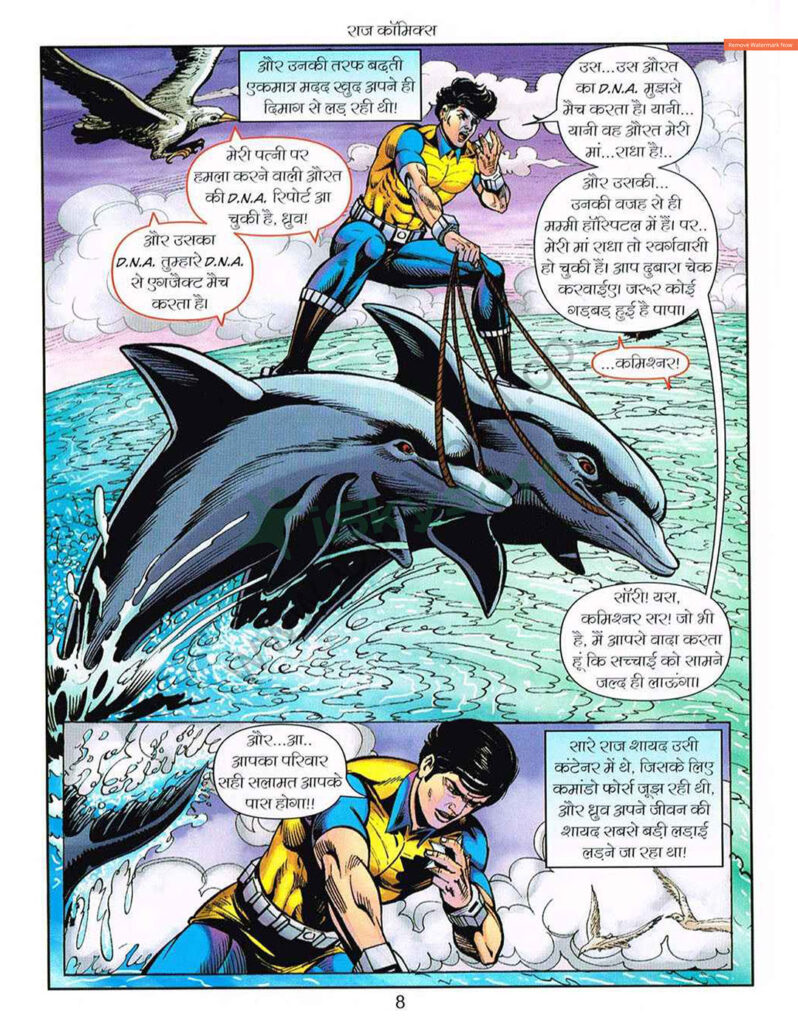
The “Hunters” gang — which is a dangerous gang of international criminals — wants to get that container at any cost. On the ship Dhruv encounters several stalwart members of the Hunters. Here Dhruv’s sharp thinking, stunts and excellent ability to fight in water are clearly visible. Dhruv reaches the ship with the help of dolphins and defeats the enemies one by one.
The story takes a big turn when a man claiming himself to be Jonathan Stone (Jacob’s son) asserts his rights to the container with a court order and police presence. Dhruv understands that this is all a big trap, but legally answering and physical fighting — both going together further increases his discomfort.
Along with this, Commissioner Rajan Mehra and his wife (who is Dhruv’s adoptive mother) also come in danger as Hunters target them to put pressure on them and weaken Dhruv. Dhruv’s biological mother Rajni’s condition in the hospital is already critical, and Dhruv finds himself at a very difficult juncture — on one hand the battle to save the past, and on the other hand the responsibility to keep his current family safe.
Mirror of the Past (Flashback):
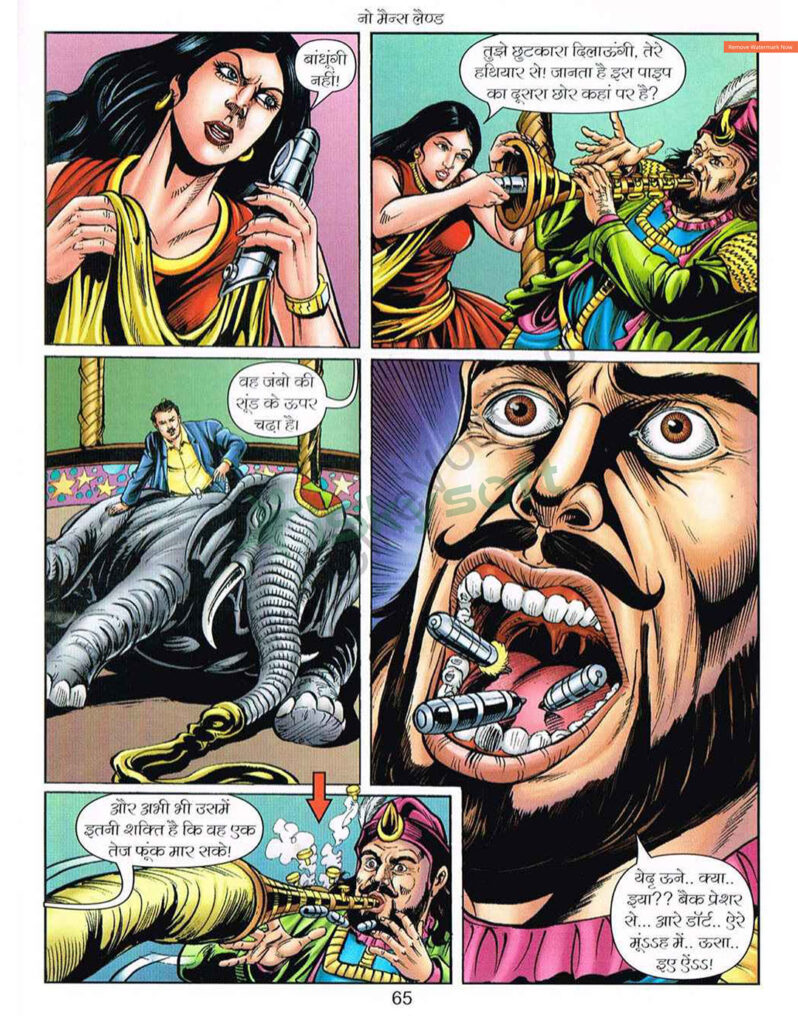
Another stream runs along the story — of the past. In it we glimpse the lives of Dhruv’s parents, Shyam and Radha, at a time when Dhruv was not even born (Radha was pregnant). Such a deadly conspiracy is looming over Jupiter Circus in which a mysterious enemy repeatedly sends an army of killers to eliminate Radha and her fetus — i.e. future Super Commando Dhruv —.
These flashback moments suggest that the extraordinary sensations Dhruv had and his sixth-sense-like abilities may have developed before birth. We see how a juggler (sapera) and several murderers enter the circus and try to take their lives. In one scene, a bomb is tied and even attacked using rabbits and rats, but Shyam and Radha face everyone with complete bravery.

Meanwhile a very deadly villain is introduced — ‘Vakra’, who specializes in the ancient Indian martial art ‘Kalaripayattu’. Shyam’s battle with Vakra in the past and Dhruv’s encounter with Vakra (or his disciples) in the present give the story a striking similarity and deep emotional impact.
Mysterious “No Man’s Land”:
This part of the story shows the mental state where Dhruv is trying to bring back his lost memories. Gilly-Gilly (hypnotizing member of Hunters) wants to overcome Dhruv’s mind, but Dhruv goes to the part of his subconscious mind where his childhood is hidden — and that is the same place as his “No Man’s Land”.
In the end Dhruv not only saves the container but also takes good notice of many dangerous members of the Hunters. But still the real big villains do not get caught, and the story opens the way to a new mystery — that directly prepares for the upcoming comic “Phoenix”.
Character Analysis
Super Commando Dhruv:
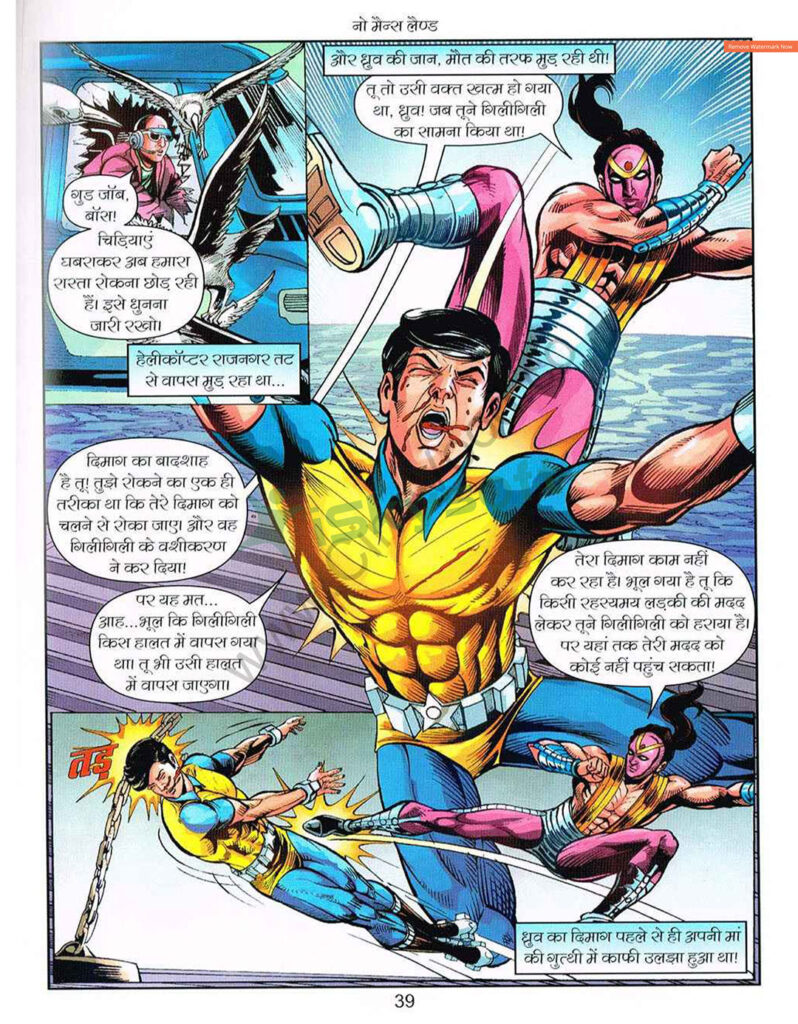
In this comic Dhruv looks not just like a superhero but like a human being who has the ability to fight and live in every situation — a real ‘survivor’. He is wounded, with broken ribs, a body tired of pain and going through a very weak moment, even mentally, but still does not give up. On pages 34 and 35 when he faces Vakra despite a broken body and uses his “reflex action” technique — it proves that the true strength of Dhruv is not his muscles, but his mind and his thinking.
And his love for his mother Rajni (who is in a coma), makes him even more human and emotional.
Shyam and Radha (Dhruv’s parents):
Anupam Sinha has not just created Shyam and Radha as flashback-filling characters, but has also presented them as completely brave warriors. Radha, despite her being pregnant, with the speed and confidence with which she outwits enemies (like using the swing on page 62–63), clearly shows that Dhruv has inherited both her heroism and mind.
Shyam appears as a father and husband who stands as a shield in front of every threat to protect his family. Both together prove that Dhruv did not become a hero — that hero was born.
Hunters (The Hunters):
This villain group is a mixed, very special and dangerous combination of completely different types of criminals.

Vakra: The most interesting and powerful character in Hunters. Vakra uses old conventional weapons and ancient martial arts like ‘Kalaripayattu’. His battle scene with Dhruv shows the modern fights versus ancient martial arts.
Gili-Gili: It does less physical fighting and attacks the brain more. He wants to defeat Dhruv by breaking his mind, not his body.
Also the robotic woman, the goons armed with technical weapons, and the rest of the members maintain a constant atmosphere of tension and danger in the story.
Shweta (Chandika) and Natasha:
These two associates of Dhruv are the strength of this story. When Dhruv is in the hospital, or is trapped in the law and court, they take charge. Their action, teamwork and trust in each other on pages 14 and 19 are worth seeing.
It is clearly visible that Dhruv alone does not do everything — with him stands an extremely strong and reliable support system that stays with him in every crisis.
Art and Portraiture
Anupam Sinha’s artwork is amazing as always and plays a huge role in taking the story forward.
Action Scene: Especially the battles on the ship (page 3–7) and the attacks inside the circus in the past (page 82–84) seemed absolutely wonderful. The momentum of the match, the impact of the attack and the changes in each panel have been shown in a very lively manner.
Water War (Underwater Scenes): Scenes of Dhruv and the dolphins (page 21) return a reminder of the days of the old Raj Comics. The water bubbles, depth and movement are beautifully depicted.
Facial Expressions: The pain, anger, fear, love and determination on the faces of the characters — everything looks very clear. Especially on page 52 when Dhruv starts regaining his old memories — those panels have a dream-like feeling.
Color Combination: The work of Vincent and his team is amazing. Very light but effective changes have been made in the tone of colors to distinguish flashbacks and current — and the same helps a lot in setting the mood of the comic.
Writing and Dialogue
The biggest feature of Anupam Sinha’s handwriting is his deep research and philosophical thinking hidden in the story.

Title justification: “No Man’s Land” is not just a place but a felt state — an invisible line standing between life and death, and between memories and forgetting. The author has made this idea a part of the story in a very beautiful way.
Dialogue: The comic’s dialogues provide jokes, sharp answers, wisdom, seriousness and emotions. For example, the conversation during the fight between Dhruv and Vakra on page 43 is not just threats — but it also seems like a discussion on honor, warrior thinking and the art of fighting.
Suspense: The entire story keeps the reader engaged from the beginning to the last page. Questions arise again and again in the mind — what is there in the container? Is Jacob’s son really real? Who was attacking Radha and Shyam in the past? These questions force us to turn the page.
Critical Analysis
Positive side (Pros):
Expansion of Origin Story: This comic adds tremendous depth to Dhruv’s ‘Balcharit’. This shows that the battles in Dhruv’s life started even before he was born — i.e. he was really a “born warrior”.
Emotional connection: Dhruv’s emotional relationship with his mother and his past makes the story stronger and more effective.
Multi-layer storytelling: The story does not run on the same timeline, but instead there is movement between the past and the present, making the story even more interesting.
Downside (Cons):
Complexity: For those who haven’t read previous episodes, the story may seem a bit muddled at first, as there are multiple characters and subplots playing simultaneously.
Pacing: In between, courtroom and legal process scenes slow down the pace of the story for a while, but they are also necessary for the plot.
Highlights and Memorable Moments
Rabbit bomb: When an innocent-looking rabbit is used to make a bomb and attack in a scene from the past, that moment really gives goosebumps. That’s where it turns out how cruel the Hunters are.
Return of the Dolphins: Seeing Dhruv once again doing action with the dolphins feels like a visual treat for the fans of the old Dhruv.
Vakra vs. Dhruv: This fight is one of the most powerful and memorable scenes in the entire comic. It was not just a battle of strength, but of technique — and great fight skills are seen on both sides.
Conclusion
“No Man’s Land” is really a masterpiece. After reading this, it is understood that a good comic does not become great just by fighting — the story is strong, the emotions are deep and the mystery remains the same, only then it reaches the heart.
Anupam Sinha again proved that no one can understand Dhruv better than him.
This comic gives us a huge message —
No matter how painful our past has been,
that’s what shapes us and makes us stronger for future battles.
Dhruv’s struggle is actually the story of fighting with oneself before fighting the world — the battle to save one’s identity, one’s existence and one’s broken childhood.
Final decision
If you are a hardcore fan of Super Commando Dhruv, then this comic must be in your collection. This “is the most important part of the Balcharit” series and does not allow a single place in the 90+ pages to get bored. Just one voice comes to mind as soon as the comic ends —
“Now you have to read Phoenix!”
⭐ Rating
4.5 / 5
