


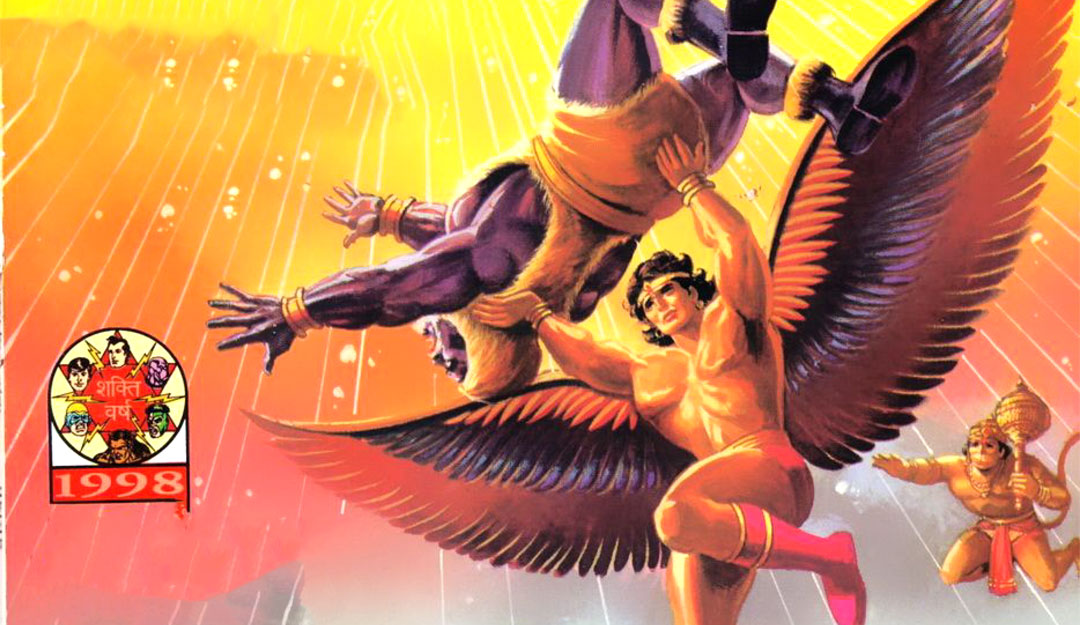
The final and most intense chapter of this timeless trilogy of Raj Comics, ‘Mahayudh’ (No. 112), is not only a decisive battle but a poignant saga of human ego, divine intervention, and ultimate sacrifice. This special issue written by Sanjay Gupta and illustrated by Kadam Studio takes the story of previous sagas—’Bhokal’, ‘Kapalika’ and ‘Kalanka’—to the peak with Maharavan and his brother Himraj.
This issue, in its grandeur and drama, is more than just a comic; it is the final stage of Mahabali Bhokal’s character development, where he has to fight his own conceit. At the same time, the role of Hanuman in the form of an old man here increases from a secret protector to a guru and guide, only with whose silent sacrifice and strategy the victory of humanity becomes possible.
Title and cover: Ego and Confrontation
The very title of ‘Mahayudh’ explains the vast scope of the story. On the cover page, Bhokal is shown struggling with his father Pawandev (or perhaps a replica of the raging wind power generated by Pawandev himself), while Lord Rama stands with his Divyastras in the background. This scene explains the main theme of the story—Mahabali’s ideological conflict with his own guru/father (Hanuman/Pawandev). The presence of divine weapons like trident, mace and sword in the hands of Bhokal’s image on the cover, and his confidence full of arrogance below, indicates the upcoming defeat of ego.

The portraiture of Kadam Studio is a confluence of extreme grandeur and subtle emotional expression in this issue. The breaking of icebergs, the eruption of volcanoes, and expressions of anger, arrogance or anxiety on the faces of the characters—everything is extremely lively and impressive.
In-depth analysis of the story: arrogance, guru-disciple tradition and sacrifice
The narrative of the ‘Mahayudh’ develops into three major stages: the arrogance of Bhokal, the elusive tactics of Maharavan, and the intervention of the gods.
Bhokal’s ego and self-destruction
The story begins with Bhokal’s unexpected arrogance. After conquering Kalankini, he denies the contributions of his companions—Bhilraj, Atikrur and Dhanusha—saying that Mahabali does not need anyone’s help. This emerges as a fatal flaw in Bhokal’s character, which Hanuman in the old form quickly recognizes.

Here, Maharavan gets the news of the death of his sister Kalankini and her companions (Mrityujit, Kapalika). On the advice of the fraudulent guru Tusharacharya, Maharavan’s brother Himraj plans to take advantage of Bhokal’s arrogance, abandoning his pseudo-death. Himraj’s strategy is to challenge Bhokal’s arrogance and entangle him in a physical duel. After conquering Himraj, Bhokal’s ego grows further, bringing him to the brink of self-murder. Defeated at the hands of Bhilraj, Bhokal is so hurt by his ‘insult’ that he stabs his own sword in his chest to sacrifice his life.
This twist is the most intense emotional moment of the story, where the hero’s greatest enemy is proven to be not an external demon, but his own ego.
Hanuman’s secret gravity and renunciation of divine weapons
Just before Bhokal’s suicidal move, Hanuman appears in his true ‘Bajrangi’ form. His anger consumes not Bhokal’s body, but his ‘ego’. Hanuman explains to him that the true hero does not sacrifice his body, but his ego. With Hanuman’s guidance, Bhokal is revived and realizes that he was in a ‘dream’, which Hanuman himself had created to break his ego.

After this, Himaraja (the real one) showers snow-rocks with his elusive powers. Bhokal, Dhanusha and Atikrur fight this crisis, but this is the first phase of Himaraja’s strategy. Himaraja and Tusharacharya confuse Bhokal and his companions with their ‘misguided illusion’ (like Dhanusha and Atikrur going astray, Bhil army getting buried in snow-rocks, Atikrur falling into disrepair due to thirst, and the illusion of killing an old man).
Great battle of Himraj, Pawandev and Yamraj
Confused by Tusharacharya’s illusion, in a fit of extreme thirst, Atikrur kills a weak old man (Tusharacharya’s illusion) in an attempt to snatch the water pot thrown by Hanuman. It also puts an emotional stain on Atikrur’s character, like Bhokal, which fills him with guilt.

Bhokal, on Hanuman’s strategy to defeat Himaraja, invokes his father Pawandev. Pawandev cannot fight directly against Maharavan and his brothers due to Brahma’s boon, but he helps Bhokal with the tremendous speed of Vayu. Himaraja calls upon Yamraj to stop Pawandev. Yamraj’s ‘death penalty’ strikes Bhokal, which Bhokal neutralizes with the power of his divine weapons, but in the process he himself collapses.
The ultimate sacrifice of the Sun
The final and most dramatic turn of the story comes when Bhokal, defeated, flies towards the Sun, picking up Himaraja, to save his entire army and companions (Bhil Sena, Atikrur, Dhanusha) from Maharavan’s army—the place where Himaraja’s power is reduced to zero.
The Sun God gets caught between two conflicting warnings from Maharavan and Hanuman:
Maharavan’s warning: If the heat of the Sun causes harm to Himraj, then the Sun will have to become the source of Maharavan’s anger (since Maharavan had forced the Sun).

Hanuman’s warning: If Surya did not help Bhokal, Hanuman himself would swallow Surya.
In this fierce moral and existential dichotomy, the harsh face of the Sun God falls—he makes his decision. The Sun God decides to stand with Bhokal, the protector of humanity. The result of this decision is—that the Sun’s intense heat creates ice vapor, and Bhokal also falls unconscious due to the fierce collision of energy with it.
Ultimate sacrifice and completion
On the last page, the Sun God says on his decision, “I am ready to become the food of Maharavan’s wrath.” When a person like Bhokal is risking his existence for the interests of humanity and gods, then why should I stay behind as a god? Here Surya sets the supreme example of personal sacrifice for religion and humanity by renouncing the dignity of the gods.

Hanuman carries the unconscious Bhokal on his chariot and goes towards the sky. Thus, the ‘Great War’ concludes with the establishment of high ideals of moral victory and sacrifice along with material victory.
Importance of characters and themes
The theme of arrogance: The biggest theme of this comic is ‘ego’. This shows that being Mahabali is not enough; true strength lies in humility and sacrifice. Bhokal’s ego takes him to the door of death.
Guru-disciple/god-devotee relationship: Hanuman is both the guru and protector here. His strategy is focused not on Divyastras or force, but on correcting Bhokal’s character defects. His secret help shows the ultimate limit of the devas breaking the rules to make the devotee victorious.
Moral sacrifice: The cruel killing of the weak in a fit of thirst, Bhokal killing his ego, and above all the Sun God standing for humanity above the wrath of Maharavan, all these give this issue a deep moral and philosophical dimension.
Maharavan and deceitful guru Tusharacharya: These two villains are symbols of deceit, illusion and cruelty here. Tusharacharya’s ‘Kapat Maya’ is extremely deadly, which destroys the hero not physically, but mentally and morally.
Conclusion
‘Mahayuddha’ is an excellent and mature conclusion to this saga of Raj Comics. Sanjay Gupta has successfully woven the story of a megastar whose biggest battle he had to fight with himself. The art of Kadam Studio has given grandeur to this emotional and mythological struggle.
This comic is proof that Indian comics have not only been full of action but also deep character development and moral education. Bhokal’s ego is broken, Hanuman’s strategy succeeds, and Surya’s sacrifice becomes humanity’s supreme victory.
