


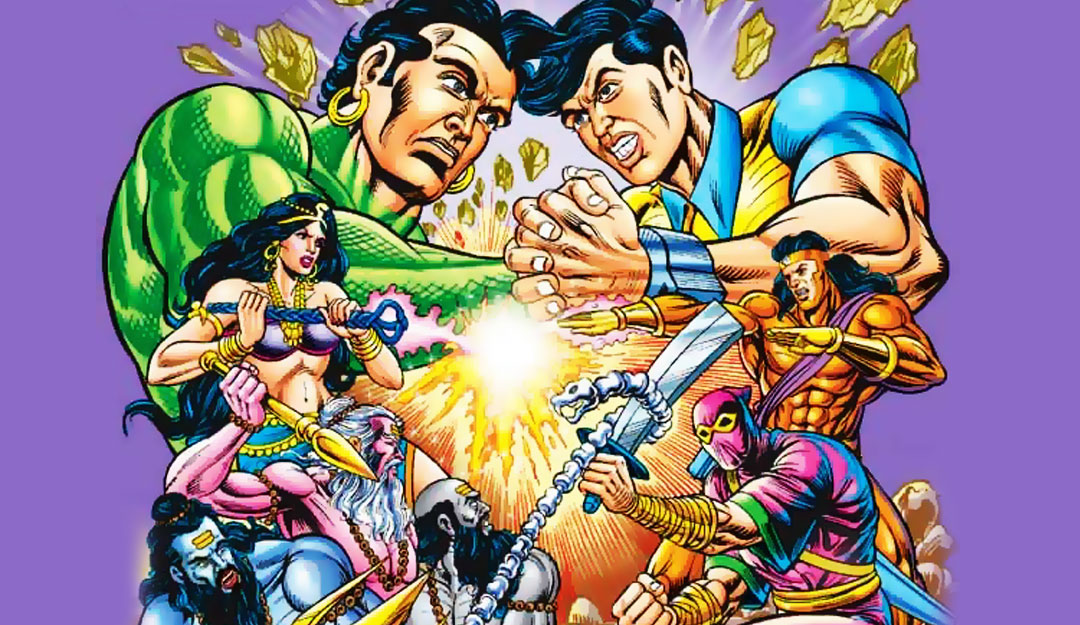
Nagraj, the flagship character of Raj Comics, has always thrilled readers through his stories. The comic “Parkale” is an important link in that series. This comic is one of Nagraj’s adventurous exploits that proves him to be not just a protector of a city (metropolis), but a warrior who maintains balance between all of humanity and cosmic forces.
This comic appears to be part of the ‘Vidhwans’ series, which is a multi-star crossover. It features the presence of other superheroes along with Nagraj and outlines a vast conspiracy. The literal meaning of ‘Parkale’ and the unfolding of ‘layers’ in its story also give this special issue the form of a psychological thriller.
Creative Team and Presentation
The exceptional success of this comic is largely due to its excellent creative team, where Jolly Sinha’s writing brings out a deep and poignant blend of suspense and human emotions. The artwork by Anupam Sinha, considered the ‘Godfather’ of Raj Comics, is the true soul of the story; the distinctive dynamism and subtle detailing of his art completely immerse the readers in the plot, where the characters’ expressions and action scenes are depicted with great realism. Finally, Manish Gupta’s precise editing ensures that the rhythm and flow of the story remain unbroken from beginning to end, making the reader’s experience seamless and exciting.
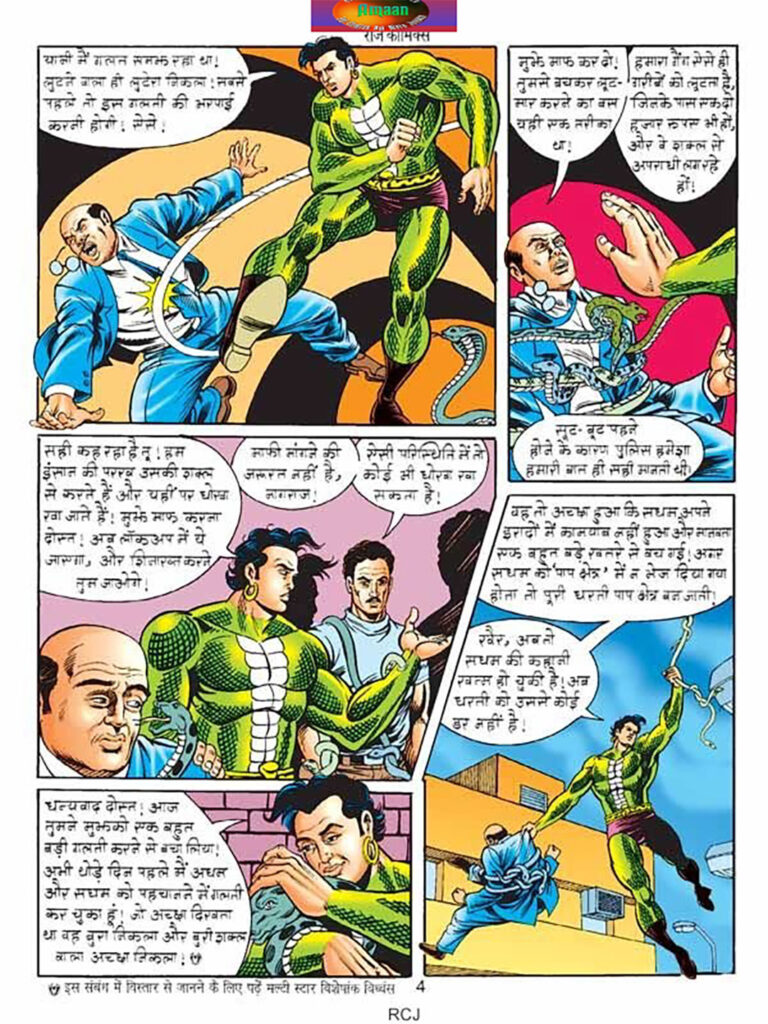
The story begins with a very philosophical and thought-provoking incident that reflects on society, which later forms the basis of the main villain’s plan.
The Game of Illusion and Reality
The story begins with a scene in the metropolis. Nagraj, whose mere presence makes criminals tremble, intervenes to stop a robbery. Here, a conflict unfolds between a man in a suit and tie (the actual robber) and an ordinary-looking man.
Nagraj, relying on his traditional thinking and judging by appearances, assumes the man in the suit is the victim and the ordinary-looking man is the culprit. However, as the truth is revealed, Nagraj realizes his mistake. The man in the suit turns out to be the real robber, who has been using his attire to deceive the police and the law.
This scene is not just a simple incident, but it establishes the central theme of the entire comic: “Appearances can be deceiving.” The robber himself admits that people judge others by their looks, and that’s where they go wrong. This episode brings humility to Nagraj’s character, as he acknowledges his mistake and apologizes to the ordinary vegetable vendor. This establishes Nagraj as a “learning hero” rather than an infallible “god.”
The Villain ‘Sadham’ and the Conspiracy of the Sin Realm
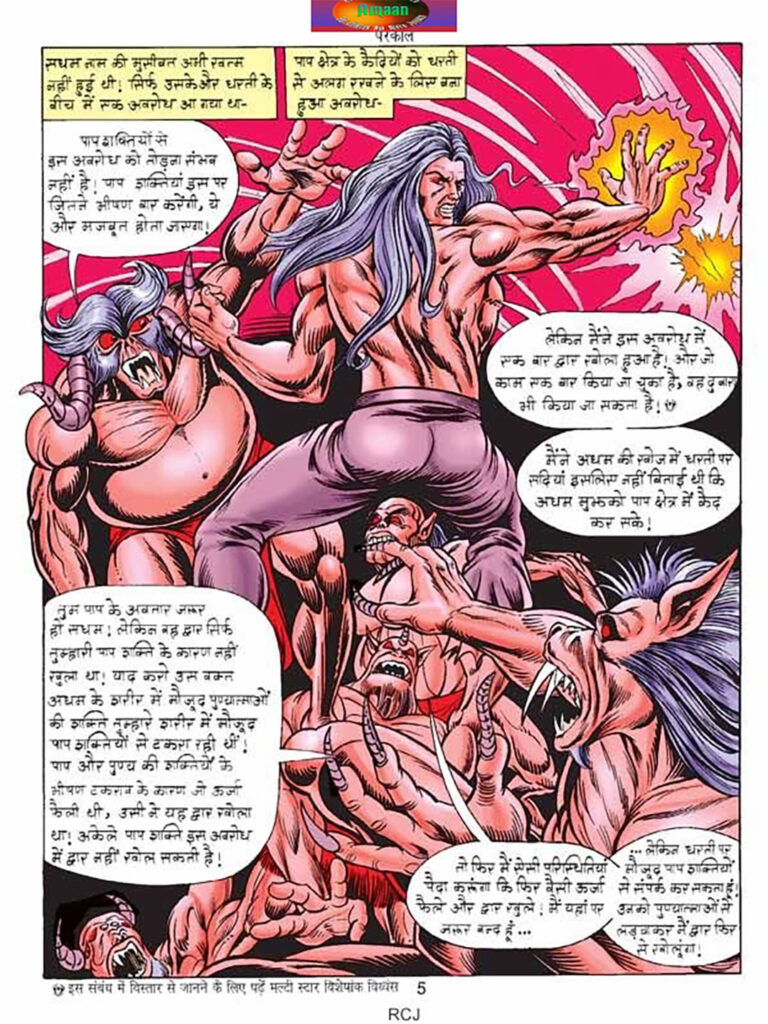
The main villain of the story is Sadham. Sadham, who symbolizes the forces of evil, is hatching a grand plan. He was imprisoned in the ‘Sin Realm’, but now he is desperate to spread the empire of sin on Earth.
Sadham’s problem is that there is an impenetrable barrier between the Sin Realm and Earth, which cannot be broken by the power of evil forces alone. Here, the author has used Raj Comics’ ‘Cosmic Science’. Sadham explains that the last time this portal opened was when the power of the virtuous souls in Adham’s (Sadham’s opposite) body clashed with Sadham’s evil powers.
Therefore, Sadham is looking for a “greatly sinful soul” who can challenge virtuous souls (like Nagraj), and the energy generated from that clash will reopen the portal. This plot captivates readers because it is not just a physical battle, but a battle of energy and balance. Sadham plans to acquire the ‘Trimunds’ and free the Sin Realm forever.
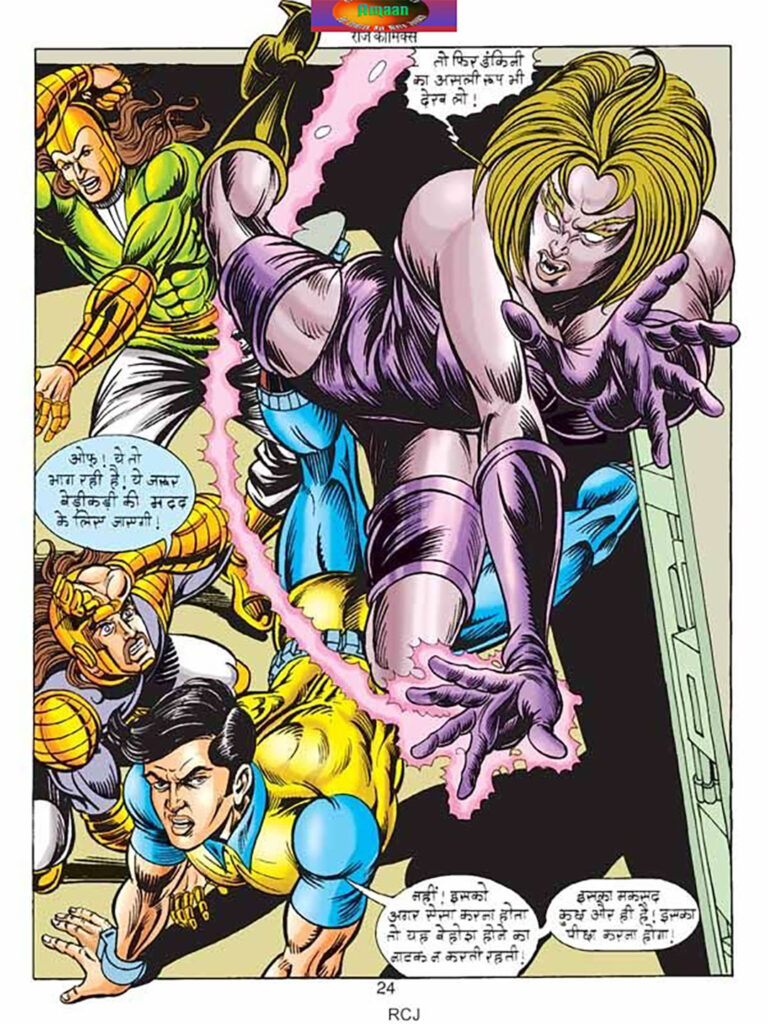
Swarn Nagari: A Marvel of Ancient Science
The next stage of the story is ‘Swarn Nagari’ (Golden City), located in the depths of the ocean. It is a secret city of beings of the divine race, an amazing example of ancient science and technology.
Sadham plays a terrible trick to carry out his plan. He sends a young woman bound in chains to the borders of Swarn Nagari. The guards and medical officers of Swarn Nagari become alert, considering it either a coincidence or a conspiracy, because it is impossible for a human to survive at such a depth.
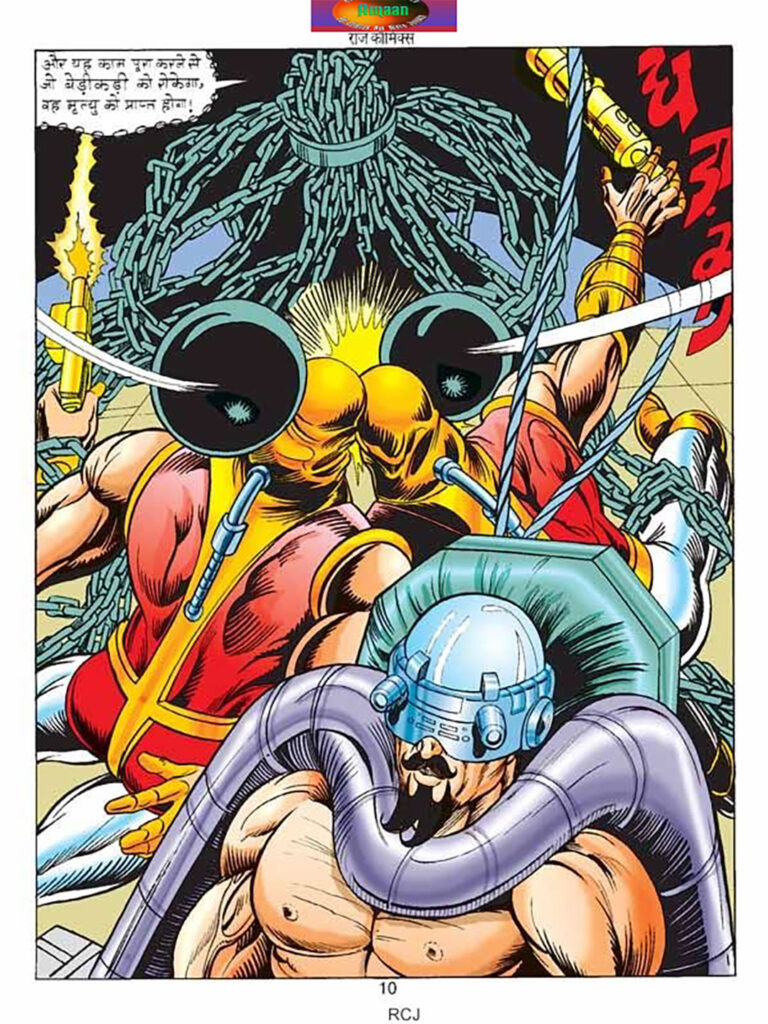
This is where the ‘Trojan Horse’ strategy is employed. The unconscious woman was merely a medium. The real danger lay in the chains and spheres that bound her. As soon as she is brought inside the city, the chains transform into a wondrous creature. Sadham’s real motive is to free the demon ‘Chandkaal’ from the captivity of the Golden City.
Chandkaal: Imprisoned in a Labyrinth
The method of Chandkaal’s imprisonment is depicted in a very interesting way. He is not only physically imprisoned, but his memory has been separated, and his mind is placed in a virtual reality where he believes he is conquering the gods. This reflects the futuristic thinking of Raj Comics. Sadham’s agent (the creature made of chains) comes to free Chandkaal from this mental and physical captivity.
Illustration and Art Review
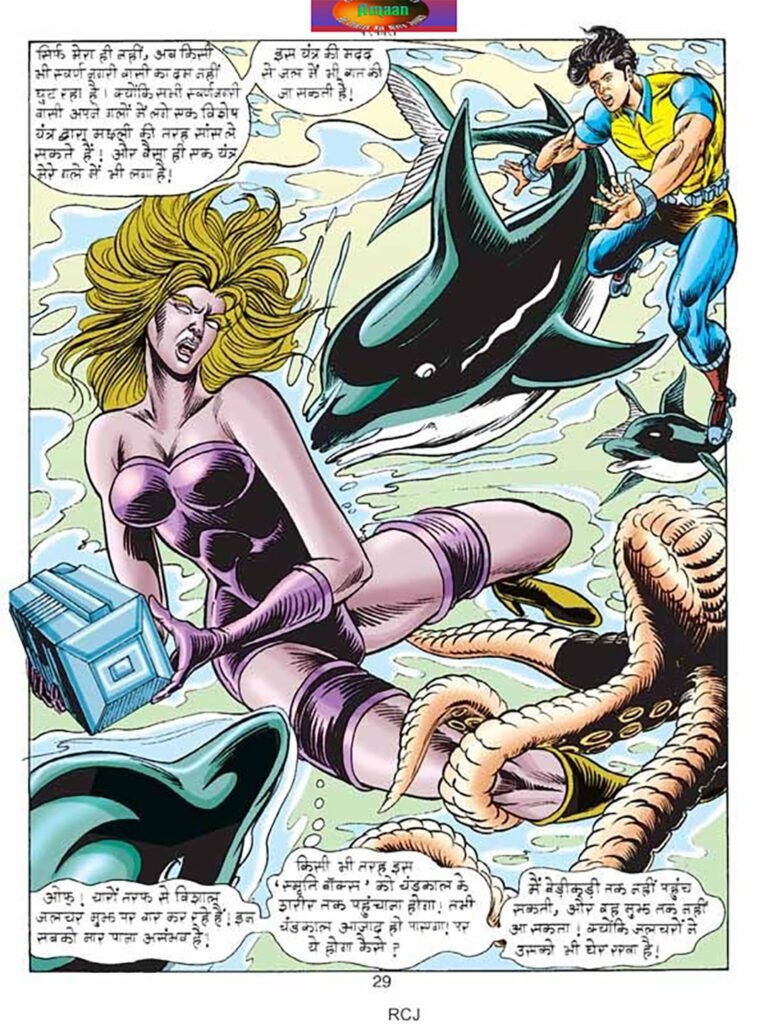
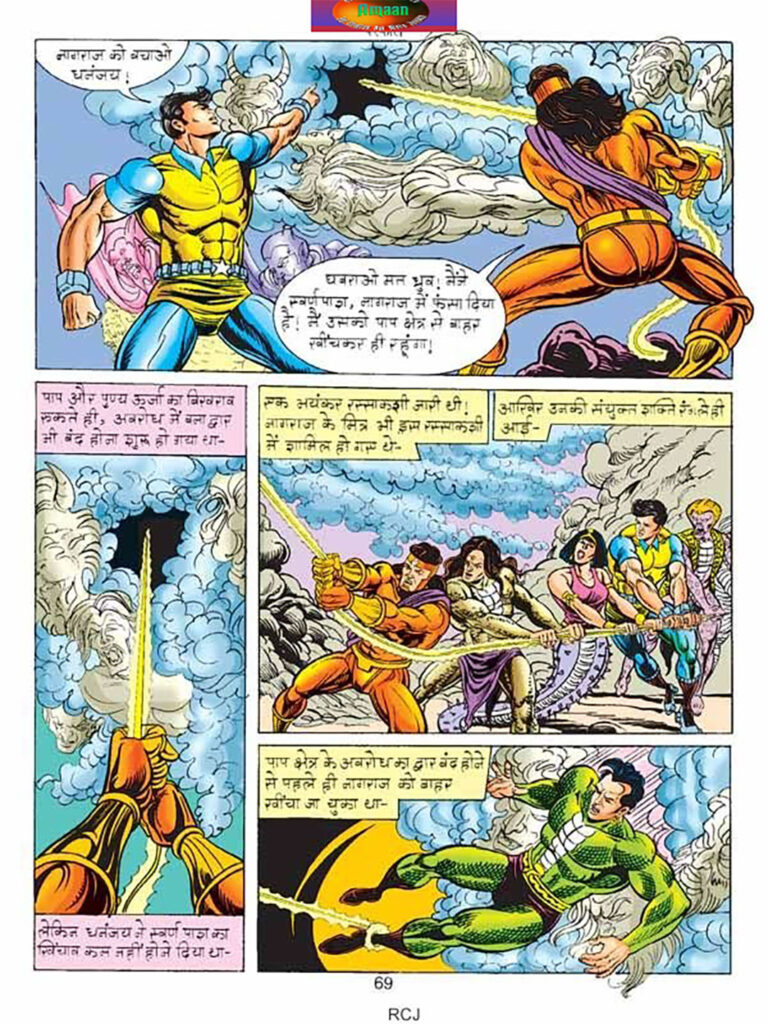
Anupam Sinha’s artwork is the soul of this comic, where he has presented Nagraj’s fighting style and his use of snake-ropes with immense dynamism; Nagraj’s distinctive postures and his confidence, as depicted by him, draw the reader into the story. Depicting the ‘Golden City’ situated underwater was a major challenge, which Sinha has handled brilliantly through the city’s unique architecture, the detailed armor of the inhabitants, and subtle effects like water bubbles. Sunil Pandey’s color scheme makes this visual experience even more effective, where the contrast between the deep red colors used for the ‘Sin Zone’ and the golden-blue colors of the Golden City creates a clear visual distinction. Ultimately, the characters’ expressions—such as the cunning reflected in Sadham’s eyes and the determination and remorse for his mistake visible on Nagraj’s face—come across more powerfully through the illustrations than through the dialogues.
Dialogue and Language Style
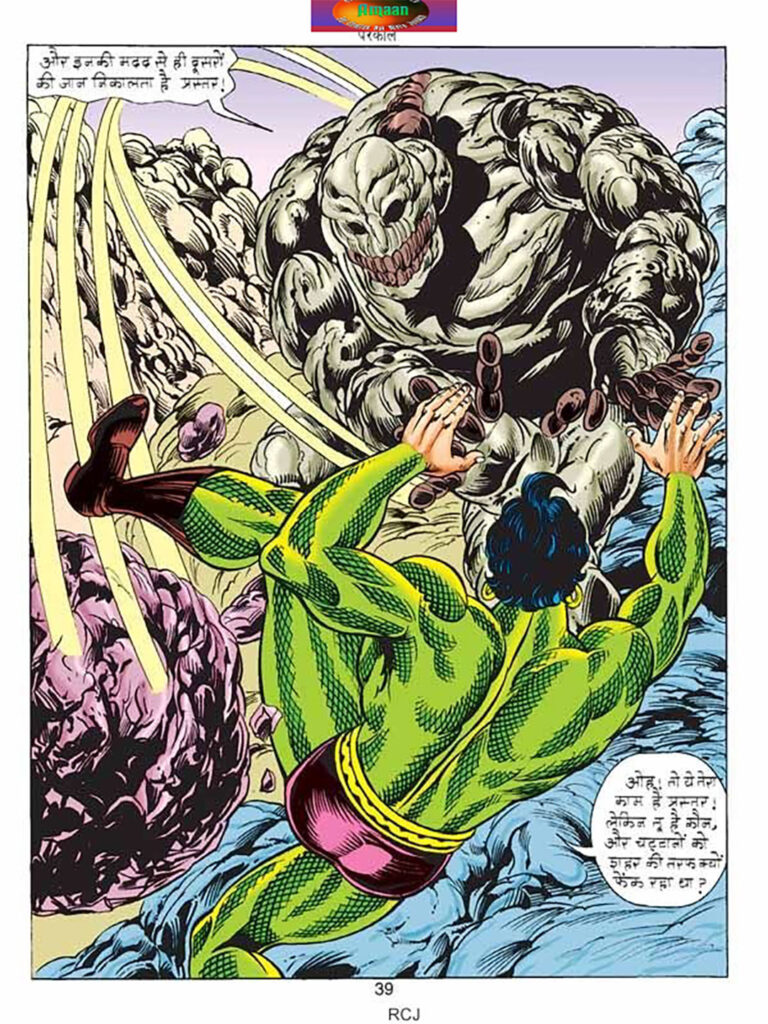
The dialogues in this comic not only propel the plot forward but also deeply highlight the inherent personalities of the characters. Nagraj’s idealism is clearly reflected in his dialogues, which consistently reiterate his unwavering commitment to justice and citizen safety, such as, “As long as I am here, no harm can come to law-abiding citizens,” further solidifying his image as a protector. In contrast, the main villain Sadham’s cunning is revealed through a sinister philosophy embedded in his dialogues; his belief that “what has been done once can be done again” underscores his relentless and dangerous nature. Meanwhile, the humor and satire interspersed between the serious situations, particularly the clever use of idioms like “the pot calling the kettle black,” create an entertaining irony that keeps readers engaged until the very end.
The Connection Between ‘Parkale’ and ‘Destruction’
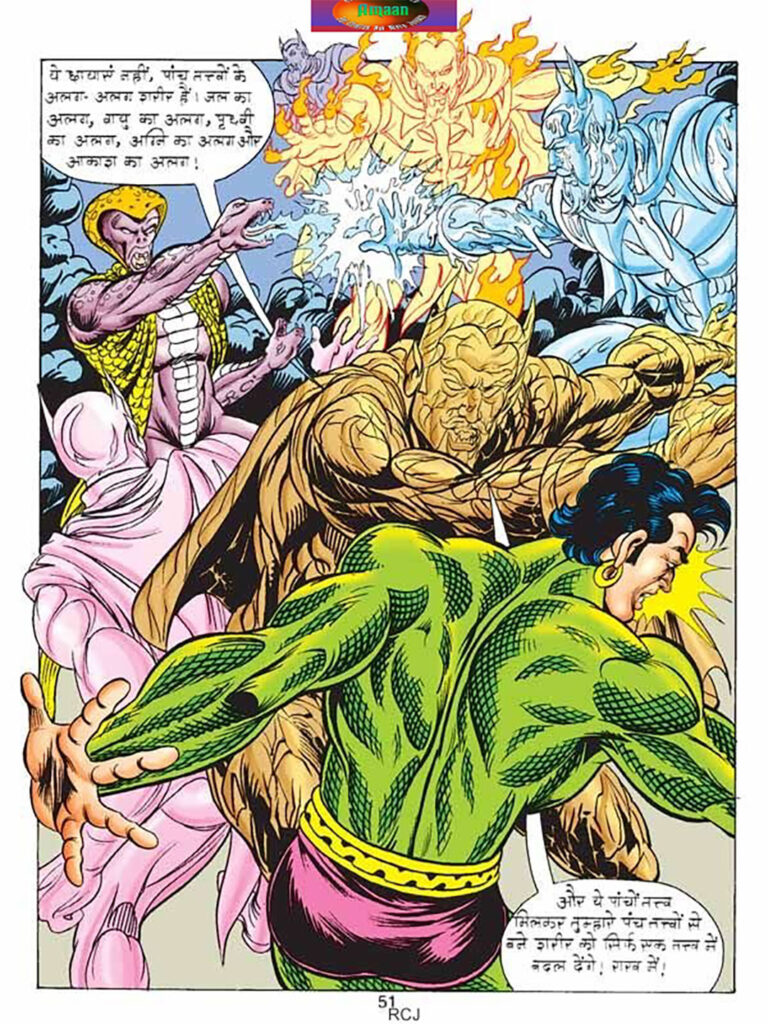
This comic is not a standalone story. It repeatedly informs readers through footnotes that to understand the complete story, they should read ‘Destruction’, ‘Grand Master Robo’, ‘Samaritan’s Flame’, etc. This indicates that ‘Parkale’ is part of a larger saga. The mention of ‘Ocean 11’ and its name on the pages clearly suggests that this story revolves around a group of 11 superheroes or villains who are on a mission underwater or are pitted against each other. The infiltration of the Golden City is part of this larger mission.
Critical Evaluation
Positive Aspects (Pros):
This comic is considered a timeless classic due to its intellectual depth and modernity, where the author, through a complex plot, demonstrates that the story is not just straightforward action, but a deep mystery that unfolds in layers. Sadham’s reliance on deception and strategy instead of direct attack establishes him as an extremely intelligent and dangerous villain. The most poignant aspect of the story is its moral dilemma; Nagraj’s initial deception proves that even a superhero is not immune to human errors, which imparts an important life lesson to readers: “don’t judge without knowing the facts”. Also, the inclusion of progressive technological concepts like ‘memory wipe’ and ‘virtual reality’ in the Golden City (especially considering the time period) reflects Jolly Sinha’s foresight, creating an excellent balance between science and fantasy.
Negative Aspects (Cons) / Scope for Improvement:
Although this comic is a timeless classic, its heavy reliance on continuity can be a challenge for new readers; without prior knowledge of concepts like ‘Adham’ and ‘Sadham’ or complex ideas like ‘Trimund,’ fully understanding the villain’s true motives seems somewhat difficult. Additionally, due to the influence of Raj Comics’ style at the time, some pages have such a high density of dialogue and action that the visual flow feels disrupted in places, forcing readers to struggle to absorb so much information in a single frame.
Conclusion: Why Read ‘Nagraj – Parkale’?
‘Nagraj – Parkale’ is not just a comic book, but an experience. It takes the reader on a journey from the streets of a metropolis to the depths of hell (the realm of sin) and from there to the golden city beneath the sea.
For mystery and adventure: If you want to know how Sadham plans to break through impenetrable walls and whether Chandkaal manages to escape, then you must read this comic.
For Nagraj fans: It’s a pleasure to see Nagraj not only using his physical strength but also his intelligence and diplomacy.
For art lovers: This is an excellent collection to witness Anupam Sinha’s masterful artwork.
Overall, “Parkale” symbolizes the legacy of Raj Comics that brought science fiction and fantasy to every household in Hindi-speaking regions. This story teaches us that no matter how cunning evil may be, and no matter how many layers (Parkale) it hides behind, it ultimately has to bow before truth and courage. But at the same time, it also warns that “a moment of carelessness can lead to disaster”—whether you are an ordinary human or Nagraj himself.
This special issue can be given 8.5 out of 10. It’s a ‘must-read’ classic that will compel you to read the next part (like ‘Vidhwans’).
