


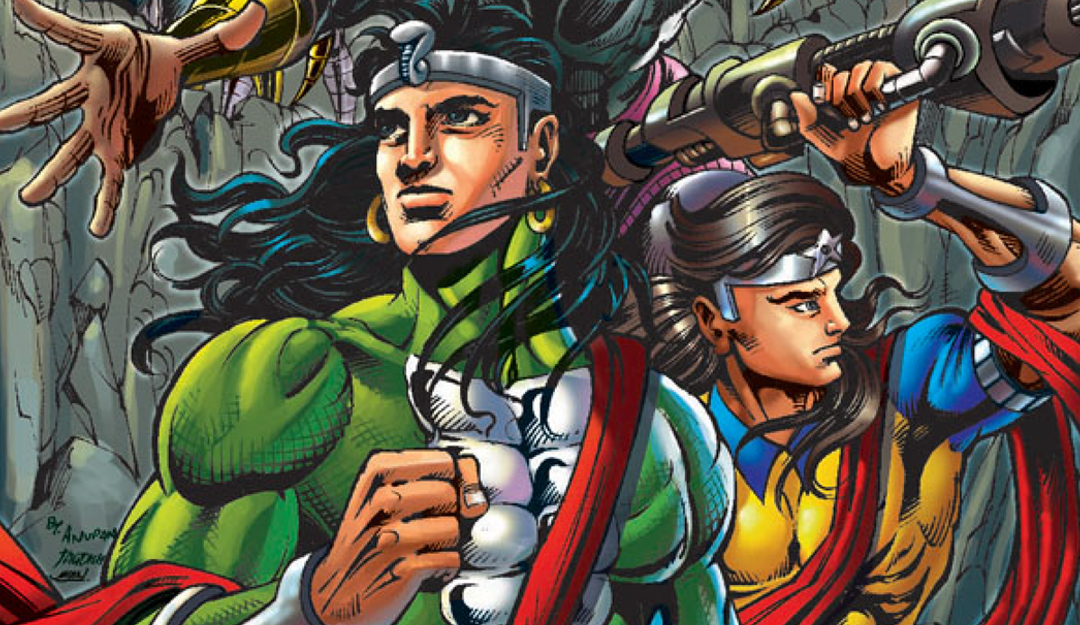
Raj Comics’ ‘Nagayan’ series is considered to be the largest, most ambitious, and most successful series ever in the world of Indian comics. Decorated with the vision of Sanjay Gupta and the brilliant art and writing of Anupam Sinha, this series combines the mythological structure of the Ramayana with future technology, science fiction, and superhero fantasy in such a way that the reader remains constantly engaged.
After the tremendous success of ‘Selection Scandal’, ‘Eclipse Scandal’, and ‘Kidnapping Scandal’, its fourth part, ‘Refuge Scandal’, takes the story to a point where heroes fight beyond their limits and villains break all limits of their cruelty. Let’s break it down.
Detailed Outline of the Plot: Lost Hope and New Conflict
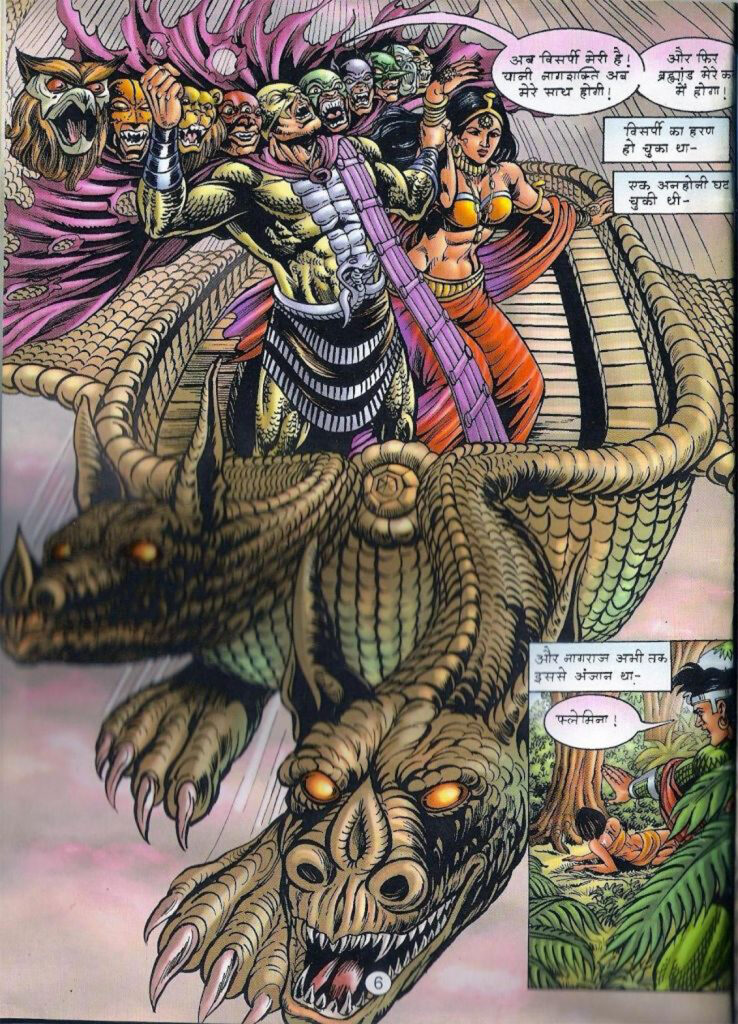
The story of ‘Asylum Scandal’ starts right where ‘Abduction Scandal’ ended, with the kidnapping of the victim. Just as Shri Ram becomes restless after the kidnapping of Mother Sita in the Ramayana, similarly, here Nagraj is also immersed in deep sorrow and anger after losing his wife and the root of his snake power, Visarpi.
Chapter 1: Seeking Visarpi
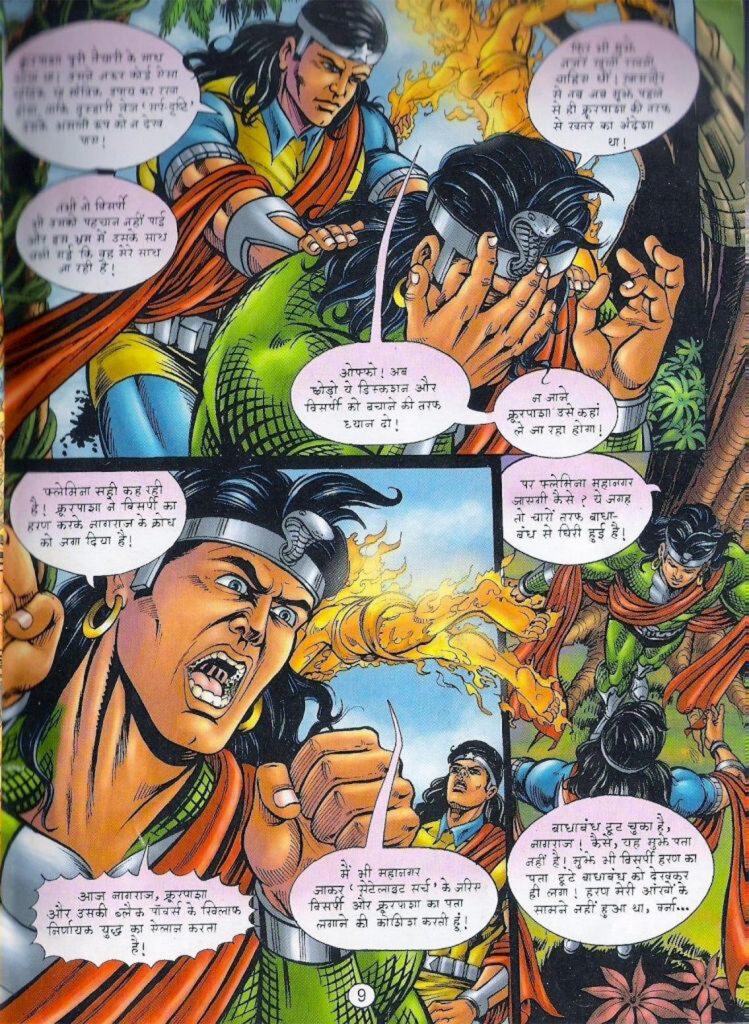
In the opening pages of the story, Nagraj and Dhruv reach the place where the ‘Barrierbandh’ Tilism was broken. There, they find Flamina (a member of the Naga caste) in an injured condition. Nagraj tries to connect to Visarpi with his ‘snake-senses’, but Krurpasha, i.e., Nagpasha, repeatedly breaks that contact with his ‘black powers’. In this entire part, Dhruv once again comes forward with his wisdom and mental strength. He chases the scent of Krurpasha’s craft and the traces of her energy with the help of his ‘sniffer’ drone.
Chapter 2: Courage and Sacrifice of Shikhangi
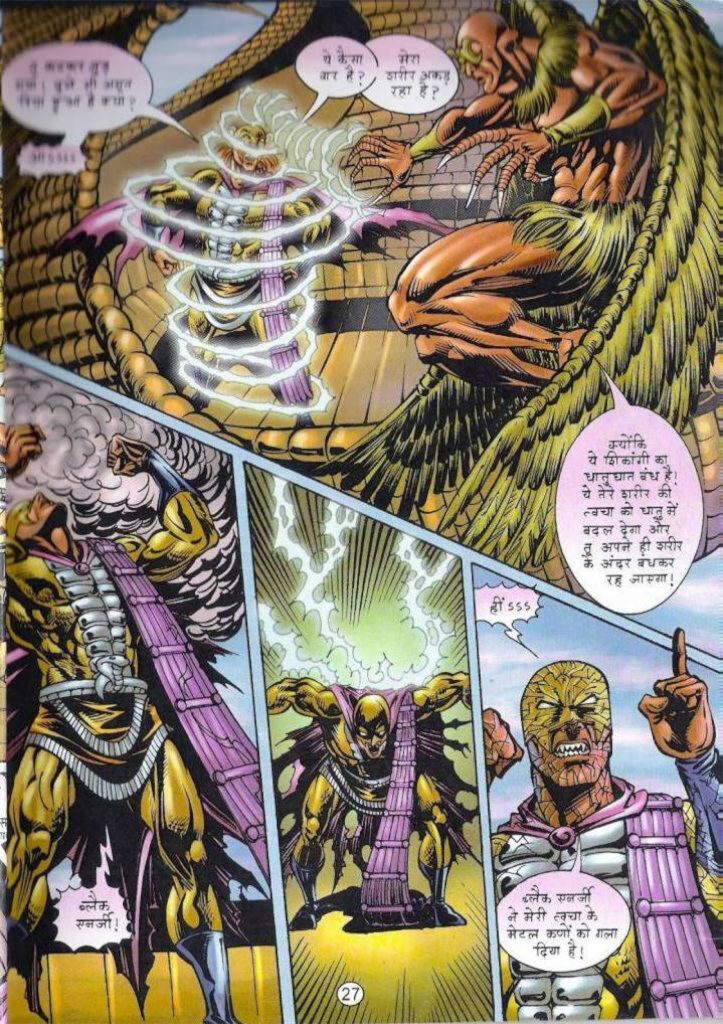
In this part, Baba Gorakhnath sends ‘Shikhangi’ with his powers to help Nagraj and Dhruv. Shikhangi is a warrior with supernatural powers like an eagle. He is directly confronted with the ‘Silt Yan’ of Krurpasha. The fight shown here is very exciting. With his eagle-like sharp eyes, Shikhangi finds the vehicle which even modern science, i.e., the god of Dhanjay, was not able to catch. But Krurpasha poses a big challenge to Shikhangi through her new black powers and the ‘giant gorilla’.
Chapter 3: The Metropolis and the Breaking Family
Another front of the story runs in the ‘underground megacity’, i.e., Metropolis. Here, the personal life of Super Commando Dhruv is completely shattered. His wife Natasha, trapped in Nagina’s trap, takes custody of her son Rishi and goes to Grand Master Robbo. On the other hand, Bharti, who is Nagraj’s first wife, tries to bring Nagraj back to the city with the help of the law, but Dada Vedacharya’s predictions and his ‘ominous warnings’ become a big obstacle on this path.
Chapter 4: Mission Alandhya and the Attack of the Yetis
Following the trail, Nagraj enters a ‘cave system’, that is, an entire chain of caves. Here, he encounters an entire army of Yetis. These are not ordinary forest-men, but dangerous warriors armed with ‘black powers’, defending the new kingdom of ‘Alandhya’, i.e., Krurpasha. In this battle, Nagraj has to rely on his physical strength as well as powerful divine weapons like the ‘Pranodastr’.
Chapter 5: Black Nagraj and the Climax
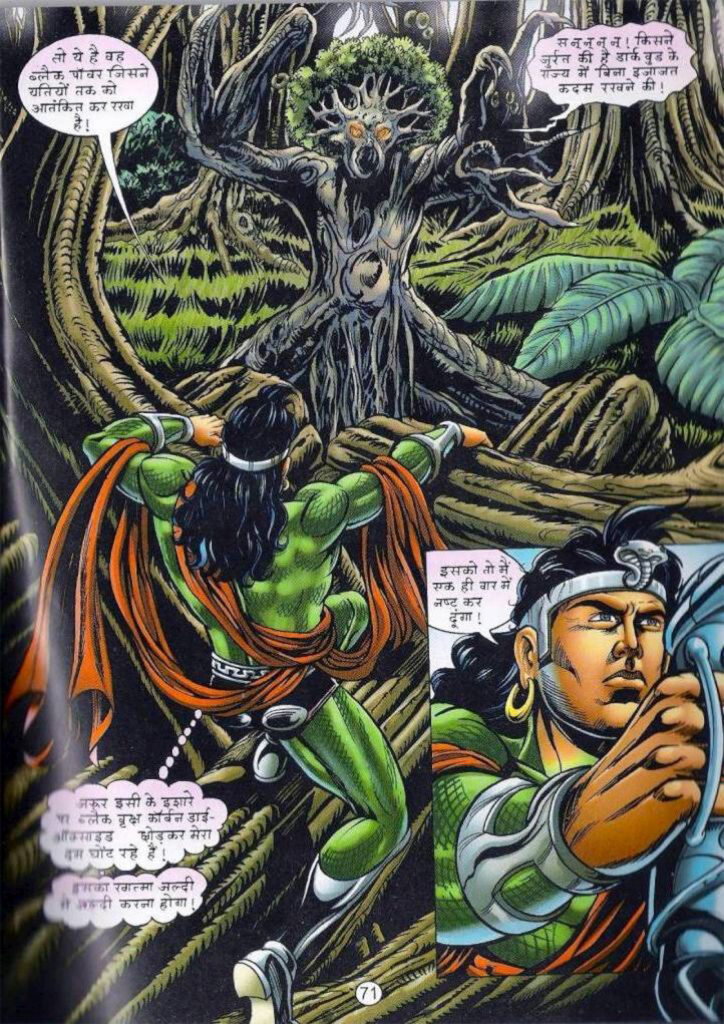
The comic’s biggest shock comes in the last chapter. ‘In the forests of Darkwood’, Nagraj gets caught in an elusive trap. Here, ‘black fruits’ made of black powers fall on his body. The juice of these fruits enters his pores and starts converting his snake powers into black powers. In the last pages, Krurpasha and Nagina jump with joy, as they believe they have made Nagraj their slave by turning him into ‘Black Nagraj’.
In-depth Psychological Analysis of the Characters
Nagraj: A Broken Hero?
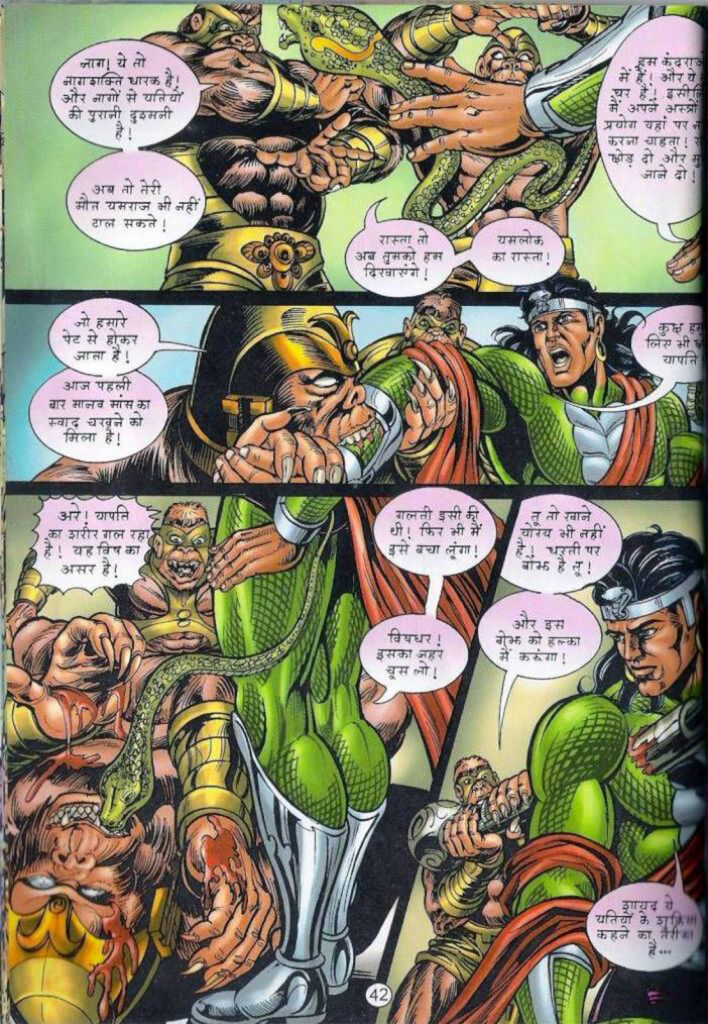
In ‘Sharan Kand’, the character of Nagraj emerges in a very complex form. He is caught between his dignity and his anger. Visarpi’s kidnapping is not just a personal loss, but also a deep blow to his self-esteem. When a Yeti taunts him that he could not protect his wife, Nagraj’s pain touches the readers’ hearts. Finally, his transformation into ‘Black Nagraj’ becomes the darkest and most uncertain turn of this series.
Super Commando Dhruv: A Combination of Sacrifice and Strategy
In this part, Dhruv plays the role of a true friend, almost like Hanuman ji. His own family is shattered, his wife has left him, and his son is with Robbo, yet he does not abandon Nagraj. His advanced gadgets like the ‘sniffer’ drone and ‘black builder’ show that he can make even the impossible possible with the help of science and courage.
Visarpi: Courageous Even in Captivity
Visarpi, in this part, is imprisoned by the cruel Pasha, but she does not appear weak or helpless. She repeatedly reminds Krurpasha that her end is near. She rejects him and maintains her dignity. The dialogue between Visarpi and Krurpasha, like—“You will make me the queen of the universe? I’ll make you king of hell!”—fills the story with tremendous excitement.
Cruel Pasha and Nagina: A Pair of Evil
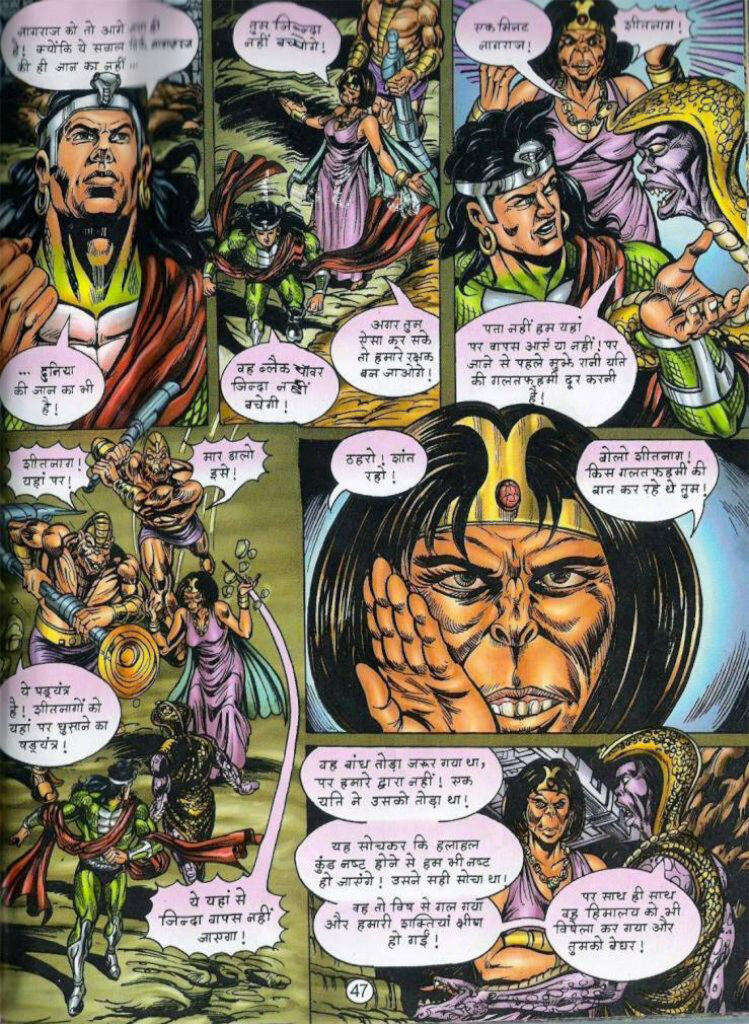
The cruel Pasha is no longer just a Nagpasha, but has become a proud and confused emperor, considering himself God. Nagina, on the other hand, has a truly clever mind. He knows when to seduce Krurpasha and when to make her dance on his fingers. Using Robbo and Natasha to disturb the peace of the Metropolis is one of his biggest tricks.
Natasha and Grand Master Robbo
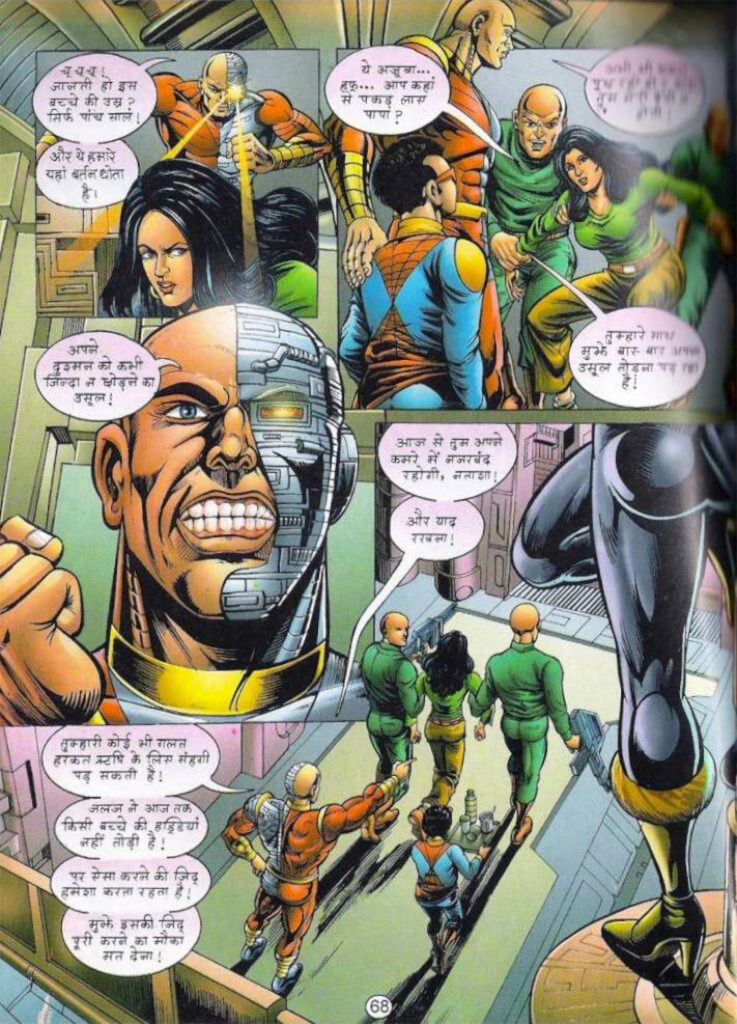
Here, Natasha’s character appears a bit negative and helpless. She is torn between her motherly spirit and her old relationship with Robbo. Robbo’s threat to kill people by cutting off the city’s air and water supply once again brings to light his old cruelty.
Art and Painting: Anupam Sinha’s Magical World
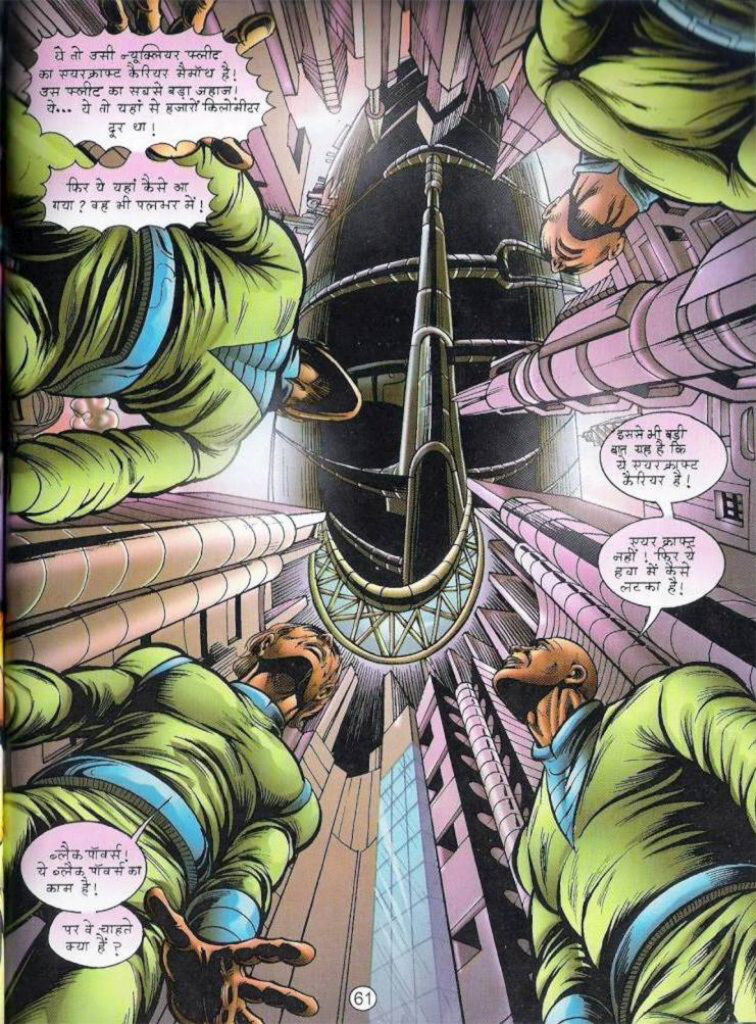
The biggest proof of why Anupam Sinha is counted among the best painters of the Indian comics industry is visible in every page of ‘Sharan Scandal’. His art in this comic has set new levels of visual presentation. By means of the magical light and electric cinematic effects emanating from ‘Energystrahns’ and ‘Divyastrahns’, they have made energy dualities like ‘Black Builder’ extremely effective.
Sinha Saheb’s biggest strength is visible in carving out the deep emotions of the characters. Nagraj’s breakdown and helplessness after Visarpi’s kidnapping, and on the other hand, the scary smile of Krurpasha, all convey a lot even without any dialogue. His dynamic paneling style, in which characters cross panel boundaries from one frame to another, brings the story’s pace to a peak in scenes such as the mid-air battle between Shikhangi and Gadad Yan.
Sunil Pandey’s color combinations make this magnificent art even more impressive. The dark blue and purple colors in the Alandhya caves bring to life the fear of black forces, while the balance of natural colors in the exterior scenes perfectly preserves the mood of the story.
Technical and Philosophical Aspects
The biggest feature of the ‘Nagayan’ series is the balanced combination of ‘mantra’ and ‘yantra’, which transforms the story into a deep social discourse and not just a fantasy. The mention of global warming and snow melting by the Yetis on page number 46 shows the author’s environmentally conscious thinking, adding a serious aspect of reality to the story.
Similarly, the fight of ‘law vs. morality’, shown through Dhruv and Natasha, brings out a bitter truth about how people like Nagina can crush justice by taking advantage of the weaknesses of the law. For this reason, Dhruv has to stay away from his own son. The most powerful twist of the story is the birth of ‘Black Nagraj’, which gives the deep message that even the greatest hero, if overcome by anger and circumstances, can deviate from his ideals and take the path of downfall.
Review: Strong and Weak Sides
Strong Sides (Strengths):
Each chapter ends at such a juncture that the reader is forced to turn the next page on their own. Three to four different stories at the same time—the struggle of Nagraj, the strategy of Dhruv, the crisis of Metropolis, and the imprisonment of Visarpi—it is a great quality of the writer to carry all these forward without complicating them. Here, there is not just hand-to-hand combat, but a wonderful combination of air combat, magical weapons, and technical weapons can be seen. The best part is that superheroes here don’t just fight, but cry, feel fear, and make mistakes.
Weak Side (Weaknesses):
For new readers who have not read the previous three parts, it may be very difficult to understand this story completely.
The number of characters is so high that sometimes the screen time of the main characters, especially Nagraj and Dhruv, seems a bit short.
Impact on Readers and Future Expectations
‘Asylum Scandal’ puts readers on a tremendous roller-coaster of emotions. In the end, Nagraj’s terrible condition and Visarpi’s broken crying can break the heart of any fan. This part clearly proves that ‘Nagayan’ is not just entertainment, but a deep story of character building.
Now, the entire responsibility falls on Super Commando Dhruv and Baba Gorakhnath as to how they free Nagraj from the black powers and bring back Visarpi. The last hint—“Gatha continues— in Combustion Scandal!”—brings readers’ enthusiasm to the extreme.
Final Conclusion and Rating
‘Nagayan: Sharan Scandal’ is an achievement of Raj Comics that they can be proud of. It teaches us that when darkness and dark forces dominate all around, only the loyalty of a true friend and the determination of the hero can save the world. The comic is a great blend of heroism, love, intrigue, and sacrifice.
If you take Indian superhero stories seriously, then the ‘Nagayan’ series, and especially ‘Sharan Kand’, must be in your collection. It is a combination of a powerful ‘soap opera’ and ‘action thriller’, not just for kids, but also for adults.
Final Rating: 4.9/5
