


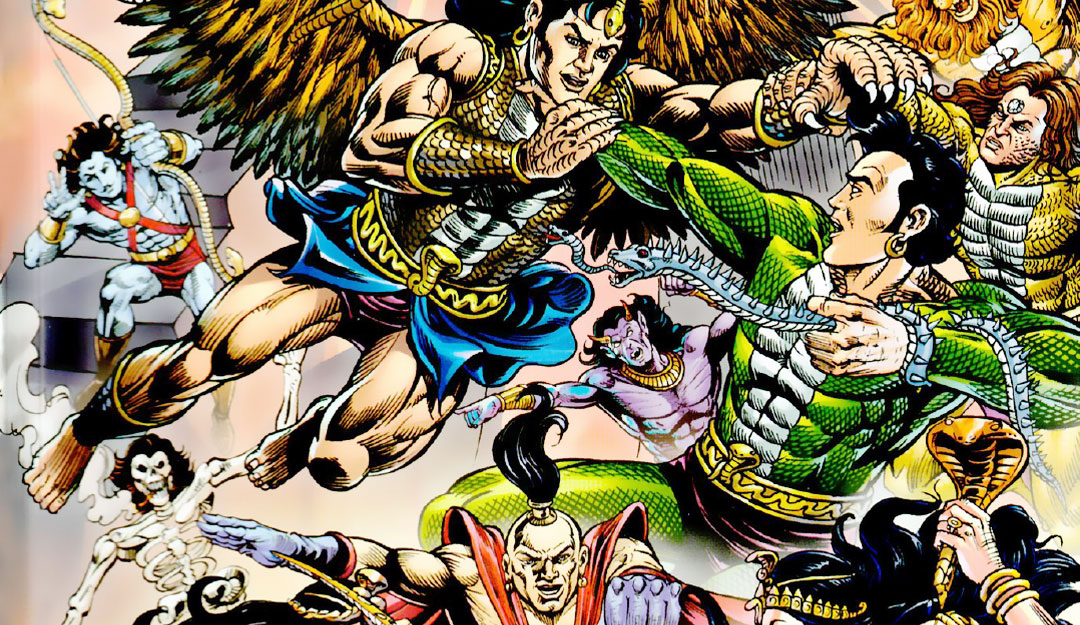
Whenever the name of “Mahasangram” or “Crossover” comes up in the world of Indian comics, the enthusiasm of the readers automatically increases. “Snake Conflict(Sarpdwand)” is not just a comic, but it is the story of a fierce clash between two powerful warriors of different comic universes—Nagraj and Tausi. The way Anupam Sinha ji has brought these two characters onto the same stage is not only spectacular to look at, but also leaves a deep emotional impact.
Background and plot of the story
The story itself starts with great tension. Nagraj, who is the protector of the metropolis, has been infected with a very dangerous “netherworld poison.” This poison is slowly taking him towards death. On the other hand, Tausi, the emperor of the underworld and the wishful serpent, is extremely angry and sad due to the sudden disappearance of his empress Apsara (Shri).

Tausi receives news that his nymph has been seen in the metropolis with Nagraj and his companions. The circumstances and misunderstandings become such that Tausi starts feeling that Nagraj is keeping his wife away from him. Tausi, who is fierce by nature and has full confidence in his strength, comes to the surface—Earth—to teach Nagraj a lesson.
Meanwhile, a legal drama is also going on in the metropolis. Advocate Tirumala is fighting the case of “Nagraj vs State.” Princess Visarpi suspects that Tirumala is actually Apsara, who has either lost her memory or is hiding due to some deep secret. When Visarpi tries to bring out the true form of Tirumala with the power of the “scepter,” the story becomes even more tangled.

The biggest attraction of the story is the moment when Nagraj and Tausi come face to face. On one side is Nagraj, with experience and restraint, while on the other side is Tausi, full of anger and immense power. This conflict is not only about strength, but also about thinking, dignity, and principles.
Characterization
Nagraj: In this comic, Nagraj is shown in a weak condition due to illness, which makes him more human. He does not want a fight, but is forced into self-defense and truth. This compulsion brings readers closer to him.

Tausi: Tausi is introduced here like a classic “anti-hero.” His love itself becomes his anger. His flight, the strength of his wings, and his hands make him a dangerous opponent on par with Nagraj. Anupam Sinha has clearly shown Tausi’s fierce nature, which was once the hallmark of Tulsi Comics.
Visarpi: Visarpi emerges as a savvy strategist and strong leader in this story. When Nagraj becomes weak, she takes charge. Her respect for the scepter and its correct use gives a turning point to the story.
G-18 (G-18): Tausi’s friend and powerful robot warrior, who accompanies Tausi in this battle. His encounter with Nagraj’s companions—the Panchanagas—further increases the thrill of the story.
Art and portraiture
Why Anupam Sinha is called the godfather of Indian comics is clearly visible on every page of “Snake Conflict.” The texture of the panels during action scenes is so sharp and vibrant that it feels like a movie playing while reading. Especially, the war over the metro train is a great example of visual art. The design of Tausi’s wings, the scales of Nagraj’s body, and the detailed depiction of the different levels of Hades, Atal, Vital, and Sutal show Anupam Sinha’s dedication to detailing.

Also, the color combination by Bhakta Ranjan and Pradeep Sehrawat gives a modern and vibrant look to the comic, where the proper use of dark colors makes the tension and atmosphere of the story more effective.
Dialogue and Screenplay

The dialogues have the same heaviness that is required in mythological and superhero comics. “Atul! Vital! Sutal!”—words like these perfectly project the depth and mysterious atmosphere of Hades. The argument between Nagraj and Tausi is not just abuse, but also shows their pride and hidden respect for each other. The author has maintained suspense in the story, making the reader eager for the next part, “Serpayagya.”
Main points of the review: Why read?

‘Serpdvandv’ is like a dream come true for 90s readers. Here, Tausi and Nagraj appear together as superheroes of two different eras, creating tremendous nostalgia. The plot of the comic is not limited to action—it offers a beautiful mix of espionage, the secrets of Tirumala, the lamentations of Tausi, and the political crisis of Nagadweep.
The war on the metro tracks is one of the finest scenes in Indian comics history, with the introduction of new powers like “Magnet Flag” and “Invisible Flag” taking the adventure to the extreme. The greatest strength of the story is its emotional depth. While Tausi’s yearning for his wife makes the reader emotional, Nagraj’s defense of others even near death makes it a living experience, elevating it above mere fantasy.
Some shortcomings

Although this comic is fantastic, for some new readers who have not read the previous part of ‘Serpentation,’ it can be a little difficult to understand the story immediately. Also, in some places, the dialogues are very long, which slightly slows down the pace of the action. However, these shortcomings are negligible compared to the overall experience.
Conclusion
‘Snake Conflict’ is a great example of the renaissance of the Indian comics industry. It is a confluence of Anupam Sinha’s imagination and Manoj Gupta’s passion. This comic shows us that destruction is certain when great powers collide, but the path to truth is always difficult.
If you are a fan of Nagraj, then this comic should be mandatory in your collection. And if you know Tausi, you will be stunned to see him in this new avatar. It is not just a fight between two snakes, but a “duel” of two cultures, two memories, and two great heroes.
Final decision: 4.8 out of 5 stars. This comic should be read by everyone who loves Indian superheroes. The story now moves towards ‘Serpayagya,’ where the flames of fire and vengeance will rise even higher.
