


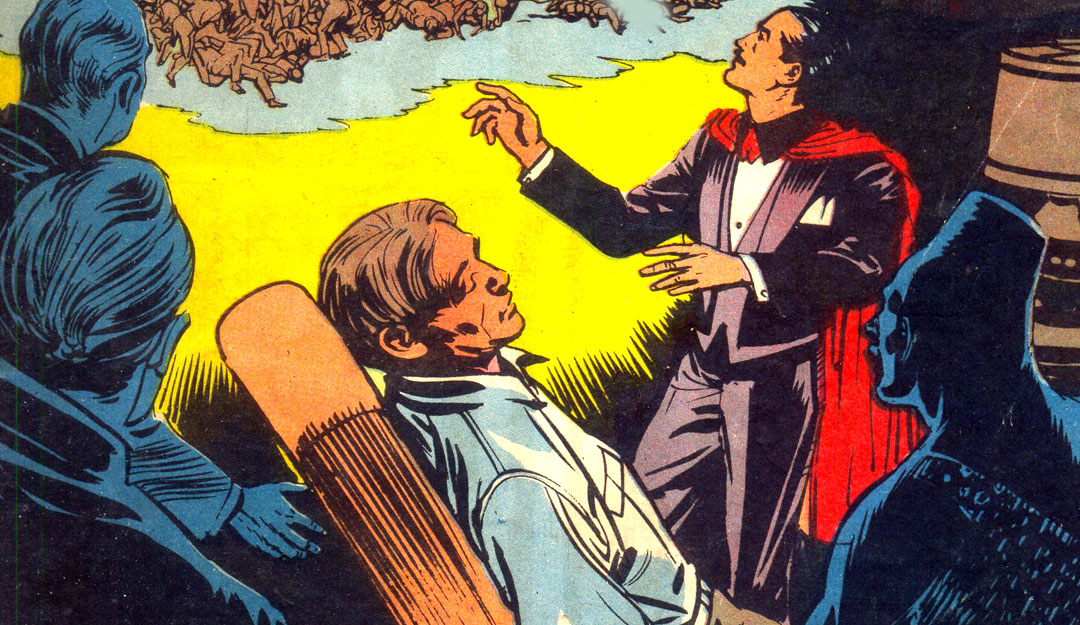
The story begins with Dr. Andrew Crane, a famous scientist, who suddenly disappears. Dr. Crane was working on an extremely dangerous weapon called the ‘proton bomb’. The scariest thing about this bomb was that it could eliminate only living beings without damaging buildings or objects. British intelligence is deeply concerned that if this technology falls into the hands of the wrong people, disaster is certain for the entire world.
Mandrake and his loyal companion Lothar also participate in this mission. Mandrake, using his special art of hypnotism, extracts the memories hidden in the subconscious mind of Dr. Crane’s assistant, Larkin. It turns out that Dr. Crane has been kidnapped by foreign spies and is imprisoned in a secret hideout near an old watermill.

Adventures and magic:
The most fun and exciting part of the story is where Mandrake creates fear and confusion in the minds of his enemies using magic. He creates the illusion of a giant sea monster from the lake and gives a cart full of grass the appearance of a terrifying monster, which frightens the detectives. This is what makes Mandrake different from other superheroes—he wins battles not with strength or weapons, but with intelligence and mind games.
Conclusion:
At the end of the story, when Dr. Crane is set free, it is discovered that he has forgotten the entire method of making the proton bomb due to torture and mental pressure. Mandrake considers this a boon for the world, as he knows that no one should have such dangerous and destructive power in their hands.
Second story: Vetala – In the Ivory Cage (The Phantom – The Ivory Cage)
It is a short but effective story in which ‘Sanbani’, a villain seeking to capture the forest of Denkali, conspires to trap Vetala. He prepares a special cage (Kataghra) made of ivory and fraudulently lures Vetala toward him through the sound of the Dol (drums).
Vetala is imprisoned, but with his wisdom and the help of his loyal companion ‘Dardy’ (a reference to Guran), he not only breaks free but also makes his enemies realize his true strength. The story may be short, but it further strengthens the image of Vetala as invincible and reinforces his myth.
Third story: The Apparition of the Desert (Mandrake and the Ghost of the Desert)
Plot and environment:
This story takes Mandrake to a completely new environment—between the American desert and cowboy culture. In a small town named Tacho, there is terror caused by a mysterious ‘phantom’. A bandit named Pancho Valde is said to have been killed some 80 years ago, but he has suddenly returned and is looting the city.

Mystery opening:
The most interesting aspect of this story is that initially Mandrake’s magic does not affect the ghost. Readers are also forced to wonder whether he is truly a spirit. Even Mandrake is taken aback. But Mandrake uses his own understanding and logic. He realizes that the ‘phantom’ is wearing a special kind of colored glasses that block the hypnotic waves coming from Mandrake’s eyes. In addition, he is wearing a bulletproof jacket (armor), due to which bullets do not affect him.
Climax:
Eventually, Mandrake further increases his hypnotic power and creates the terrifying illusion of a giant fire-breathing dragon. This time, even the criminal’s glasses cannot save him, and he is caught. This story gives a clear message that behind superstition, there is often a cunning and vicious mind hidden.
Art and Portraiture
The artwork of Indrajal Comics shows a great combination of simplicity and impact. Keeping in mind the printing quality of that period, primary colors like red, yellow, and blue have been used extensively, which make the pages feel more alive. Mandrake’s red and black coat and Lothar’s cheetah-skin shirt give them a classic and memorable look. The expressions of the characters are also quite impressive—a calm confidence always appears on Mandrake’s face, while fear and surprise are clearly visible on the faces of the villains.

Since Mandrake’s character is not based on physical fighting but on illusion, ‘smoke’ and ‘waves’ have been used very effectively to show the impact of magic in the artwork, which makes the mystery of the story deeper.
Language and Dialogue
The Hindi translation of this comic is quite pure and literary, yet it still feels connected to the story. Words like “Sammohini Vidya”, “Unconscious Mind”, and “Terror of Doomsday” create a serious and mysterious atmosphere. The dialogues are not very long, but their impact is direct and strong. Especially this sentence of Mandrake—
“Mandrake made only one sign, and a terrible scene emerged in front of the spies”—
gives the reader’s imagination a chance to fly freely.
Character Analysis
Mandrake:
Mandrake is a gentleman superhero. He does not resort to violence without reason and tries to solve every problem with his mind. His character is a symbol of patience, understanding, and mental strength.
Lothar:
Despite being the most powerful man in the world, Lothar is Mandrake’s most loyal companion. He represents physical strength, just as Mandrake represents mental strength.
Villain:
The villains in this issue are not just ordinary criminals but are also dangerous in terms of intellect and intent, such as spies who seek to control destructive forces like the proton bomb.
Cultural and Moral Importance

These comics are not limited to entertainment alone but also raise important moral questions. The story “Terror of the Holocaust” shows deep concern about the misuse of science. It reflects the fear of the nuclear age, when people believed that the entire world could end at the press of a button. Mandrake’s justification of the loss of a scientist’s memory clearly shows that, for him, peace and humanity are more important than any scientific progress.
On the other hand, the story “The Phantom of the Desert” shows the victory of logic and understanding over superstition and fear. It teaches readers that behind things we find scary or supernatural, there is often a cunning human mind at work.
Conclusion
Overall, “Mandrake and Pralay Ka Terror” is a brilliant and memorable issue of Indrajal Comics. It stands as a fine example of Lee Falk’s excellent writing style and the powerful visual storytelling of that era. Characters like Mandrake and Vetala remind us that a true hero is not just one who knows how to fight, but also one who knows how to protect society from destruction when needed.
In today’s digital world, filled with high-graphics and fast-paced comics, reading such classic titles offers a different kind of comfort. It is a treasure trove of memories for the older generation and a wonderful way for the new generation to understand the golden age of Indian comics. If you are fond of suspense, scientific thrillers, and classic magic, this issue truly deserves a place in your collection.
