


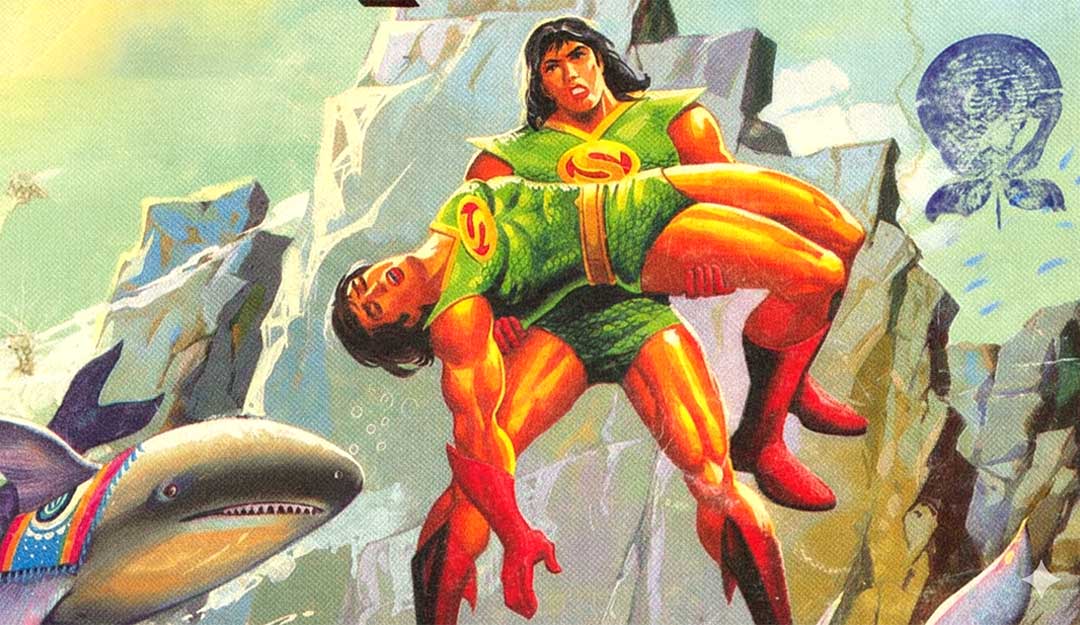
This review of ‘2nd Shark’ (Doosra Shark), published by Manoj Comics, not only talks about the story of this particular issue but also explores the thin line between creative thinking and inspiration present in Indian comics of that period. This comic is the second and most important part of the ‘Shark’ series, where the story does not remain just that of a superhero, but moves toward themes of power, greed, and intrigue.
‘Second Shark’: A Detailed Critical Review

‘Second Shark’ carries the story forward directly from the first issue. While in the first part we saw the birth of the Shark and the emergence of his powers, in this issue the story becomes deeper, more mysterious, and much more political. Writer Mahendra Jain and artist Chandu have together created a world beneath the sea where not only peace and beauty, but also violence, deception, and power struggles exist. For its time, this comic can be called quite dark and violent, which makes it different from other comics.
Plot Expansion
The story begins in another frightening area of the sea, the ‘Snail Castle’. Here, the king of demons, ‘Snail’, rules. The dangerous villain of the first issue, ‘Roar’, now appears bowing before the same Snail. Hunkar hands over Somaru, the real king of Jaldhar City, to Snail’s prison so that he himself can rule Jaldhar City without any restrictions.
On the other hand, the Shark is using his powers to protect marine creatures. He rescues small fish from a terrifying eight-eyed sea monster. In this part, along with the bravery of the Shark, his compassionate nature also comes to the forefront. Water-sage Jarka tells him that it is time to put an end to Roar and to understand the secret associated with his mother, ‘Mansi’.
Main Turns of the Story:

Hunkar’s cruelty appears at its peak in this issue. He is shown as a truly disgusting villain who demands the innocent children of Jaldhar Nagari as his breakfast and food. This scene creates deep hatred for him in the reader’s mind and proves him to be a true monster.
The combination of the worlds of earth and sea is also seen in this issue. A mysterious water-ball emerges on the beach of Rajnagar, inside which Shark’s mother, Mansi, lies unconscious. Inspector Wagle, a fearless and honest police officer, begins investigating this strange incident. This sub-story not only limits the comic to the ocean but also connects it to the human world.
Meanwhile, the real conspiracy of Queen Jagitta, the second wife of King Somaru, is revealed. She wants to make her son Akhilecha the king, and in this greed, she joins hands with Hunkar. Jagitta calls Hunkar to the ‘Water Islet’ to eliminate the Shark and cleverly sends the Shark there as well.
The climax becomes even more dangerous upon reaching the Water Islet. Here, the Shark becomes a victim of deadly attacks by poisonous plants and Roar. Just when it seems the Shark has been killed, suddenly another Shark appears there—that is the ‘Second Shark’. This mysterious warrior gives Hunkar a terrible death by throwing him onto a bed of sharp arrows. In the end, that other Shark sacrifices himself while saving the real Shark’s life, leaving behind a big question—who was he?
Characterization and Development

Shark emerges as a more intelligent and mature warrior in this issue. However, his sentimentality becomes his weakness, as he gets caught in the schemes of Rani Jagitta, his stepmother. This highlights his innocence and trusting nature.
The end of Hunkar is the most satisfying part of this comic. His cruel actions, such as eating children, make him stand out among the scariest and most hateful villains in Indian comics.
Inspector Wagle is the backbone of the storyline unfolding on land. His style resembles that of an old-fashioned, honest, and “salaam-thok” police officer who wants to reach the truth at any cost.
Queen Jagitta is portrayed as a classic evil stepmother whose hunger for power pits her against her own family. Her character emerges as the true face of intrigue and betrayal in the story.
Art and Portraiture

Chandu’s artwork in this issue is even better than in the previous one. He openly depicts scenes of violence without hesitation, with blood and death shown in detail. Especially the scene of Roar falling on sharp arrows, along with the entire battle leading up to it, feels quite effective. The design of monstrous fish and the imagination behind the ‘Snail Castle’ clearly reflect the artist’s creative thinking. The perfect balance of blue, green, and purple colors in the undersea scenery successfully creates a deep and mysterious atmosphere, making the reader feel like part of that world.
Issue of ‘Mimic’ or ‘Motivation’
If we look closely, it becomes clear that the character of ‘Shark’ and this particular issue are inspired by several global and mythological sources. Shark’s dialogue with the sea and his existence between two worlds—earth and ocean—are directly reminiscent of Aquaman and Namor. Meanwhile, the sudden appearance of the ‘Second Shark’ in the story feels similar to the “clone trope” or Bizarro-type concepts already present in the comics world.
The ‘S’ logo on Shark’s chest is a direct imitation of Superman’s ‘House of El’ symbol, with almost no changes, reflecting the casual attitude toward copyright issues during that era. Additionally, several characters also appear to be influenced by Indian mythology—Rani Jagitta’s conspiracy is reminiscent of Kaikeyi, and Hunkar’s ruthlessness seems inspired by demonic figures like Kansa.
Social and Moral Aspects

This comic essentially carries a message of humanity, courage, and standing up against injustice, but its violence may be somewhat uncomfortable for young children. The idea of Hunkar kidnapping and eating children was enough to instill fear in the minds of young readers of that time. Nevertheless, the horrific end of evil firmly establishes a sense of justice and shows that tyranny is ultimately destined to fall.
Drawbacks
In some places, the dialogues become overly dramatic, making the story feel a bit heavy. From a logical standpoint, questions arise about how Shark falls so easily into Queen Jagitta’s trap despite Jarka’s clear warning, which slightly undermines his intelligence. Also, the “secret of the Second Shark”—although intriguing as a cliffhanger—is given very little explanation in this issue, leaving the reader with a sense of incompleteness.
Conclusion
‘2nd Shark’ is a daring and memorable offering from Manoj Comics. It is not just a superhero story, but a deep narrative about family, betrayal, and sacrifice. Its ending leaves readers eagerly waiting for the next issue, ‘Innocent’.
Is This an Original Creation?
Not entirely. It is a hybrid character created by blending the visuals of Western superheroes with Indian folklore and emotions. Still, the way Hunkar and Jaldhar Nagari expand the story’s universe makes it a memorable experience for Indian readers.
If you want to relive the comics of the 90s that didn’t just entertain but also shocked readers with their dark themes, ‘Second Shark’ truly feels like a masterpiece.
Final Rating: 4/5 ⭐⭐⭐⭐
