


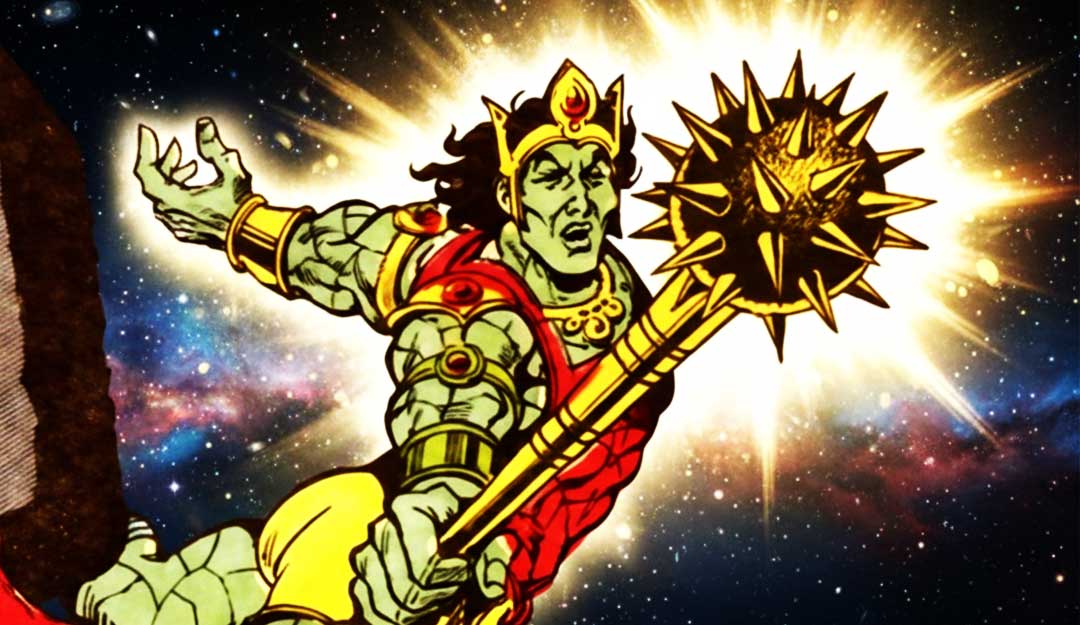
The story begins with the palace of the country ‘Trikhand’, where King Drupada looks extremely troubled. His own brothers, Nupur Sen and Ghunghra, have cleverly divided the kingdom and now they want to completely eliminate King Drupada. In such difficult times, King Drupada takes refuge in Maharishi Balikaj. Maharishi Balikaj is a great ascetic who, with his penance, initiates a huge ‘Mahayagya’ for the destruction of Nupur Sen.
This is where the real twist in the story comes from. Nupur Sen and Ghunghra enlist the help of two extremely powerful demons named ‘Snob’ and ‘Kumbh’ to destroy Maharishi’s yagya. Maharishi Balikaj reveals a protector named ‘Kangru’ through his penance, but he cannot stand long in front of the arrogance, cunningness, and power of Kumbh. Enraged, Maharishi curses both of those demons, but later the same curse becomes a boon for them. During this time, Maharishi finds some golden and strange stone parts scattered in the forest. When the Maharishi connects all those parts, a wonderful and extremely powerful human is born—this is ‘Vajra’.
Vajra’s past and scientific background:

The story does not just limit itself to magic and penance but also takes us on a journey to the ‘stone planet’, Planet Tapori. Actually, Vajra is the prince of the same planet. His father, Emperor Stono, had granted Vajra immense scientific powers with the help of ‘Pokhar’, the greatest scientist on his planet. The body of Vajra is made of a special type of stone, which has been made very powerful through scientific methods.
From here, the main villain of the story, ‘Pokhar’, comes out completely. Pokhar is a greedy and cunning scientist whose eyes are set on the biggest energy power of the stone planet, ‘Raktamani’. For his own selfishness, he provokes a fierce war between two neighboring planets—the stone planet and the Gig planet. He murders Emperor Stono’s messenger and puts the entire blame on Emperor Shushanda of the planet Gumtum. These scenes of politics, deception, and interplanetary war give this comics a blatant ‘space opera’ feel.
Main conflict and climax:

When Pokhar steals Raktamani and runs towards Earth, the stone planet reaches the verge of complete destruction. Vajra follows him to Earth, but his body is shattered into pieces by the strong friction of the atmosphere and the deadly attack of Pokhar. These are the pieces which Maharishi Balikaj later finds in the forest.
On Earth, Vajra, Maharishi Balikaj, and King Drupada fight together against unrighteousness. The ending of the story is quite dramatic and exciting. Nupur Sen, Ghunghra, and Pokhar—all three collide with each other due to their own selfishness. Ultimately, Vajra, displaying his immense powers, frees the people of Nupur country from the terror of Pokhar. In the final battle, Vajra not only destroys his enemies but also saves his planet from complete destruction by regaining Raktamani with his intelligence and cleverness.
Character illustration

Vajra: Vajra comes across as a perfect hero. A wonderful combination of courage, discipline, and immense strength can be seen in his character. He is not just physically strong, but he also has an amazing ability to feel and catch mental waves (Mental Waves). His body can break into stones and reconnect, which makes him completely different and special from the rest of the superheroes.
Maharishi Balikaj: Maharishi Balikaj is a symbol of knowledge and spirituality. His character clearly shows that science and spirituality cannot be enemies of each other but can complement each other.
Pokhar: Pokhar is the most effective villain of this comics. He shows what a great threat a sharp mind, if corrupted, can pose to the entire universe. His longing, deceit, and ambition give impetus to the entire story.
Nupur Sen and Emperor Stono:
These two characters represent two completely different tendencies of rulers. On one side is Nupur Sen, who is filled with jealousy, hunger for power, and selfishness, while on the other side is Emperor Stono, whose life is linked to love and responsibility for his son and his subjects. Through both of these, the story clearly shows that when power runs on greed, it brings destruction, and when it runs on duty, it saves civilization.
Art and portraiture

‘A.M.R.’ The drawings by ‘A.M.R.’ take this episode of Vajra far beyond most comics of its time. The views of the stone planet and the Gig planet look extremely imaginative. Especially the unique designs of spacecraft and scientific machines take the reader to a completely new world. The style of Vajra breaking and fighting again, and the speed (motion) shown in his mace’s blows, bring the action scenes to life. Plus, the great use of colors—especially the divine glow of Raktamani and the aura of the golden limbs of Vajra—gives a premium and gorgeous visual experience to the entire comics.
Writing and dialogue:

Anil-Anand’s writing is completely filled with ‘heroic ras’. The roars of the heroes and the laughter of the villains have been transformed into adventure through simple but impressive dialogues. The pace of the story and the smooth transition between scenes keep the reader engaged from beginning to end. Along with entertainment, this comics also gives many deep moral messages, such as betrayal ultimately taking a toll on oneself, the power of unity through the union of the trisection, and a powerful warning on the misuse of science, which suggests that the wise man who misuses it ultimately becomes Bhasmasur for himself.
Reviewer’s opinion (Critique):

If seen in depth, the story of ‘Vajra’ seems to be an interesting juxtaposition of Hollywood films and Indian mythology of that period. The body of Vajra disintegrating into pieces and rejoining is reminiscent of modern concepts like ‘Terminator’ or ‘Transformers’, which is beautifully threaded through Maharishi in the Indian context.
Although the story may feel a bit complicated due to the large number of characters in some places, the author connects all the threads well by the time he reaches the end. A special identity of Manoj Comics was that it showed its heroes in a very human and emotional form, and Vajra is no different. His respect for his father and his duty to his land make him a true and memorable hero.
Conclusion:
Manoj Comics’ ‘Vajra’ is a priceless heritage of Indian comics history. It reminds us that we too had such original superheroes whose stories were in no sense less than Marvel or DC. If you are fond of old comics or want to read a story that combines magic, science, conspiracy, and heroism, then ‘Vajra’ is a must-read and memorable comics for you.
This review reinforces that ‘Vajra’ is not just a story of pictures made on paper, but it is that flight of imagination which feels equally fresh, relevant, and exciting in today’s digital era.
