


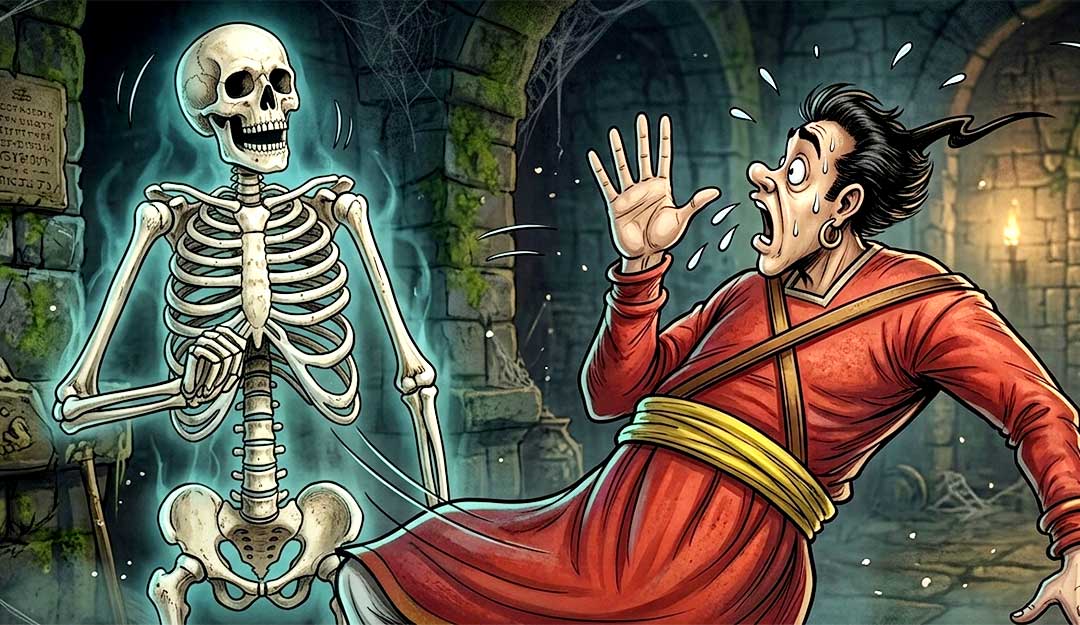
Bankelal’s comics are not just a story, but a brilliant blend of humor, satire, and folklore that captivates the reader from beginning to end. ‘Bankelal Aur Murda Shaitan’ is a gem of this series, which is not only known for its strange and interesting story, but also for the balance of fear and comedy present in it, which makes it a cult classic. The front page of this comic is so effective that it was natural for any child to develop curiosity and a slight shiver after seeing a skeleton standing in front of a wrestler. Bedi ji’s brilliant painting and Tarun Kumar Wahi’s writing together bring alive the imaginary world of Vikramgarh, where a new conspiracy is seen waiting for Bankelal at every turn.
The soil of Vikramgarh and the fierce fear of Dara Pehalwan

The story begins with the dusty akhara of Vikramgarh where the festival of Mallavidya is going on. The famous wrestler Dara of Darapur is immersed in the pride of his invincible strength. He is not only defeating the wrestlers one after another, but is also openly challenging the reputation of Vikramgarh. Here the author has shown Dara’s character to be so huge and powerful that even Raja Vikram Singh gets worried. Dara has a personality as strong as a mountain and his maneuvers are so dangerous that the opponent in front can do nothing but have his bones broken.
When Chilappo, the last wrestler of Vikramgarh, also loses, the honor and respect of the state come under question. This is where Bankelal’s entry is prepared. Dara’s loud laughter and his bulging muscles are clearly visible in Bedi ji’s artwork, which is enough to make the reader realize how big the crisis is. This scene reminds us of the wrestling matches of the nineties that we often read about in folk tales.
Bankelal’s web of cowardice and conspiracy
Bankelal is not a common hero; he is an ‘anti-hero’ who always has a desire to do bad to Raja Vikram Singh. When the king orders him to fight Dara, the ground slips beneath Bankelal’s feet. Bankelal’s mental struggle is shown here in a very interesting way. On one side stands a dangerous wrestler like Dara, as terrifying as death, and on the other side stands the king’s order.
Bankelal’s specialty is that he uses his intelligence in difficult times not to fight, but to escape. The fear, sweat drops, and mischief in his eyes seen on his face have been depicted very closely by the artist. This characterization of Bankelal endears him to readers, because he is afraid like us, weak like us, but his luck always makes him a hero. Bankelal’s attempt to escape and leave the palace in the guise of a washerman clearly shows his cunning nature.
The utter darkness and the dreadful rebirth of the dead devil

When Bankelal escapes the soldiers and runs towards the forest, the story suddenly turns from humor to a scary atmosphere. Bankelal falls into a mysterious cave while trying to hide in the cavity of an old tree. The atmosphere here seems no less than a horror film. When Bankelal’s blood accidentally falls on a skeleton amid spider webs, old dust-filled chests, and silence all around, the ‘Murda Shaitan’ awakens.
This character emerges as the biggest attraction of this comic. The powers of this devil, who wakes up after a hundred years of sleep, are limitless. Its mere structure of bones and yet talking creates shivers in the minds of readers. The bloody thirst of the dead devil and his scary personality make this comic a supernatural thriller. Here Bankelal’s cleverness is seen at its peak, when he makes a deal with the dead devil to feed him the blood of Dara Pehalwan to save his life.
A scene of bloody thirst and terror

This alliance of Bankelal and the dead devil leads to a disastrous outcome. The hunger of the dead devil is not normal; he needs human blood. Bankelal brings him to the arena where Dara Pehalwan is celebrating his victory. Suddenly, a living skeleton comes into the arena, causing a stampede among the entire crowd and the soldiers.
The kind of action scenes that Bedi ji has created here seem to compete with the animations of today’s era. The dead devil’s attack on the soldiers, the people jumping in the air, and the screams echoing all around create such an atmosphere of panic that the reader’s heartbeat becomes faster while reading. The powers of the dead devil make him immune to any attack because he is already dead. His mutant-like nature and supernatural strength make him one of the most memorable villains of Raj Comics.
Bedi’s magical portraiture and the magic of the nineties

If Bedi ji’s work is not discussed in this review, it will remain incomplete. Bedi Raj is one of the pillars of comics who gave the characters a real identity. There is a special kind of dynamism in his paintings. When Bankelal jumps into the air or when the dead devil cracks his bones, it seems as if sounds are coming out of the pages. The selection of colors, especially the dark background behind the white structure of the Dead Devil, creates a strong visual contrast.
Another specialty of nineties comics was their ‘hand-lettering’ fonts. The clouds behind the dialogues and the circles that show Bankelal’s thinking take us back to that innocent period, where these paper pages were the biggest means of entertainment. The details that were present in the artwork of that time made the characters even stronger.
The great battle and the unbreakable game of destiny in the arena

The climax of the story is extremely dramatic. When the dead devil attacks wrestler Dara, the scene becomes truly worth watching. Dara, who considered himself the most powerful, begins to appear helpless in front of a bone structure. But it is here that the famous ‘luck’ of Bankelal or the boon of Shiva works. During an unintentional struggle, Dara’s hand, which had been useless for a long time, is suddenly healed by the blow of the dead devil. This is the same signature twist of Bankelal’s comics where Bankelal wants to do bad, but the result is always good.
The completion of the dead Shaitan’s time and his return to dust symbolize the end of evil. But for Bankelal, it is another ‘sad’ victory, as he has to become beloved by the king again and gain respect, which he never wanted.
The psychological depth and strategic maneuvering of the characters

If we look deeply, Bankelal’s strategies seem like those of a chess player; the only difference is that he spoils his chessboard himself. In this comic, Bankelal tried to use the dead devil as his shield, so that he could get rid of both Dara and the king. The hero’s strategy that ‘the enemy of the enemy is a friend’ fails here in a very interesting way.
The character of Dara Pehalwan is also not limited to just one Bahubali-like figure. In the end, his showing respect towards Bankelal and accepting his defeat further strengthens his personality. The wisdom of General Dharam Singh and the innocence of Raja Vikram Singh also give this entire story a family drama feel. Every character is complete in himself and plays an important role in taking the story forward.
An unforgettable conclusion of a timeless creation
‘Bankelal Aur Murda Shaitan’ is not just a comic, but it also shows the ironies of human nature. This story tells us that even the biggest strength and the biggest conspiracy can fail before fate. Bankelal’s crying and his finally thinking that ‘the leg of my plan has been broken again’ makes the readers laugh.
The world of fantasy and adventure that Raj Comics has created through this story still seems as fun and relevant as it was thirty years ago. This comic is a must-read for all who want to return to their roots and enjoy the simple yet entertaining stories of that period. If you read it as a child, re-reading it will take you back to those golden memories, where Bankelal’s mischiefs used to be the greatest entertainment.
