


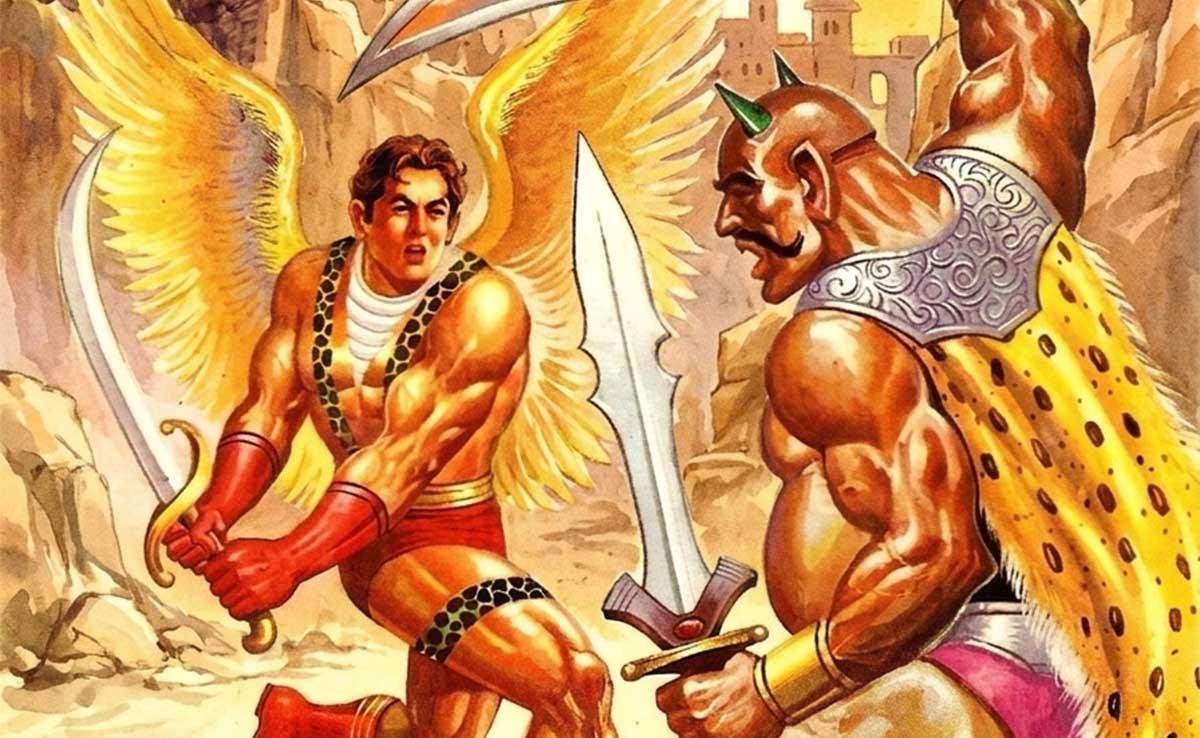
When Bravery Itself Becomes a Victim of Conspiracy!
What happens when a selfless and extremely powerful hero, hearing the scream of a victim, moves forward fearlessly to protect her, but has no idea that he has become a pawn in a terrible mystical conspiracy? Will Ajgar’s immense power be able to safely bring him out of the maze of the ‘world of death’? And does a hero’s self-respect break when his powers are used by his biggest enemy for his own benefit? This issue of Manoj Comics raises these big questions before the readers.
A Story of Deceit, Bravery and Revenge

Written by Anil Anand, this story begins in a very religious and grand atmosphere, where Prince Ajgar’s ‘Ajgar Mani’ is being installed in the temple. But the story immediately takes an exciting turn when Ajgar sets out to protect humans on Earth and, hearing a woman’s scream, enters the ‘world of death’ (the Tilismi Gate).
The biggest feature of the story is its ‘Twists and Turns’ (Twists & Turns). Usually in comics, the hero goes straight and confronts the villain, but here the villain himself uses the hero as a means to overcome his challenges. Gatgat knows that the divine objects (Dev Mani and Divya Havan Kund), which he cannot acquire, can only be obtained through the tremendous bravery of Ajgar. The first half of the story focuses on the adventures of Ajgar, while the second half tells the story of the destruction of ‘Ajit Nagar’, the struggle of Rajguru Devacharya and the terrible revenge of Gatgat.
Feeling of Bravery Versus Mystical Ego

In this comic, mainly the balance of power and ideas among the three characters is visible.
Ajgar (Hero): Ajgar is shown as a very courageous, kind and strong-willed hero. His sixth sense and ability to change his body form (Adhamra/Huge form and half-snake, half-human form) make him different from everyone else. His dialogues clearly show his anger against injustice and his strong devotion to justice.
Tantrik Gatgat (Villain): Gatgat is not only a cruel monster, but he is also a cunning strategist. His arrogance, yearning to avenge his defeat and his laughter in the dialogues (“Ha… Ha… Ha…”) leave a scary impression on the minds of readers.
Rajguru Devacharya (Protector): Devacharya’s character is as impressive as the sages of Indian mythology. His divine powers (fire peacock, tree human) and his war with Gatgat give the story the feel of mythological fantasy.
The dialogues are quite effective and in keeping with the traditional comics genre of the ’90s, with a perfect blend of pure Hindi and strong language.
Art Style and Portraiture: That Golden Charm of the ’80s-’90s

The artwork of Vijay Kadam and Atmaram Pund is the biggest strength of this comic.
Color Combination: The use of bright and dark colors (red, purple, yellow and green) on the pages brings the magical atmosphere to life. The maze of the world of death, the ghoul-like hideous body of Gatgat in purple and the scenes of the dreaded vampire-birds flying make the whole experience extremely exciting.
Panel Design: The design of the panels in action scenes is extremely dynamic. Especially when Ajgar cuts off the heads of flying birds with a sword or when the giant ‘tree man’ throws them to the ground, these scenes keep the reader hooked.
Artistic Expression: The characters’ facial expressions—Ajgar’s anger, Gatgat’s vicious laughter and Kanaklata’s fear—are very closely depicted.
Speed and Action: An Ever-Increasing Thrill

The pace of the story (Pacing) does not slow down anywhere. New adventures emerge page after page. Ajgar’s battle with terrible vampires, the trees of living death gripping Ajgar, the huge punch coming out of the earth and the deadly attack of ‘Chakra’, then the devastating attack of Gatgat on Ajit Nagar and his great divine battle with Rajguru Devacharya—all these events constantly increase the thrill of the story.
Not only physical strength, but also different magical and mystical powers are seen in every action scene. When Devacharya reveals ‘Agni Mor’ and Gatgat releases ‘Agni Sarp’ in response, which is then swallowed by the Mor, this scene is no less than spectacular for readers who like fantasy.
Cameo of ‘Thimphu’ and Expansion of the Comics Universe

A special thing about this issue is that it features the entry of another popular character of Manoj Comics, ‘Thimphu’ (Thimpu). When Ajgar falls into the web of countless swords emerging from the walls, Thimphu crosses that obstacle using his rubber-like, stretchable body.
This cameo saves the story from becoming boring and shows how easily and naturally a ‘crossover’ (Crossover) of different characters was done even in comics of that period.
A Great Confluence of Fantasy and Adventure
‘Ajgar Aur Gatgat’ is not just a superhero or magical comic; it is the story of that old battle between good and evil, where evil can dominate for some time by playing all kinds of tricks, but the hero’s determination never wavers.
The story ends in suspense and on a ‘Cliffhanger’ (Cliffhanger), where Ajgar meets a new character, ‘Sukrat’, which brings curiosity about the next issue (“Ajgar and Sukrat”) to a peak.
