


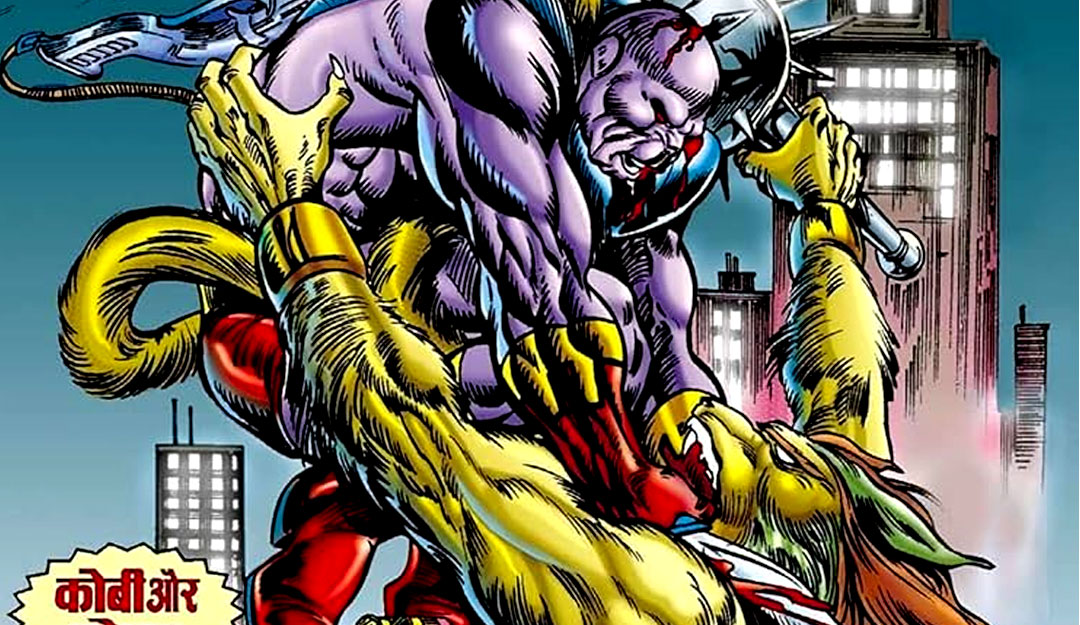
Crossover in the world of Indian comics, i.e., the coming together of two different heroes, has always been no less than a festival for readers. When two famous characters come face to face, curiosity automatically increases. “One Sheath, Two Swords” is a very important link in this tradition. As the name itself suggests—two swords in one sheath cannot last long. Here, the ‘sheath’ is Mumbai city, and the ‘two swords’ are Doga and Kobi.
This comic is not limited to just action and action, but it is a story of two completely different ways of thinking, rules, and conflict of forces. On one side is Doga, who is the protector of Mumbai and whose way of doing justice is absolutely straight and harsh—“judge is also Doga, criminal is also Doga, and executioner is also Doga.” Doga is not a god with superpowers, but a common man who has made himself physically and mentally steel. Kobi, on the other hand, is a wolf-human from the forests of Assam, who has animal-like cruelty and divine strength. When the law of the jungle penetrates the concrete jungle of the city, devastation is bound to happen. This comic is the story of that very confrontation and devastation.
Background: Kobi’s arrival in Mumbai
The story begins with an interesting twist. Kobi, who was earlier a part of Bhediya (wolf) but has now separated from it, leaves the forests of Assam and comes to Mumbai. It becomes clear in the opening pages of the comic that Kobi is broken from inside. His wife ‘Gen’ has left him. The stumbling block, loneliness, and anger found in love together make him a dangerous criminal.

A mafia boss seduces him and brings him to Mumbai. Here, writer Tarun Kumar Wahi has given a new color to the character of Kobi. Kobi is no longer just a jungle animal, but he wants to become a big name in the underworld of Mumbai. He wears suits and boots (even though they don’t suit him), uses a mobile phone, and speaks mafia-like language. This change both shocks readers and seems funny. The connection of a very powerful being to guns, gangs, and the underworld comes as the biggest challenge Doga has ever faced.
Detailed analysis of the plot (Plot)
The story begins with the mutual enmity within the Mumbai underworld. The underworld is divided into two factions—one is the ‘King Organization’, headed by the ‘Older Brother’, and the other is the ‘Cobi Organization’, run by the ‘Elder Brother’. Kobi is currently working for the Older Brother and is handling tasks like hafta extortion.

Scene from the prison break (Jail Break): The story picks up real speed when the Older Brother plans to release his younger brother from prison. A deal is finalized between the Old Brother and the Elder Brother. The responsibility of this dangerous work is given to Kobi; he has to safely take the younger brother out of Mumbai Central Jail.
Kobi’s entry here is shown to be like a villain from a Hollywood film. He does not sneak up the wall, but with his strength and long tail, he smashes the prison’s security system. The author has openly shown the scary and creepy look of Kobi in this part. Breaking inside the prison, he calls himself “little brother,” which shows his strange and dark humor.
As Doga receives news of this prison break, he arrives to stop Kobi. This is the moment the reader was eagerly waiting for—Doga and Kobi face to face.
It is quite interesting to see that the Doga who becomes Yamraj for common goons and criminals feels helpless in front of Kobi. Bullets have no effect on Kobi. Doga’s martial arts and strength weaken against Kobi’s animal-like power. Kobi not only beats Doga badly but also humiliates him. He calls him “dog,” which deeply hurts Doga’s self-esteem.
Kobi escapes in a van with the younger brother. Doga follows him. This whole part is very fast and full of thrills. Kobi uses his ‘flying squad’, and Doga tries to reach the van while fighting them.
But the most impressive scene is when Kobi drags Doga down the street with his long tail. It is very rare to see a hero in this condition. This scene makes it clear that Kobi is not an ordinary villain. Kobi finally tricks Doga by cutting off his tail (which later regrows) and manages to escape.

This defeat at the hands of Kobi shakes the sun, i.e., Doga, to the core. He realizes that a demon like Kobi cannot be stopped by human power alone. From here, the story takes a scientific turn. Suraj, with the help of Ginger Uncle, prepares a special ‘steroid’ or chemical that can increase his physical strength manifold.
This part shows Doga’s stubbornness and passion. Ginger Uncle clearly warns him that its side effects can be fatal—blood can boil, veins can burst. But the sun just says, “I want… at all costs.” This dialogue suggests that Doga is willing to risk even his own life to save his city. This spirit of sacrifice lifts him from an ordinary anti-hero to a true superhero.
Character analysis
Kobi (Kobi):
Kobi may be shown as a ‘villain’ in this comic, but if we look deeper, he comes out as a ‘sad and broken villain’. There is no direct competition to his strength—he can uproot prison doors and withstand bullets; that is, his power is almost unlimited. If we understand Kobi’s psychology, the emptiness that forms inside him after Gen leaves pushes him towards the intoxication of power and control. His passion to become “Mumbai bap” is actually an attempt to hide the deep pain buried behind his ego.
Moreover, the repeated ‘hik’ (hichki) and strange kinds of sentences in his dialogues not only make him scary but also add an uncertainty to his nature. The reader always feels that there is no assurance of what Kobi will do next.
Top of Form
Doga (Doga):
In this story, Doga emerges as a kind of ‘underdog’, where for the first time he looks so physically weak and helpless that readers genuinely start to fear whether he will even win or not. His greatest strength is his willpower. Even after losing badly, being dragged on the road, and being insulted, he does not give up. He turns his frustration into a strong resolution and makes a dangerous decision like drinking the ‘chemical’.
Here, Doga is not just dependent on power. His cunning, spying, and cruelty are clearly visible when he hangs ‘Coin’ on the tower and gets Kobi’s hideout exposed. This proves that Doga can go to any extent to achieve his goal.

Underworld (Mafia):
Old Brother and Elder Brother:
Both these characters work to move the story forward. They want to use Kobi’s strength to their advantage, but have no idea that they are riding a lion that is beyond their control.
Jane and Monica:
Jane may not be directly present in the story, but her absence is Kobi’s biggest motivation. At the end of the story, it is revealed that Kobi now wants to marry ‘Monica’. This is a big twist, because Monica is Doga’s (Suraj’s) love. From here, this fight is no longer limited to the underworld only, but turns into a completely personal enmity.
Art and Presentation

Suresh Degwal ji’s penciling and inking showcase the classic style of Raj Comics in the best possible way, where the body language and movements of the characters are worth watching. In the action sequences, when Kobi swings his mace or Doga makes a long jump, the panels give a sense of real movement.
Kobi’s design is particularly impressive. His huge physique, powerful arms breaking the prison bars, and the anger, intoxication, and ego rising on his face all combine to make him a very dangerous villain. The way Mumbai is shown in the background—high buildings, dark nights, and the atmosphere during van chases—deepens the dark tone of the story.
Sunil Pandey ji’s color combinations add life to the visuals. Against the dark blue shades of the night, the yellow-red colors of explosions, the green tone of Kobi, and the red-black suit of Doga create a visual contrast that leaves a deep impression on the eyes.
Dialogue and Lettering

The dialogues are filmy and effective.
Kobi’s dialogues like, “What does hafta ask for hafta, Father?” or “Is apun bap, break bone,” may sound strange coming from a forest creature, but they fit perfectly into the atmosphere of Mumbai’s underworld.
Doga’s dialogue—“You people are enemies of society. The whole society is your enemy.”—clearly presents his thinking and ideology.
Critical Vision
Positive Side (Pros):
The face-off between Doga and Kobi is the greatest strength of this comic. On one side are Doga’s training, technology, and weapons, while on the other side is Kobi’s magical and animal-like raw strength. The pace of the story is so well balanced that the reader does not feel bored anywhere. Events rapidly shift between encounters, prison, streets, and the laboratory.
Along with this, the emotional connection is also strong. Anger is felt at Doga’s defeat, and sympathy arises for his resolution. Kobi’s decision to marry Monica and Doga’s departure to stop him at the end create a powerful cliffhanger, pushing curiosity for the next part, ‘Gangwar’, to the extreme.
Downside (Cons):
There also seems to be a lack of logic in some places in the story. For example, it feels a bit unbelievable that Kobi comes out of the forest and learns the language and mafia ways of Mumbai so quickly. Also, seeing Doga so helpless may disappoint some diehard fans, as they may question why their hero was shown to be so weak in front of Kobi. However, this twist was also necessary to justify his ‘power-up’ later in the story.
Additionally, stereotypical villains like the Elder Brother and Old Brother seem somewhat worn out. If there had been a little more depth to their characters, the underworld angle could have become more impactful.
Thematic Analysis

Power vs. Justice:
“One Sheath, Two Swords” revolves around this central theme. Kobi symbolizes power—unbridled, raw, and selfish strength. He considers himself above law and morality. Doga represents justice, even if his methods are cruel. This comic shows that when injustice becomes too powerful, justice also has to break its own rules—like Doga drinking the chemical.
Animality vs. Humanity (Beast vs. Humanity):
Kobi, despite being an animal, desires human happiness—marriage, money, and power. At the same time, Doga, despite being human, hunts like an animal. This contradiction adds depth to the story. Kobi’s cry for Jane and then his pursuit of Monica show the confused beast inside him, which does not fully understand human emotions.
“One Sheath, Two Swords” – Justification of the Title:
This title fits perfectly. Mumbai is the center of the criminal world. Kobi wants to become the only ‘bap’, the sole sword. Doga is the protector of Mumbai—the second sword. A protector and a great destroyer cannot coexist in the same city. Eventually, one of them must break or be eliminated.
Memorable Moments:

Kobi breaking into the prison and telling the prisoners, “apun hai younger brother.” This scene feels funny on one hand, while on the other it clearly shows Kobi’s madness and strange thinking.
Doga and Kobi’s first direct encounter, where Doga’s powerful kick hits Kobi on the chest but has no effect on him at all.
Kobi tying Doga with his long tail and dragging him down the street behind the van.
Suraj drinking the dangerous chemical and suffering intense pain. The artist has shown the emergence of nerves in his body in a very detailed and effective manner.
Hanging Coin upside down on the tower and plucking him away using eagles. It is a trademark view of Doga’s “cruel justice.”
Role of the Upcoming Part:
This comic is the first part of a two-part story. This entire part is actually a build-up for the upcoming storm. The real clash is going to happen in the next part, “Gangwar.”
What will be the real effect of the medicine that Suraj has consumed? Will he really be able to compete with Kobi?
Will Kobi manage to forcefully marry Monica?
In which direction will the arrival of Jane, Bhediya, and Fujo Baba from Assam to Mumbai take the story?
The appearance of the wolf, that is, the real Kojo, on the last page (Page 59) gives a clear indication that now this fight is not going to be limited to just Doga and Kobi, but a dangerous triangle is going to form between ‘Doga, Kobi, and the Wolf’.
Conclusion
“One Sheath, Two Swords” from Raj Comics is a brilliant example of the golden age of comics. This comic is not just about action, but also a well-crafted story with a strong screenplay. Tarun Kumar Wahi has taken special care to ensure that while introducing a very powerful character like Kobi into Doga’s world, the importance and respect of both characters remain intact.
This comic is a must-read for Doga fans, as they see their favorite hero breaking, losing, and then trying to rise like a phoenix from the ashes. It is also an interesting journey for fans of Kobi and Bhediya, where their favorite character is seen in a completely new avatar—a mafia don.
Rating:
Story: 4.5/5
Artwork: 4/5
Entertainment: 5/5
Total: 4.5/5
Last Word:
If you are a true fan of Raj Comics, then this comic must be in your collection. It reminds readers of a time when the best balance of story and action was seen in comics. The struggle of Doga and the terror of Kobi keep readers engaged from beginning to end and force them to wait eagerly for the next part. This comic proves that the law of the jungle does not work in Mumbai, because there, the law is written by Doga—and it is impossible to erase Doga.
