


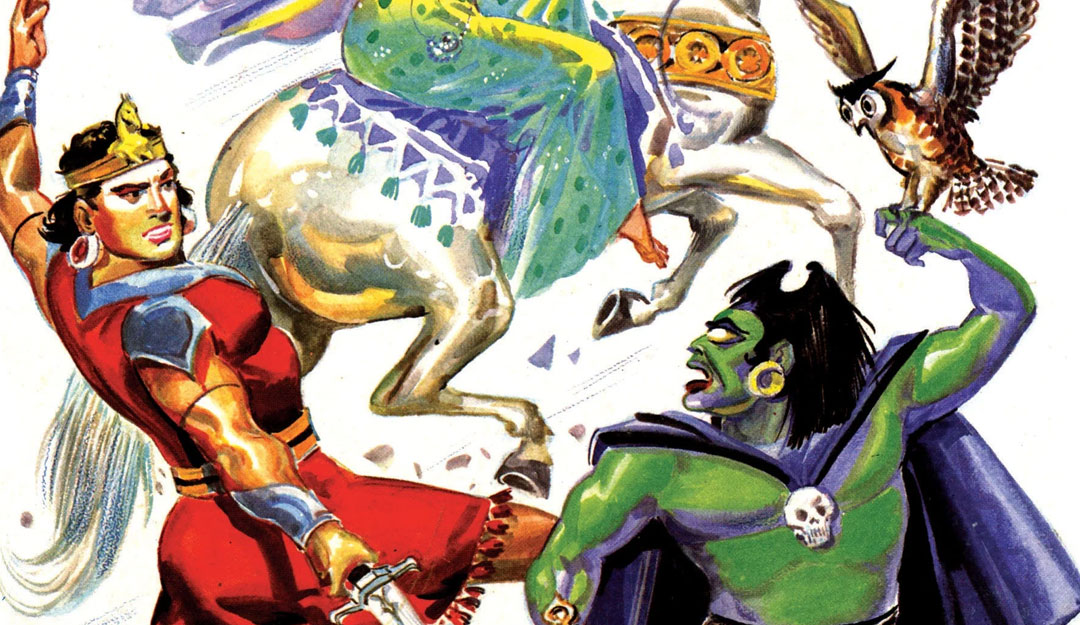
One of the most special works of the golden age of Raj Comics, ‘Pralayankari Ashwaraj’ is not just a superhero comic, but it is the culmination of a tremendous story of courage, emotion, deception, and revenge. This 30-page comic is the last and most important part of the ‘Ashwaraj’ series, which takes readers into an imaginary world where humans, horses, and magical powers exist side by side.
In this detailed review, we will look deeply at the different aspects of this comic, such as story, characters, art, and writing style.
Introduction to the creative team

Big comic creators of India are behind the success of this comic. Writer Meenu Wahi and screenwriter Tarun Kumar Wahi have created a story together which is a brilliant blend of mythological and modern ‘action’. The art direction is done by the great Pratap Mulik, whose painting style gave a new identity to Indian comics. The drawing is done by Vitthal Kamble, who has carved the bodies of the characters and the battle scenes in a very impressive manner. Sanjay Vispute’s decoration has made every scene more alive.
Beginning of the plot: Facing ‘Bala’

The story begins at the mouth of the valley of Karun. Ashvaraj is near the floor with his five brave horses—Raktambar, Kalakhor, Ashvavat, Neelkanth, and Shravyashakti. Here, the author has shown the special powers of the horses very well. The black-eater smells danger, hears the sound of audible power, and warns Ashwaraj.
As they step into the valley, they encounter a fierce demon ‘Bala’, who is like a dragon with huge wings. Bala creates a snowstorm with his breath, in which Ashvaraj and his horses get trapped. The mention of Ashwaraj’s ‘Yoga Bal’ here is very powerful. He melts that ice with his inner energy.
Ashwaraj’s biggest strength is his ‘wishful’ ability. He himself takes the form of ‘Bala’ and competes equally with that evil creature. This war scene is shown in great detail through painting, where, in the end, Ashvaraj kills the demon by slitting his throat.
Touching Revelation: The Truth of Ashvakirti

After the war, Ashvaraj reaches the place in the valley of Karun where he had imprisoned Ashvakirti in his previous life. He hoped to find his girlfriend alive there but finds only a skeleton. This scene is very emotional and heart-touching.
There, a blood-written text is found, which reveals to Ashvaraj that Ashvakirti was not a fraud. He was controlled by the magic of Tutabuta. She apologizes to Ashwaraj. This twist fuels the fire of vengeance in Ashvaraj’s character. He swears that he will find Tutabuta even from the underworld. This emotional part elevates the story from just an action comic to a serious drama.
Merger of characters: Father-son union

After finding the treasure, a mysterious masked man attacks Ashwaraj. During the war, it is revealed that he is none other than Emperor Tarpidro, the masked man, Ashwaraj’s father. They had also reached there in search of the treasure and their son. This father-son union brings a new twist to the story. Emperor Tarpidro tells Ashwaraj that after finding the ‘Treasure of Karu’, it should be destroyed because it is just the root of troubles.
Here, Emperor Tarpidro is seen as an experienced and wise king, while Ashvaraj appears as a young and enthusiastic warrior. Emperor Tarpidro hands over his twelve bodyguards (who are disciples of Maharishi Fook-Masan) to help Ashvaraj.
End of Tutabuta and Dadbora

On the other hand, Satan Tutabuta is watching everything with his magical mirror. He is very angry at the failure of Amir Dadbora. When Dadbora fails to stop Ashvaraj, Tutabuta takes a very cruel step. He causes Dadbora to lose his eyes through his loyal owl (who is actually his spy) and kills him. This scene strongly shows Tutabuta’s cruelty and her villainous character.
Last great battle: The power of Ashvamani

Ashvaraj reaches the fort of Tutabuta. Here he encounters an army of dwarf devils and three of Tutabuta’s most dangerous warriors—Tambola, Ghost-Cranial, and Scorpion-Thread.
The role of ‘Ashvamani’ proves decisive in this war. The divine rays emanating from Ashvamani destroy the swords of Tambola and melt the poisonous stings of the scorpion like wax. This confluence of Ashvaraj’s bravery and Ashvamani’s divine power symbolizes the victory of good over evil.
A new form of Princess Kudumchummi can also be seen here. She is not just a ‘helpless princess’, but she takes on Tutabuta’s elusive maid (Wild Cat) and defeats him. Ashwavata, the horse of Ashvaraj, also shows his wisdom in battle and protects the princess.
End and epilogue of Tutabuta

The final duel takes place between Ashvaraj and Tutabuta. Tutabuta uses his swordsmanship and magical powers but cannot stand up to Ashvaraj’s agility and strength. Ashvaraj punches him hard and then hits him with a sword, collapsing him. With the end of Tutabuta, the danger looming over Ashvaloka and Chintapokali ends.
At the end of the story, Ashvaraj sends Karun’s treasure to Ashvaloka and returns to Chintapokli Nagar with Princess Kudumchummi himself. Raja Chittint Singh is happy to have his daughter, but he knows that Kudumchummi now belongs to Ashvaraj. The union of Ashvaraj and Kudumchummi actually completes the entire story of Ashvaraj and Ashvakirti’s unfulfilled love.
Analysis of art and portraiture
The pairing of Vitthal Kamble and Pratap Mulik has made the visuals of this comic like a cinematic experience.
The huge size of the dragon ‘Bala’ and its depiction is scary and gorgeous. Ashvaraj’s mourning and then taking his vow in front of Ashvakirti’s skeleton is shown very effectively through facial expressions. Swords colliding sounds (Khatak, Khachak) and characters’ ‘action’ postures are special hallmarks of the comics of that period. Gold and purple colors for magical powers, and white and blue colors for snowstorms give further depth to the scene.
Review of writing and dialogue
The Wahi brothers have kept the dialogues very loud and impressive. While Ashvaraj’s dialogues give a feeling of bravery and justice, Tutabuta’s dialogues show his cunningness and crookedness.
There is an important dialogue when Emperor Tarpidro says— “Ashvaraj! Don’t be deceived, only Tutabuta or Ashvakirti knew about this treasure.” This dialogue adds suspense to the story. The world of ‘Ashvalok’ and ‘Karun Ki Valley’ created in the entire comic is commendable.
Conclusion: An immortal saga
More than just a comic, “Pralayankari Ashwaraj” stands as the pride of its era’s comics culture, masterfully blending adventure and morality into a definitive finale for the series. Through its pages, it reinforces the eternal victory of truth over cunning evil and offers a profound new definition of love through Ashvakirti’s immortality and Ashvaraj’s pursuit of justice, while the unwavering loyalty of his five horses highlights the deep bond between man and animal. Every turn of the page presents a new challenge, showcasing the legendary synergy of Pratap Mulik’s art and the Wahi brothers’ writing, which has solidified Ashvaraj as an iconic hero for future generations. For any fan of classic Indian comics, this issue is a true treasure that transcends simple entertainment to spread the virtues of heroism and morality, making it an essential addition to the top of any favorite list.
