


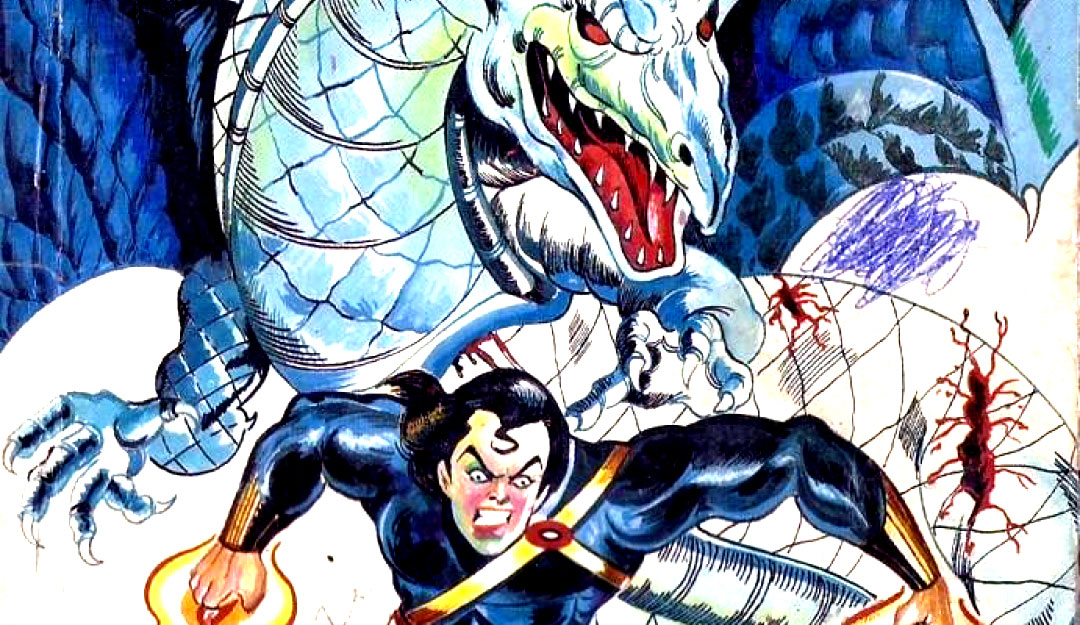
One of the most popular characters of Durga Comics has been ‘Torah-Torah’. The presented comic “Blue Death” (Neeli Maut) is a story in the Torah-Torah series that is not only made up of science fiction and mythological fiction, but also beautifully shows the thinking and imagination of that period. This 32-page comic takes the reader from the depths of the ocean to the heights of the skies, where danger and adventure exist at every step.
Detailed analysis of the plot:
The story begins with a very big global crisis. ‘Blue Death’, a huge and scary dragon, suddenly becomes a sign of devastation to the world. It is in the early pages of the comic that an atmosphere of confrontation between Torah-Torah and this dragon is created. Author Abid Rizvi creates a kind of ‘doomsday’ atmosphere from the beginning, which immediately draws the reader into the story.

The hero of this story is Torah-Torah, known for his tremendous physical strength and powers such as lightning. He sets out on a mission to stop this ‘Blue Death’. The story takes an interesting turn when Torah-Torah goes on a special mission under the sea. Here, he encounters a very huge crocodile. The scene shows the strength of Torah-Torah in a spectacular way. He uses both his wisdom and strength to tear the crocodile’s jaw and ends up in a mysterious cave hidden deep within the ocean.
The atmosphere inside the cave feels like a horror movie. Here, Torah-Torah ‘reaches the spiders’ world’, where many humans have been trapped in webs. It is at this place that he encounters a ‘human-eating spider’. The special thing about this comic is that science and technology have also been well added to it. On one hand, Torah is fighting the dangers, while on the other hand, Professor Taneja and Professor Raghav at the ‘Central Scientific Research School’ are keeping an eye on his every move through computers. According to the comics of that time, this thinking was quite modern.
Another important character in the story is ‘Madam Marina’, who appears like a villain in the beginning. She sends a tree-like demon named ‘Tree-Wildering’ from her lab built deep in the ocean to fight Torah-Torah. Torah-Torah uses his electric shock powers to completely eliminate this demon.
The most mysterious and interesting character in the story is ‘Yogiraj Gunjara’. He is a powerful yogi, possessing powers such as divine vision and hypnosis. After accepting defeat, Madam Marina takes refuge with Yogiraj. Yogiraj hypnotizes Torah-Torah with his powers. This is where a gray area is formed in the story—Is Yogiraj really bad, or does he have some other big motive? He makes Torah-Torah his slave so that he can be made to attack the fort of Natanja, the main villain.

After this, the story enters the ‘jackal warrior’, which looks like a cyborg, half human and half machine. Yogiraj sends Torah-Torah and Madam Marina towards the fortress of Natanja. On the way, once again ‘Blue Death’, i.e. the dragon, comes forward. This is the most exciting part of this comic, where there is a fierce battle in the sky. Torah-Torah tries to defeat the dragon with the power of lightning emanating from his hands and thighs.
Natanja, who is a high-tech villain, fields his four most powerful warriors—Stilo, Clobo, Kali and Rhodiar. All four are experts in technology and martial arts. The last part of the comic sees a fierce battle between Torah-Torah and these warriors. In the end, the fort of Natanja is destroyed and Torah-Torah is freed from hypnosis.
Character illustration
Torah-Torah is the real center of this comic. His look appears like a mix of Superman and desi wrestlers. The lightning-like stripes on his body clearly show his powers. He is not just a fighter, but also seems to be a kind of ‘super soldier’ associated with scientists.

Yogiraj Gunjara is a combination of Indian sages and magicians of modern fantasy. He can fly in the air and control people’s minds. His character gives more depth to the story.
Madam Marina is a strong female character, representing science and technology. Later, the change in her heart and fighting together with the heroes gives an emotional touch to the story.
Natanja is a technology-loving villain who wants to rule the entire world with his fort. He relies more on his robotic warriors and weapons than on fighting directly.
Art and portraiture
The artwork by Mag Arts is quite powerful for that time. The front-page cover, which features the giant dragon behind Torah-Torah, immediately catches the eye. Bright colors like red, blue and yellow make the action scenes more alive.

When Torah-Torah punches or releases electricity, sound effects like ‘torso’, ‘tired’, and ‘chi-e-e-s’ make the comic more fun. The undersea caves, scientists’ labs, and Natanja’s flying fort are shown in a very imaginative manner.
Dialogue and language:
The language of the comic is mostly in pure Hindi, which also contains words from Sanskrit, such as ‘cataclysm’, ‘impermeable’, ‘hypnosis’ and ‘destructor’. The dialogues are short but effective. In the conversations of scientists, English words like ‘transmit’, ‘computer system’ and ‘electric shock’ give it the feel of a technology-based comic.
Critical Commentary
“Blue Death”’s greatest strength is its speed. The story does not slow down anywhere. Almost every other page, a new threat and a new enemy appear. However, in some places, the logic seems a bit loose, like Yogiraj suddenly hypnotizing Torah-Torah and then using him against Natanja. But this does not bother much from the point of view of children and fantasy comics.

This comic also shows the thinking of that time, where on one hand there is faith in yoga and sadhana, and on the other hand there is also the passion to adopt science and technology of the future.
Conclusion:
“Blue Death” is not just a simple comic, but it is a key part of the memories of 90’s children. Durga Comics gave a hero in the form of Torah-Torah who was powerful, brave, and completely dedicated to his mission.
If you want to return to nostalgia or see how superheroes were introduced in Indian comics, “Blue Death” is definitely a must-read comic. It ends with suspense, and a glimpse of the next issue, ‘Janjaju’, keeps the reader curious.
This comic reminds us that sometimes both science and spirituality have to come together for the victory of goodness. Even in today’s digital age, the thrill and fragrance of this old comic are still alive.
