


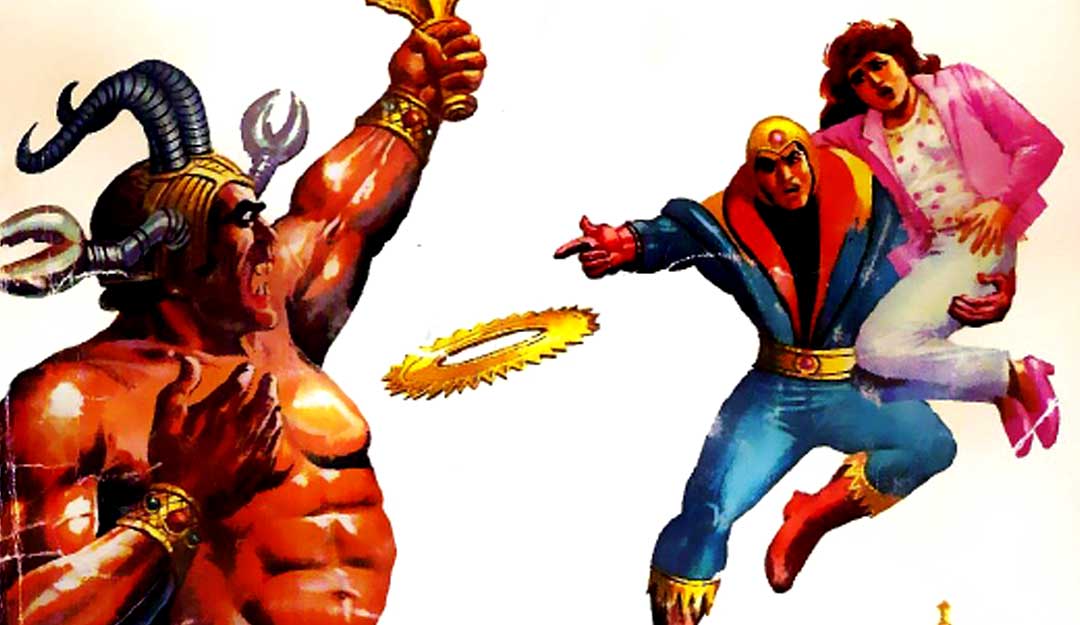
Manoj Comics has given us many memorable superheroes, and one of them is the special hero named ‘Totan’. Totan is known not just for his strength, but for his unique combination of technology and divine powers. The comic ‘Totan and Lavasur’ is a very exciting episode of this series, in which a tremendous combination of science, fantasy, and mythological thinking can be seen. Written by Mahendra Jain and illustrated by A.M.G., this story takes readers to a world where demons hidden under the sea and the yogis of the Himalayas become part of the same narrative.
Summary of the Story
The story begins with a scary night in Delhi’s ‘Immortal Colony’. Suddenly, a strange flying saucer appears in the sky, and out of it comes a terrible demon named ‘Tejab’. Tejaba, who is Lavasur’s commander, starts killing people by shooting acid rays from his eyes. He threatens the Indian government that if he is not given all the gold within two days, he will destroy the entire country.

The government does not listen to him, and Air Force planes attack him, but Tejaba blows up the planes with his own breath. When fear and despair spread everywhere, our hero Totan enters. Totan confronts Tejaba with the help of his laser rays and special shoes (vacuum shoes). Meanwhile, Baba Mahantnath, who is doing penance in the Himalayas, receives orders from Lord Shiva to help Totan. Baba Mahantnath grants divine powers to Totan, such as ‘Agni Chakras’ and the power that marks an ‘A’ on the faces of enemies.
Eventually, Totan catches Tejaba and hands him over to the police. From here, the real villain ‘Lavasur’ enters the story, who is the king of ‘Lavanagari’, which lies beneath the Indian Ocean. The history of Lavanagari is linked to the Ramayana period—according to the story, when Hanuman ji burnt Lanka, the gold there melted and fell into the sea, and that same gold became the food of Lavasur and his subjects. Lavasur sends his companions (Sammohini, Mayavini, and Kekra) to eliminate Totan and acquire gold. Further in the story, the complete thrill of deception, hypnosis, kidnapping, and finally the victory of goodness is depicted.
Characterization
Totan (Mukund): Totan’s real name is Mukund. He is a combination of Professor Ramakant’s technology and Baba Mahantnath’s blessings. The laser rays and flying power from his eyes make him a dangerous warrior. In this comic, he is shown to be not only powerful but also quite smart. He even pretends to be hypnotized to capture his enemies, which shows his strategic mind.

Lavasur (Main Villain): Lavasur is a very different kind of villain. His whole world revolves around gold. He eats and drinks only gold. His look and the design of Lavanagari are shown to be quite gorgeous and scary. He is a power-hungry and ruthless ruler who can do anything for his cause.
Tejaba, Sammohini, and Mayavini: These three supporting villains make the story more interesting. Tejaba’s acid rays, Sammohini’s hypnotic powers, and Mayavini’s magical web become major challenges for Totan. Especially Mayavini’s look (a skull-like face and green hair) has been made quite scary and memorable.
Barkha (Reporter): Barkha is a brave reporter and also the daughter of Commissioner Sinha. She adds an element of human emotion and curiosity to the story. But her excessive curiosity traps her in Tejaba’s scheme, bringing the classic ‘girl-in-trouble’ moment to the story.
Art and Portraiture

A.M.G.’s artwork is a hallmark of 90s comics. Considerable attention has been paid to the characters’ bodies and muscles. Lavasur’s huge body and Totan’s blue-yellow suit look very attractive. The backgrounds feature detailed depictions ranging from buildings in Delhi to the undersea palaces of Lavanagari. Sound effects like ‘dhadam’, ‘khachak’, and ‘asss’ in the fight scenes make the story more fun. The colors are quite bright and vibrant, which fits perfectly with the printing technology of that era and the preferences of children.
Mythological and Scientific Confluence

The biggest feature of this comic is its plot. On one side are Professor Ramakant’s lab, his vacuum technology, and scientific experiments, while on the other side, the phenomenon of the Tretayuga ‘Lanka Dahan’ has been linked to the origin of Lavasur. This clearly shows the imagination and thinking of the author. This kind of story was a great attempt to connect Indian readers with their roots. At the same time, the intervention of the Himalayan yogi Baba Mahantnath adds a different spiritual depth to the story, which is not usually seen in Western superhero comics.
Positive Side (Strengths):
The pace of the story is so fast that one does not feel bored anywhere, and something new keeps happening on every page, due to which the reader’s curiosity remains intact. Totan’s new powers—like the fire cycle and the ‘A’ mark on enemies’ faces—have been introduced in a very exciting way. Facing five different types of villains in the same story brilliantly brings out Totan’s skills and strengths. Finally, the message given by Totan to children that “I was born to protect humanity” gives a strong positive and social message to the story.
Downside (Weaknesses):
In some places, the lack of logic in the story is a bit irritating, such as Barkha going to jail alone to interview Tejaba and unknowingly freeing him, which seems a bit childish. Additionally, despite having powerful female villains like Sammohini and Mayavini, the lead female character Barkha ultimately needs to be saved, making her character feel weak. Also, the sudden disappearance of Lavasur and the loss of Lavanagari so easily make the climax a little rushed, where there was scope for further expansion.
Detailed Analysis and Review:

‘Totan and Lavasur’ is not just an action comic, but it symbolizes the imaginative thinking of the period when Indian superheroes were creating their own identity. The character of Totan is somewhat reminiscent of heroes like Superman and Thor, but his roots are completely embedded in Indian culture.
The power of the ‘A’ mark given by Baba Mahantnath is quite interesting. It is reminiscent of ‘Zorro’, but here it is shown more like a curse or warning, always reminding the criminal of his mistake. This is a great way to fight not just physically, but also mentally and psychologically.
Lavasur’s ‘Lavanagari’ kingdom is also conceived in a very imaginative way. Drinking molten gold and eating gold bricks under the sea represent the height of greed. Author Mahendra Jain gives a clear message here that excessive greed and intoxication with power ultimately lead to destruction. Lavasur had everything, yet he wanted to capture the gold of India, and this greed devastated his entire empire.

The climax of the comic is quite explosive. Totan’s killing of Mayavini and Tejaba gives complete satisfaction to the readers. The use of the Agni Chakra is reminiscent of the Sudarshan Chakra, which is a well-known and emotional symbol for Indian readers. Saving Barkha and finally Totan returning to Delhi give a happy and satisfying ending to the story.
Conclusion:
Overall, ‘Totan and Lavasur’ is a precious gem in Manoj Comics’ treasure. Today’s readers may find its style a bit old, but its originality and thrill are equally effective even today. This comic reminds us that Indian writers also had the full potential to create world-class stories. If you want to reminisce about the 90s or read a fantastic desi superhero adventure, this comic is a must-read.
Totan’s character makes us realize the importance of courage, sacrifice, and technical knowledge. Through this story, Manoj Comics gave children a hero who could stand as their protector in difficult times. ‘Totan and Lavasur’ still holds a special place in the hearts of Indian comics lovers.
Rating: 4.5/5
