


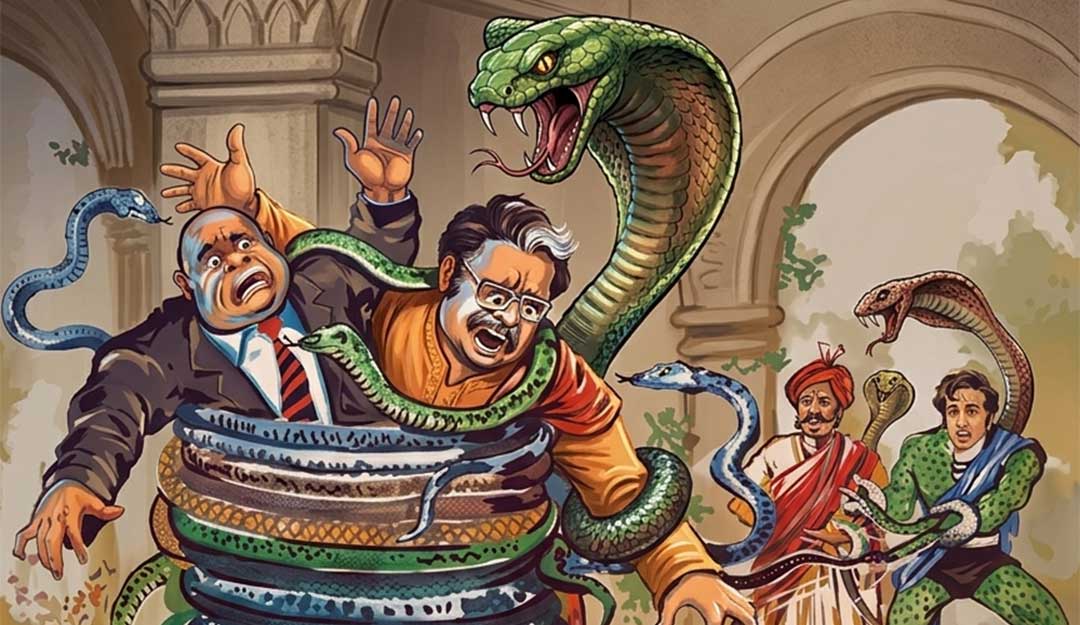
In the world of Indian comics, ‘Nagraj’ is not just a name, but a feeling. The previous part, ‘Tomb of Nagraj’ (Nagraj Ki Kabr), left readers at a point where gunpowder smoke had spread everywhere and our hero lay buried under the debris. ‘Nagraj’s Revenge’ (Nagraj Ka Badla) continues the same adventure. This comic is not just a story of revenge, but also a brilliant example of Nagraj’s agility, intelligence, and invincible strength.
Parshuram Sharma’s fast and tight story and Sanjay Ashtaputra’s lively illustrations have made this comic a ‘must-read’ classic. Let us understand every aspect of this wonderful story in detail.
Summary of the Story: Defeating Death and the Return of the Mission

The story begins where the previous part ended. Terrorist leader ‘Bulldog’ and the corrupt Prime Minister of Kampli state, ‘Kilaul’, are under the misconception that Nagraj is dead. They are planning to make Kampli state a big base for arms smuggling and opium cultivation.
Bulldog’s men retrieve Nagraj’s “body” from the wreckage. Bulldog wants Doctor Simto to examine Nagraj’s body so they can create a powerful artificial human (Android/Machine) similar to Nagraj. But this is where the story takes a big turn. Nagraj was not dead; rather, he had held his breath. On the operating table, he uses his ‘hypnotism’ on Doctor Simto and takes control of him.
Nagraj’s Strategy: News of ‘Death’ and Betraying the Enemy

Nagraj sends the news to Bulldog through Doctor Simto that he is dead and poisonous gas is coming out of his body, so it should be immediately thrown into the river. This was a well-thought-out move by Nagraj. He is thrown into the ‘Dong Darya’, from where he comes out alive.
Here readers get to see a different form of Nagraj—a hero who not only fights with strength, but also defeats enemies with his mind. His skill in psychological warfare makes him different and special from the rest of the superheroes.
Social Justice: Protector of Kamru and the Villagers
After coming out of the river, Nagraj reaches a settlement where a cruel man named ‘Kamru’ abducts girls. Nagraj appears here as a protector. He not only beats Kamru and his goons severely, but also removes fear from the hearts of the villagers.

This part further strengthens the character of Nagraj in the story. He not only fights big terrorists but also stands against the injustice being done to common people. The scenes of martial arts maneuvers and defeating enemies with the help of snakes are shown in a very spectacular manner.
Vishkanya Suvangini: Poison vs. Mahajahar
When Prime Minister Kilaul learns that Nagraj is alive, he sends a poison girl named ‘Suvangini’ to destroy him. Suvangini is confident that one kiss or bite will be enough to eliminate Nagraj. But she does not know that the ‘poison of thousands of snakes’ is running through Nagraj’s veins.

When Suvangini bites Nagraj, his poisonous blood backfires on her, and she dies in agony. This scene showcases Nagraj’s special physical abilities and thrills the readers. Here, Nagraj’s dialogue—”There is poison of thousands of snakes in my body”—becomes quite powerful and memorable.
Masterplan of the Climax: The Orgy of Justice in the Water Palace
The last part of the story reaches Kampli’s ‘Jal Mahal’. Nagraj and the real Maharaja of Kampli arrive there disguised as a magician and his assistant, where Bulldog and Kilaul are celebrating their victory. Here, Nagraj makes great use of his hypnotic power and the art of disguise.
He exposes Bulldog’s true face to everyone. During this time, it is revealed that Bulldog was none other than a cunning criminal who had betrayed the Maharaja. In the end, Bulldog gives up and blows himself up with a bomb planted in his body for fear of being caught. Nagraj saves the life of the Maharaja and frees the entire princely state from traitors.
The Magic of Drawing and Art

Sanjay Ashtaputra’s illustrations are the greatest strength of this comic, and the kind of color palettes used in the late 80s give a different vintage feel. In this comic, the scenes of Nagraj flying using his ‘Nag Rope’ and the action scenes involving the helicopter look equally spectacular even today. Also, the view of Dr. Simto’s lab and the grandeur of Jal Mahal have been shown very effectively, creating visual suspense. The character design, including Bulldog’s scary face and Nagraj’s muscular body, gives the comic an ‘international look’.
Screenplay and Dialogue: Classic Raj Comics Style
Parshuram Sharma does not let the pace of the story slow down anywhere. The level of dialogues in ‘Nagraj Ka Badla’ is quite strong. Nagraj’s disguise while accompanying the Maharaja to the court and the use of telepathy there give the story the thrill of a spy thriller.

Seen from an SEO perspective, this comic reinforces the “Indian Superhero Mythos”. It shows that in the initial phase, Nagraj had fewer ‘wishful’ powers compared to today, but he fought like a ‘Super Soldier’.
Highlights: Why Read This Comic? (Key Highlights)
The ‘resurrection’ adventure of coming out from under the debris and returning through the river is spectacular in this comic, where Nagraj’s return shows his invincible strength. For the first time, readers see a massive display of ‘advanced powers’ like hypnosis, telepathy, and poisonous blood, which takes him far above an ordinary hero. The ‘helicopter action’ scene, where Nagraj fights on a flying helicopter, gives a film-like feel, and finally, by freeing a foreign kingdom from terrorists, he achieves a big ‘moral victory’. The story ends with the demise of a big villain like Bulldog, which shows a spectacular and decisive victory for Nagraj.
Conclusion: An Invaluable Gem for Nagraj Fans
‘Nagraj Ka Badla’ is not just a comic, but an important part of Nagraj’s journey of becoming a ‘legend’. This story tells that no matter how powerful evil is, it can be defeated with courage and wisdom.
If you have read ‘Nagraj Ki Grave’, then this part is important for you. This comic is also great for readers who want to enjoy stories from that era, unlike today’s modern comics, where there was a great combination of simplicity and adventure.
Reading this memorable creation of Raj Comics is a great experience for readers of all ages. It seems as entertaining and relevant today as it was at the time of its publication.(Read also: Nagraj First Comic Review: The Origin That Changed Indian Superhero Comics Forever)
