


In the big and story-filled world of Raj Comics, the character of ‘Ashwaraj’ has always been a favorite of readers due to his distinct identity and brilliant imagination. ‘Khoonbund’ is not just a comic but a living example of painting and imagination that takes readers into a magical world called ‘Ashwaloka’. Featuring art direction from Pratap Mullick and drawings by Vitthal Kamble, this comic is from the era when Raj Comics was at its best in terms of visual storytelling. In this detailed review, we will talk more about the subtle artistic features and technical aspects of this issue than the ups and downs of the story, which make it a precious gem of Indian comics history.
Pratap Mullick’s iconic cover art: Visual confluence of fear and heroism

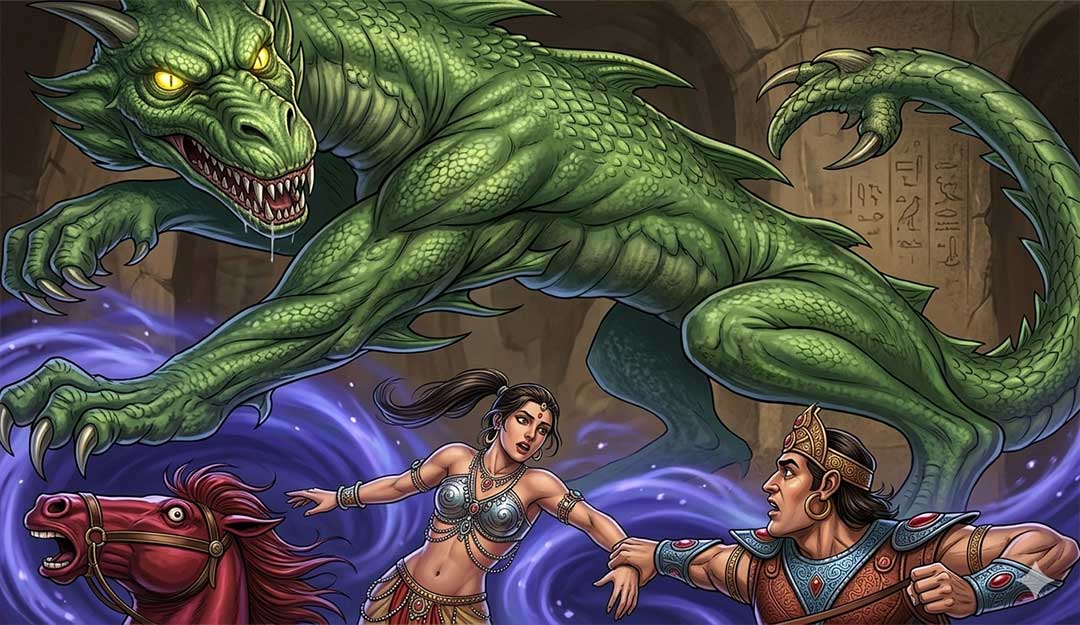
When we look at the cover page of ‘Khoonbund’, the first thing that comes to mind is Pratap Mullick’s memorable style, which maintained the identity of Raj Comics for years. The horror in which a giant green dragon-like monster is depicted on the cover instantly evokes thrills and shivers in the reader’s mind. The pale, shining eyes of this monster and the fine detailing of its body scales show the artist’s keen eye.
The expressions of struggle and determination seen on the faces of Ashwaraj and Princess Ghorilekha are so lively that they explain the entire situation without any words. The dark purple and blue background used on the cover further strengthens the explosion of magical powers and the atmosphere of danger. The five horses’ rapid movement and the depiction of dust flying from their hooves create spectacular motion on the page, making the cover feel even more vibrant.
Ashwaraj’s physical appearance: Masterclass of Anatomy of the ‘Ashvamanav’

The character of Ashwaraj is the most sophisticated form of the concept of ‘Centaur’ (half human–half horse) in Indian comics. The strength with which Vitthal Kamble has depicted Ashwaraj’s body shows his deep understanding of body structure. The meeting point of the human torso and the equine body has been shown so effortlessly by the artist that it seems completely natural. The blue and red stripes used in the design of Ashwaraj’s armor give him the appearance of a glorious warrior.
When Ashwaraj transforms into a ‘Maha Ashvaman’, the detailing of the sharp thorns and bulging muscles emanating from his body makes the reader realize his unlimited power.
Architecture of Ashwaloka: A grand depiction of a magical kingdom

The grandeur with which the architecture of Ashwaloka is shown at the beginning of the comic is truly praiseworthy. The artist has shown it as a city situated amidst the mountains, where the combination of modernity and antiquity is visible. Symbols of horses have been used strategically in the carvings on the walls of domes, tall minarets, and palace buildings. The carvings of chandeliers, carpets, and pillars in the interior scenes of the palace show how hard the artists have worked on the world-building. The depiction of the mountains seen in the background and the clouds covering them gives depth to the scene.
The design of the villain ‘Blooddrop’ and its magical crookedness
The visual design of the main villain ‘Khoonbund’ resembles a sly and powerful tantrik. Her green royal clothes and crooked facial expressions clearly show her negativity. Her biggest feature is her ‘blood power’, which the artist has shown very effectively. When she transforms into a giant pink dragon, the tearing of her skin and the growth of bones during that transformation are depicted with very scary accuracy. The fine work done in the dragon form, the texture of every part of her body, and her long tail take the level of painting to new heights.
‘Paya’ and ‘Kantaloo’: Unique creatures and visual effects of death bubbles

Another proof of the artist’s creativity is found in the depiction of a creature called ‘Paya’. A giant-headed creature carrying a machine that releases ‘death bubbles’. Having human palms trapped inside these transparent bubbles is a very scary and unique idea. The artist has beautifully used the ‘Glow Effect’ in the scenes of bubbles bursting and the deadly forces emanating from them. The way the crowd of small thorny creatures called ‘Kantaloo’ is shown together makes the scene very ‘action-packed’.
Living depiction of five divine horses: the magic of chariot dynamics

Ashwaraj’s chariot is incomplete without his five horses—Toofan, Raktambar, Kalakhor, Ashwavat, and Neelkanth. The artist has not only given different colors to these five horses, but has also kept their facial expressions different. When these horses gallop, the ‘speed lines’ used to show the movement of their legs and their hair waving in the air make the scene very dynamic. The design of the chariot wheels and the detailing of the weapons on it show that the artist has paid special attention to every small element. The muscle strain on the horses’ bodies is shown in such a way that the reader clearly feels their strength.
Modernity of action choreography and panel layout
The combination of action sequences in this comic feels like a Hollywood movie. The artist has broken through the boundaries of traditional square panels to spread the artwork across the pages in such a way that the reader’s gaze easily passes from scene to scene. The dramatic manner in which the assassination of Emperor Tarpidou, where the sword passes through his neck, is shown with the sound effect of ‘Shyaa’, becomes quite memorable. Onomatopoeia (sound-signifying words) like ‘impact stars’ and words like ‘Thud’ and ‘Slash’ that come out with every blow increase the intensity of the scene manifold.
Colour and Light: Artistic Contribution of Sanjay Vispute

Sanjay Vispute’s coloring has brought the fantasy world of this comic closer to reality. Light and shadow (Lighting & Shading) are used very intelligently in this issue. Scenes within the caves, where only torchlight is visible, show part of the characters’ faces in the light and the other part in deep darkness, further strengthening the atmosphere of mystery. The yellow and red rays emitted during magical transformations represent bursts of power. This selection of colors succeeds in drawing the reader’s attention directly to the most important part of the page.
Dialogue and Lettering: The Art of Breathing Life into the Story
Mahesh Palavankar’s lettering is clean and attractive. Dialogue balloons (Speech Bubbles) are arranged so that they do not cover the main pictures. Boldening important words and capitalizing the villain’s attacks make visual storytelling more effective. While the seriousness of a warrior is visible in Ashwaraj’s dialogues, a catchphrase like ‘Compulsion is brother’ in Khoonbund’s dialogues makes the character more crooked and memorable.
Conclusion: An invaluable document of imagination and subtle art
Ultimately, ‘Khoonbund’ is not just a superhero comic, but a living example of the hard work and thinking of the artists of that era. Every detail—be it the architecture of Ashwaloka, the glow of the horses’ muscles, or the scary look of Khoonbund—takes the reader to a world from which it becomes difficult to come out. Vitthal Kamble’s lines and Pratap Mullick’s direction make it an essential part of Indian comics history. Even in today’s digital comics era, these handmade artworks of ‘Khoonbund’ remind us that real magic lies in the nuances (details). This issue is a ‘masterpiece’ for every reader who wants to see the finest confluence of painting and fantasy.
