


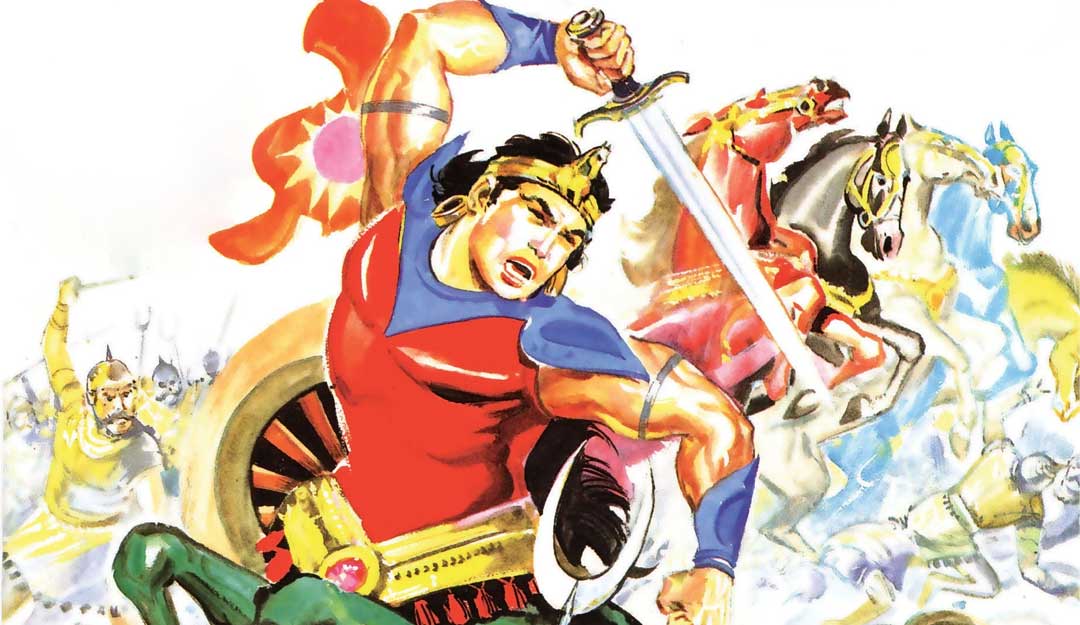
‘Tilism Ka Khiladi’ is a very important and thrilling episode of the Ashwaraj series. This comic is not just the story of a brave hero, but it is beautifully woven with deception, greed for power, magical illusions, and the complications of human emotions. This story makes the reader think on every page about how blurred the line between right and wrong can be.
Story summary and flow:
The story begins with a very tense and interesting scene, where Ashvaraja is riding on his chariot and a warrior girl, Ashvakirti, stands in front of him as a challenge. It is here that the author presents the character of Ashwaraj very effectively. Ashwaraj is not just a great warrior, but he also gives equal importance to his moral values. He does not want to attack any woman, even if she is his enemy. When Ashvakirti uses the ‘Kanyastra’, Ashvaraj gets trapped in a religious crisis—victory is necessary, but not by breaking his principles.

It is here that Ashvaraj’s five horses—Raktaraktambar, Kalakhor, Ashvavat, Neelkanth, and Shravyashakti—play a special role in the story. These horses are not just means of riding, but true companions of Ashvaraja, armed with magical powers. When Ashvaraj hesitates to attack, these horses find a solution to the problem with their wisdom and intelligence. This scene gives a clear message that war is not won by strength alone, but the support of wise and loyal comrades is equally important.
As the story progresses, the reader goes deeper into the mysteries of ‘Karoon’s treasure’ and the ‘Tilism’ spread around it. To stop Ashvaraj, five dangerous devils—Kalakhjura, Chandal, Panjal, Bhonkamp, and Chokarant—are sent. This is where the ‘wishful’ form of Ashvaraja appears, in which he transforms into a centaur, that is, half human and half equine. This transformation is extremely impressive to witness. The cruelty, strength, and bravery with which he kills these five demons become a major high point of this comic.
Villains and Conspiracies:
The real mastermind of this story is ‘Tutabut’, who has been truly called the ‘Tilism player’. He prefers to play mental games rather than take to the battlefield and fight himself. His character is crafted in a very interesting way. He controls the entire war through his magic mirror. His plan is not limited to just eliminating Ashvaraja; he wants to weaken both kingdoms by making two great kings—the Suryavanshi Emperor Tarpidho and the Chandravanshi Emperor Ashvantak—fight among themselves, so that in the end he can capture the treasure of Karun.

The character of Emperor Ashwantaka is a living example of greed and the blindness of power. He is so blinded by power that he even agrees to have his own son, Ashvaraja, killed. This creates deep emotional tension in the story. When Ashwantaka himself appears before Ashvaraj and tries to take him prisoner, the story suddenly takes a new and shocking turn.
War and horror:
The middle and final parts of the comic are filled with tremendous battle scenes. To defeat Ashvaraja, Ashwantaka uses a magical box, from which an entire army of dwarfs emerges. These small dwarfs pierce the body of Ashvaraja with their poisonous and subtle arrows. Seeing an invincible warrior becoming weak at the hands of such small creatures becomes a very painful experience for the readers. Ashvaraja falling unconscious and being dragged to safety by his loyal horses is a sad but extremely emotional moment in the story.

After this, a fierce war breaks out between the armies of Emperor Tarpidro and Ashwantaka. The author has shown the devastation and fear of war very effectively here. It is during this time that the secret of ‘Ashvamani’ and its destructive power is revealed, which takes the climax of the story to a different magical height. The deadly rays emanating from Ashvamani turn entire armies into ashes in a moment, and the scene is reminiscent of the terrifying power of ancient Mahastras.
Character illustration
Ashvaraj: Ashvaraj comes across as an ideal hero. His true strength lies not in his muscles, but in his principles and thinking. He is a willful warrior who uses his powers only to protect religion and justice. The deep mental and emotional relationship he has with his horses makes him different and special from other heroes.
Tutabuta: Tutabuta is the real life of this story. Her calm face and slight crooked smile make her even scarier. He believes in playing tricks instead of attacking openly. Using his own daughter, Ashvakirti, as a pawn clearly shows his cruel and heartless nature.
Emperor Ashwantaka: Ashwantaka is a father who, in his greed for treasure and power, becomes an enemy of his own blood. His character shows how low greed can bring a person down. In his fascination with power, he even forgets that Ashvaraja is his own son.
Maharishi Fukamsan and Raja Chinta Singh: Both these characters add elements of mythology and prophecy to the story. Through them, the story gets a deep philosophical foundation, which takes it beyond just an action comic.
Art and portraiture

Pratap Mulik’s art direction and Chandu’s portrayal are the biggest strengths of this comic. The distinct identity that Raj Comics of the 80s and 90s had is visible here with full intensity. The choice of colors is deep, dense, and impressive, which makes every scene powerful.
The transformation scenes of Ashvaraja show the combination of human body muscles and a horse torso very closely. This change is as powerful as it looks and is highly memorable.
The scenes of blood flowing on the battlefield, heads being cut off, and dust flying are so vivid that the reader begins to feel like a part of the same battle.
Demons such as Kalakhjura and Bhonkump have scary as well as quite original designs, making them different from common villains.
The tilismi caves, skulls, and huge palaces in the background deepen the story’s mysterious atmosphere even further.
Writing and dialogue
The writing of Meenu Wahi and the script of Tarun Kumar Wahi are quite tight and effective. There is a kind of heaviness and seriousness in the dialogues, which fits perfectly with the mythological atmosphere.
“Ha ha ha! Ashvaraj! Will you fight with a girl?”—such dialogues create both challenge and satire, while dialogues like “Ashvaraj, tumhari hun will overcome all obstacles” strengthen deep faith in the hero. The pace of the story is fast, and the reader does not feel bored anywhere.
Critical Comment:
‘Magic Player’ is not limited to just entertainment, but it is also a deep study of human nature. It shows how one person’s ego, like Ashwantaka’s, and another’s cunning intelligence, like Tutabuta’s, can lead the entire world toward destruction.
The story ends with a big suspense. The news of Ashvaraja’s death has spread, and Emperor Tarpidro himself has entered the battlefield with Ashvamani. This cliffhanger forces readers to read the next part, ‘Then Aaya Ashwaraj’.
Conclusion
If you want to get lost in nostalgia and get a real taste of the golden age of Indian comics, ‘Player of Magic’ is a must-read comic. This is such a combination of story, drawing, and adventure that is rarely seen.
This journey of Ashwaraj teaches us that no matter how powerful evil is and how deep the conspiracies are, ultimately truth and loyalty prevail.
Raj Comics has preserved this heritage even in the digital era, for which they deserve praise. The comic will appeal to today’s younger generation as much as it did to their parents. This saga of Ashwaraj will always remain a memorable milestone in the history of Indian graphic novels.
Rating: 4.5/5
Review: A wonderful magical journey that keeps you engaged till the last page.
