


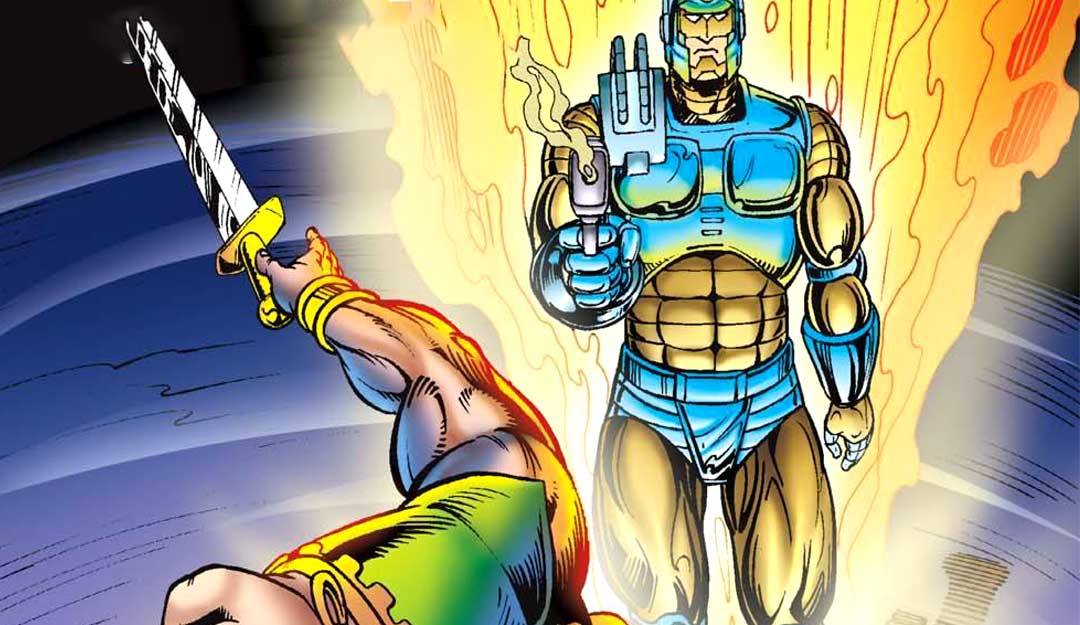
In the golden age of Raj Comics, many such experiments were done that gave new heights to the Indian comics world. One of these experiments was ‘Crossover,’ where heroes of two different genres or eras were brought together. ‘Bhoot Bhavishya’ is a very exciting and important link in this series. This comic presents the story of the confrontation and union of the great warrior of the ancient era, ‘Bhokal,’ and the great man equipped with the technology of the future, ‘Inspector Steel.’ This 76-page comic is not just full of action but also offers a great blend of time travel, astrology, and human emotions.
Dilemma and planning of Kaal Kundli:
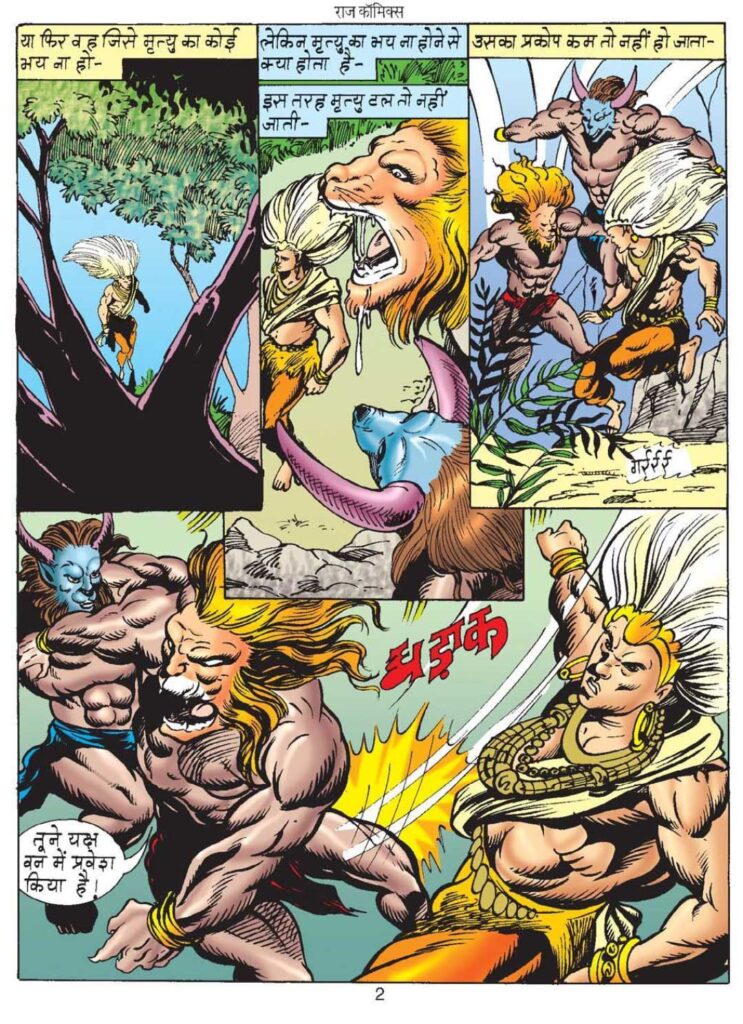
The story begins in a mysterious forest located near Vikas Nagar, where the great astrologer and tantrik ‘Kaal Kundli’ is busy solving the biggest puzzle of his life. Kaal Kundli has received a curse that his death will happen at the hands of Bhokal only. But astrological calculations say that it is impossible to kill Bhokal. To remove this confusion, he calls for the ‘Question Yaksha.’ Question Yaksha tells him that Bhokal cannot be killed by any warrior of the present; only a warrior of the future can kill him, one who is ahead of him in technology and strength. From here, the foundation of the story rests on the connection of ‘Bhoot’ (ancient times) and ‘Bhavishya’ (modern times).
Mahanagar Rajnagar and Inspector Steel:
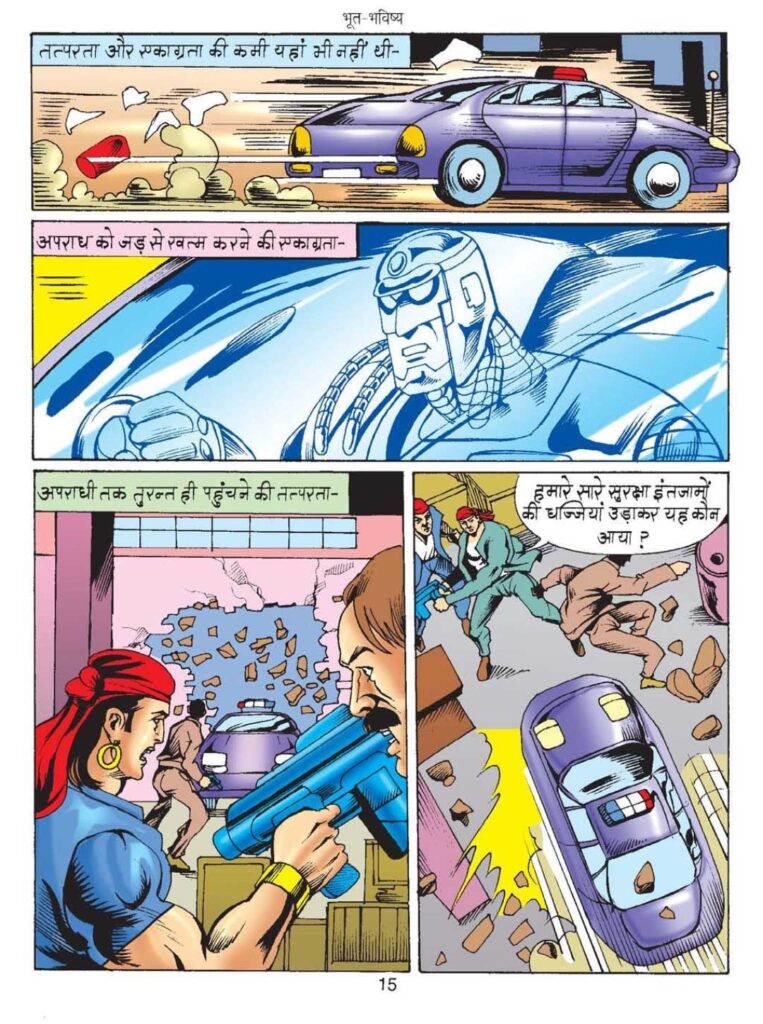
The other end of the story opens in the future city of Rajnagar. Here we see that Inspector Steel, who is a cybernetic super-cop, remains a challenge for criminals. He catches a cunning criminal named ‘Kazar’ with the help of his ‘Megagon’ and advanced sensors. Kazar had stolen the main chip of Dr. Anees’s ‘time machine.’ This form of Inspector Steel makes him look like a conscientious machine, but within him works the mind of a human being (immortal), keeping him connected with emotions.
Time travel and accident:
Dr. Anees, who is a steel manufacturer and friend, wants to test his time machine. They decide to send Steel to the past as a test. But this is where the story takes a big turn—due to the tampering done by Kazar in the chip, the time machine explodes violently. Inspector Steel ends up in past Vikas Nagar, but he loses his memory, and the machine also breaks down badly.
Mahabali Bhokal vs Inspector Steel:
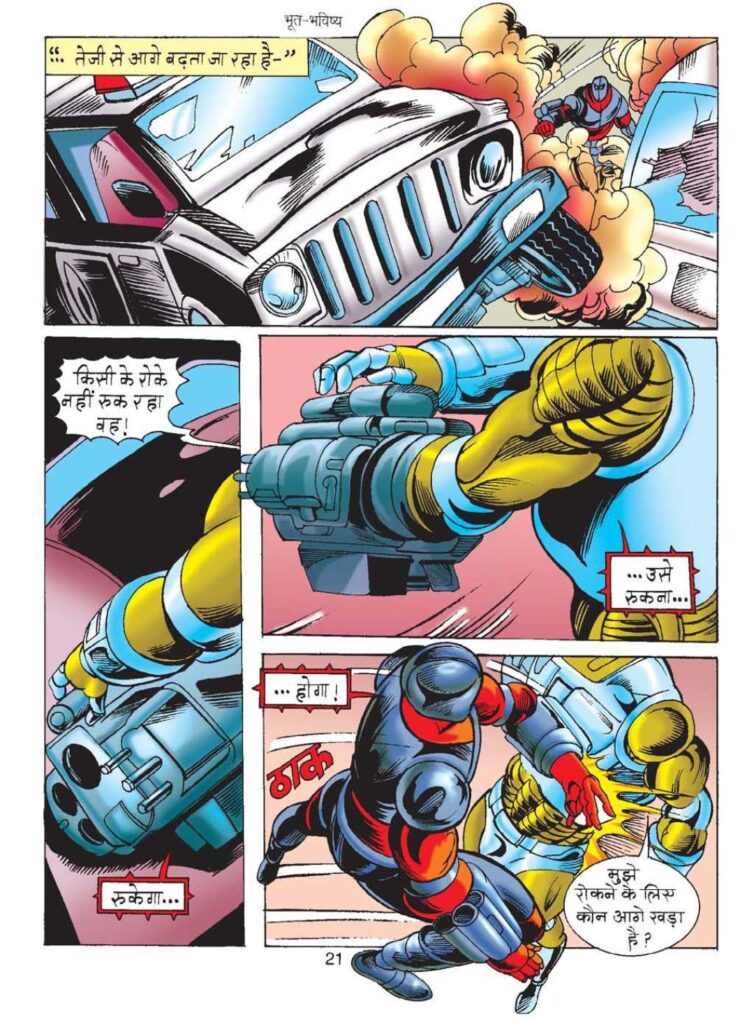
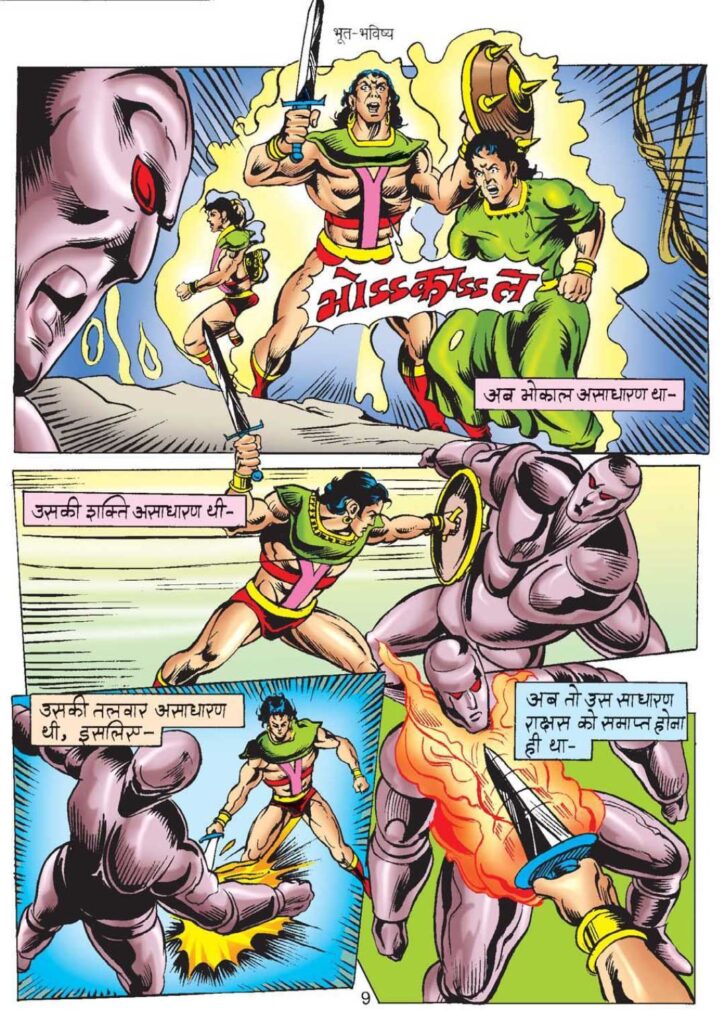
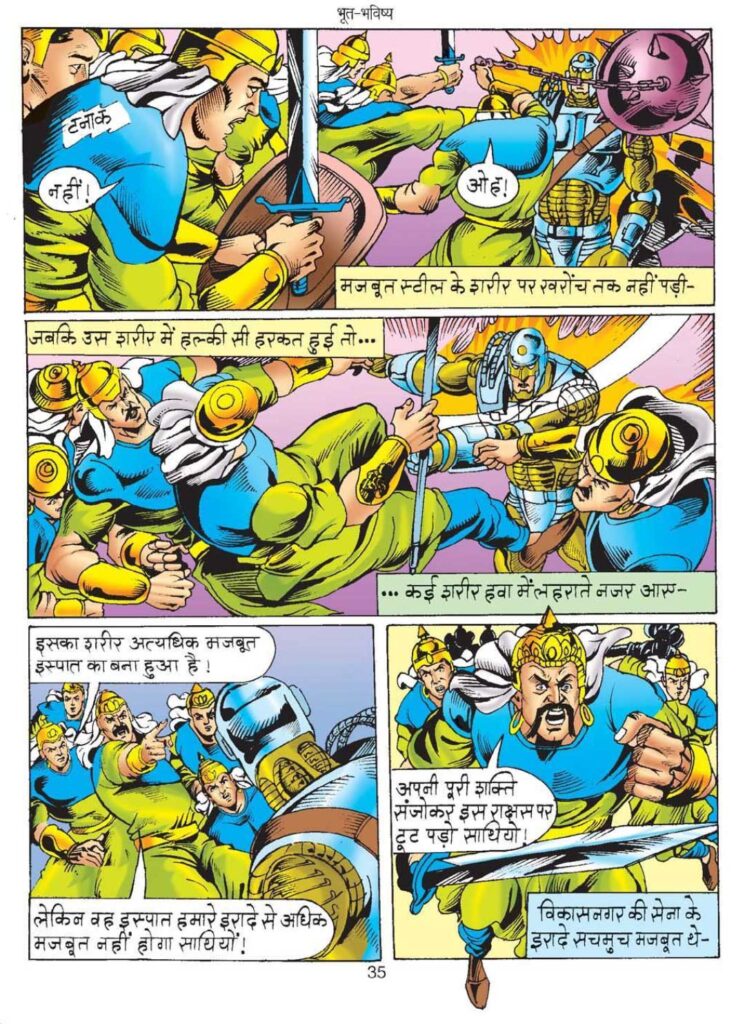
When Steel steps onto the land of Vikas Nagar, the soldiers there attack him, considering him a ‘strange monster.’ To Steel, they are all unknown enemies. This is where Mahabali Bhokal enters. This encounter between two tremendous powers becomes the biggest attraction of the comic. On one side is the ‘flame power’ of Bhokal’s sword, while on the other side are the ‘Megagon’ and missile-proof body of Steel. Writer Hanif Azhar has shown this fight in a very balanced manner. The two heroes are right in their respective places, but misunderstanding makes them stand face to face.
Conspiracy of Kaal Kundli and ‘Judwan Graha Yoga’:
Kaal Kundli takes full advantage of this opportunity. He convinces the memory-lost Steel that he is his master and that Bhokal is a sinful and tyrannical king. To make the story more complicated, Kaal Kundli creates a ‘clone’ of Bhokal using ‘Judwan Graha Yoga.’ This fake Bhokal oppresses the innocent public, making the real Bhokal a villain in Steel’s eyes. This psychological trick gives more depth to the story.
Final struggle and opening of truth:
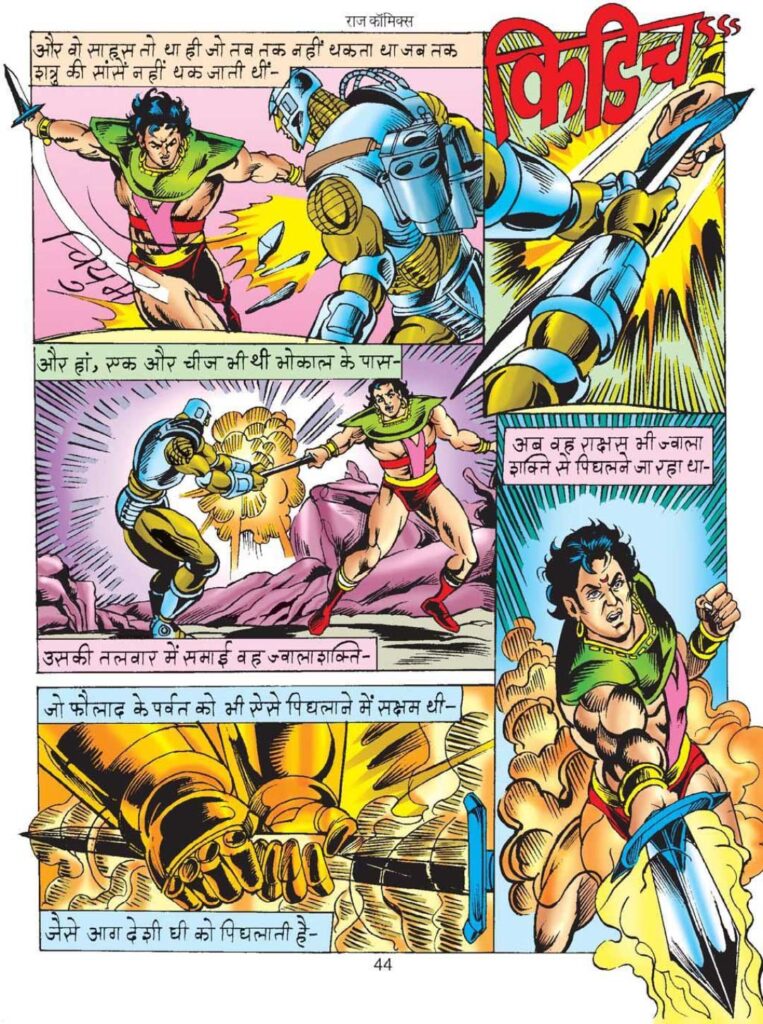
As the story progresses, a final and overwhelming contest between Steel and the real Bhokal ensues. Steel uses his ‘extreme heat beam,’ which causes even Bhokal’s shield and sword to melt. The atmosphere is completely filled with tension. But then Dr. Anees, present in the future, manages to capture the frequency of Steel’s mind. On the other hand, Steel’s battery starts to run out due to constant fighting, and he begins to weaken and fall. At this critical moment, Bhokal realizes that this ‘Iron Man’ is not actually bad but is a victim of some big conspiracy.
End and farewell:
Bhokal recognizes the power unit behind Steel’s back and helps recharge it (as Steel points to it by mustering his last strength). Steel understands the whole truth as soon as his memory returns. He immediately arrests Kaal Kundli. Finally, Dr. Anees manages to pull Steel back into the future with his technical understanding. That last farewell and mutual respect between Bhokal and Steel leave a deep impression on the reader’s heart.
Analysis of characters:
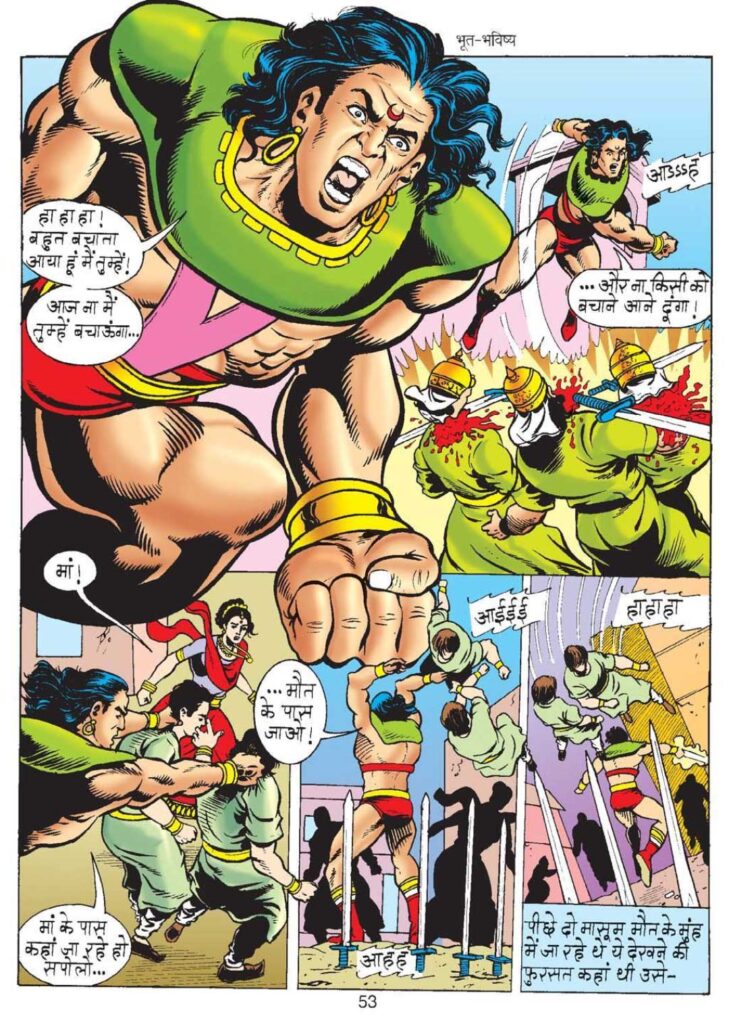
Bhokal: In this comic, Bhokal is seen as a just and powerful warrior, as always. His true greatness is revealed when he decides to save the life of his archenemy (Steel, whom he had until then thought to be the enemy). His ‘Jwala Shakti’ and his devotion towards ‘Mahaguru’ give him the status of a divine hero.
Inspector Steel: The character of Steel is based entirely on technique and logic. His confusion and then acceptance of the truth show the strength of the human mind within him. The use of his modern weapons in ancient times makes the story even more interesting.
Kaal Kundli: He is a cunning and dangerous villain. He uses his intelligence and tantra-mantra more than his strength. The fear of his death is what made him play such a big game, which makes him an interesting ‘gray-shade’ villain.
Dr. Anees: He represents the stubborn and positive side of science that doesn’t give up until the last moment. His concern for Steel feels like that of a father figure, adding emotional depth to the story.
Art and portraiture:
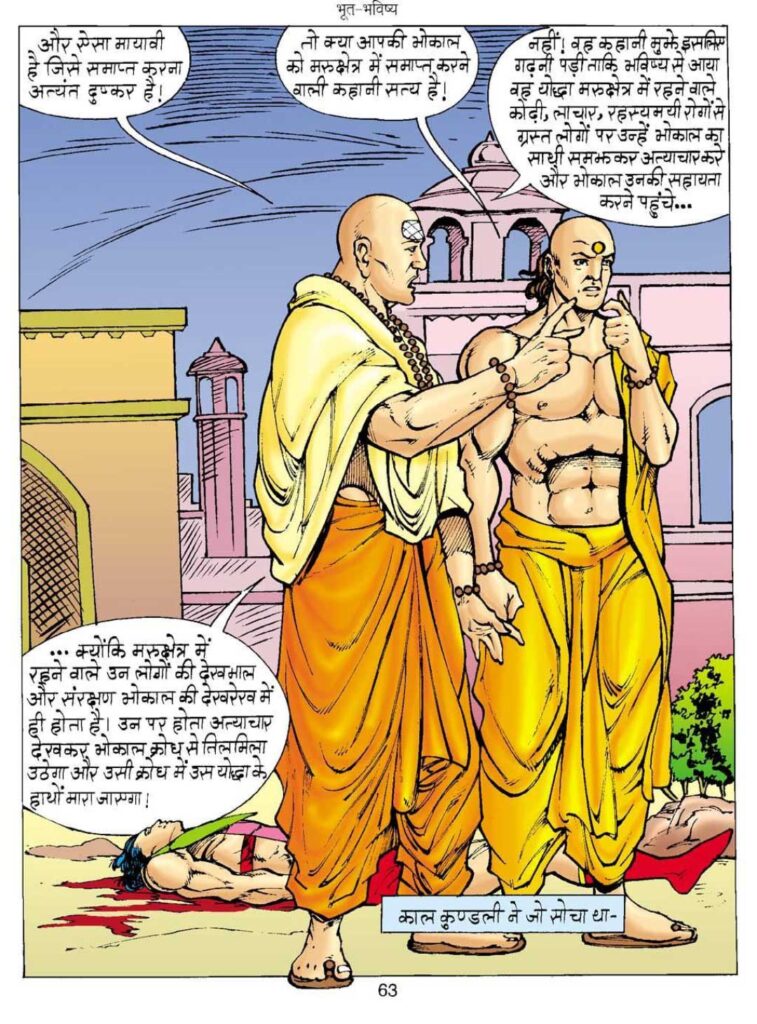
Raj Comics’ identity has always been its vibrant artwork, and ‘Vink’ and his team have done a great job in this comic too. The difference between the palaces and forests of ancient Vikas Nagar and the high-tech buildings of future Rajnagar has been shown in a very clear and effective manner. The pace feels smooth in the fight scenes. The rays emanating from ‘Megagon’ and the flames emerging from Bhokal’s sword have been beautifully highlighted through colors. Also, the modern armor of Inspector Steel and the traditional ensemble of the time coil feel like two different poles, which perfectly strengthens the ‘past-future’ theme of the story.
Theme and message:
This comic touches on many deep ideas. Through science vs. miracles, the question has been raised whether the machines of the future can defeat the occultism of the past. In the end, the story makes it clear that the greatest strength is always truth and morality. Also, the dangerous consequences of misunderstanding are shown—how a lie can bring two great heroes face to face. The steadfastness of time is also proved by the story of Kaal Kundli; the path he chose to avert his death led him to his end.
Critical Comment:
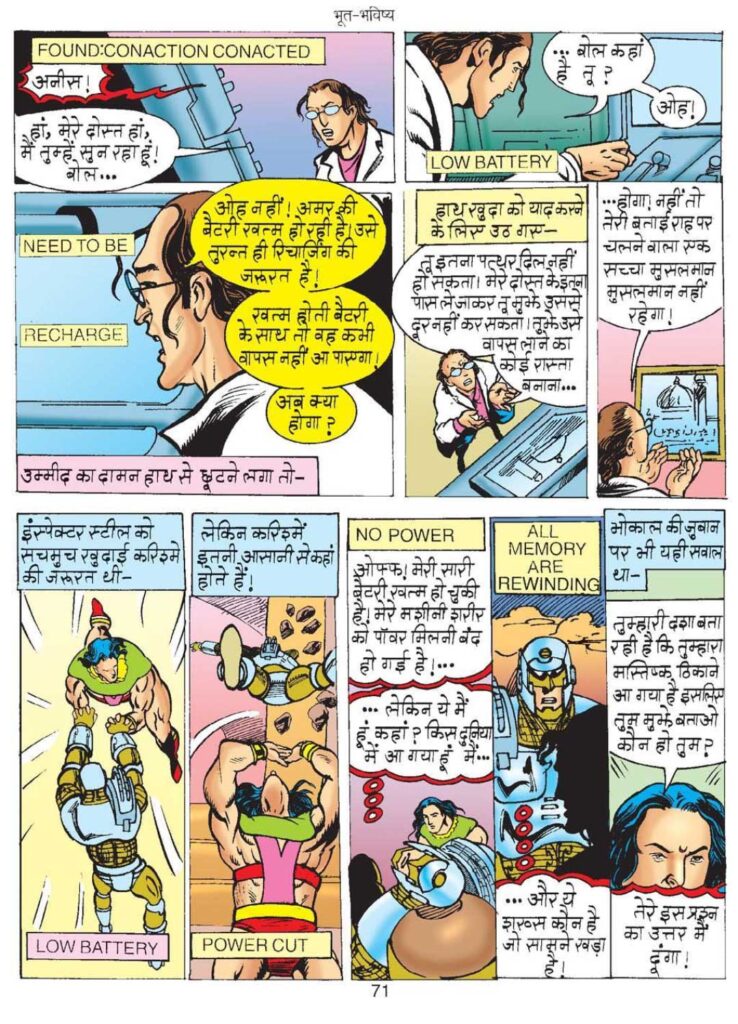
The biggest strength of ‘Bhoot Bhavishya’ is its pacing. The story does not bore anywhere and continues to move forward. Yes, there is some cinematic leeway in the logic of time travel (like Bhokal suddenly understanding the battery system), but according to fantasy comics, this can be easily accepted. The dialogues are quite powerful, especially the moments when Bhokal and Steel respect each other’s strengths.
The title of this comic, ‘Bhoot Bhavishya,’ fits perfectly. It is not just a story of two different times, but it shows that while time and technology may change, the principles of heroism and justice always remain the same.
Conclusion:
If you are a fan of Raj Comics, then ‘Bhoot Bhavishya’ must be in your collection. It is such a tremendous combination of the shine of Bhokal’s sword and the tinkling of Inspector Steel’s machine that keeps you engaged from beginning to end. This comic once again reminds us why Raj Comics was called the emperor of Indian comics. This journey of 76 pages becomes a great journey of adventure, mystery, and emotions.
