


‘Raj comics’ universe after ‘Nagraj’ (Nagraj Ke Baad) comes up with the answer to the dangerous turn readers were left at in this comic—“fuel” (Fuel). If after ‘Nagraj’ was the sad end of a great story, then ‘fuel’ is a mysterious spark rising from the midst of the same sorrow. Presented by Sanjay Gupta, this comic, based on the story of Jolly Sinha and the magical pictures of Anupam Sinha, is not just a story but a new parameter of suspense and action in the Indian comics world. Where in the previous episode we saw Nagraj losing and getting extremely close to death due to the ‘suicide-ray’ (Suicide Ray), ‘fuel’ makes that mystery even more intriguing. This review will try to understand this exciting 60-page journey from every aspect.
Suspense in the Darkness of Death: Sharks, Seas, and an Invincible Warrior

The story begins where Nagraj fell amidst the dreaded sharks in the depths of the sea. On pages 4 and 5, we see that despite the effect of the ‘suicide-ray,’ Nagraj’s body and his subconscious mind are not ready to give up. Here the author has shown a very interesting scientific and psychological confrontation—on the one hand is the ray that eliminates the desire to live, and on the other hand is a hero whose entire existence is meant to protect humanity.
The undersea scene adds to the thrill when Nagraj discovers that the shark is not real but a ‘mechanical shark’ (Mechanical Sharks), with bombs attached. Anupam Sinha’s art here really looks amazing. The movement shown in the underwater action scenes is very impressive. Nagraj’s confrontation with those bombs and finally foiling that mysterious ‘king’s’ plan proves that it is not so easy to eliminate Nagraj. But here a big question remains—is he really Nagraj?
‘Rise of snake eyes’: New and Clever Incarnation of the Defenders

An important part of the story is the establishment of the ‘Snake Eyez Security Agency’ (Snake Eye Security Agency). Soudangi, Sheetnag Kumar, and the rest of the wishful serpents come in human form and form an agency, adding a funny twist to the story like a ‘corporate thriller.’ Their dialogue with Hemal Bhai on page number 11 and their use of hypnotism show that Nagraj’s companions are no longer dependent only on strength but are also applying equal mind and strategy.
This agency is not just a business but a strong means of keeping an eye on the enemies of Nagraj spread across the metropolis and finding the ‘secret forms’ of Nagraj. The understanding between Bharti and Soudangi and their concern connect the readers emotionally. It is interesting to see how his companions assume full responsibility in the absence of a superhero.
‘fuel’ philosophy: Energy Hunger and the Destruction of Humanity

The title of the comic “fuel” (Fuel) hides within itself a very deep meaning. It does not just talk about fuel made from snake venom, but it also tells the story of hunger for power. The dialogue between villain ‘king’ and ‘nagmani’ on page numbers 10 and 31 clearly shows that for them the destruction of the world is also just a business.
Through ‘Venom Fuel’ (Venom Fuel), the author has made a sharp comment on today’s energy crisis. When natural resources start running out, to what extent humans can fall—this is the real basis of this story. The greed of characters like Nagdant and Nagmani shows that when science is separated from morality, it creates only destruction in the form of ‘fuel.’
Mysterious Stranger: A Big Question on the Identity of the Hero

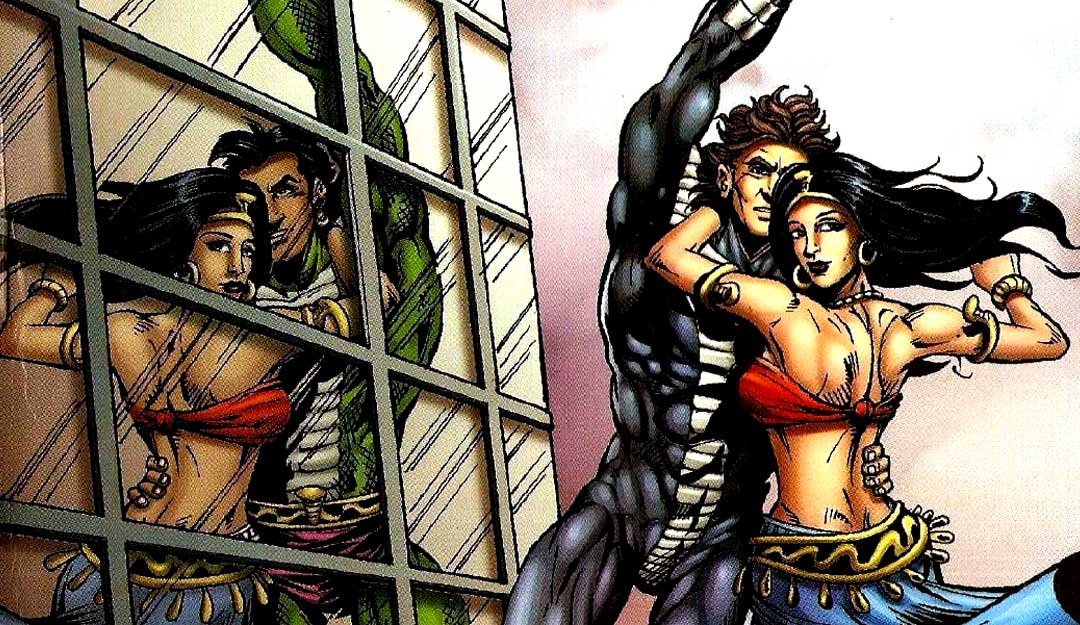
What is discussed most throughout the comic is that ‘stranger’ (Stranger) who definitely looks like Nagraj, but his powers look different. From page number 33 to 45, we see him protecting the metropolis. He acts like Nagraj, but he doesn’t seem ‘wishful.’ He fights fire, saves the giant ‘globe’ (Globe) from falling, and confronts the dragonoids (Dragon-noids).
Around this character remains a mysterious feeling like an ‘angel’ (Angel) or ‘devil’ (Devil). Even Bharti and Visarpi are unable to recognize him. Is he the soul of Nagraj? Is he a clone of him? Or is there someone else who is using Nagraj’s name? Visarpi fastening him in ‘bonds’ and his sudden disappearance on page number 46 make this mystery even deeper.
Mahakumbh of Scenes: A Lively Display of Anupam Sinha’s Paintbrush

If ‘fuel’ is called a great visual experience, then the biggest credit for it goes to Anupam Sinha. The sight of the giant dragon attacking the metropolis on pages 15 and 16 really gives goosebumps; its size, its blazing fire, and the devastation spreading in the city seem extremely effective. On pages 17 and 18, the huge globe stuck in the air and the hero holding it can be counted among the most memorable panels of Indian comics. Apart from this, the uncertainty and pain seen on the faces of Visarpi and Bharti say a lot without words. The use of dark blue-violet colors in dark scenes and bright orange-yellow colors in action scenes completely maintains the pace and mood of the story.
New Face of Terror: ‘king’s’ Strategic Bet

The main villain of this series, ‘king,’ is not an ordinary criminal but a very clever strategist. On pages 52 and 53, we see him trying to extract information from the mind of ‘nagdant.’ He understands very well that the real strength of Nagraj is hidden not just in his body but in his mysterious past and his different forms.
King’s character proves that the dangerous enemy is not one who just has a large army, but one who knows how to read the hero’s mind. His claim—“Nagraj is my prisoner” (Panna 59)—brings the story to a point where the reader is really shocked and the curiosity to know what will happen next increases.
Psychological Warfare: ‘suicide-re’ and Collision of Wills

The concept of ‘suicide-re’ is like the backbone of this entire series. This clearly shows that battles are not won by weapons alone. King believes that if he eliminates Nagraj’s ‘will to live,’ his body will give up on its own. But on pages 6 and 7, it is clearly visible that the duty of the hero outweighs his desire for death.
The subplot also emerges as a metaphor for depression (Depression) and mental conflict. The story indicates that when a person has a greater purpose like protecting others, he can also fight and defeat the darkness within him.
Return of Visarpi and Danger Looming Over Nagalok

Visarpi’s entry adds new life to the story. Her fighting skills on pages 43 and 44 clearly show that she is not just a princess but also a strong warrior. The danger looming over Naglok and the hunting of wishful snakes show that this war is not going to be limited to just the metropolis.
‘Nagmani’s’ dream of taking the princess of Naglok hostage and her plan to suck the poison of wishful snakes add a strong tinge of fantasy and mythology to the story. This clearly gives the feeling that as the protector has weakened, the hunters have become active from all sides.
The Depth of the Dialogues: Philosophizing and Heroism Side by Side

Jolly Sinha’s dialogues are the real strength of this comic. The line said about Nagraj on page number 2—“Nagdev Kaljayi’s poison killed a child, but the same poison gave him new life…” reminds the reader of Nagraj’s glorious past.
The dialogues of the mysterious stranger leave a deep impact even in few words, while the arrogance and cruelty in the villain’s dialogues make them more scary. The use of words like “persuasion” and “demonstration” (Panna 27–28) gives a modern and global feel to the story, making it a big-canvas narrative rather than just a traditional superhero comic.
The Last Blast: A Shocking Revelation
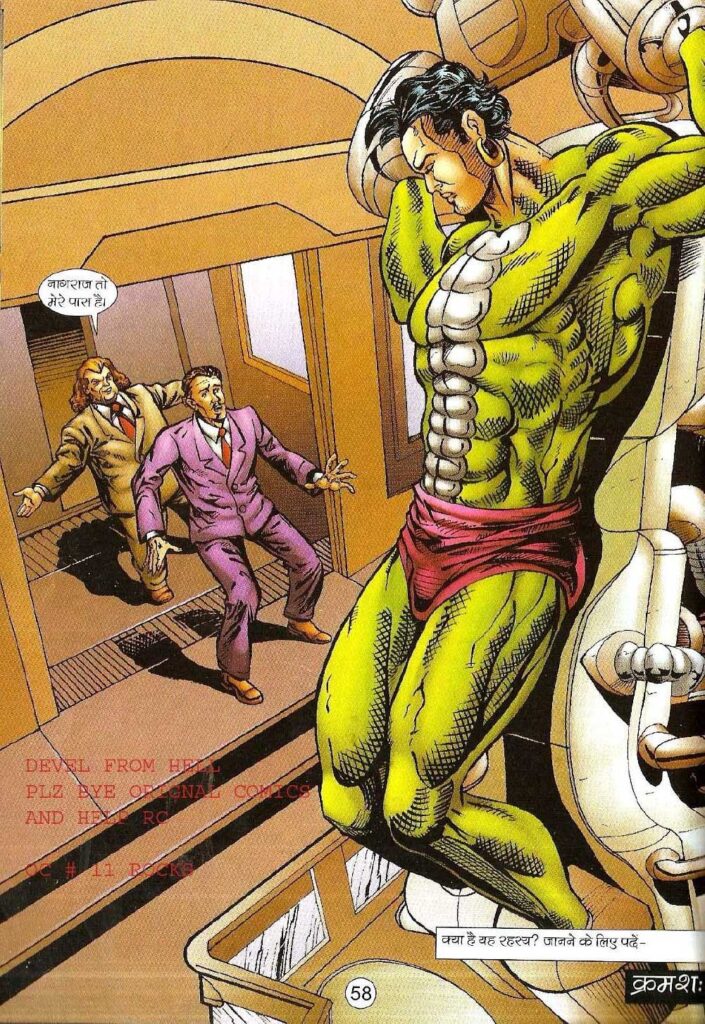
The end of the comic (pages 58–59) is a really strong shock. The truth behind the ‘stranger,’ which the readers were feeling relieved about by considering him as Nagraj till now, turns out to be much more scary. Finally, seeing the real Nagraj stuck to the machines and unconscious completely stuns the readers.
This climax clearly shows that what we have seen so far was just a small part of a very big game. “What is this secret?”—this question sticks in the reader’s mind so strongly that he becomes restless to read the next part, ‘vinom’ (Venom). It’s a powerful ending that makes this comic really ‘must-read.’
Critical Conclusion: Why Is “fuel” an Indispensable Masterpiece?
“fuel” is not just a sequel to ‘after Nagraj,’ but it takes the character of Nagraj into a new dimension. This comic tells us that the hero never really ends; he just changes his appearance over time. It is not easy to completely put into words the mixture of politics, science, greed, and bravery seen in the story.
Its biggest strengths are a great balance of mystery and adventure, a great combination of new and old characters, Anupam Sinha’s world-class art, and an attempt to connect a real issue like the energy crisis with superhero fantasy. Yes, the story is definitely a bit complicated, so some new readers may have to look at ‘after Nagraj’ again to understand it completely. But for a true Raj Comics fan, this becomes not a shortcoming but a fun challenge.
Conclusion:
‘fuel’ is a comic that keeps wandering in the mind for a long time after reading. It is not just a symbol of Nagraj’s battle, but of every human being who keeps searching for light even in the midst of darkness. If you want to get the feel of the golden age of Indian comics, then this saga must be in your collection. Raj Comics has once again proved that they have such ‘fuel’ of stories which is not going to end soon.
