


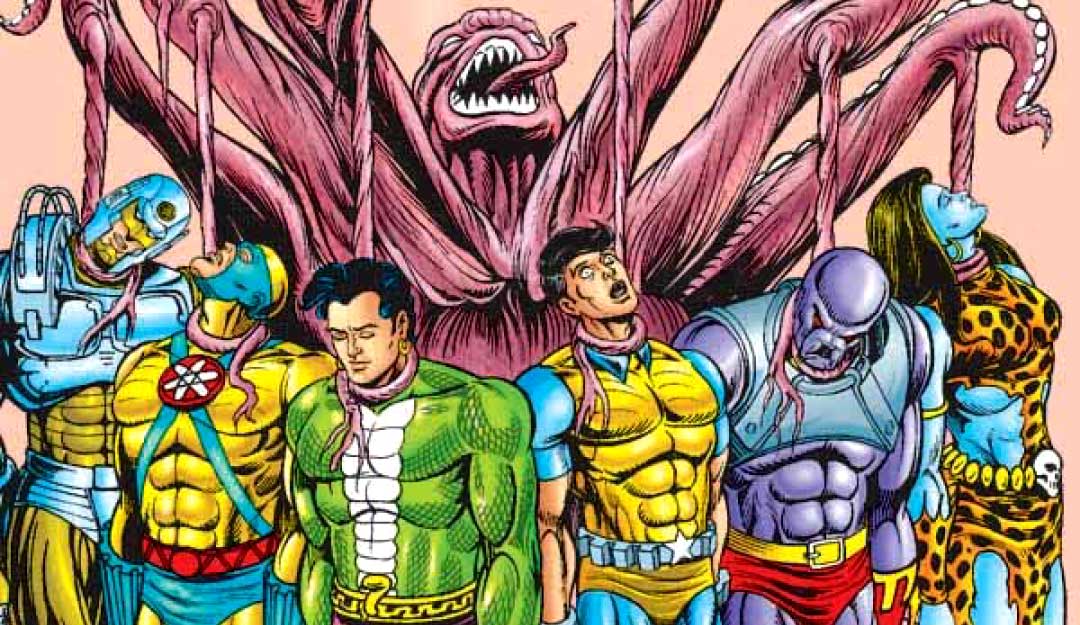
Raj Comics has been another name for superhero comics in India. The popularity with which Raj Comics ruled the hearts of children and teenagers in the 90s and early 2000s is still rarely seen. There is a very big, powerful, and thrilling link to the same golden period—‘Omnipotent’ (Sarvashaktimaan). It is not just a comic, but a complete multi-starrer mega special issue, where almost all the big heroes of Raj Comics—Nagraj, Super Commando Dhruv, Atomic, Doga, Inspector Steel, and Shakti—come together to face a terrible threat to the whole world. This massive 113-page comic offers a large-scale story that makes it necessary to review it in depth.
Story Plot
The story begins at the NASA Center in the US, where a highly modern robotic craft named ‘Spirit’ is to be sent to Mars. This mission is scheduled for 6 June 2003. Its purpose is to find out whether life ever existed on Mars or not. But even before this scientific mission starts, the situation suddenly begins to worsen.

At launch, the sky suddenly darkens and a very large swarm of ‘machine locusts’ (robotic locusts) attacks the rocket. These locusts are not ordinary; rather, they even consume metal and completely destroy the computer system. From here, the universe protectors of Raj Comics, i.e., the superheroes of the world, come into action.
The story moves simultaneously in several different directions at this juncture.
Atomic and Nagraj Front
Atomic starts trying to stop these mechanical locusts, while Nagraj starts protecting the cable network spread underground. He has to fight a digital and magnetic virus named ‘Java’. Java is not a common enemy, but a dangerous virus that can control even living cells through computer programming.
The Mystery of Mars
The real twist in the story comes when it is revealed that some Martians have been living on Earth disguised as humans for hundreds of years. A deep and scary conspiracy emerges through characters like Dr. Gadre and Harihar. The purpose of these Martians is to take over the Earth, because their own planet has been completely destroyed due to a terrible epidemic—‘Omnipotent’.Rise of the Almighty
‘Omnipotent’ is not a human being or an ordinary villain, but an alien virus or consciousness that absorbs energy and living cells to make itself even more massive. When the Spirit craft returns from Mars—or rather, when its wreckage falls to Earth—it brings with it this same dangerous infection. This virus gradually starts absorbing humans and machines and finally takes the form of an extremely huge, muscular, and mechanical monster.
Great War
Eventually, things become such that all the superheroes come together and face this devastating threat. Dhruv’s precise strategy, Nagraj’s tremendous strength, Atomic’s energy, and Doga’s fearless courage all work together as a team to save the Earth from this devastating infection and the terror of the Almighty.Portrayal of Characters

Nagraj: In this comic, Nagraj is seen in the role of a senior protector. His collision with Java looks quite interesting technically. Here, Nagraj is shown fighting not only with his strength but also with his mind and mental strength, which makes his character stronger.
Super Commando Dhruv: Dhruv is the real ‘mastermind’ of the team, as always. When the rest of the heroes are taking charge with their respective powers, Dhruv understands the situation, analyzes it, and plans ahead. Especially helping Atomic and Inspector Steel in the right direction shows his strategic thinking.
Atomic: This story is no less than a personal battle for Atomic. He reaches the real source of the mechanical locusts, enters the giant mechanical monster, and fights within it. His ‘nuclear energy’ becomes the lifeline of the tremendous action scenes of this whole story.

Doga: Doga’s presence makes the story darker and grittier. On the Mumbai front, he confronts criminals and Mangalwans who want to take advantage of this global crisis and play their own game.
Other Heroes: Inspector Steel, with his mechanical strength, and Shakti, with her divine energy, contribute significantly to the story and strengthen the team.
Writing and Art
Jolly Sinha’s writing is quite impressive. The biggest challenge in a multi-starrer story is ensuring that every character gets the right importance and enough ‘screen time’, and in this case, the writers are successful to a great extent. The combination of science fiction and fantasy seen here gives the entire comic the feel of a Hollywood blockbuster film.

Talking about the art side, Anupam Sinha and his team have done a really great job. The detail with which the horror and giant form of the locust attack, the giant space center, and ‘Omnipotent’ are shown is praiseworthy. The use of colors (by Sunil Pandey and Manish Gupta) varies with the mood of the story—NASA scenes have modern and bright colors, while scenes involving the people of Mars reflect mystery and fear.
Main Themes
This story presents the conflict between science and nature in a compelling way and raises the question of whether humanity’s desire to conquer space is unknowingly inviting a great danger. The Martians are shown not just as villains, but in a ‘gray shade’, making them seem a little human as they fight for their survival. Finally, ‘Omnipotent’ gives a strong message that when a crisis befalls the whole world, forgetting mutual differences and uniting is the only way for humanity to survive.

Positive Side (Pros):
The story does not become loose anywhere. There is something new on every page— a new threat, a new twist, or a new revelation. The use of elements such as Java programming, magnetic waves, and NASA missions is interesting as well as informative for children and youth. ‘Omnipotent’ being shown as a muscular virus is a new and fear-inducing concept in itself.Downside (Cons):
Due to the presence of so many heroes, sometimes some characters, such as Shakti or Inspector Steel, seem relatively less effective. The end of the story feels resolved a little too quickly, where such a huge threat ends in a relatively short time.Detailed Review
Another interesting aspect of this comic is its time period. The understanding of the internet and computers was rapidly increasing in India around 2003. At such a time, words like ‘Java’ virus and coding seemed extremely modern and ‘cool’ to readers.

The background of Mars reminds us of that period when various kinds of stories and imaginations about Mars were popular. The author has intelligently linked NASA’s real missions with his imaginary world.
Between pages 90 and 110, the story reaches its peak. The Almighty becomes so huge that entire buildings start looking small in front of him. Here, the helplessness of the heroes is shown very effectively. Nagraj and Steel losing together creates fear in the minds of readers, which is the hallmark of a good thriller.
The idea of Dhruv sending Atomic inside the virus by ‘shrinking’ him clearly shows the science-fiction thinking of Raj Comics. This concept may be reminiscent of Marvel’s ‘Ant-Man’, but it is completely molded within an Indian environment.
Conclusion
‘Omnipotent’ (Sarvashaktimaan) is a memorable and proud work in Raj Comics history. It proves that the Indian comics industry has been capable of creating big and powerful stories on a global scale. It is not just a superhero fight, but a story of courage, wisdom, and sacrifice.
If you are an old fan of Raj Comics, then this comic must be in your collection. And if you are a new reader, this is a great entry point to understand the world of Indian superheroes.
Final Rating: 4.5/5 
