


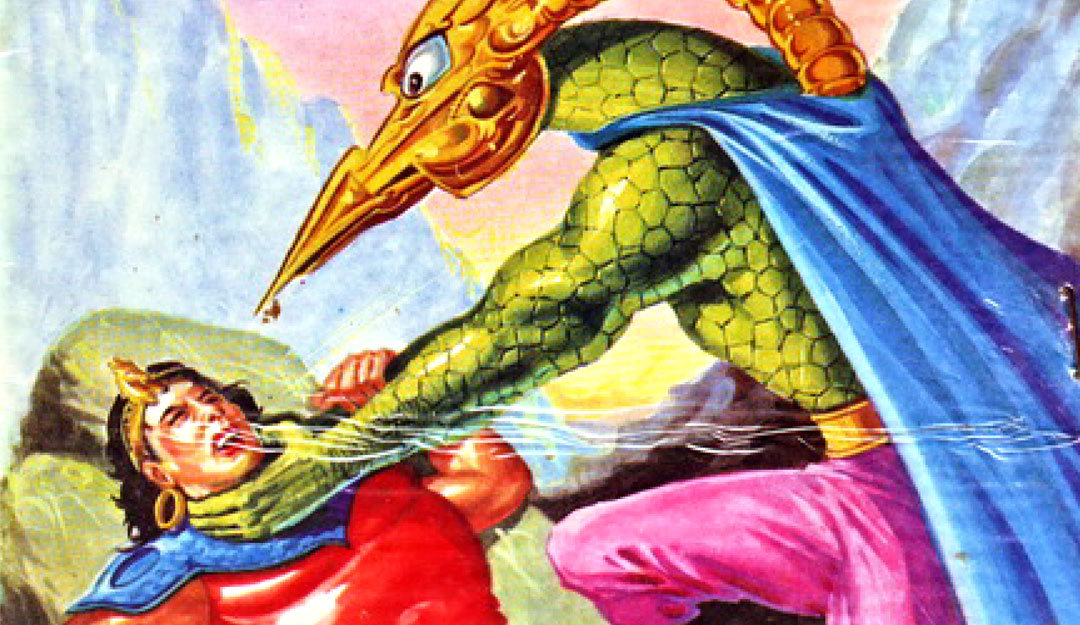
The Ashwaraj series was a unique historical-fantasy saga, revolving around the Suryavanshi prince Ashwaraj of an unknown period; his eccentric Panchashva (five horses) and his justice-loving nature set him apart from other heroes. Raj Comics’ presentation, No. 564, “Kalyug,” not only gives an unexpected twist to Ashwaraj’s story, but it also goes beyond its time and comments on some serious social and environmental issues. Adorned by the writings of Tarun Kumar Wahi and the art of Milind Misal and Vitthal Kamble, this comics is more than a simple ‘fish-out-of-water’ story, as it is a classic ‘dharma versus unrighteousness’ struggle, which is painted on a dystopian future canvas of science-fiction.
The essence of the plot: the leap from past to future
The “Kalyug” comics picks up where its previous episode “Ashwaraj” ended. The reader is told through a brief recap how the villain Ashvabaz had planned to enter a colorful time-portal called ‘Bhavishya’ by looting Karu’s treasure. Ashwaraj’s Panchashva and Princess Kutumchumbi were also forced to join the horseman’s chariot in that circle. At the last moment Ashwaraj arrives and snatches away his treasure from Ashvabaz. In a fierce struggle, Ashwaraj decapitates the villain Ashvabaz and locks him in a dry well.But the tragedy had already happened. The princess and Panchashva had entered that portal. Before the portal could be closed, Ashwaraj also jumps into that colorful circle to save his loved ones.
This is where the real story of “Kalyug” begins. Ashwaraj reaches the other side of the portal into a world he had never imagined. It was a ‘grand city’ of skyscrapers and bustling buildings, where flying cars written ‘Raj’ and ‘Hard’ were floating in the air. It was like a dream city, but this dream was soon going to turn into a nightmare.
Ashwaraj, suffering from thirst, moves towards a reservoir, where he meets an Ashvamanav (half horse, half human) who is trying to drink water. Then a horse-soldier (soldier of the same species) comes there and ruthlessly pounces on the poor horseman for trying to ‘touch’ the water. He cuts off both his hands and scoffs at him by hanging them on a spear. When he’s about to kill that helpless creature, he declares — “It won’t tear the chest of the earth… Because oppression rules here. Sin and tyranny are religion… That’s it… Kalyug!!”
Ashwaraj, who came from the era of ‘Dharma’ and ‘Nyaya’, cannot tolerate this barbarity. He teaches the soldier a lesson by snatching the spear from him. He talks to the dying horseman, whose name is Ghodak. Ashwaraj cauterizes the blood flowing from the horseman’s severed hands by warming his sword and saves his life.

Ghodak becomes the guide of Ashwaraj and makes him aware of the reality of this Kalyug. This city belongs to the future, but it is a bleak future. Ashwaraj sees the ‘pollution control device’ and Ghodak tells him that it is to clean up the pollution caused by “increasing population”, “mechanical movement” and “indiscriminate cutting of trees”.
The most shocking moment of the story comes when they hear a scream and reach an alley. The dead body of another horseman is lying there. Why was he murdered? Ghodak tells — “Only for a pair of shoes.” Ashwaraj is stunned to hear this. Ghodak tells him the bitter truth of this world, “Maybe that’s why you’ve lost both your hands as the price of water… A drop of water is sold here, Ashwaraj!”
Ashwaraj gradually understands that in the future he has come to, there is a severe shortage of resources, inhumanity is at its peak, and the law of ‘whose stick, his buffalo’ (Might is Right) works. Horsemen are oppressed and considered lower-class citizens here.
The story gains momentum when Ashwaraj and Ghodak reach Ghodak’s settlement. The local goons there harass them, but Ashwaraj, a Suryavanshi warrior, defeats them. For the first time, the buried horsemen of the colony see someone fighting for them. They start seeing their Messiah in Ashwaraj.

This news reaches senior officers of the horse soldiers. They attack the settlement with their mechanized horse forces. Ashwaraj, who till now was only searching for his princess and Panchashva, now bears on his shoulders the ‘dharma’ of leading these helpless people. He inspires the Ashwamanavas to fight. There is a fierce battle, in which Ashwaraj, with his fighting skills, frees them from the enemies.
Two big twists come at the end of the story. First, Ashwaraj finds his loyal Panchashva and Rath, who were being held by the soldiers. Now he was free to fight with all his might. And second, the biggest shock — when Princess Kutumchumbi appears. But she seems to be standing with the rulers of this future world, not as a helpless hostage. She orders Ashwaraj to stop the war. And then in the final panel, the comics reveal the real ruler of this world — he is none other than the head of the villain Ashvabaz, who is kept alive in a jar and who is ruling the entire city through machines.
“Rest in next issue…” This exciting comics ends with this line, leaving the reader with an incredible shock and a restless wait for the next issue.
Characters of Kalyug
Ashwaraj: The hero of this comics is truly a symbol of ‘dharma’. He is a king and has the blood of ‘Praja-Rakshak’ in his veins. When he sees the inhumanity of ‘Kalyug’, he cannot turn away. His character is that of a classic hero — heroic, just, and full of compassion. His real struggle is not so much with external enemies as with the decadent values of this new age. He is a ‘Messiah’ (saviour) for this world.
Ghodak: Ghodak is the soul of this comics. He is the ‘common man’ of this bleak future, a victim of oppression. His severed hands become a permanent symbol of the cruelty of this era. He acts as a guide for Ashwaraj, and through him the reader is able to understand the horrors of this dystopian society.
Ashvabaz: This portrayal of Ashvabaz as a villain is extremely frightening and creative. Only his head is alive, which shows how difficult it is to root out ‘evil’ or ‘unrighteousness’. He is ruling the entire future on the strength of his intelligence and technique, despite being physically disabled. This makes him a very dangerous and memorable villain.

Princess Kutumchumbi: Her mysterious cover-up at the end of the comics adds a new dimension to the story. Has she also met the villain? Or does she have some compulsion? This question takes the reader’s curiosity to its peak.
Themes and Analysis: Not Just a Comics
If you consider “Kalyug” to be just a fantasy-action comics, it would be unfair to it. Tarun Kumar Wahi has touched upon some very serious and ahead-of-his-time topics through this story:
Modern interpretation of “Kalyug”: The author took the mythological concept of ‘Kalyug’ and transformed it into a futuristic, dystopian setting. This ‘Kalyug’ is not a religious era, but a future born of human greed, selfishness, and cruelty. Here ‘sin’ and ‘unrighteousness’ are ‘religions’, because society has adopted them.
Serious social commentary: This comics, despite being written in the 90s, directly hits today’s issues.
Environmental Destruction: The mention of “indiscriminate felling of trees” and “pollution” clearly shows that the author was understanding these concerns of the future. This connects directly with today’s discussion of ‘climate change’.
Resource Scarcity: “A drop of water sells here” — a line very close to the truth in many parts of the world today (like Cape Town, or many cities in India itself). This is a frightening signal towards future ‘water-wars’.
Economic Inequality: “Murder for a pair of shoes” shows the gap between two sections of society. On one side there are grand buildings and flying cars, and on the other side there are settlements like Ghodak’s where people are dying for basic needs.
Inhumanity and the Decline of Values: This comics shows what society looks like when values like compassion, kindness, and philanthropy are lost. The cruelty of horse soldiers and the indifference of the people is the real face of ‘Kalyug’. The arrival of Ashwaraj is an attempt to rekindle the seeds of ‘humanity’ in that sleeping society.
Art and Writing Style
Writing: Tarun Kumar Wahi’s writing is well done and impressive. The dialogues are short, sharp, and soulful. “That’s it… Kalyug!!” or dialogues like “Here a drop of water sells” leave a deep impact on the reader’s mind. The pace of the story is excellent; it captivates the reader from the first moment and brings out a new adventure or mystery on every page. World-building work has been done very efficiently through Ghodak.
Artwork: The art of Milind Misal and Vitthal Kamble is the hallmark of that classic era of Raj Comics. The depiction of the future city (cityscape) is imaginative. Flying cars and quaint architecture are very advanced for that era. The action scenes are very dynamic and full of energy. The expressions of the characters, especially the anger of Ashwaraj, the suffering of the horseman, and the cruelty of the horse-soldier, have been depicted very well. The most effective panel is the hand-cutting scene of the horseman, which sets the motif of the story even in its brutality. The use of colors is bright and attractive, which is in line with the printing technology of that era.
A Timeless Masterpiece
Raj Comics’ “Kalyug” is not just a comics, it is a warning. This is a scary picture of a future where we can reach today because of our actions (destruction of the environment, increasing inequality, inhumanity). This saga of Ashwaraj picks him up from an ordinary prince and establishes him on the post of a ‘dharma-warrior’.
The comics is still relevant today for its exciting plot, powerful action, memorable characters, and above all, its deep social message. It is a testament to the maturity and vision of 90s Hindi comics writers and artists. The exciting twist at which “Kalyug” ends makes it one of the finest ‘cliffhangers’ in Indian comics history. This is undoubtedly a precious gem of the treasure of Raj Comics, which every comics lover should read.
