


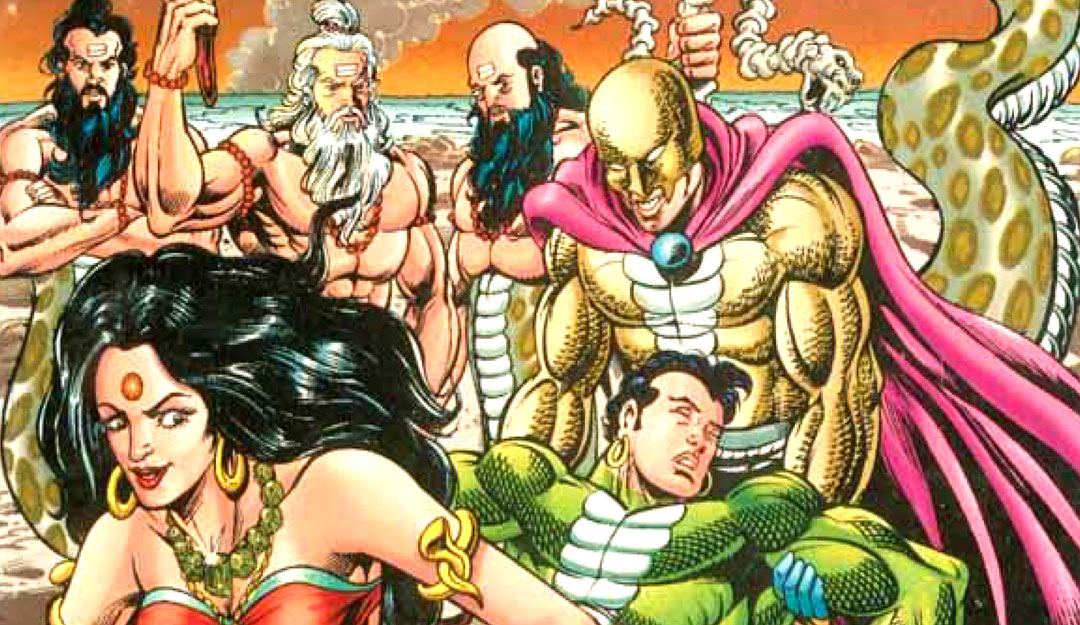
There are some comics in the history of Raj Comics which become milestones not only because of their story but also because of their presentation, a lot of powerful characters and deep plot-lines. ‘Death Penalty’ (number-0202) is also one of such special comics. This comic, written by Jolly Sinha and created by Anupam Sinha with a brilliant artwork of his own identity, brings the world of Nagraj to a new and very dangerous turn. This is not just a superhero story, but a big and exciting saga of the curse of immortality, hunger for power and the clash of ancient Tantra-vidya.
‘Death Penalty’, as soon as the pages are turned, clearly feels that it is not a common comic, but a deep and many-layered story which has been presented in comic form. The speed of the story, the confrontation of old and new enemies, and the increasing threats on Nagraj make this issue Raj Comics’ ‘classic’. Writer Jolly Sinha has very neatly woven the threads of the series ‘Khazana’, while Anupam Sinha’s artwork brings alive every action and every emotional moment, especially his art in his impressive portrayal of villains — Nagpasha, Asthisup, Nagina and Garalgant — shines brightly.
Story: A tremendous plot with many layers
The story of ‘Death Penalty’ runs on not one, but several parallel tracks, which finally meet in the Central Hall for a banging climax. The beginning of the story is so dramatic and shocking that the reader is immediately immersed in it.
Nagpasha’s curse and Gurudev’s cunning plan:
The story begins with Nagpasha, Nagraj’s old and immortal enemy, who attempts suicide. Due to not getting the treasure again and again and the burden of immortality, death has become a relief for him. Gurudev saves his life and tells him the real secret of the treasure, which has ‘three Nagamaniyas’ — which have the power to rule the past, present and future. These gems shall only work if they are applied to a golden statue of ‘Trifn’ serpent.
Gurudev’s real eye is not on the treasure, but on the manuscript in which the entire history of Nagraj and his dynasty and the knowledge of the treasure are recorded. In his jealousy, greed and desire for power, Gurudev makes Nagpasha a pawn and sets out to trap Nagraj in his tricks.
Arrival of Asthisup and difficult test of Nagraj:
As per Gurudev’s plan, some terrorists hijack a plane to drag Nagraj towards the place where the treasure is on display. Nagraj enters the plane by making a ‘snake-tunnel’ and there he encounters the bone-like being, a Tantra-techno human, whose bones were like sharp needles and who could suck blood.

The strength of Asthisup was so dangerous that it even stopped Nagraj from turning into wishful particles. This entire part shows the deadly combination of system and technology. Nagraj changes his strategy and defeats Asthisup by weaponizing his own horn, but before he can know the name of his creator, Gurudev destroys Asthisup from a distance.
Movement and emergence of Visarpi in Nag-Dweep:
On the other hand, the story takes us to Naga-Dweep (Nagamani Island), where the fourth death anniversary of Visarpi’s father Maniraj is going on. Visarpi, Nagraj’s girlfriend and daughter of Maniraj, is currently the executive ruler of the island.

This is the time when rebellion erupts. A very powerful rebel snake named Danshak attacks the palace. Danshak’s power was amazing, but Visarpi, erudite in the art of warfare, defeats him. This character of Visarpi is a strong symbol of women power and also proves that she has full ability to take over the reins of Nag-Dweep. This sub-story points to Visarpi’s larger role in the future of Nagraj.
The Great War of the Central Hall and the Dangerous Game of Nagina:
The climax of the story comes in the Central Hall, where the treasure is displayed. Nagraj and his companion Bharathi are there under guard, while Gurudev and Vedacharya are studying the manuscript. It is at this place that all the characters and their powers come face to face.
Clash between Gurudev and Vedacharya:
Gurudev attacks Vedacharya so that he can snatch the manuscript. Vedacharya destroys Gurudev’s counterpart ‘Tarwal’ with a trap, but Gurudev, with the help of his man Kentucky, sends Bharati and Vedacharya away and takes the manuscript in hand.
Nagina’s explosive entry:
A big twist in the story comes when a Tantra-power attacks Nagpasha — and it is about to attack Nagina. The same Nagina, who had earlier failed to grab the treasure by befriending Nagraj, has now returned as a very powerful Tantrika.
Roar of Garalgant:
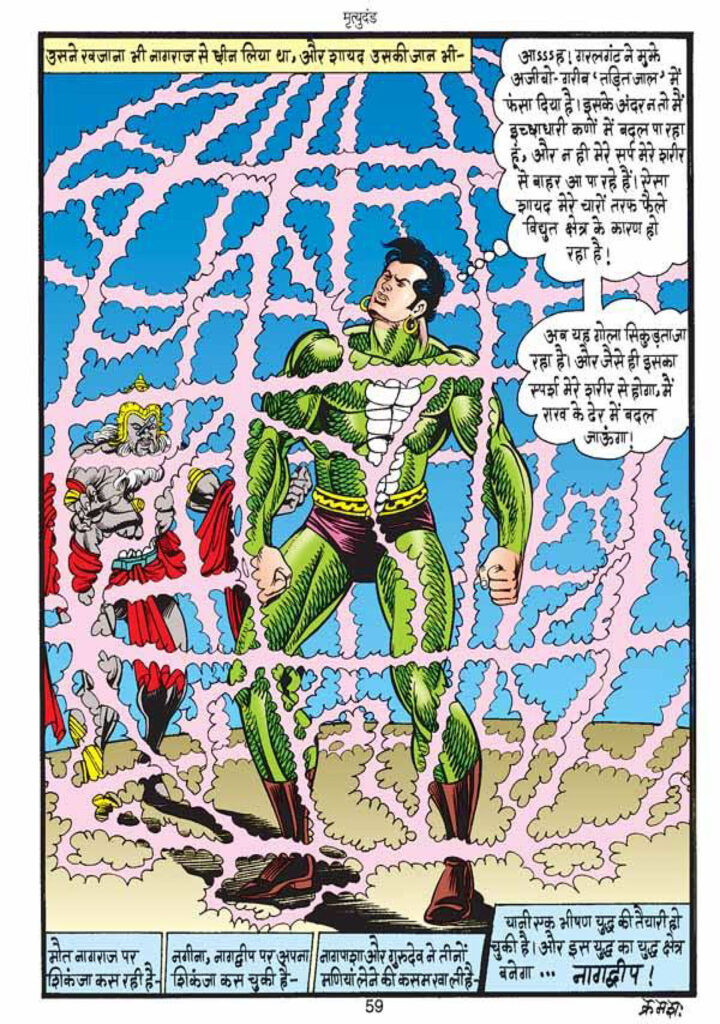
Nagina sends the Yaksha-demon Garalgant (whose power is said to be equal to that of the god Kalajayi) under her to Nagraj. Trapped in the ‘lightning-net’ power of Garalgant, Nagraj is unable to even turn into wishful particles and almost reaches the verge of turning into ashes.

The plight of Nagpasha and Kaaldoot:
Nagina defeats Nagpasha by cutting him with a stone wheel and makes him her slave. After this, when she reaches Nag-Dweep, she subdues the ruler Kaaldoot with her ‘Mantralaya Ankush’ and makes him a slave and declares herself ‘Empress’ of Nag-Dweep.
Analysis of characters and their roles
Nagaraj (Nagraj):
In this issue, Nagraj looks more like a pawn than a superhero. He defeats Asthisupa with his traditional art of warfare, but his strength slows down a bit in front of the Tantra powers. His competition extends from science (Asthisupa) to pure Tantra-vidya (Garalgant, Nagina), which shows that his challenges are continuously increasing. Finally getting caught in the trap of Garalgant is like some ‘death penalty’ for him — a danger where all his powers are neutralized.
Gurudev (Gurudev):
Gurudev is the real ‘mastermind’ of this story. He is not just an old Tantrik, but a symbol of the jealousy and hunger for power associated with the lineage of Takshakaraja. Sacrificing one’s own image (Tarwal), his passion for the manuscript, and using Nagpasha as a pawn, all bring out his cunning, ruthless, and greedy nature.
Nagpasha (Nagpasha):
Nagpasha is the most emotional character in this story. Immortality has not become a boon for him, but the biggest curse. His death wish turns him into a sorrowful villain. At the hands of Gurudev he becomes a helpless puppet, who just wants treasure. In the end, Nagina’s bitter insult and slavery proves how useless he can prove to be if immortality is not accompanied by purpose and power.
Nagina (Nagina):
Nagina is the strongest and most important character in this comics. Her arrival changes the power balance of Nagraj’s entire world. She is an adversary who does not rely only on force (Garalgant), but on both Tantra and the mind (taming the Kaaldoot with the Mantralaya Ankush). Her objective is clear, to control Nagraj and become the ruler of Nag-Dweep. Nagina’s confidence, her ruthlessness and finally her victory (trapping Nagraj with Garalgant and enslaving Kaaldoot) make her one of the most dangerous female villains of Raj Comics.
Kumari Visarpi (Kumari Visarpi):
Visarpi’s sub-plot is like an urgent breath in the main story. Defeating Danshak and her determination to protect Naga-Dweep suggests that the lineage is in safe hands even in Nagraj’s absence. Her character lays a strong foundation for the upcoming ‘treasure’ series.
Art, design and portraiture (Anupam Sinha’s Artistry)
Anupam Sinha’s art is the life of this special issue. 90s Raj Comics identity — big, lively and punchy panels — looks at its best in ‘Death Penalty’.
Action sequence: From plane hijacking to Nagraj’s fight with Asthisup and Garalgant — the action scenes are very smooth and fast flowing. Especially the skeleton-like body of Asthisupa and the huge demon-like image of Garalgant seem very powerful.
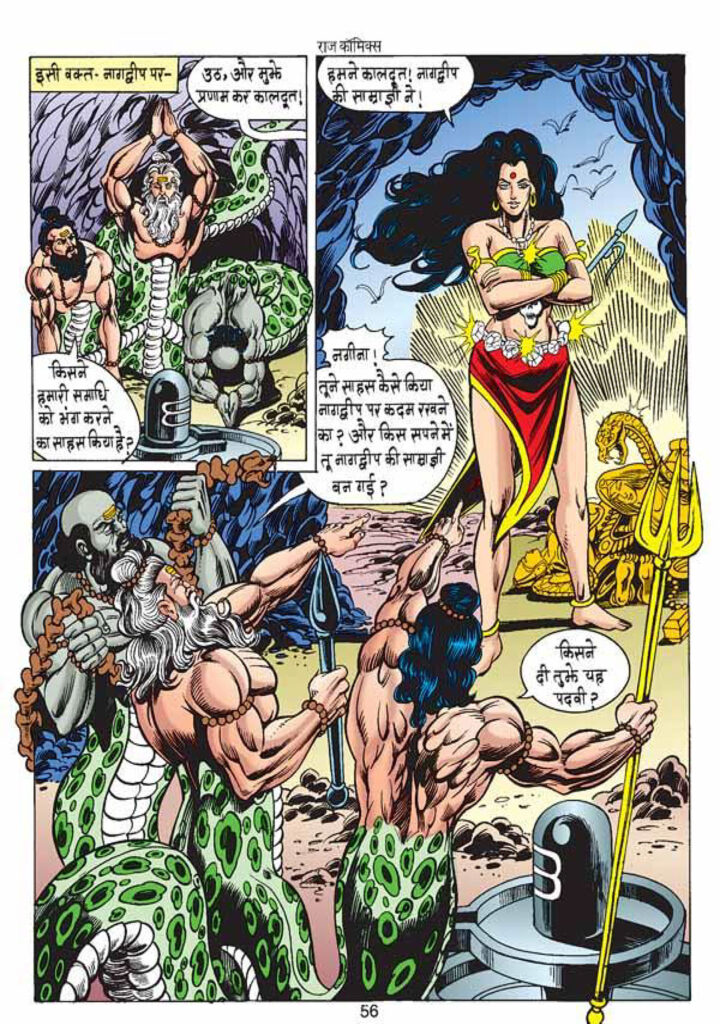
Emotional depth: Nagpasha’s pain and frustration are clearly visible in the early panels of his suicide attempt. Visarpi’s firm facial expressions and Nagina’s clever smile also fully reflect their personality.
Design: The design of the villains is amazing. The bone-like body and its poisonous needles, the electrical web of Garalgant, and the beautiful but dangerous form of Nagina all combine to make this comics visually stunning.
Critical approach and conclusions
‘Death Penalty’ is a comics yet gives the experience of a whole series. The author has tried to cover big topics like the curse of immortality, the tug of power, old Tantra-vidya and the struggle of a superhero in a single issue — and the funny thing is that he has been successful in it to a great extent.
Positive aspects:
Deep and layered story: It comes with many sub-plots and many new characters, keeping the comics fun and full of adventure from beginning to end.
Magnificent development of Nagina: Nagina rising from a minor character to becoming the main villain and taking over a powerful character like Kaaldoot — makes the stakes in the story very high.
Strong Action: Anupam Sinha’s action panels are bang-on as always — especially the end of Asthisup on page 49 and Nagraj falling into the trap on page 58 are long remembered scenes.
Some critical points:
Too many incidents: By adding so many characters and incidents (suicide, kidnapping, Asthisup, manuscript, Nag-Dweep war, Danshak, Visarpi, Central Hall war, Nagina, Garalgant, Kaaldoot) in a single issue, the story becomes very fast at times. The reader has to stop and understand things from time to time.
Climax lack: The comics end with a bad situation for Nagraj, falling into the trap of Garalgant. This clearly shows that the further story will be found only in the next issue. This ‘cliffhanger’ is intentionally created, but it makes this issue feel a little ‘incomplete’, as if there is still rest left.
Conclusion:
‘Death Penalty’ is one of the best stories of Raj Comics’ ‘golden age’. It touches not just a superhero’s win-loss narrative, but deep human and mythological themes such as immortality, power, and deception. Anupam Sinha’s tremendous drawing and Jolly Sinha’s multi-layered story together make this special issue an essential part of every comic lover’s library. For Nagraj this ‘Death Penalty’ proves to be a terrible start, hinting at the big war with ‘Nag-Dweep’ that will happen in the coming numbers. The story makes the reader both restless and curious, so that he waits for the next part.
