


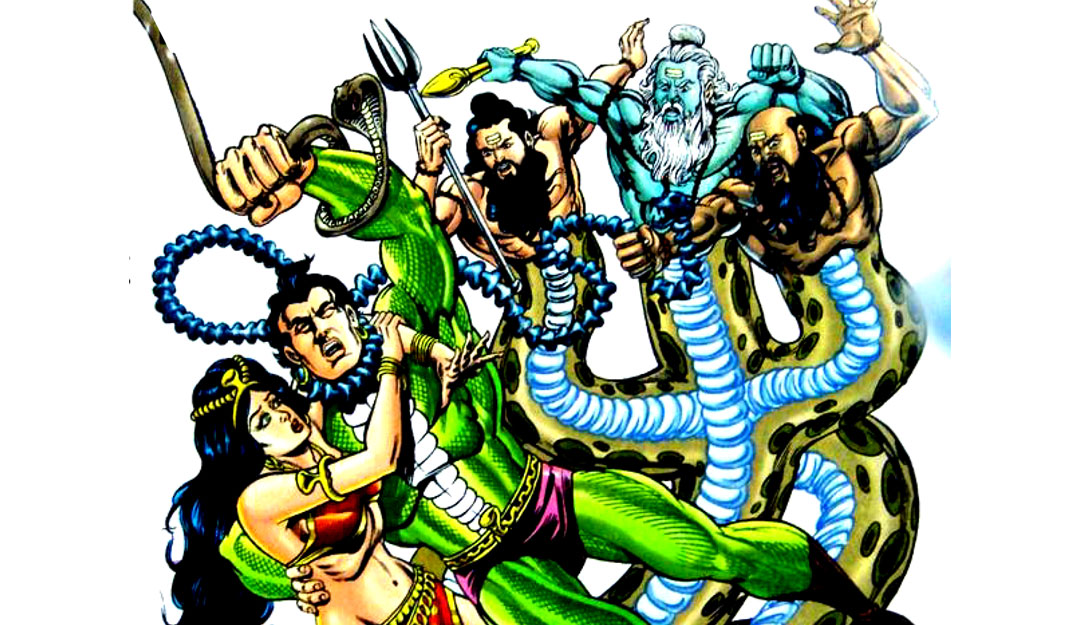
In the history of Raj Comics, the ‘Khazana’ series had created a new, larger and quite complex universe for Indian superhero stories. ‘Death Penalty’ special issue (#202) left Nagaraj trapped in the dangerous ‘Lightning Trap.’ ‘Nagadweep’ special issue (#206) breaks the same trap and starts a great war that will destroy Nagaraj’s identity, his lineage and his biggest enemy, and changes Nagpasha’s fate forever.
The pairing of writer Jolly Sinha and painter Anupam Sinha is seen at its top in this issue, where action, emotion and mental conflicts open together. This comics further builds the seriousness of the previous issue, pitting Nagraj against his biggest mental and physical enemy — Mahatma Kaaldoot.
The story of ‘Nagadweep’ shows the ongoing great conflict between power and thinking in the life of Nagraj, where he has to repeatedly use his scientific understanding and sharp mind to compete with divine, tantric and supernatural powers. This comics is such a mixed storm of personal, family and global danger for Nagraj, in which he gets trapped between Gurudev’s tricks, Nagina’s merciless ambition and the unique strength of Kaaldoot.
Preview and background of the story
The story of this comics starts from where the previous comics ‘Death Penalty’ ended. The focal point of the entire series is that legendary treasure of Nagraj, which contains three such gems (Gems) that can grant the bearer unlimited power to rule the past, future and present.

The story begins with a very tense scene. Nagraj is trapped in a “flattened sphere” (Lightning Sphere) created by the Yaksha-monster Garlgant. This scene shows the scientific thinking of Anupam Sinha. Usually superheroes break walls with their physical strength, but here Nagraj resorts to physics. He sees that the electric cage is in the air and ‘earthing’ is not happening. Nagraj removes the metal snake from his belt and sinks it into the ground and completes the circuit and releases the energy of the cage into the ground. This scene establishes that Nagraj is not only strong but also intelligent.
Liberation and boon of Garlgant
As soon as he comes out of the cage, Nagraj faces Garlgant. Here comes a turning point in the story. Nagraj understands that Garlgant is attacking not of his own free will, but under the influence of Nagina’s ‘Tantra Ankush.’ Instead of killing Garlgant, Nagraj uses his microscopic snakes (Microscopic Snakes) to pull out that Ankush.
This incident shows the greatness of Nagraj’s character (compassion). He even frees his enemy from pain. In return, Garlgant gives him a boon that in future the Ankush will never affect Nagraj. This one small plot point proves decisive at the end of the whole story.
Nagina’s conspiracy and the fall of Nagadweep
On the other hand, the second part of the story focuses on Nagina’s manipulations. Nagina, one of the most dangerous female villains in Raj Comics, also betrays Nagpasha. She makes Nagpasha her slave on the strength of Tantra Ankush. It was shocking for the readers to see that even a powerful villain like Nagpasha can dance to someone’s tune.
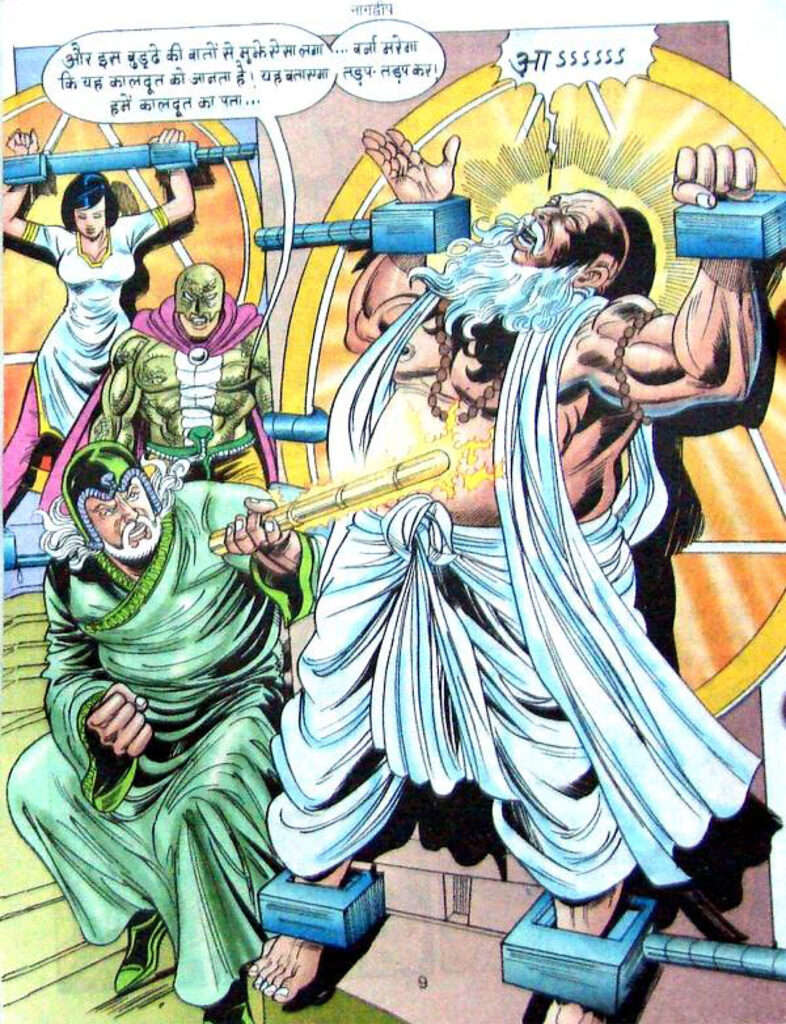
Nagina reaches ‘Nagadweep’ in search of treasure. Here the story takes an emotional turn. Kaaldoot, the protector of Nagadweep and a kind of guru/father-like Mahatma of Nagraj, gets trapped in Nagina’s trap. Nagina also makes him her slave due to the influence of Ankush. Nagadweep, once invincible, is now in danger due to its own protecting power (Kaaldoot).
Revolt of Visarpi
A civil war-like situation arises in Nagdweep. Visarpi, who is the daughter of Kaaldoot, sees that her father is under the control of Nagina and is oppressing his own subjects. The character of Visarpi comes here very bright. She chooses Raj-dharma between “Pitru-bhakti” and “Raj-dharma.” She leads the rebellion. This scene is a great example of women empowerment, where Visarpi takes up arms against her own father to protect her subjects as a warrior, not as a weak one.
Kidnapping of Dada Vedacharya and Bharati
Gurudev (Nagpasha’s guru) makes a different move to maintain suspense in the story. He kidnaps Dada Vedacharya and Bharati to find out the secret of the treasure. This subplot adds emotional tension (Emotional Tension) to the story as Nagraj now has to not only save the treasure, but also secure his family (Bharti and Vedacharya).
Characterization

Nagraj (Nagraj)
In this comics, Nagraj emerges as a complete warrior. He is ‘almighty’ but not arrogant. When he fights Garlgant, he is aggressive, but when he discovers that Garlgant is a slave, he becomes kind. His helplessness and then the spirit of return in front of Nagina and Kaaldoot keep the readers engaged. His biggest weapon is his ‘wishful power’ and ‘diplomacy.’
Nagina (Nagina)
Nagina is set as the main villain (Main Antagonist) in “Nagadweep.” Her laughter, her confidence and her nature of using others and throwing them away make her creepy. She proves that she is not only a sorceress, but also a vicious strategist by controlling both Nagpasha and Kaaldoot.
Nagpasha and Gurudev (Nagpasha & Gurudev)
Usually Nagpasha is the ‘Main Villain’, but in this story his condition is shown to be pathetic. He becomes a slave to Nagina, marking his character’s downfall (Downfall). However, Gurudev’s presence ensures that Nagpasha’s camp still remains in the game. Gurudev’s loyalty and cunning balance the story.

Emperor Kaaldoot (Emperor Kaaldoot)
The character of Kaaldoot is the most tragic in this story. A great warrior and knowledgeable Mahatma, who is forced to attack his own people and his daughter against his will. Showing a mixture of anger and compulsion on his face is a huge success for the artist.
Visarpi (Visarpi)
Visarpi is the ‘undeclared heroine’ (Unsung Heroine) of this story. When Nagraj was not there, she took charge. Her leadership skills and the art of war (Combat Skills) are amazing. Her fearless standing in front of Nagina suggests that she is Nagraj’s lover as well as an independent warrior.
Illustration and art side
Anupam Sinha ji’s artwork is the life of this comics.
Portrait of Nagdweep: The way he has put Nagdweep on paper is amazing — a mixture of advanced technology (Futuristic Tech) and ancient architecture (Ancient Architecture). The buildings, laboratories and seashore visible in the background have amazing detailing in every panel.
Action Scene: The depiction of the muscular structure (Anatomy) and movement (Movement) of the body during the battles of Nagraj and Garlgant seems lifelike. When Nagraj avoids the electric cage, the use of lightning effects is excellent.
Facial expressions: Brutality on Nagina’s face, firmness on Visarpi’s face and emptiness on Kaaldoot’s face (blank expression of a slave) are carved very closely.
Color Combination: Sunil Pandey’s color combination does justice to the mood of the story. Dark and mysterious colors have been used in the scenes of Nagina, while the scenes of Nagdweep are full of bright and technical colors.
Dialogue and Screenplay Jolly Sinha’s script is tight. The story does not slow down anywhere.
Dialogues: Dialogues have drama (Drama) which is liked by Indian readers. For example, when Nagina says, “Now this whole Nagadweep is my slave,” it feels like a shivering force.
Humor: Intermittent conversations between Kentuki and Nagpasha or Nagraj’s own comments lighten the atmosphere a bit, although this comics is mainly serious.
Subject matter and symbolism

The basic theme of the entire story is ‘control’. Ankush is a symbol of power. The one who has control is the king. This shows that if power goes into the wrong hands (the gem), it brings destruction. The specialty of Raj Comics has been that it does not promote superstition, but presents it as a ‘technology’. Nagraj’s avoidance of electricity is science, while Ankush is system. In the end, Nagraj’s victory comes from the balance of the two. Garlgant’s gratitude towards Nagraj is a symbol of loyalty, while Nagina’s betrayal of Nagpasha shows greed for power.
Critical Analysis
Positive side (Pros):
The story progresses very fast. The reader is in a hurry to turn the page. Where is the treasure? What will happen to the gems? This mystery remains till the end. As mentioned earlier, the artwork is world class.
Downside (Cons):
For new readers who have not been able to read previous episodes (such as ‘Death Penalty’), it may be a little difficult to jump in the middle of the story. Excess of characters (Overcrowding) can sometimes confuse. Nagpasha’s fans may be disappointed as he is shown to be very weak and helpless in this issue. However, this was the demand of the story.
Place in the universe of Raj Comics
“Nagadweep” is important because it takes the world of Nagraj out of the ‘metropolis.’ Often Nagraj’s stories revolve around terrorists and urban crimes. But this story is fantasy (Fantasy) style. It has magic, monsters, flying snakes, and mysterious islands. This diversity makes Nagraj the most versatile superhero in India. This comics proves that Nagraj can also spy like James Bond and fight in the fantasy world like He-Man (He-Man).
Conclusion
Finally, “Nagadweep” is a “Must Read” (Must Read) comics. It is not just a children’s book, but a graphic novel in which politics, war, science and emotions are everything. The pairing of writer Jolly Sinha and painter Anupam Sinha has done wonders here. This comics teaches us that no matter how big the trouble is (even if you’re in an electric cage), one can get out of it with a cool head and intelligence. It also teaches that sometimes it is not necessary to kill an enemy to defeat him — making him your friend (like Garlgant) is a bigger victory.
If you’re a 90’s reader, this comics will take you to nostalgia (Nostalgia). And if you are a new reader, this is a great start to understanding the depth and quality of Indian comics. This special issue fully makes its value (20 rupees for that time) worthwhile.
Rating: 4.5/5
Verdict: A masterpiece that should be in every comics lover’s collection (Collection).
Additional comments
At the end of the review it is necessary to mention that the story does not end here. The final pages mention Trifna (Trifana), which deepens the mystery. This forces ‘Cliffhanger’ readers to buy the next comics. The way Nagina and Nagraj come face to face and Trifana’s secret is revealed from behind lays the foundation for an epic finale. Thus, “Nagadweep” is like a precious gem embedded in the crown of Raj Comics.
