


Radha Comics has given many memorable superheroes to Indian readers, like ‘Judo Queen Radha’, ‘Shaktiputra’ and ‘Jaambaz Jwala’. The comics we are going to review today are a great offer of this same publication—”Janbaaz Jwala”. This comic is not just a story of the origin of a superhero (Origin Story), but also a fantastic blend of science fiction (Sci-Fi) and fantasy (Fantasy) of the time. The pairing of writer Rajat Rajvanshi and painter Parvinder Mishra has made it a memorable and interesting experience.
In this review we will analyze in depth the individual aspects of the story, the characterization of the characters, the portraiture style and the flow of the story.
The rise of the present from the womb of the past

The story begins with a flashback (Flashback), which takes us back 100 years. The place is—Magnum Islet (Magnum Island). The island was once a center of science and research, where the great biologist Dr. Mikhail Vasukov was conducting experiments challenging the laws of nature in his laboratory. He had collected eggs and sperm from many animals, which were part of some big plan for the future.
But destiny had something else in store. A severe earthquake and volcanic eruption devastated the entire island. Dr. Vasukov’s laboratory and his dreams were buried under debris and lava. This beginning creates curiosity in the mind of the reader as to what will be left after that devastation?
Return to the present and arrival of new characters
The story progresses 100 years. We meet Dr. Vasukov’s descendants, his grandson and great-grandson, Andrey. They return to Magnum Island. Here the author has shown the difference of generations in a very beautiful way. While the grandfather is skeptical of his father’s decision to stay on the islet, Andrey, a young man of the 21st century, is impressed by the beauty and tranquility of the islet.
Here he meets Khurram, who has been taking care of the Vasukov family’s land for generations. Khurram is a symbol of loyalty, who protects his master’s property despite every difficulty. But a villain is also necessary in every story, and here he plays the role—Salman.
Conflict and mystery
Salman is a local strongman and greedy man. He once found silver jewelry in the excavation, and since then he believed that the treasure was buried under this ground. He continues to dig the ground, which Khurram opposes.
The story takes a turn when Salman takes Andrey and the grandfather to a big stone. Salman shows his strength and removes the heavy stone, which opens a secret path (stairs) below. Salman claims that this is the way to the treasure. There is greed in his eyes, while curiosity lingers in the minds of Andrey and the grandfather.
Underground laboratory and discovery of ‘flame’

As they descend the stairs, they reach a world that is cut off from the outside world. This is Dr. Mikhael’s safe part of Vasukov’s destroyed laboratory. The atmosphere here is mysterious. They find a skeleton, which belongs to Dr. Vasukov. They find a diary and a glowing diamond (natural flashlight). This diamond is small but important in the story, because it shows light in the dark—actually and also symbolically.
As they move, there is a feeling of warmth. And then, they see a wonderful view. A fire pit (Fire Pit), with flames rising, and a human sleeping among those flames. His body is shining like Kundan. This scene may be one of the most iconic scenes of Indian comics.
The human awakens and introduces himself as “Yug Purusha Jwala”. He bathes in fire. For him, fire is not heat, but life. He tells that he is Dr. Vasukov’s son—a creature that was created by science and raised by nature (volcano). It is a unique confluence of science and nature.
Deception and retaliation
Meanwhile, Salman shows his true colors. He goes out and blocks the secret path with a stone, trapping Andrey, the grandfather, Khurram, and Jwala inside. Salman’s objective is clear: capture of land and treasure.
The flame, which does not understand worldliness, shows its power. Together, he and the others try to remove the stone, but in the end Jwala opens the way with his strength. When they come out, it is revealed that Salman has created a ruckus. He has killed Majid, an elder of Khurram’s village, and forcefully taken his daughter Sona.

Final Battle (The Climax)
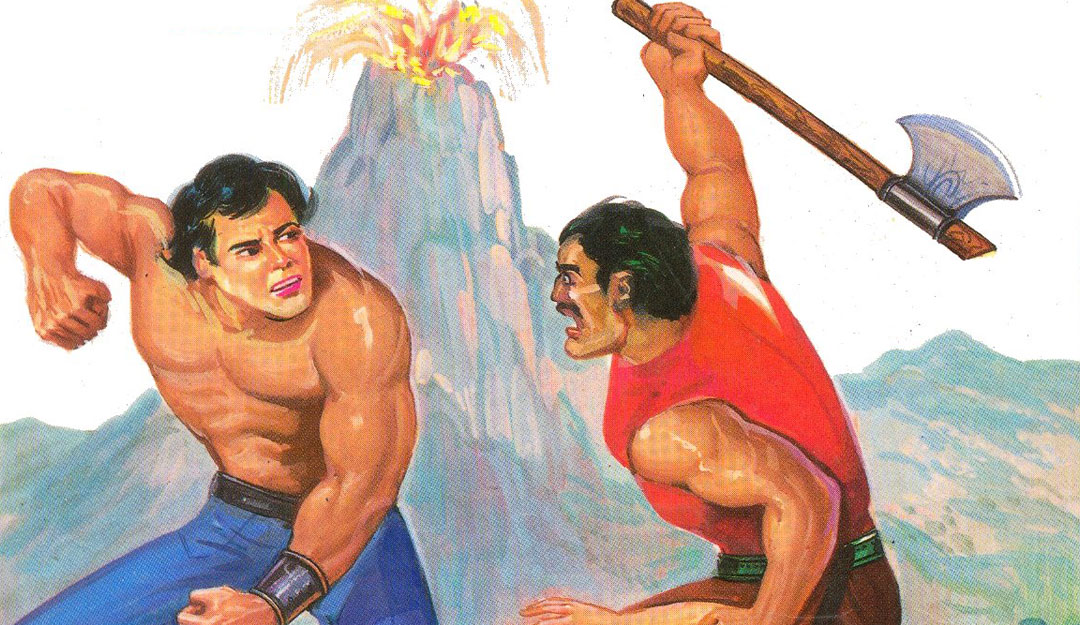
Jwala faces Salman in the climax. This fight is not just a physical one, but a fight for good and evil. Salman has an axe and is cruel, but Jwala has the power that was created by burning in fire.
Jwala foils every attack of Salman. When Salman attacks with an axe, Jwala’s body proves to be like steel. Finally, Jwala throws Salman into the air in a single punch. Salman dies after falling into the same volcano from whose fire Jwala was born. It is a brilliant example of poetic justice (Poetic Justice).
The story ends with Jwala’s decision. He decides to stay there and take care of his “mother” (Earth/Nature) and Sona instead of going to the city with Andrey and the grandfather. He feels that he is not ready for the outside world yet.
Character analysis
Brave Flame (The Hero)
Jwala, the hero of the comic, is not a common superhero. He is a ‘test tube baby’-like character made of genetic engineering and the natural forces of volcanism. His naive personality keeps him away from the deceitfulness of the world (like Salman’s deception), while his powers include the ability to survive fire, superhuman strength, and possibly longevity. Flame symbolizes both forms of nature—raudra and protector.
In contrast, Salman represents the classic villain of 90’s Hindi films and comics. His entire character revolves around greed and cruelty for wealth and sexuality (his attachment to gold). Killing an elderly person like Majid shows his cruelty. Salman is in complete contrast to Jwala’s innocence and natural power, which shows the clash of human greed and nature.
Andre and Grandpa
Both these characters are the architects of the story. The grandfather is a link to the past, who knows Vasukov’s legacy, while Andrey represents the reader—new, curious and adventure-loving.
Writing and dialogue
Rajat Rajvanshi’s writing style is very lively and captivating. The story remains interesting on every page. The dialogues have a dramatization that was typical of the time. For example:
“I’m era man… Era male flame… Fire can’t burn me… Fire is my life.”
“It’s Earth… I’m on earth… That’s sky.”
These dialogues show Jwala’s character well. He sees the world like a child, but speaks as if he is a god. The story also has a mixture of science and superstition. Khurram and the tribal people consider Jwala as a ‘god’, while the grandfather knows that he is a miracle of science. The author has presented it very minutely.
Art and portraiture

Parvinder Mishra’s portrayal is the life of this comic. It shows the special style of 90’s Indian comics—dark colors, angular faces, and vigorous action lines. The use of colors is special, especially red, yellow, and orange, which give a feeling of ‘heat’ and ‘energy’ in the story in the scenes of volcano and flame. The action sequences are shown in a very dynamic way; as when Jwala tosses Salman into the air, the panel layout further increases that speed and impact. Also, attention is paid to the background—Magnum Islet forests, destroyed laboratory, and volcanoes—which further enliven the story.
Thematic analysis
The main theme of ‘Jwala’ comic is nature versus man’s greed. Dr. Vasukov’s tampering with nature in the name of science has disastrous consequences, while Salman’s digging of the earth for money causes his death. On the contrary, the flame is completely with nature (fire), which is why it is alive and powerful.
Also important in the story is the search for origins and identity (Origin and Identity). Jwala’s entire journey revolves around the question of who he is, who his father is, and why he woke up 100 years later—This ‘self-discovery’ theme makes him different from other action heroes. Finally, the flame’s stay on the island shows its duty of conservation. He is not just a superhero, but a protector of his roots and the place that gave birth to him, and shows his devotion to nature.
Conclusion
‘Janbaaz Jwala’ is not just a 7 bucks comic, but it is also a document of that period. It shows how Indian comics writers were adapting Western superhero concepts (such as Tarzan, He-Man, Hulk) to the Indian environment and emotions.
Positive side:
‘Jwala’ comic instantly captivates readers with its fast-paced storylines. The hero’s unique origin—a mix of genetic engineering and natural forces—makes it special. Parvinder Mishra’s brilliant and colorful illustrations give the comic a lively energy, especially in the volcano scenes. Simultaneously, the story gives a clear moral message—the power of nature in the face of human greed and finally the victory of good over evil.
Downside:
The story may seem a bit predictable, especially Salman’s betrayal.
The arguments of science are a little weak (like sleeping 100 years in a fire), but in the world of comics it can be accepted under ‘Suspension of Disbelief.’
Overall, ‘Janbaaz Jwala’ is an entertaining and readable comic. If you want to remember the old days of Indian comics or know what kids read in the 90’s, this comic is a great choice. It not only entertains, but also reminds us that real power lies not in the ‘fire’, but in the ‘heart’ that controls it.
