


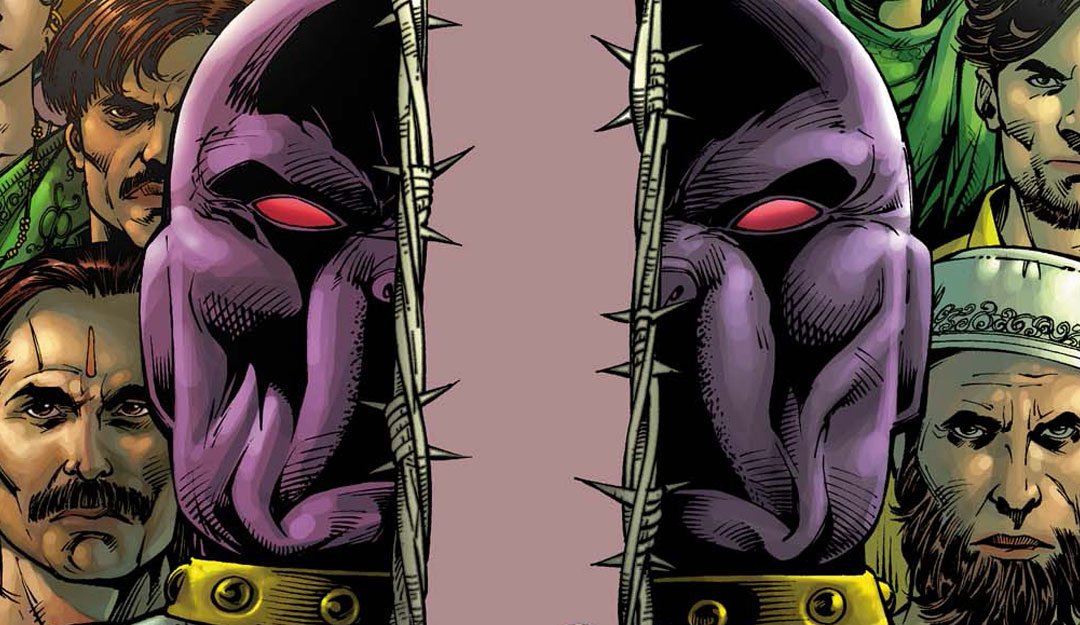
The stories of ‘Doga’, the most brutal, tough, and down-to-earth hero of Raj Comics, have always revolved around cleaning up the mess of society. Doga has never been a shining hero, but rather a response to crime thriving in dark alleys. But the “Apna Bhai Doga” series, written by Tarun Kumar Wahi and presented by Sanjay Gupta, goes to a different level. Here, Doga is not just fighting criminals, but he is also clashing with a mindset and an illusion that has the power to burn the entire city of Mumbai to ashes.
In this review, we will try to understand how the image of an anti-hero is tried to be branded as ‘racist’ as part of a well-planned conspiracy, and how the same hero is trying to save his existence, his identity, and the definition of his justice.
Plot expansion: from a human tragedy to a market of hate
The story begins with a shocking incident. A school van meets with a terrible accident in front of Suraj’s eyes, in which many innocent children are badly injured. From here, the authors bring out the first major disease of society—corruption and insensitivity. The in-charge of the blood bank and the blood broker are seen dealing in death instead of serving humanity. They flatly refuse to give blood without taking money.
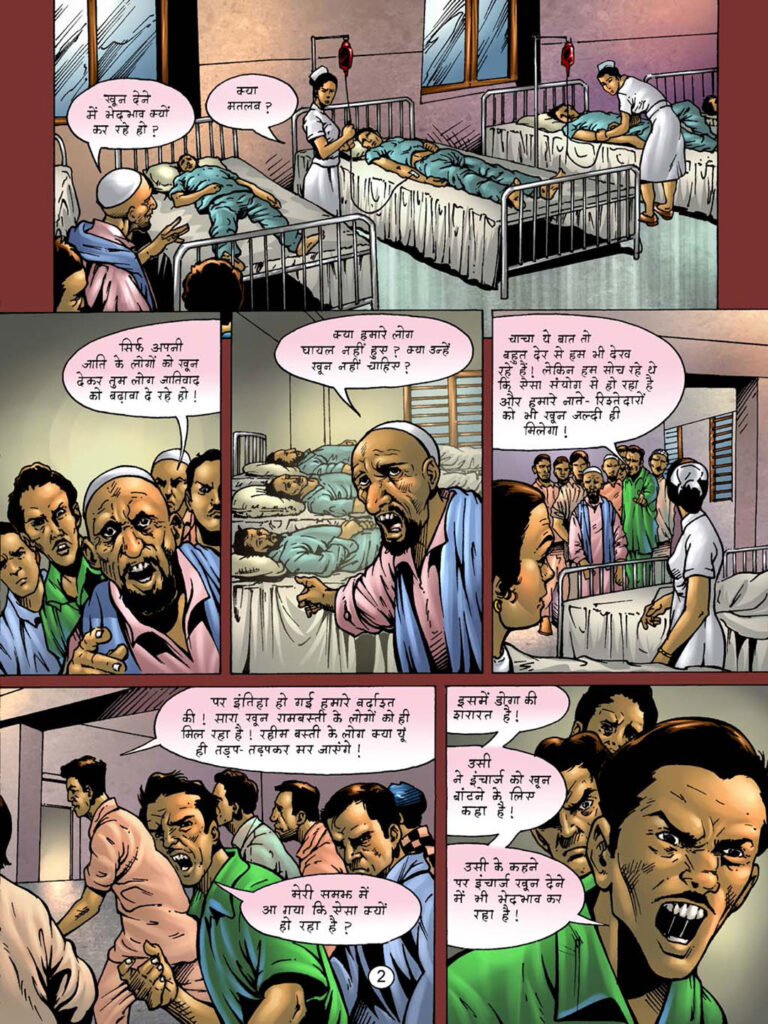
It is from here that the anger within Suraj, i.e., Doga, is born. As night falls, he teaches those pimps a lesson, but the story takes a really dangerous turn when the main villain ‘Bloodman’ enters. Bloodman is not just a criminal; he is a vicious mind that spreads hatred. He murders five Muslim agents among those injured by Doga and deliberately leaves the Hindu agents alive. All this is part of a deeper conspiracy, so that the message spreads throughout the city that Doga is a ‘Hindu protector’ and an enemy of people of other religions.
After this, the entire city gets burned in the fire of communal riots. ‘Rambasti’ and ‘Raheem Basti’ people, who once lived and ate with each other, now become thirsty for each other’s blood. The hospital, which is a place meant to save lives, becomes a den of hatred and poison.
Riot, rumor, and psychology

An important aspect of this review is that this comic shows how powerful a rumor can be. This issue clearly shows how a false statement—that Doga has killed only Muslims—breaks the fabric of the entire society. Blood distribution inside the hospital no longer happens on the basis of humanity, but on the basis of religion and caste.
Bloodman takes full advantage of this condition. He deliberately instigates riots so that the number of injured people increases and his blood business can earn more profits. This is a true picture of the white-collar criminals in our society who build their politics and business on corpses.
Doga’s inner duality and existential crisis
For Doga, this fight is no longer just about guns and punches. When he reaches the riot site, the Hindu mob calls him ‘their brother’ and starts considering him their Messiah. This becomes the biggest insult and the biggest crisis for Doga. Doga has always had the same principle—
“I don’t obey the law, I just erase crime.”
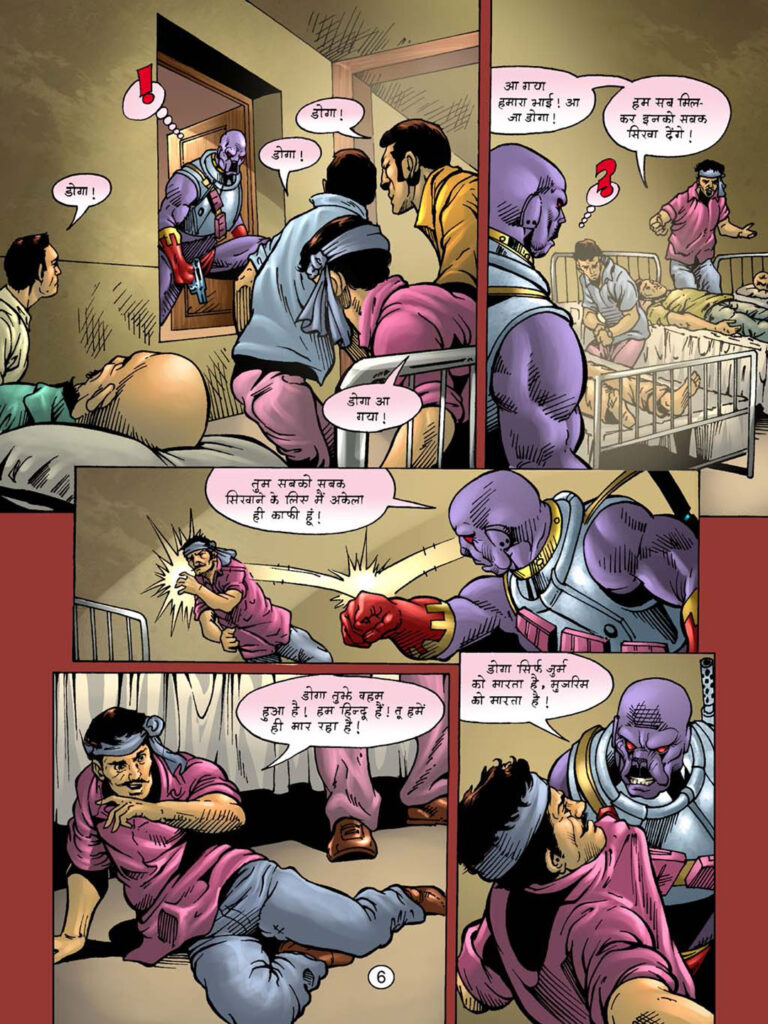
But when he is made the protector of a particular religion, questions arise about the fairness of his justice.
Doga’s words—“Will Doga be able to fight crime while carrying the stigma of being racist?”—clearly show his inner restlessness. He fears that if he is not able to erase this stain today, then in the future, whenever he punishes a criminal, people will look at him only from the perspective of religion. There can be no greater defeat for a hero than when his work is buried under his identity.
Supporting characters’ roles: Ginger Chacha, Monica, and Cheetah
The character of Ginger Chacha in the story acts as a moral light. When he himself goes to donate blood and the mob attacks him, this scene shows the defeat of humanity in a very painful way. Ginger Chacha explains to Suraj that sometimes retreating is the real bravery, especially to avoid a situation from worsening further.
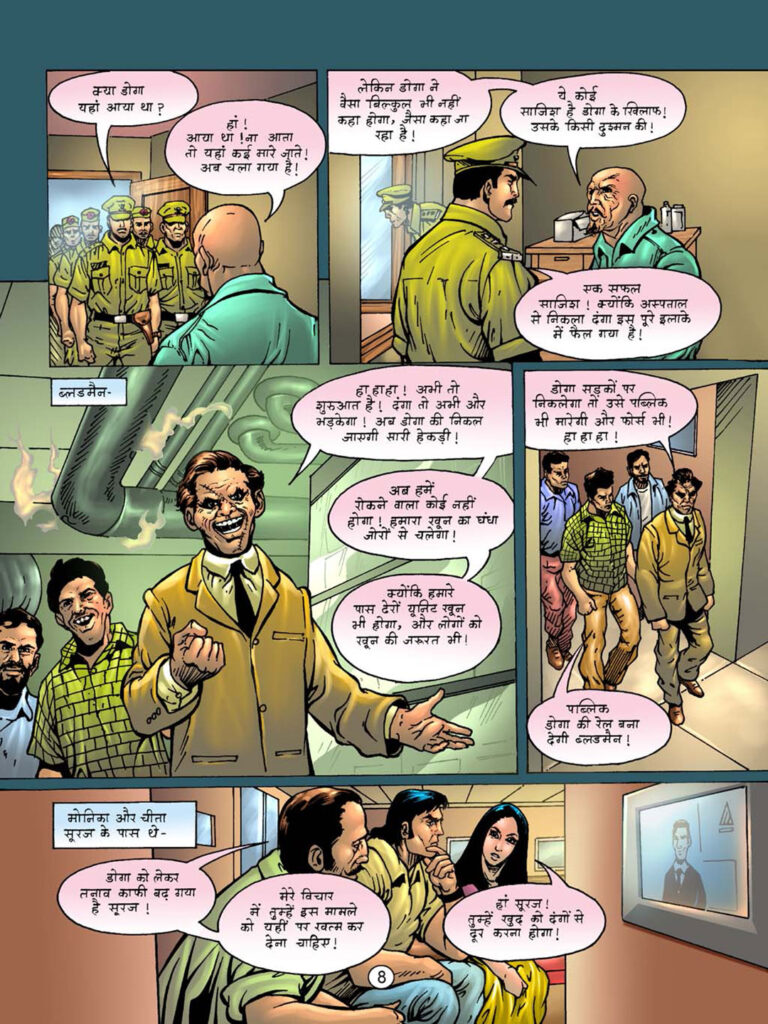
Monica and Cheetah try to convince Suraj that he should leave this matter to the police. But Suraj’s rebellious nature and his yearning for justice do not allow him to remain silent. He knows that the police can catch the rioters, but they cannot extract the poison that Bloodman has filled into the minds of society.
Villain analysis: ‘Bloodman’ – a modern-age monster
Bloodman is a symbolic villain. He represents those people who take advantage of society by creating cracks within it. His name, ‘Bloodman’, not only reflects his blood business, but also the hunger that is quenched by people’s mutual hatred and conflict. His end at the hands of Doga is not just the killing of a criminal, but the defeat of a mindset that survives by selling hatred.
Art, cinematography, and calligraphy (Art and Visuals)

‘Apna Bhai Doga’ is illustrated by Studio Image. The rawness visible in the artwork captures the tension and chaos of Mumbai—Doga’s workplace—very effectively. The use of red and orange colors in the riot scenes powerfully brings out the atmosphere of fire, anger, and devastation. The frustration visible on Suraj’s face and the strong will hidden behind Doga’s mask are finely engraved by the artist.
Sunil Pandey’s calligraphy further amplifies the power of the dialogues. Especially in scenes where Doga addresses the crowd, the choice and presentation of words become extremely effective.
Social and political relevance
This comic becomes even more relevant in today’s times. We are living in an era where even a small rumor spread on social media can become the cause of massive riots. ‘Apna Bhai Doga’ warns readers how dangerous it can be to view any hero or event through the prism of religion.

The comic sends a very clear message: “A criminal has no religion.” If a Muslim commits a crime, he is a criminal, and if a Hindu commits a crime, he is also a criminal. Doga’s mask with the symbol of a dog represents that he stands at a level of humanity where he recognizes only loyalty (to justice) and betrayal.
Shortcomings and merits of the story
Pros:
At that time, writing a comic on a sensitive subject like communalism was a huge risk, which Raj Comics took with full conviction. Doga is shown not merely as a fighting machine, but as a human being who can think, question, and feel disturbed.
The pace of the story is fast, keeping the reader engaged from beginning to end.
Deficiencies:
Some scenes contain excessive violence, which may not be suitable for very young readers.

The ending could have been expanded slightly more, especially in the part emphasizing society’s healing and reconnection.
Conclusion: An immortal masterpiece
‘Apna Bhai Doga’ is not just a comic book; it emerges as a social document. It tells us that truth and justice are the first to burn in the fire of hatred. Doga’s struggle reminds us that to create a better society, we must rise above our narrow and limited thinking.
Through this special issue, Raj Comics proved that comics are not just a medium of entertainment for children, but can also be a powerful platform to address serious and important issues. This Doga issue should be read by everyone who wants to understand the politics of hatred spreading in society.
At the end of the review, it can only be said that Doga “is our brother”, because he breaks the fear and silence within us that we often hide when witnessing injustice. This comic is a story worthy of being written in golden letters in the history of Doga.
