


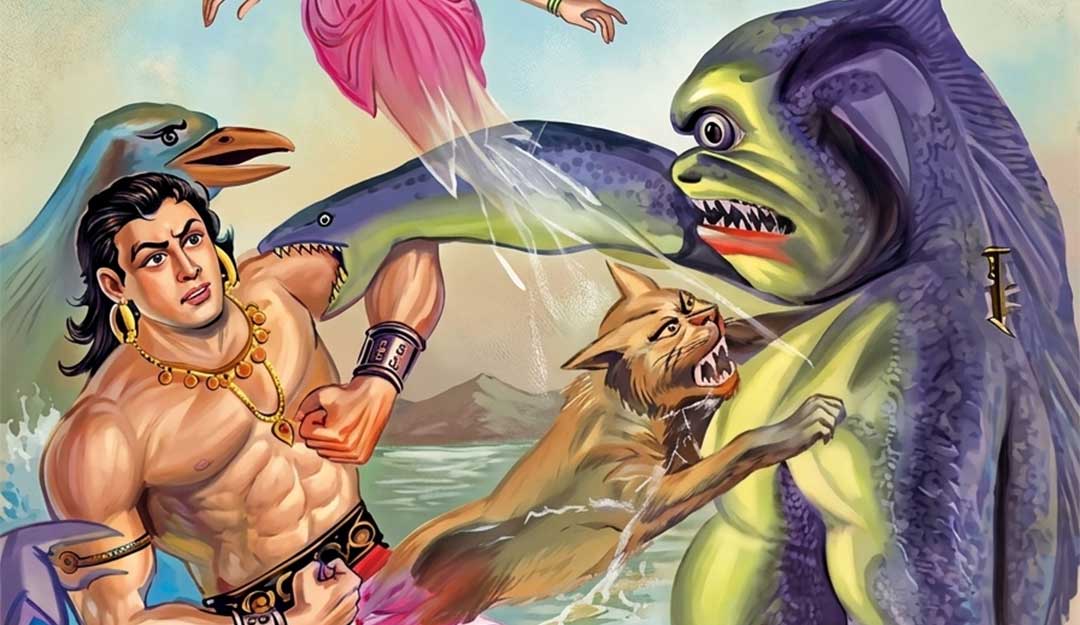
‘Mahabali Gojo’ was a hero whose roots were deeply embedded in Indian folklore, mythological courage, and magical powers. This comic, written by Tarun Kumar Wahi and edited by Manish Gupta, titled ‘Mahabali Gojo’, is not just a simple story but a brilliant creation full of bravery, magical thrill, and sacrifice. Chandu Studio’s artwork has brought every character in this story to life. While reviewing this comic, one is reminded of the period when every page of a comic opened the door to a new world. Gojo’s character was also different from other superheroes because his powers were based on his invisible helpers and his deep connection with animals and birds.
The Beginning of the Story and the Crisis Looming Over Arjun Nagar

The story begins with a sensation in the palace of Pinjore Bagh, where King Dhindhora Dev becomes worried after receiving an emergency message. This message is from his elder brother, King Munadidev, whose kingdom, ‘Arjun Nagar’, has faced a terrible crisis. The center of trouble is Princess Srija, daughter of Munadidev. King Dhindhora Dev immediately calls his most trusted warrior, Mahabali Gojo. Gojo, who arrives with his loyal eagle ‘Shakal’, immediately understands the seriousness of the situation.
From here, the story takes a sharp turn when Gojo rides his giant vulture ‘Sankat’ and sets out toward Arjun Nagar. The view of Arjun Nagar seems like a scary dream; there, an invincible demon named ‘Shilajit’ is wreaking havoc. Shilajit is not an ordinary being but a demon made of clay and magical elements who is neither affected by swords nor modern weapons.
The Terror of Shilajit and the Initial Failure of Gojo
Shilajit’s character is a very strong part of this comic. He is the pawn of an evil magician named Durjanmukh. Durjanmukh has not only captured neighboring kingdoms but also wants to forcibly marry Princess Srija. When the princess refuses, he sends Shilajit to destroy Arjun Nagar.

When Gojo reaches the battlefield, he sees King Munadidev’s soldiers scattering like straws in front of Shilajit. Gojo invokes his divine powers ‘Shakal’ (power), ‘Bijlika’ (electricity), and ‘Samharat’, but Shilajit’s clay-made body withstands every blow and reconnects itself. This part of the story creates disappointment in the minds of readers, because even a Mahabali like Gojo appears helpless here. Shilajit badly injures Gojo, and the princess is kidnapped.
Guidance of Maharishi Tejashwi and the Mystery of the Immortal Dagger
When Gojo is defeated and becomes unconscious, Maharishi Tejashwi enters the story. He saves Gojo with his yogic powers and tells him the truth. Maharishi explains that Shilajit is an immortal demon, and it is impossible to defeat him with normal powers. The only way to eliminate him is the ‘Amar Khanjar’, which is kept safe in a thousand-year-old temple.

The temple is in the territory of the Kana clan, whose people are notorious for eating human flesh. Here, Gojo faces a double challenge—on one hand, to avenge his defeat and save the princess, and on the other hand, to obtain the immortal dagger by passing through the dangerous path that no one has been able to complete till date. This information from the Maharishi turns the story into a discovery journey, which further increases the curiosity of the readers.
Challenges of the Magical Path and Competition of Sardar Tamta
When Gojo reaches the Kana clan, he learns that the warlord ‘Tamta’ is himself an immortal human and has organized a dangerous competition to obtain the immortal dagger. In this race, along with Gojo, many other warriors are also involved—like runners, mace bearers, fanners, pitchers, and Jeevats. This part becomes one of the most exciting sections of the comic.

Here, Gojo has to show not only his strength but also his intelligence and humanity. The path of the competition is magical, where danger is hidden at every step. On the way, a water monster appears, which swallows Jeevat. A magical illusionary path follows, where the Fanner loses his life. Gojo appears more sensitive than the rest of the contestants here, as he tries to save others while also continuing in the competition.
The Runner’s Selfless Sacrifice and the Height of Bravery
Only Gojo and the runner survive the final stage of the competition. When Gojo reaches the temple of the Konkan deity and acquires the immortal dagger, Sardar Tamta reveals his true intentions. He doesn’t want anyone to return alive with the dagger. Tamta attacks Gojo with his infallible weapon ‘Hawthani’.

At the same time, the runner—who had appeared as Gojo’s rival by now—comes in front of Gojo and takes the fatal blow to his chest. The runner’s words touch the hearts of both Gojo and the readers as he dies; he says that Gojo’s survival is more important for humanity. This sacrifice gives emotional depth to the story and proves that true bravery lies not only in winning wars but also in sacrificing one’s life for others. Gojo becomes extremely sad and angry at the runner’s sacrifice and then flies back to Arjun Nagar with the dagger.
The Last War: The End of Shilajit and the Victory of Truth
The climax of the story takes place in Arjun Nagar, where Shilajit has caused huge devastation. He is about to uproot the huge dome of the palace and throw it away when Gojo reaches there. This time, Gojo has the weapon that can destroy Shilajit. A fierce battle once again begins between Gojo and Shilajit.

Shilajit tries to scare Gojo, but Gojo remains calm and waits for the right opportunity. As Gojo drives the immortal dagger into Shilajit’s heart, the clay demon slowly begins to turn into a heap of ashes. With the end of Shilajit, the powers of the magician Durjanmukh also weaken. Gojo immediately flies to Durjanmukh’s hideout, takes him prisoner, and frees Princess Srija from his clutches. In the end, evil comes to a complete end, and peace and prosperity return to Arjun Nagar.
Critical Analysis of Writing, Art, and Illustration
From a technical point of view, this comic of ‘Mahabali Gojo’ seems to be ahead of its time. Tarun Kumar Wahi’s writing is well-crafted, and there is a special kind of seriousness in the dialogues, which fits the mythological atmosphere. The artwork of Chandu Studio is quite detailed; especially the way Shilajit’s scattering and reconnecting scenes are shown, it seems quite new for that time.
The choice of colors is also vibrant, which makes the magical atmosphere more impressive. The layout and panel design of the comic maintain the pace of the story. Although the plot of the story is based on the traditional framework of ‘hero vs. invincible villain’, the concept of Gojo’s assistants—Shakal, Bijlika, etc.—gives it a distinct identity. This story also teaches that no matter how powerful an enemy is, he can be defeated with the right guidance and strong determination.
Conclusion: Raj Comics’ Legacy and Gojo’s Place
In today’s digital era, where animation and high graphics dominate, comics like ‘Mahabali Gojo’ are a reminder of the simplicity and creativity that were the true identity of Indian comics. These comics were not just entertainment but also developed qualities in children such as heroism, morality, and courage.
This issue of ‘Mahabali Gojo’ can be included among the best issues of Raj Comics, which presented fantasy and adventure brilliantly in an Indian environment. The runner’s sacrifice and Gojo’s justice make this story memorable. Finally, this comic is collectible for everyone who wants to relive the golden era of Indian comics. Mahabali Gojo is still alive in the hearts of readers as a symbol of ‘truth and courage’, and his story will continue to inspire the coming generations.
