


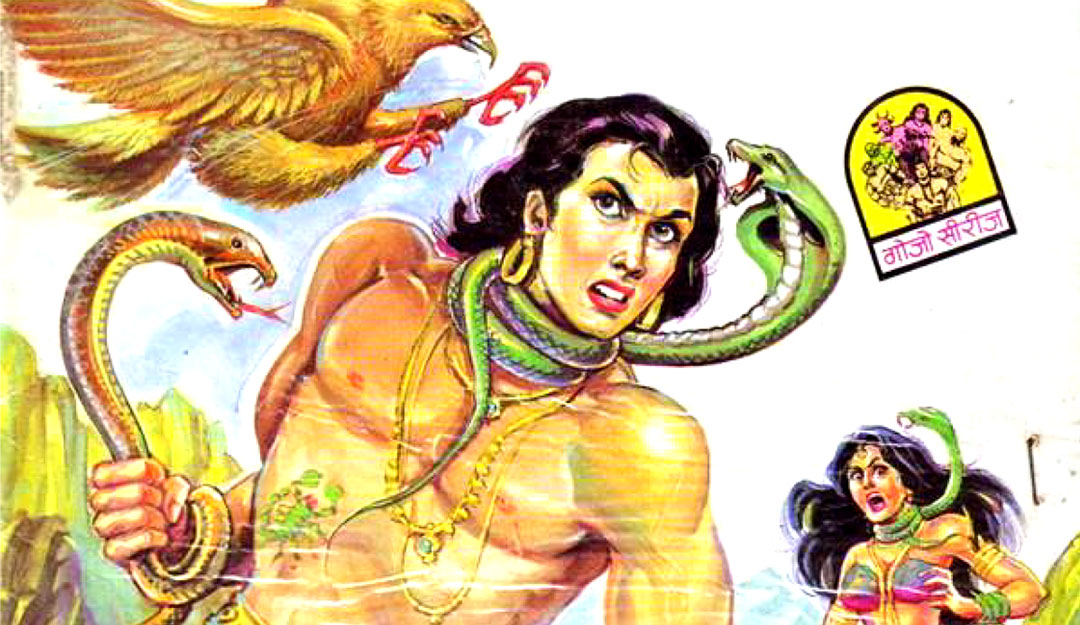
While superheroes like Nagraj, Super Commando Dhruv and Doga were fighting criminals in modern cities, ‘Gojo’ took readers to a completely different world. Gojo’s world was filled with swords, magic, monsters, and old secrets. It was a bit like fantasy worlds like ‘He-Man’ and ‘Conan the Barbarian’, and Indian readers took it to heart.
‘Gojo Ki Jung’ is a very important part of this series. This comic not only shows Gojo’s strength but also brings out his courage, mental strength and ability to fight even with fewer resources. Writer Tarun Kumar Wahi, who is known for fast and catchy stories, also weaves such a story in this comic that the readers stay connected from the beginning till the last page.
Story Outline
The story begins in a very mysterious and fear-inducing manner, which immediately arouses questions and curiosity in the minds of the readers.
Arrival of mysterious figures: The story begins with strange and scary events in several states. At one place, suddenly a very large red oval sphere appears, as if it is filled with blood. On the other hand, a huge ‘bambi’ (termite mountain) grows overnight in the middle of Vijayanagara, and a large oval structure is also visible in Pratapnagar. These incidents were not at all normal, so both soldiers and common people get nervous.
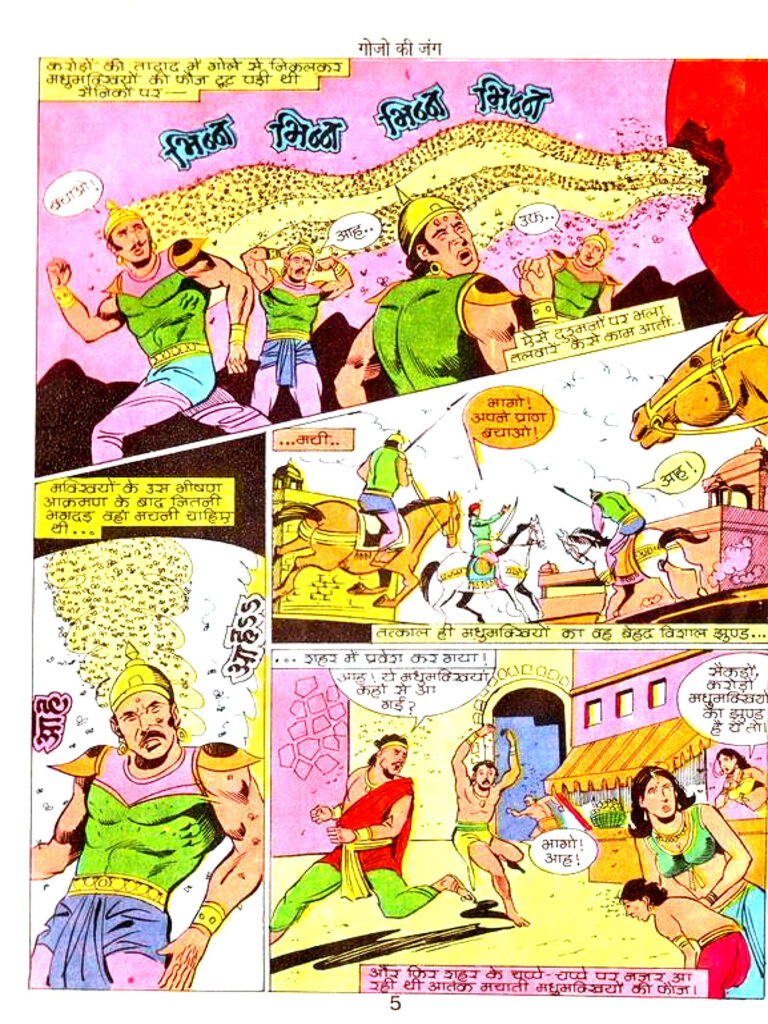
Orgy of Destruction: The author doesn’t drag the suspense for long, and the story immediately jumps into action. As the soldiers try to destroy these figures, a catastrophe ensues. As soon as the red shells and bambi break, lakhs of red poisonous ants and snakes come out. Here the drawings done by Praveen Gursale completely revive the fear and chaos. Ants pouncing on humans and snakes spewing venom seem like a horror movie going on. This attack is not just an attack — but a deliberate massacre.
Gojo’s Compulsion and Struggle: The real turning point of the story comes when our hero, Gojo, is seen in front. Gojo is currently in Maharishi Taptmukhi’s ashram and is stuck in a big crisis. This is where it is revealed that Gojo has lost his three greatest powers — ‘Third Eye’, ‘Gurughantal’ and ‘Billaura’. This is also a shock for the readers, because Gojo has always been seen with these powers.
Maharishi Taptmukhi explains that these powers cannot come back without ‘fire churning’ — but the next fire churning will happen after 50 years. This twist is the real strength of the story. Now Gojo is no longer the invincible hero he once was. He has to fight the enemies of humanity only by relying on the remaining powers — ‘Bijlika’, ‘Sankharak’, ‘Judoka’ and ‘Shakal’. For this reason, ‘Gojo Ki Jung’ becomes not just an action comic, but a real survival battle.
Technique vs. Primitive Power: As the story progresses (especially in later pages), it turns out that the danger is not limited to just animals — i.e. snakes and ants. The story also features very large robot-like structures and stones with different colors, which take the form of machines or monsters and wreak havoc. It’s a great mix of fantasy and science-fiction — and that’s also been the specialty of Raj Comics. Gojo has to fight these enemies, both magical and modern, with his limited strength.
Characterization (Character Analysis)
Gojo: A different form of Gojo can be seen in this comic. Usually superheroes depend a lot on their powers, but here Gojo is not as strong as before (“weak” compared to his old position). When he learns that he must remain without his main powers for 50 years, he still does not break. This dialogue of his – “I know Maharishi that now along with these four I have to confront the enemies of humanity” – shows his real courage and strength. Instead of crying over the situation, he decides to enter the battlefield with what is left. This thing also inspires readers.
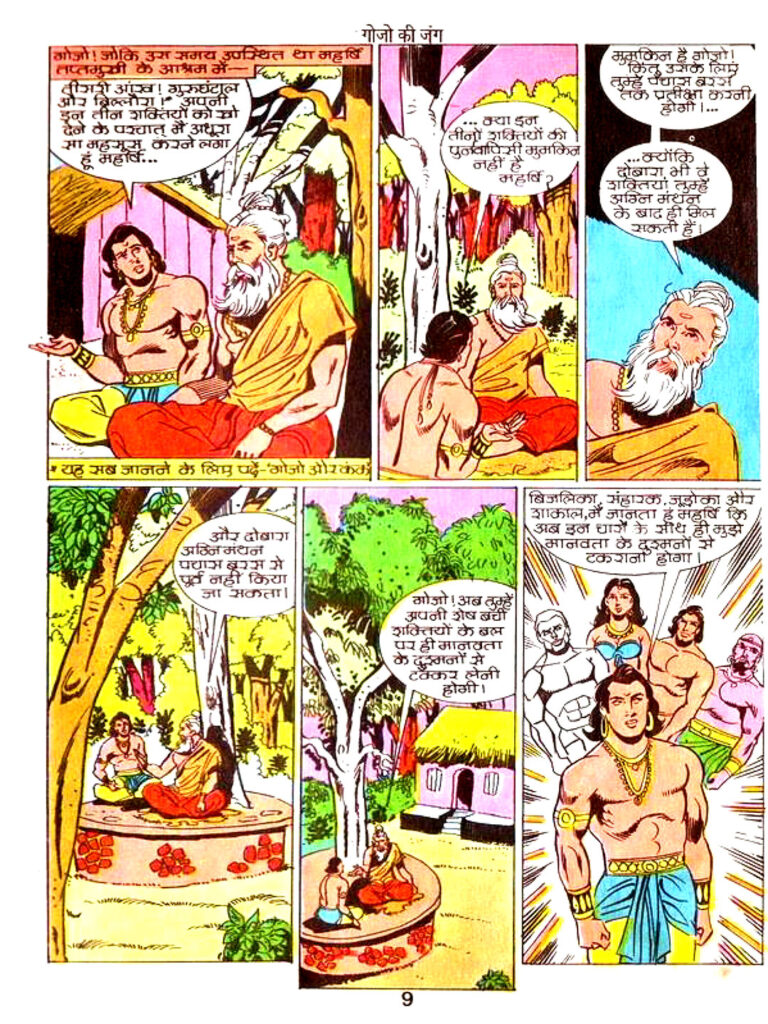
Maharishi Taptmukhi: Maharishi plays the role of a guide in the story. He tells readers about Gojo’s past powers and the rules that follow. His calm and balanced nature equalizes and guides Gojo’s fierceness.
Villain (The Antagonist): The name or face of the main villain in the PDF is not completely clear until the end, but it is clear that the enemy is very cunning and dangerous. Instead of attacking directly, he first creates fear in the minds of people with things like mysterious eggs and bambi and then creates havoc by releasing biological weapons — i.e. ants and snakes. Later the arrival of robotic and demonic elements shows that the opponent has the power of both magic and science — i.e. the enemy is playing the game at a very high level.
Drawing and Art (Art and Illustrations)
Praveen Gursale’s portrayal reminds us of the period when hand-drawn comics were real life. The movement is shown very brilliantly in the action scenes. When Gojo wields a sword or mace, or leaps, real energy is felt in the paintings.
Stampedes, people’s screams, and fear are perfectly visible in the ant-attack pages. Fear, pain and nervousness are very clearly engraved on the faces. The comic has great use of bright colors — especially red, yellow and green. To show the danger, the use of red color (red balls, red ants) has been very powerful. When colorful rocks appear in later pages, their color combination seems a little strange and alien-like — which deepens the mysterious atmosphere of the story.
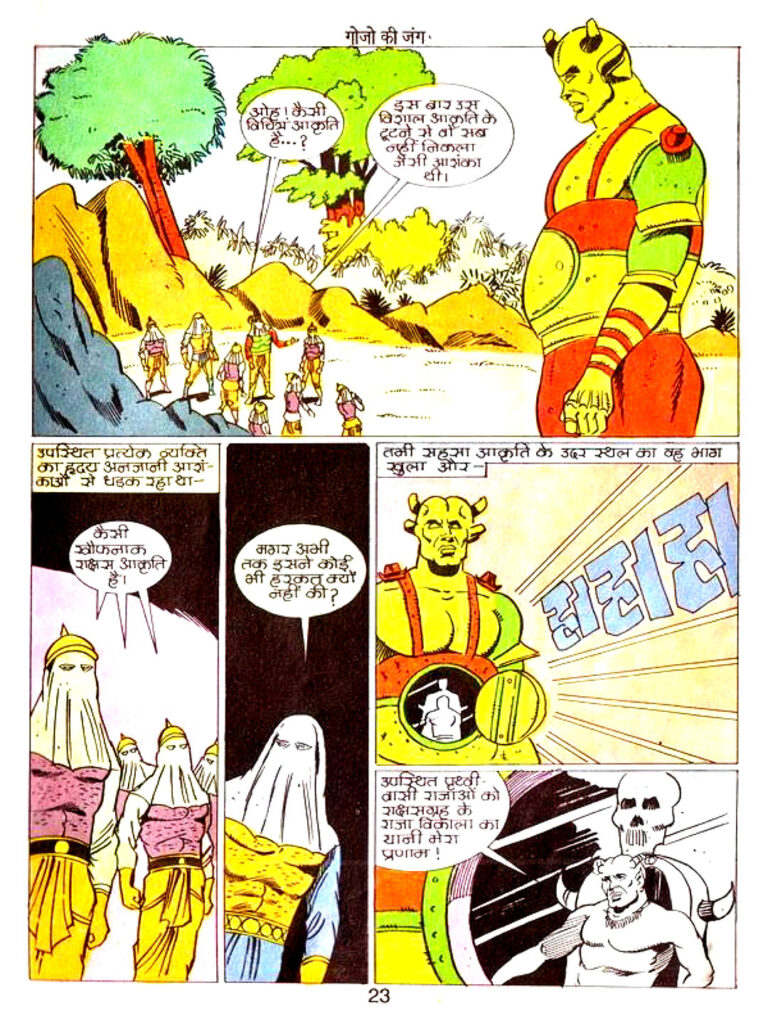
Pictures of old palaces, forests and ashrams are also amazing — they give a feeling of grandeur and antiquity like Vijayanagara, making the comic’s “period drama” touch stronger.
Writing and Dialogue
As always, Tarun Kumar Wahi’s writing style is tightly held here too. He does not stretch the story unnecessarily and creates mystery and tension from the beginning. “What is this?”, “Where did it come from?” — dialogues like these show the nervousness and panic of common people in a very real way.
The dialogues have dramatisation — which was the biggest hallmark of 90’s comics. When Gojo talks about his powers and circumstances, the language reflects seriousness and weight. “This conflict continues! Ever in some form… so sometimes in some form” — these lines from the beginning tell that this is a never-ending battle going on between good and evil.
The story progresses at a very fast pace.
mysterious event → mayhem → Gojo’s entry → Gojo’s action
Nowhere does the story come loose, and it gives the reader no chance to get bored.
Subject matter and message
‘Gojo Ki Jung’ is not just an action comic, there are many deep and sensible messages hidden inside it.
The biggest message is — what is real strength? When you don’t have all your strength, your attitude becomes your identity. Gojo continues the fight instead of retreating despite losing his main powers. It states that real power lies not in weapons and magic, but in intentions and willpower.
The attack of ants and snakes shows that even nature’s creatures can be used as weapons of destruction. On the other hand, Gojo and sages appear as protectors of nature.
Sentence written at the beginning of the story –
“Justice has clashed with injustice and humanity with Satanism ever since creation was created”
The entire comic depicts this infinite fight and the eternal struggle between good and evil.
Drawbacks (Critical Analysis)
The story is fantastic, but from a critic’s point of view, a few things can be noted:
Many times logic is left behind in the fantasy stories of Raj Comics. Like where did these giant eggs come from? Were they completely organic or mechanical? Explanations of these things are sometimes given too superficially or are left to the imagination of the readers.
In some places the fight scenes seem a bit repetitive. The attack of ants and snakes is scary, but goes on in almost identical texture for several pages.
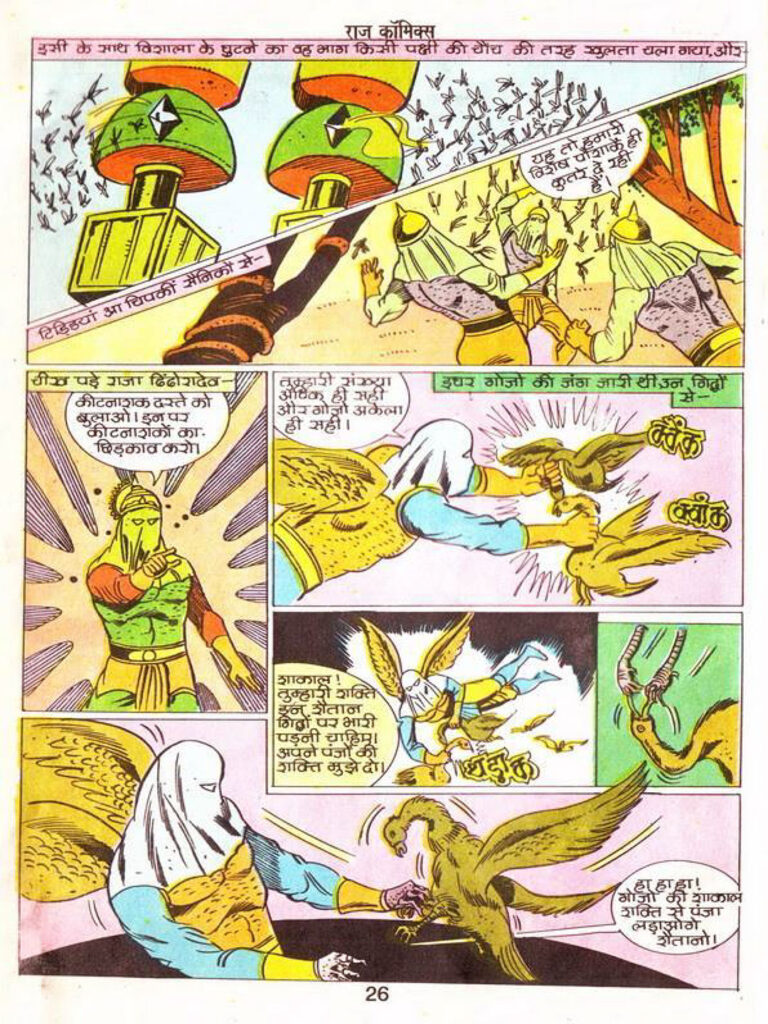
Many times in Gojo stories the villain’s aim seems to be just “to destroy the whole world.” A deep reason or solid motive is sometimes missing, which makes the villain a little lighter.
Nostalgia and importance
In today’s era, when we see big visual effects in the high-tech films of Marvel and DC, reading ‘Gojo Ki Jung’ gives a different relief. Reading this, it seems as if we have reached a period when entertainment was hidden in lines engraved on paper pages. Despite reading in PDF, the scent and texture of old pages are remembered.
There is no heavy-duty “multiverse”, no confusion of “time travel” in this story. It’s a simple “hero vs villain” story — that relaxes the mind and awakens passion in the heart.
The specialty of the Gojo series is also that it gave a superhero to Indian children in an Indian environment — Vijayanagara-like setup, sage-muni, sword and magic — i.e. a “barbarian hero” in Indian style. And this was the reason why Gojo became so popular.
Conclusion
Overall, ‘Gojo Ki Jung’ is a shining gem in the treasury of Raj Comics. This is a great combination of both the brilliant imagination of Tarun Kumar Wahi and the wonderful art of Praveen Gursale.
The real beauty of this comic is not that Gojo wins — but that Gojo does not give up the courage to fight despite being incomplete. This is what elevates it above ordinary comics and makes it an inspirational story.
The gist of this 1100-word review is that if you like classic Indian comics, fencing, fantasy and magical worlds, this comic is a must-read (Must Read) for you.
There is suspense, horror, emotion and full action in it.
And above all — it reminds that Gojo is not just the name of strength…
Gojo is a passion — the passion to stand against evil at all costs.
Rating: 4/5
If you have read it in childhood, then reading it again will refresh the golden memories of childhood.
And if you are a new reader, then definitely read it to know how exciting and rich the history of Indian comics has been.
