


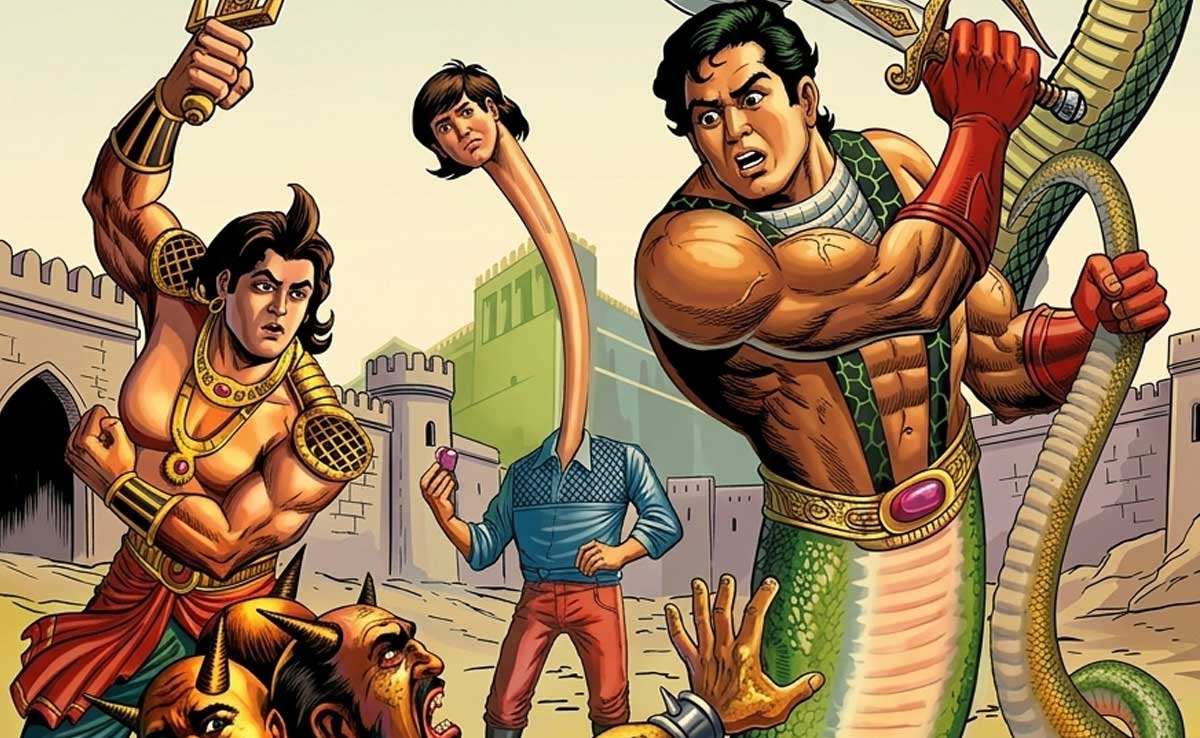
Did you know that without a magical ‘Mani’, the entire ‘Ajgar Lok’ could have suffocated to death in just 15 days? Manoj Comics’ Ajgar Aur Trikaldev is one such hair-raising story. The warrior, who was half human and half snake, and the mighty Trikaldev, who possessed the powers of the Trinity—when these two came together, the roots of the empire of crime were shaken.
Today, we will turn back the wheel of time and return to that golden era of Manoj Comics (Special Issue No. 32), where such a story of magic, willpower, and true friendship was written that it is still considered a ‘classic’.
Python Lok: Where ‘Wind’ Was the Greatest Wealth
The story begins in the mysterious ‘Ajgar Lok’. It is an empire where shape-shifting dragon humans live. Everything was going on peacefully there when a terrible demon named ‘Hawakhor’ arrived. The wind eater was not an ordinary monster. His body was like a horse, and his face was terrifying. His greatest strength was swallowing the wind.
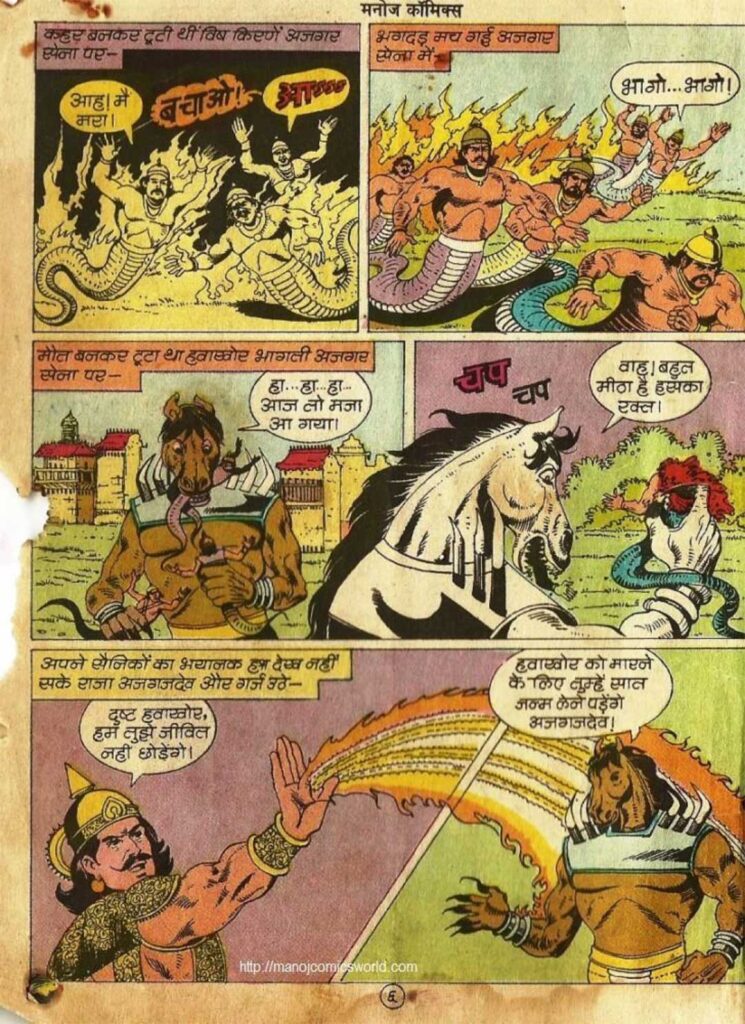
He started swallowing all the air of the python world. Innocent pythons started dying due to suffocation. Even the army of Ajgardev, the king of the python world, started looking helpless before that demon. When hope was almost lost, the prince of the python world, Tripund (Ajgar), came forward.
The Sacrifice of Prince Tripund and the Mystery of the ‘Mani’
Tripund defeated Hawakhor, but by then it was too late. Before he died, the demon had swallowed so much of the world’s air that the people there could now survive for only a month. Kuluguru Jayadron said that now only the ‘Kuladevata’ could save this world.
This is where the story takes an emotional turn. A ‘sacrifice’ was needed to please the Kuladevata. Prince Tripund cut his neck with his sword without thinking for a moment. The Kuladevata was pleased with his selfless sacrifice. He not only revived Tripund but also gave him the ‘Ajgar Mani’.
This gem was life-giving for the python world. As long as this gem remained in the temple, there would be no shortage of air there. But there was also a warning—if this gem remained outside the python realm for 15 days, the whole empire would turn into ashes.
Kaudiya’s Betrayal: An Enemy in the Guise of a Friend
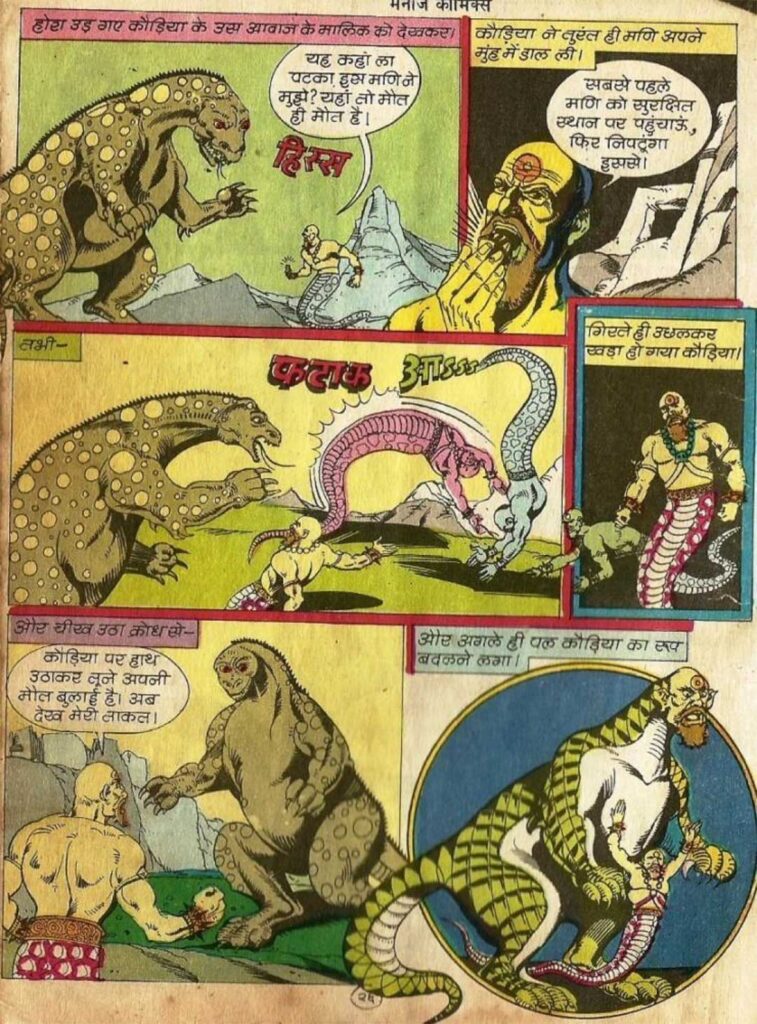
Where there is light, there is also darkness. Kuluguru had a disciple named ‘Kaudiya’. He had been greedy for the throne and power from the beginning. He acquired shape-shifting powers by performing severe penance. Kaudiya resorted to deception, took the form of Tripund, and stole the Ajgar Mani.
As soon as the Mani was stolen, earthquakes started occurring in the python world, and the air started becoming poisonous. Kaudiya fled to Prithvi Lok (Kaushal Nagar) with the Ajgar Mani. Now Tripund had only 15 days to bring back the Mani, or else his entire lineage would have perished.
Trikaldev and Thimphu: Meeting the Great Defenders of Earth
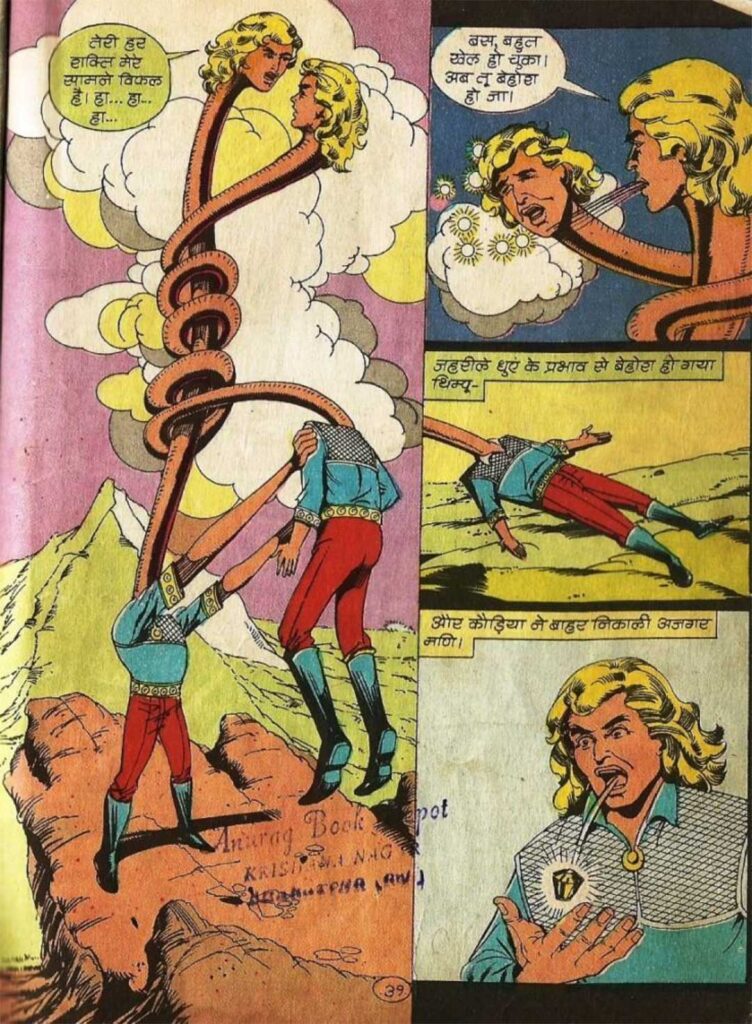
After reaching Earth, Tripund meets Mahabali Trikaldev and his unique friend Thimphu. Thimphu was a character who could stretch his neck like rubber (Manoj Comics’ own ‘Mr. Fantastic’). Trikaldev, who was the master of divine weapons, came to know about Tripund’s troubles and promised that he would help him get the Mani back.
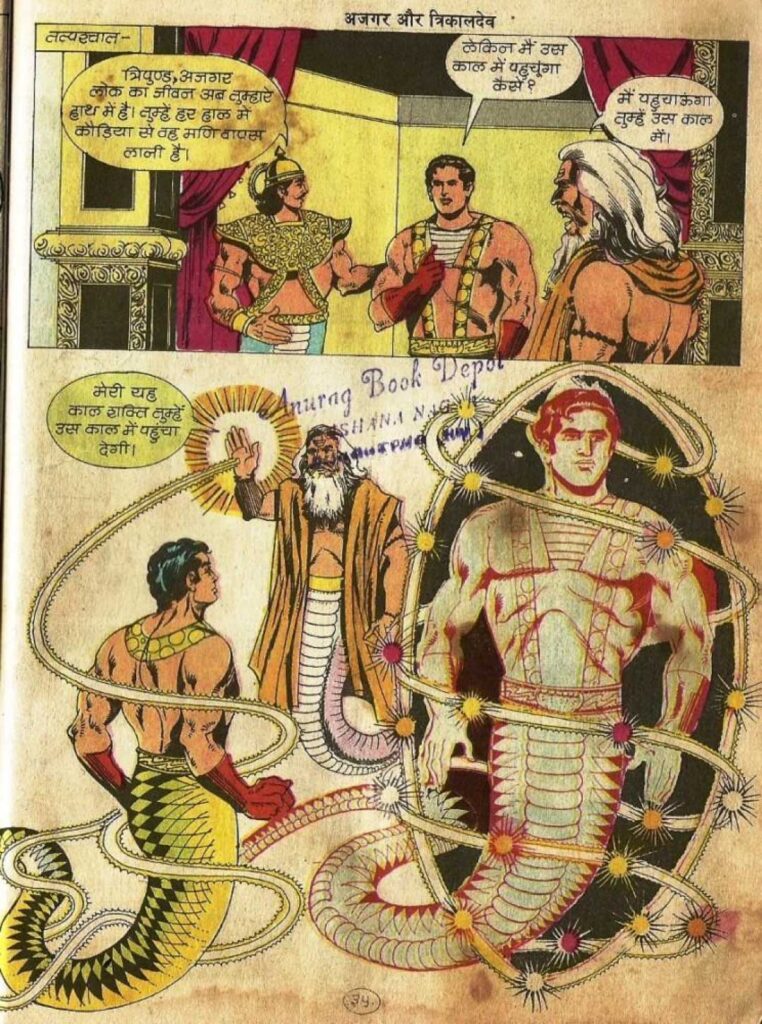
Trikaldev’s character: Trikaldev was considered a ‘god-level’ superhero in Manoj Comics. He had ‘triple power’, through which he could manipulate time and space. This pairing of Tripund (Ajgar) and Trikaldev was as exciting as the team-up of today’s Avengers.
The Orgy of Shape-Shifting Powers: That Terrible Final War
Kaudiya went mad as soon as he got the power of the Mani. He started wreaking havoc in Kaushal Nagar. Sometimes he would turn into a huge split-faced snake, and sometimes he would become a fire-breathing monster.
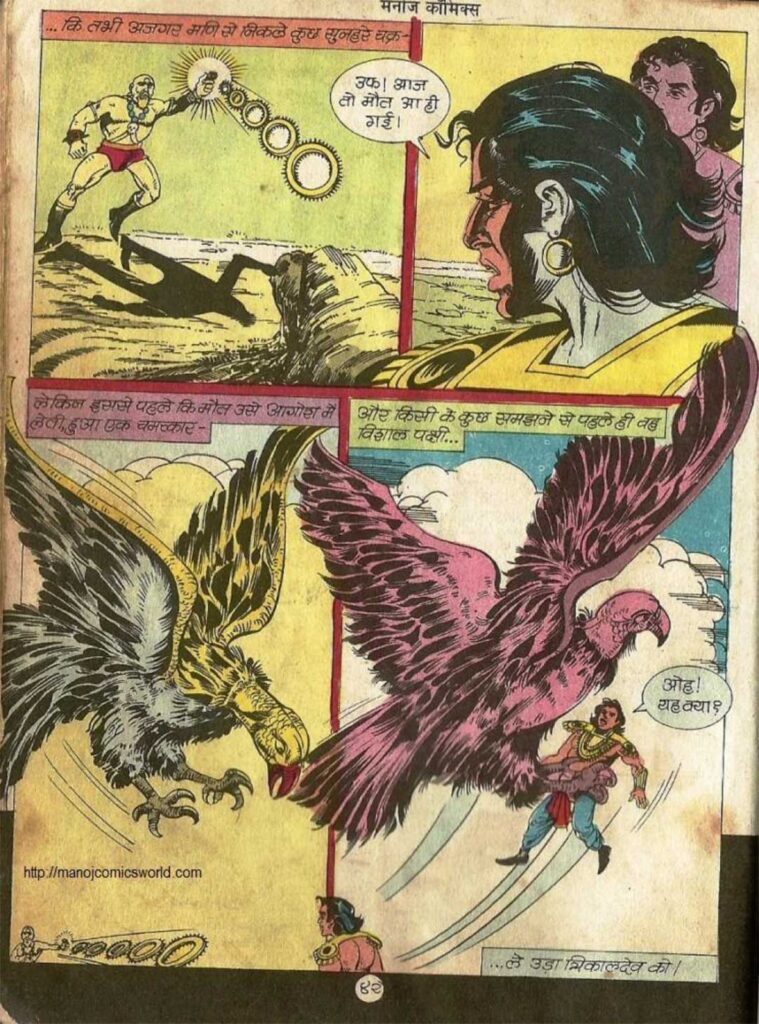
The climax of the comics (pages 49–53) is full of tremendous action. Kaudiya had swallowed the Ajgar Mani so that no one could snatch it from him. Here Thimphu’s wisdom worked. He used his long neck and agility to force Kaudiya to bring the Mani out of his stomach.
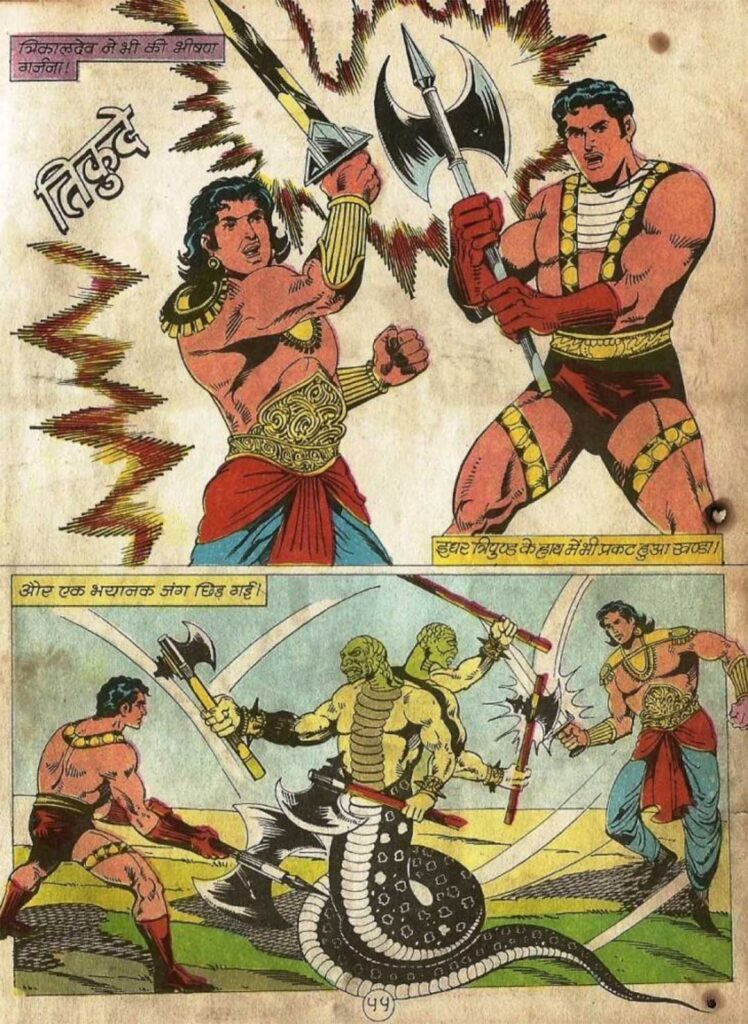
Trikaldev broke Kaudiya’s elusive web with his divine axe. At last, Tripund ended that treacherous Kaudiya with his sword and regained the Mani safely.
Why Is ‘Ajgar Aur Trikaldev’ a Classic?
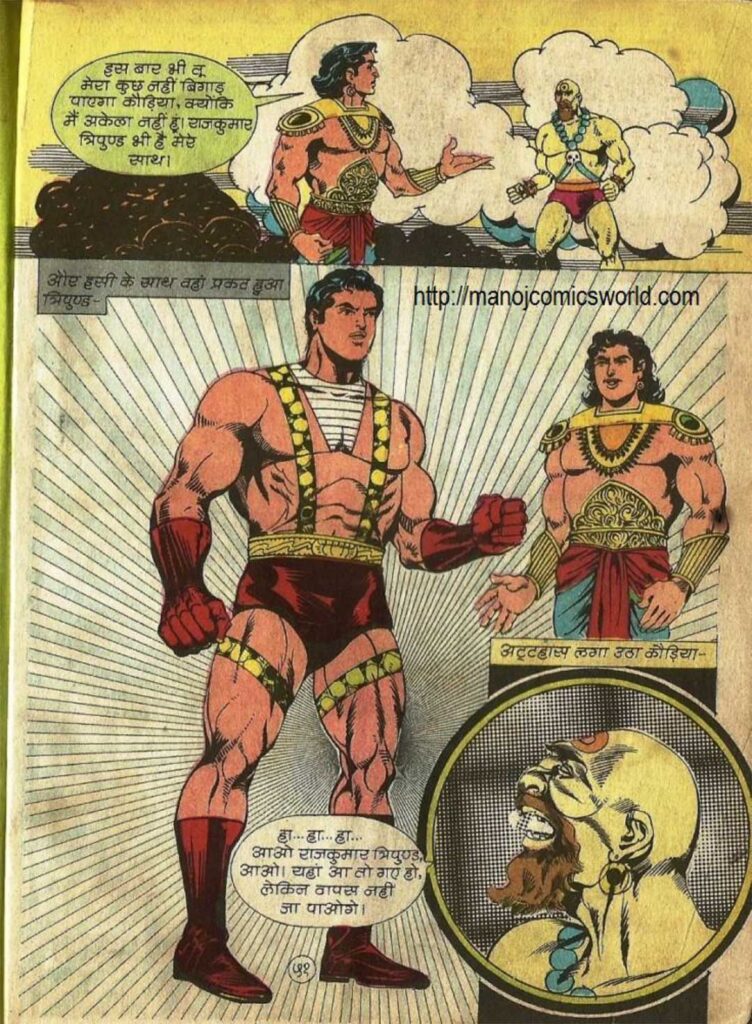
- Great artwork: The artwork in this ’90s comic (in the style of Kadam Studio/Drona Features) is superb. Showing the python humans as half snake and half human was no less than a visual treat for the children of that time.
- High Stakes: The 15-day time limit (deadline) in the story maintains constant suspense and tension, which keeps the reader turning the pages.
- Great characters: The seriousness of Tripund, the strength of Trikaldev, and the funny style of Thimphu. Together, these three make the story completely balanced.
- Nostalgia Factor: Do you remember? The advertisement of getting a ‘water bottle free’ with this comic was printed on the cover page itself. At that time, such free gifts were a major reason for buying comics.
Special Facts for Readers (Quick Trivia)
• Publication: Manoj Comics, then Raj Comics’ biggest rival.
• Price tag: At the time, it was priced at ₹16. Finding its original copy today is like finding a treasure.
• Thimphu’s magic: Thimphu’s character was so popular among children that many of them called him ‘Rubber Man’.
• Concept of the Mani: The ‘Mani’ has always been the biggest center of power in Indian comics, whether it is Nagraj’s Mani or the Ajgar Lok’s Mani.
Conclusion: Victory of Sacrifice and Friendship
Ajgar Aur Trikaldev teaches us that when the intention is good and true friends are with you, no power from the underworld to the skies can defeat you. Prince Tripund’s sacrifice of cutting his own neck is the greatest example of self-sacrifice, which makes him a true hero.
Let us know in the comments:
• Did you like Thimphu’s neck-stretching power?
• If Trikaldev had not been there, would Tripund have been able to defeat Kaudiya alone?
• What’s your favorite duo in Manoj Comics?
Do share this blog with your friends with whom you swapped comics during your childhood!
Disclaimer: This review is a tribute to Manoj Comics. All characters and illustrations are copyrighted by Manoj Pocket Books.
