


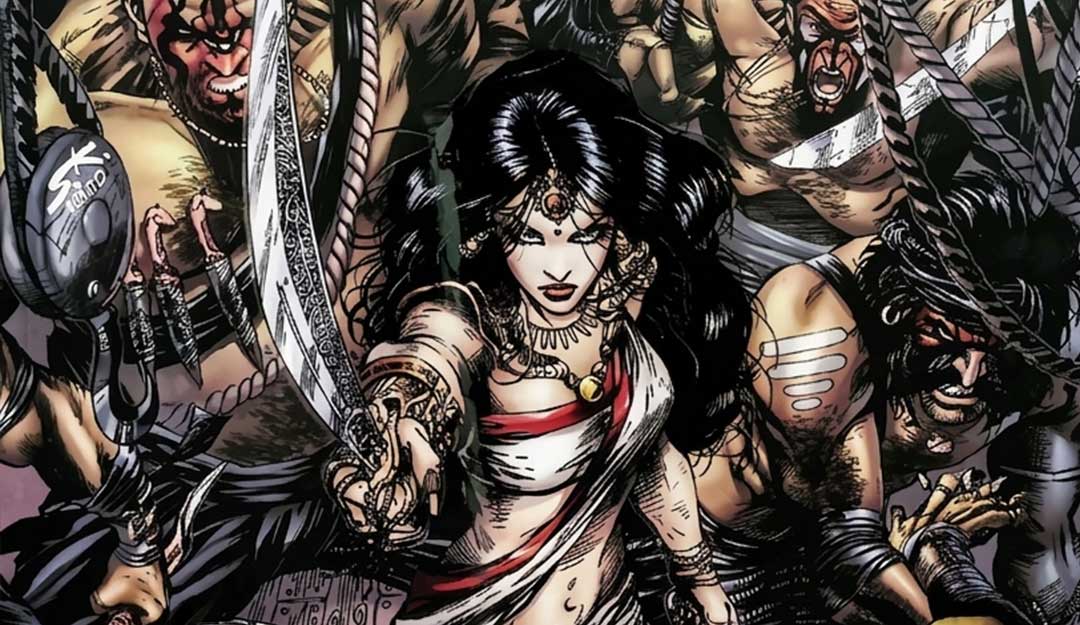
Bankim Chandra Chattopadhyay has a very special place in the history of Indian literature, especially Bengali novels. His timeless novels not only entertained readers but also strengthened the spirit of the Indian freedom struggle. In this series, Yali Dreams Creations has made a very courageous and brilliant effort. They have presented Bankim Babu’s famous novel ‘Devi Chaudharani’ to today’s readers by transforming it into a graphic novel. The grandeur and detail with which screenwriter and art director Shamik Dasgupta has presented this historical story is a great achievement for the Indian comics industry. ‘Devi Chaudharani: Part 1 – Matsyanyaya’ is not just a story, but a fantastic saga of the chaos, exploitation, and the journey of an ordinary woman becoming a ‘revolutionary queen’ of 18th-century Bengal. Yali Dreams Creations, already known for great creations like ‘Rakshak’ and ‘The Village’, has taken its art to a greater level this time and created a vibrant world within a historical atmosphere.
Analysis of the dark period of Indian history and the philosophy of Matsyanyaya

The story begins in Bengal in 1792, where the general public was suffering badly under British rule and local landlords. The title of this issue, ‘Matsyanyaya’, represents the concept from ancient Indian philosophy where the ‘big fish eats the small fish’. Bengal of that time was also a victim of this Matsyanyaya. On one side, East India Company officials were filling their coffers, while on the other side, greedy landlords like Harballabh Chaudhary were sucking the blood of their own people. Shamik Dasgupta has made the struggle of a young woman named Prafulla the center of the story amidst this chaotic atmosphere. This setting shows readers the bitter truth of a period where justice was almost nonexistent and only power was considered supreme. Yali Dreams Creations has presented this historical background in such an effective way that the reader begins to feel immersed in the dark nights and dense forests of that era.
The journey from Prafulla to Devi Chaudharani: An extraordinary transformation of an ordinary woman
The greatest strength of this graphic novel is the character of its heroine, Prafulla. At the beginning of the story, we see a cheerful girl who defeats boys in the game of marbles, but she is also helpless in the face of society’s old thinking. Prafulla is married to Brajeshwar (Braj), but due to dowry issues and false accusations, her father-in-law Harballabh throws her out of the house. The journey of a girl rejected by society, wandering through forests and creating a new identity for herself, shakes any reader to the core.

Prafulla’s transformation does not happen suddenly, but is the result of hard work, mental pain, and self-discipline. She raises a tiger cub in the forest, which becomes a symbol of her fearlessness. This same Prafulla later becomes ‘Devi Chaudharani’, who not only becomes the leader of a large group of dacoits, but also proves to be a messiah for the poor and a nightmare for the British.
Bhavani Pathak: The emergence of a mysterious guide and revolutionary ideology

Bhavani Pathak’s entry into the story gives a new twist to the plot. The character of Bhavani Pathak is counted among the most mysterious figures in Indian literature. Shamik Dasgupta has associated the character with a physical condition called ‘hypogonadism’ (Hypogonadism), which makes him look like a 13–14-year-old boy even at the age of 45. His innocent face hides the strategist and warrior within him. Bhavani Pathak is not just a dacoit, but also a major face of the Sanyasi rebellion. He not only teaches Prafulla how to use weapons, but also educates her in politics, economics, and languages. Bhavani Pathak’s belief that ‘a woman is not weak; she just needs to recognize her strength’ awakens Prafulla’s inner goddess. He explains to her that to become a queen, not only money and an army are needed, but also the love and trust of the people.
Historical context and the story of the Sanyasi-Fakir Rebellion

Through this graphic novel, Yali Dreams Creations has once again reminded readers of the ‘Sanyasi and Fakir Rebellion’ from Indian history, which often did not receive much attention in mainstream historical narratives. The story shows how these rebels looted the British treasury and distributed the wealth among people suffering from famine. Bhavani Pathak and his associates, like Madan Khan, who was a loyal commander of Nawab Siraj-ud-Daulah, were fighting this battle beyond the barriers of religion and caste. An effective depiction of the condition of Bengal after the Battle of Plassey and the fall of Siraj-ud-Daulah can be seen here. The courage of the Indians in the face of the British army’s modern guns and disciplined forces, along with the depiction of guerrilla warfare tactics, creates immense thrill while preserving historical depth. This comics reminds us that the fight for freedom had begun long before 1857.
Nishi and Diva: A wonderful combination of women power and diversity

Prafulla’s two fellow companions, Nishi and Diva, play a very important role in her journey. Nishi, who is of African descent and was brought to India as a slave by Portuguese traders, is rescued by Bhavani Pathak. Nishi’s strength and loyalty act as a strong shield for Prafulla. Meanwhile, Diva, who is an Anglo-Indian orphan, teaches Prafulla English and French. By including these characters, the story shows how open-minded the rebel group of that era was and how it embraced people from all backgrounds. The wrestling and lathi-khela scenes between Nishi and Prafulla prove that Bhavani Pathak left no stone unturned in their training. Through these characters, the author conveys the message that language, color, and origin do not matter in the fight against injustice.
The artistry of Vikas Satpathy and Iqbal Sampad: 18th-century Bengal comes alive on every page

The soul of any graphic novel lies in its artwork, and ‘Devi Chaudharani’ appears to be of international standard in this regard. The artwork by Vikas Satpathy and Iqbal Sampad breathes life into the story. The facial expressions of the characters, their costumes, and the depiction of Bengal from that era have been crafted with great attention to detail. Especially the forest landscapes, the plundering of the palanquin on a moonlit night, and the sea battle in the final part look absolutely spectacular. The innocence on Bhavani Pathak’s face and the depth in his eyes have been portrayed brilliantly. Vishwanath Manoran’s coloring changes according to the atmosphere of the story; the colors appear light and faded during moments of sadness and loneliness, while they become more intense during scenes of war and revenge. Crimzon Studio has transformed this entire work into a cinematic experience.
Piracy and the exciting clash with Portuguese enemies

In the final part of the issue, the story moves towards the Bay of Bengal, where Portuguese pirate Captain Albuquerque and his ship encounter the army of Devi Chaudharani. This section adds a fresh layer of adventure to the story. Prafulla, who has now become Devi Chaudharani, displays her leadership abilities not only on land but also at sea. Here, we also get a glimpse of Brajeshwar Chaudhary, who is working on a British ship. He does not recognize his wife, but is shocked to witness the bravery of Devi. The way the ship battle, the roar of cannons, and the clash of swords are depicted keeps readers engaged until the very end. This part also hints that Devi’s struggles and challenges are going to become even greater in the upcoming issues.
Writer Shamik Dasgupta’s vision and the challenges of modern transformation

Turning a novel into a graphic novel is not an easy task, especially when the original story is written by a legendary writer like Bankim Chandra Chattopadhyay. Shamik Dasgupta has added a brilliant touch of his creativity to the original story while keeping its soul intact. He has presented the character of Bhavani Pathak with a scientific mindset and has portrayed the action sequences in a modern style. The author has struck a very fine balance between the sweetness of Bengali culture and the sharp spirit of rebellion in the dialogues. In the section ‘From the Writer’s Pen’, Shamik ji clearly explains why he sees Bhavani Pathak as a ‘mad scientist’ or a ‘super-intelligent child’. His perspective makes this classic story more interesting and relevant for today’s generation. It is the foresight of Yali Dreams Creations that they decided to present this precious gem of Indian literature to the world in a new form.
Conclusion: Why Devi Chaudharani Part 1 should be in every reader’s collection

Overall, “Devi Chaudharani: Part 1 – Matsyanyaya” is a brilliant work that takes Indian comics to a new height. This is not just a story of revenge, but an inspiring journey of self-respect, education, and the empowerment of a woman. Yali Dreams Creations has proven that our own literature has enough power to rival any alien superhero story. This graphic novel is extremely important for history lovers, art lovers, and all readers who want to experience a serious and impactful story. This journey of Prafulla teaches us that when society closes every path for us, a person must create a new path for themselves. Finally, the ‘cliffhanger’ twist at the end of the story leaves readers extremely excited for the second part, ‘Dwairath’. This is a clear indication of the bright future of the Indian graphic novel industry.
