


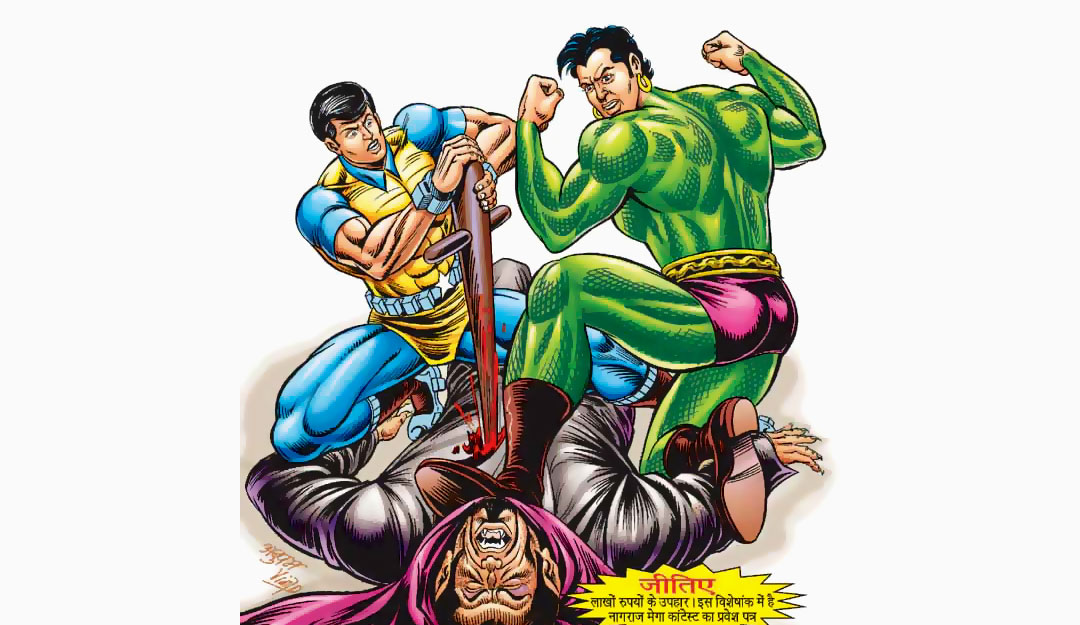
There are some stories in the history of Raj Comics which, once read, make a place in the hearts of the readers forever. The “Dracula Series” is also one such memorable series. “End of Dracula” is the chapter of this entire epic where adventure, fear, and heroism appear in their full glory. This comic is not just a story, but also a hallmark of the Golden Age of Raj Comics. Being issue number 400, it is a historical and milestone special issue in itself. In this story, legendary heroes like Nagraj and Super Commando Dhruv are seen fighting their last and decisive battle against the world’s most dangerous vampire, Count Dracula.
This story advances the events of the previous comics “Dracula’s Attack” and “Nagraj and Dracula.” While Dracula’s horror and terror were firmly established in earlier parts, this part, as the name suggests, seeks to completely root out that terror.
Plot: A Complex Saga of Destruction and Vengeance
The story begins exactly where the previous comics ended. Vedacharya uses his magical powers to throw the bloodthirsty Dracula into an unknown and deserted dimension. Dracula finds himself in a desolate world with no sign of life and no sign of death. All his powers have been taken away from him, and he is almost completely helpless. But that’s where the story takes a shocking turn.
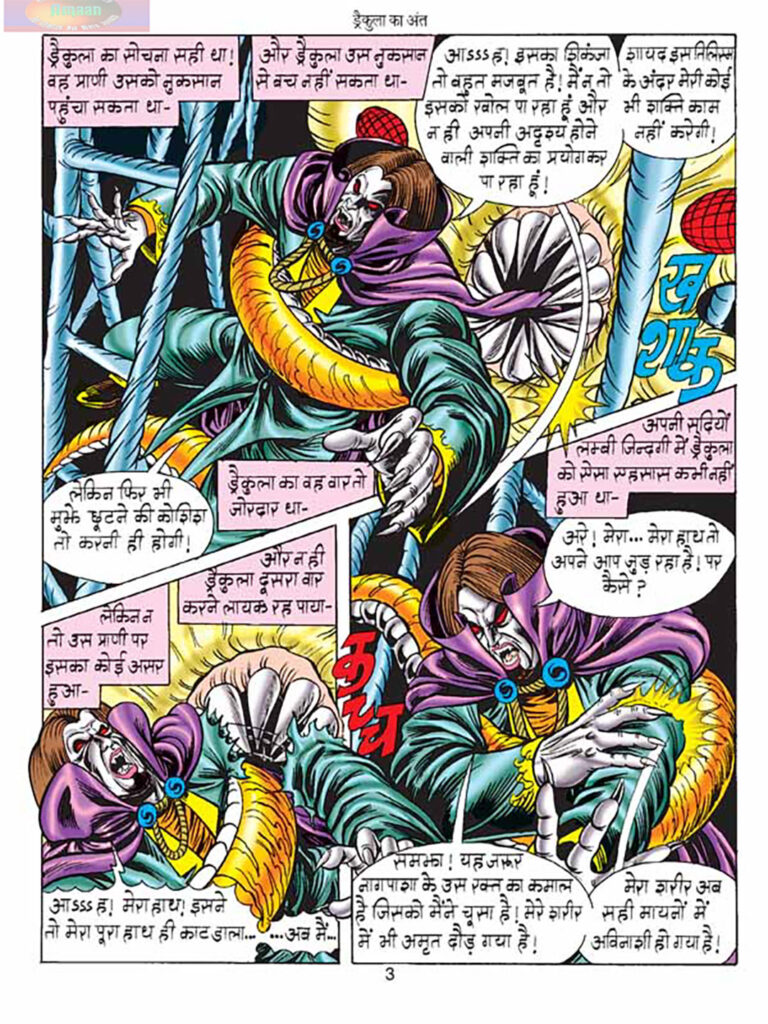
Dracula gradually realizes that he has now become truly indestructible due to drinking blood mixed with Nagpasha’s nectar. His body reconnects on its own even after being cut or destroyed. This truth gives him a new and even scarier strength—the vanity of being immortal. He understands that no one can kill him anymore. With this confidence and arrogance, he starts fighting the terrible creatures present in that desolate dimension on the basis of his cunning, cruelty, and strength.
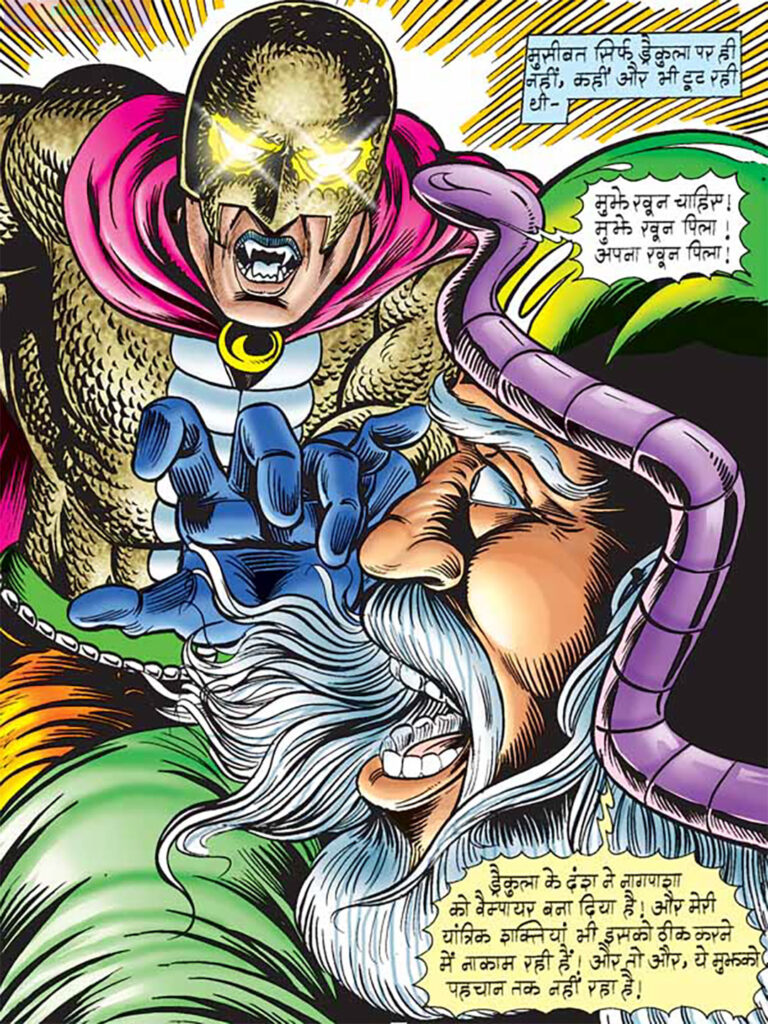
On the other hand, the situation on Earth has become even scarier. Nagpasha, whom Dracula had already bitten, has now become a dangerous vampire himself and stands ready to drink his own master’s blood. Nagraj and Vedacharya arrive at the right time and stop him, but it is clear that this is just a temporary solution.
Meanwhile, Super Commando Dhruv reaches the metropolis after hearing the news of the vampire attacks. He is accompanied by Lori, a descendant of Saint Yulojian, whose blood contains the ability to drain vampires of their strength. But here the story delivers another blow—the blood of Lori does not show any effect on Nagpasha. Vedacharya explains that Dracula has learned how to overcome his weaknesses over time and has developed immunity against them. Now, old and tried methods are proving useless.
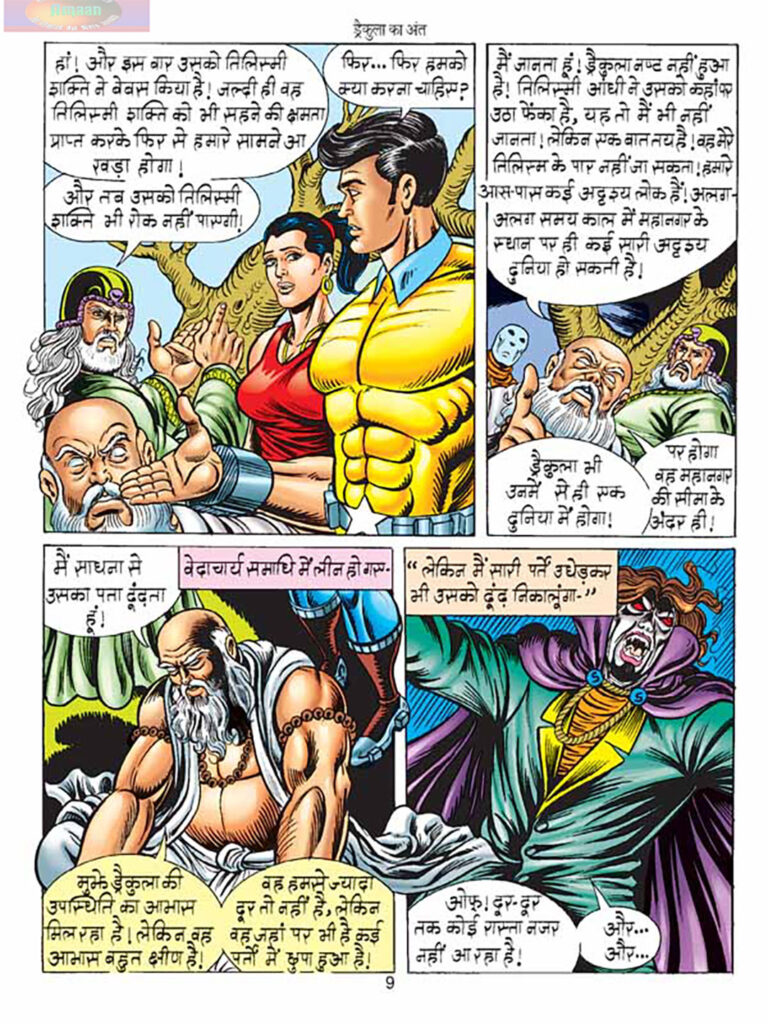
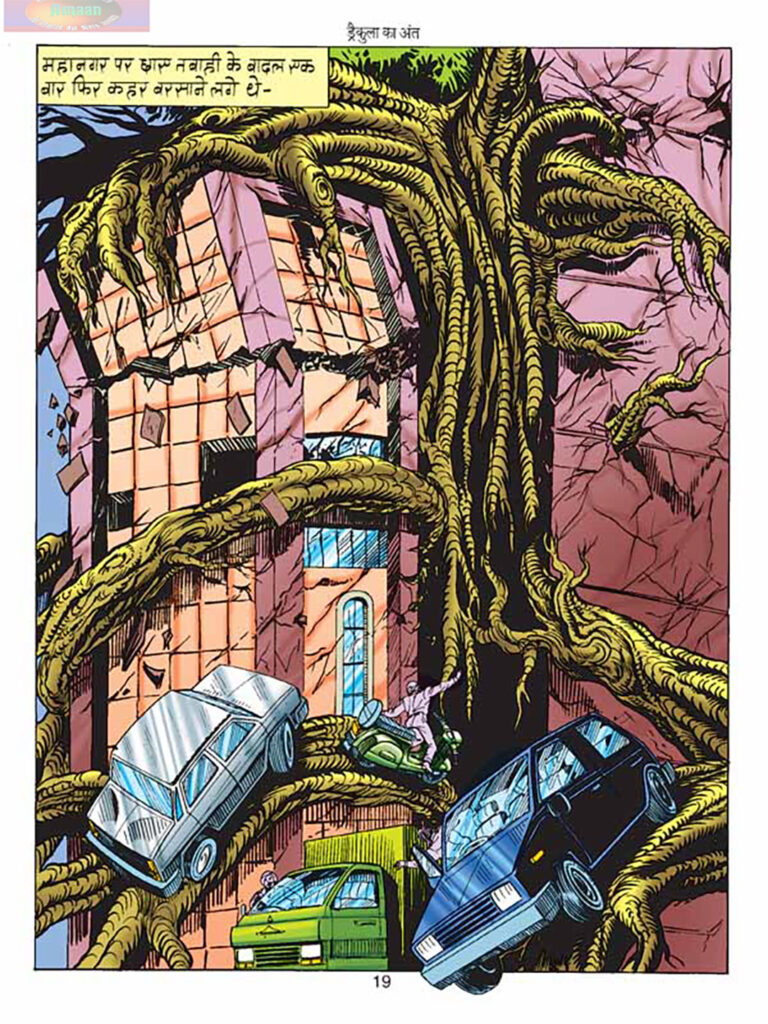
Through his deep meditation, Vedacharya finds out that Dracula is not dead, but is imprisoned in some parallel dimension connected to the metropolis. After this, a plan is made to bring him back and finish him forever. But Dracula is also not sitting idle. He starts sending the effects of his demonic powers to Earth from that other dimension itself. Suddenly, huge and monstrous trees begin growing in the metropolis, breaking down buildings and trapping innocent people within their roots.
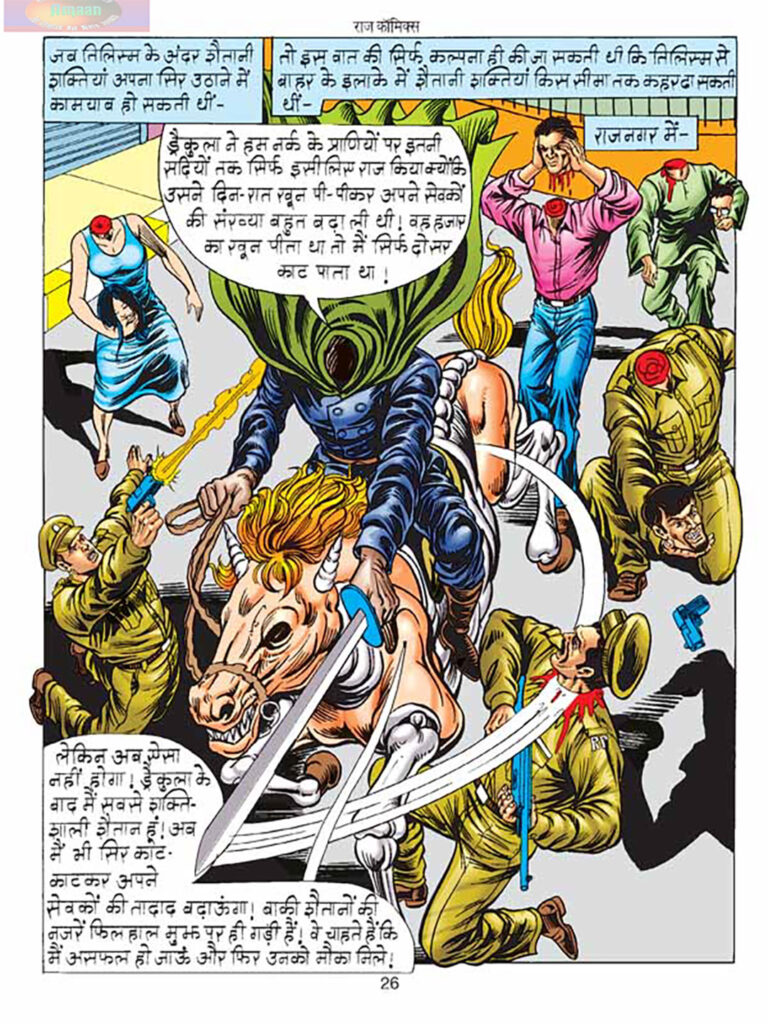
It is from here that the story starts moving forward simultaneously on many fronts. On one hand, Nagraj and Dhruv fight these monstrous trees and their dangerous roots, while on the other hand, Vedacharya and other tantriks get involved in creating a very complex and dangerous magical ritual to recall Dracula. Meanwhile, Dracula makes a powerful tantrik named Shuma and his cavalry of demons his companions in that other dimension.
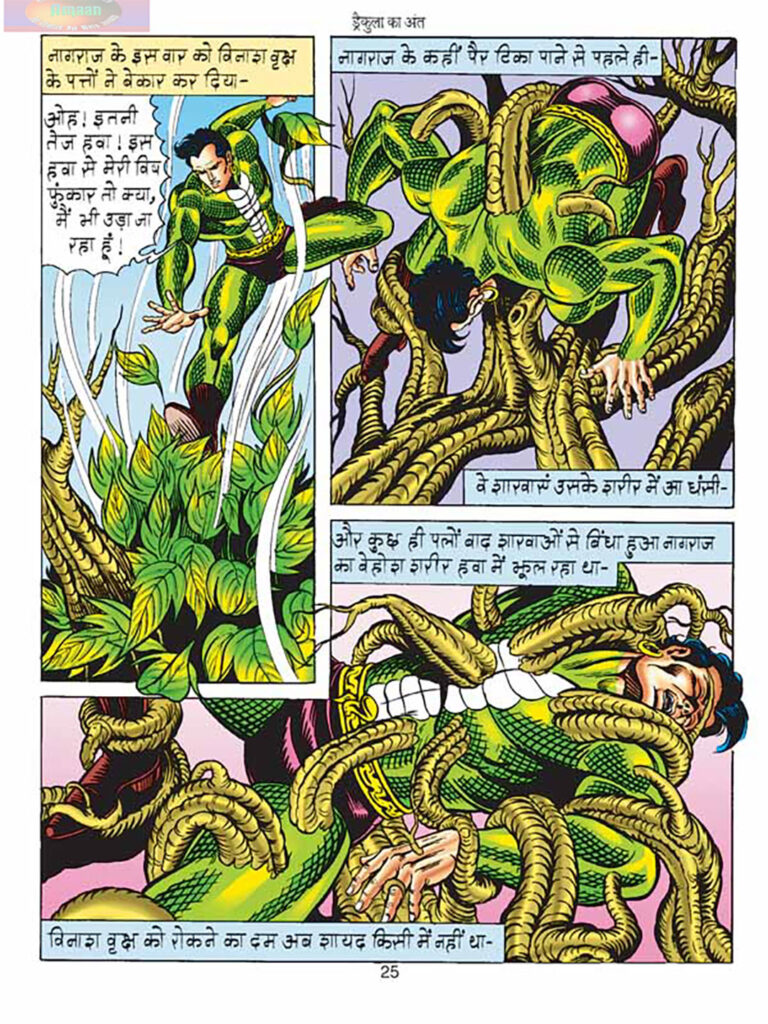
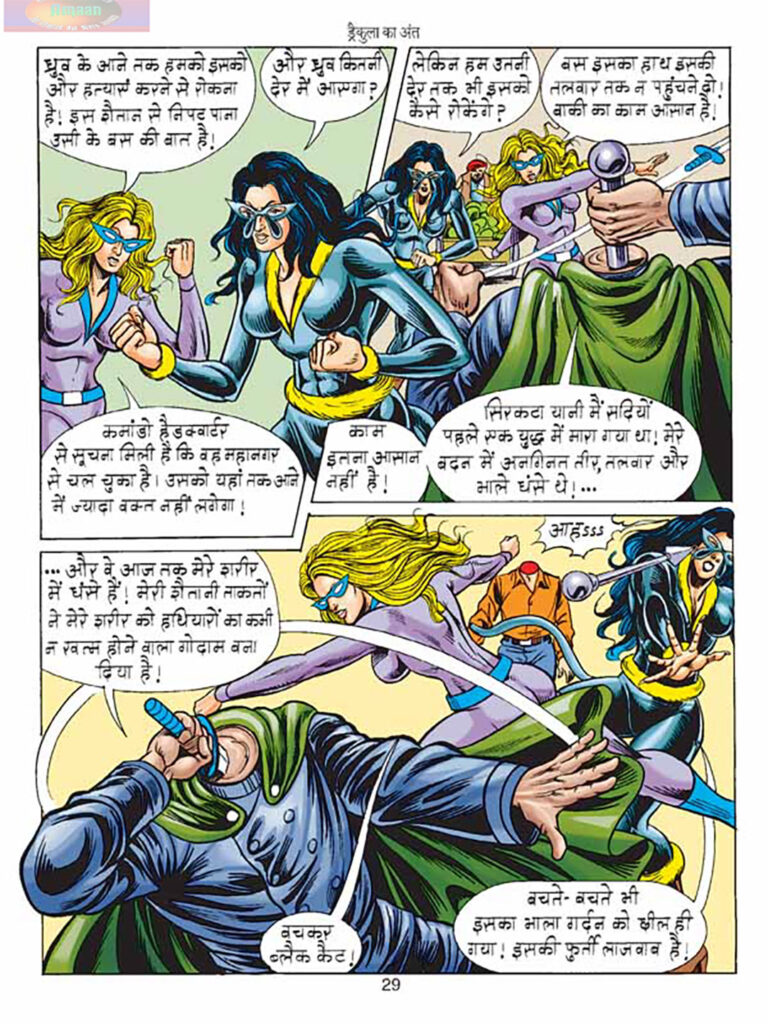
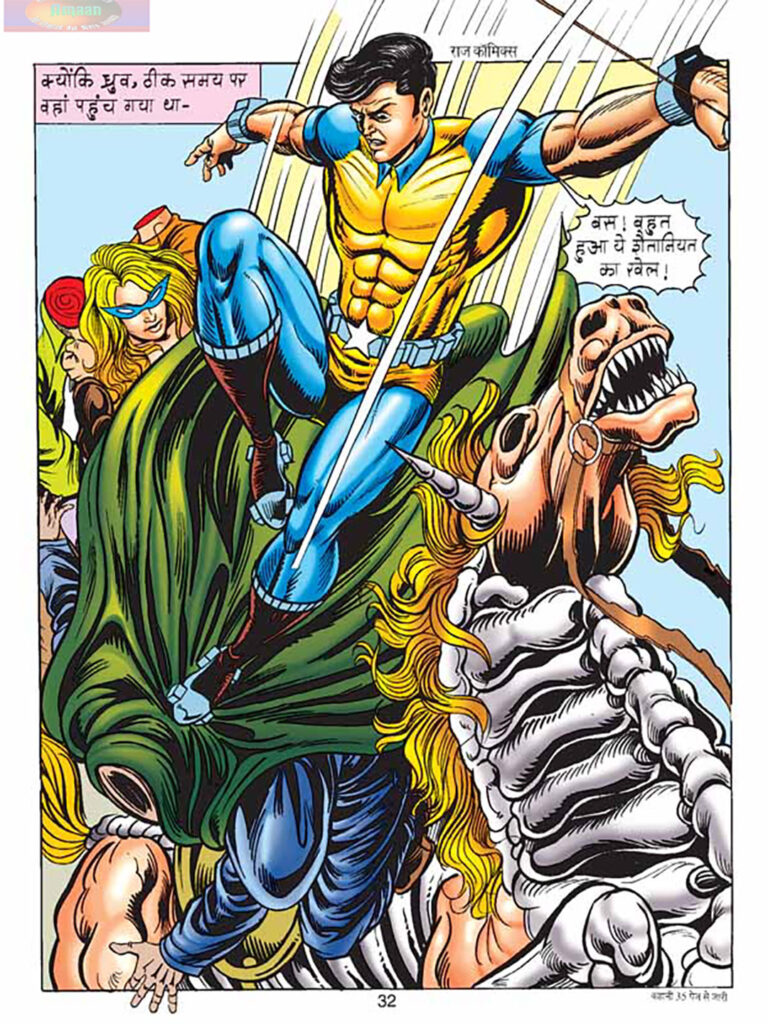
The middle part of the story turns completely into a vast battlefield. Shuma and his demons come to Earth through the magical gate and start wreaking havoc all around. Super Commando Dhruv confronts them with his commando force, while Nagraj tries to stop this terror of trees by using his snake powers. It is the same part of the comic where action, danger, and adventure reach their pinnacle.
Ultimately, Vedacharya’s plan succeeds, but the cost of this success is very heavy. Dracula returns to Earth, but has now become even more powerful and almost invincible than ever. Now, just strength or simple magic is not enough to defeat him.
Climax: No Power, ‘Grace’ Required
The climax of this comic is one of the most different, deep, and thought-provoking climaxes in the history of Indian comics. It is here that a very important character, Nostrodomus, enters the story. Nostrodomus is the protector of the equilibrium of the universe. He explains to everyone that Dracula is no longer just a vampire, but has become a negative force that cannot be completely destroyed. It can only be balanced. It takes grace, not strength, to defeat him.
This ‘grace’ is not a simple force, but a divine energy that can only be awakened through a special ritual. For this ritual, the descendants of Nagraj, Dhruv, Vedacharya, Lori, and Nostrodomus all have to come together and focus their energy on a single centre. This process is extremely dangerous, as they all become almost completely unsafe and weak during the ritual.
Dracula senses his coming defeat and attacks them with all his might. On one side, the ritual is going on, while on the other side, Nagraj and Dhruv keep Dracula and his army entangled with their last remaining power. This final battle is not just a test of physical strength, but also of willpower and faith.
Eventually, the ritual is completed. A divine beam of light descends from the sky and takes Dracula under its siege. Dracula does not scream in pain, but looks at that energy with bewilderment and awe, because this energy is not killing him. It is slowly pulling the evil that created Dracula from his existence. His body slowly dissolves, and this time he truly ends forever. This end is not through destruction, but through purification.
Nagpasha also makes a full recovery as Dracula is finished, and the crisis that has engulfed the metropolis is finally averted.
Characterization: Heroes, Villains, and Their Complexities
Dracula: The most powerful and influential character in this comic is Dracula himself. He is not just a monster thirsty for blood. He is a very clever, intelligent villain who adapts himself to circumstances. When his powers are taken away, he makes his cruelty his greatest weapon. And when he is blessed with immortality, his pride makes him even more dangerous. The author shows him rising above a simple horror villain into a threat that can disturb the balance of the entire universe, and that is what makes him special.
Nagraj: In this story, Nagraj is seen in all his bravery and valor. He is a symbol of strength and courage. But here, not only his physical strength but also his tolerance and strong willpower are severely tested. He understands that this battle cannot be won on the basis of strength alone, and hence he completely trusts Vedacharya’s plan.
Super Commando Dhruv: While Nagraj is a symbol of power, Dhruv is a symbol of intelligence and strategy. He has no innate superpowers, but his sharp mind, scientific inventions, and knowledge of martial arts make him no less than any superhero. He understands every situation, analyzes it, and then moves forward with a concrete plan. This is the biggest quality of the pairing of Nagraj and Dhruv—the strength of one complements the intelligence of the other.
Vedacharya: He is the backbone of this entire story. His knowledge and magical powers take the story forward. He plays the role of a true traditional guru, who shows the right direction to his disciples and always takes decisions by understanding the bigger picture.
Other Characters:
Supporting characters like Lori, Nostrodomus, Nagpasha, and Shuma give more depth and detail to the story. Lori’s compulsion and then her pivotal role bring an emotional connection to the story. Whereas the character of Nostrodomus takes this entire story to a philosophical and spiritual level, which elevates it far above an ordinary superhero story.
Art and Painting: The Magic of Anupam Sinha
Anupam Sinha’s artwork has always been the identity and soul of Raj Comics, and his work in this comic truly stands at its peak. Every panel is so alive that it feels lifelike. As soon as the pages are turned, a different energy is felt, which pulls the reader inside the story.
Action Sequences:
The fight scenes are very powerful, fast, and effective. Be it the deadly attacks by Nagraj’s snakes or Dhruv’s agile and acrobatic moves, the speed and flow are clearly visible in each action frame. It seems as if the scenes are not static, but moving.
Characterization:
The facial expressions of the characters reflect the atmosphere of the story very well. The fear and pride seen on Dracula’s face, Nagraj’s anger and determination, Dhruv’s concentration, and Vedacharya’s worry—everything is so clear that the emotions are understood even without reading the dialogue.
Design:
The design of the organisms and monstrous trees of another dimension is extremely imaginative and fear-inducing. They do not just seem dangerous; they also feel strange and mysterious. Shuma and his equestrian demons also have a look that, once seen, settles in the mind.
Panel Layout:
Anupam Sinha has used the panels in a very sensible and effective manner. Big splash pages add grandeur to the story’s important and memorable moments, while smaller and rapidly changing panels add to the thrill of the fights. The color combination done by Sunil Pandey makes the atmosphere of this entire comic deeper and more effective.
Critical Analysis
Positive Side (Pros):
This story has been created on a very large scale. It includes not only India, but also international locations like Romania and many other imaginary worlds. It is good to see how science (nuclear/robo) and tantra (Vedacharya/Lori) come together to fight against the same enemy. This reflects the thinking of Raj Comics, where different forces work together in unity. Showing a big and dangerous villain like Nagpasha in a helpless and miserable condition, and then his complete recovery, becomes a strong and emotional parallel plot that runs alongside the main story.
Downside (Cons):
A lot of elements are present together in the story—tilism, things like the world of painting, volcanoes, past events, and phantoms. In such a situation, a new reader may sometimes get entangled in understanding the story. Furthermore, Dracula’s ending could have been shown to be a little more challenging. Despite such tremendous powers, his physical fall into the lava at the end seems somewhat banal. However, the heart and emotional angle that is added to the story largely counterbalances this shortcoming.
Conclusion: An Unforgettable Masterpiece
“Dracula’s Ending” is not just a superhero comic. It is a story that teaches that the greatest evil cannot always be defeated by just raw force. Sometimes it requires unity, understanding, faith, and dedication to a higher power. Its ending goes beyond the simple “win-loss” to offer a spiritual and philosophical solution, giving it a distinct and special identity in Indian comics.
This comic is almost a must-read for every fan of Nagraj and Super Commando Dhruv. It is a great example of the golden age of Raj Comics, where story, art, and creativity come together to create wonders. If you want to read a story that keeps you hooked until the last page and even makes you think afterward, “Dracula’s Ending” is the perfect choice for you. This is proof that even in Indian comics, fantastic stories can be told with depth and maturity.
