


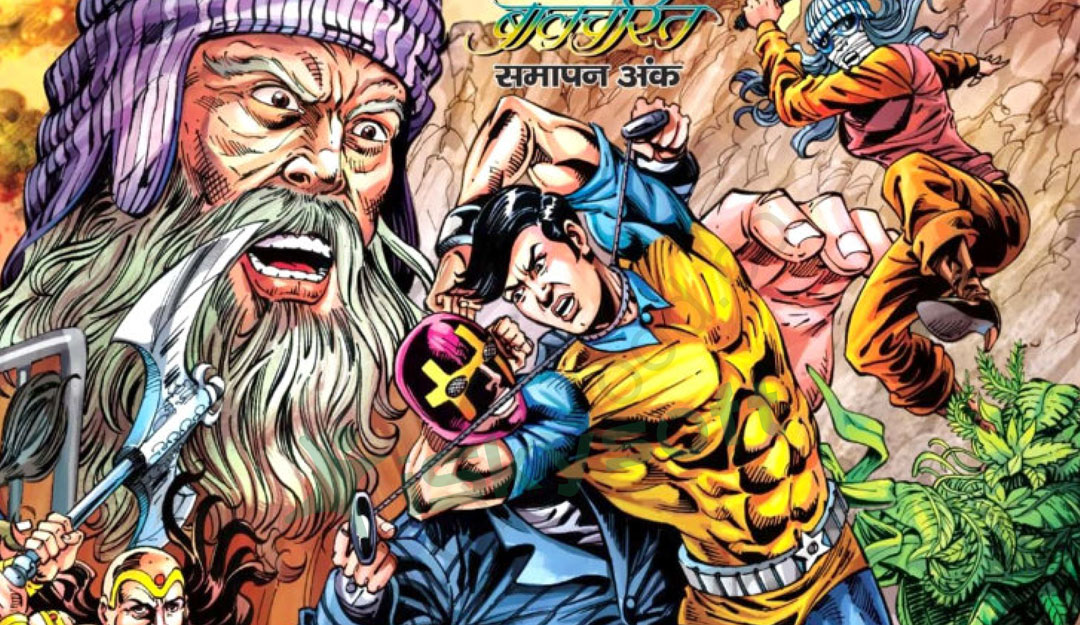
There are some stories in the history of Indian comics which not only provide entertainment but also become documents in a way. The ‘Balcharit’ series that Anupam Sinha made for Dhruv (which includes ‘Hunters’, ‘Flashback’, ‘No Man’s Land’, ‘Finix’ and finally ‘End Game’) is one of those exact same stories. We knew for decades that Dhruv was a Jupiter Circus performer and his parents were murdered. But ‘End Game’ makes the same simple-looking beginning an epic story.
“End Game” doesn’t just seem like a comic; it is the last and biggest proof of Dhruv’s existence, his pain, his journey and his entire process of becoming a ‘superhero’. This comic answers every question that has been raised in the last four episodes. This over 150-page special issue takes the reader on a passionate and thrilling roller-coaster ride.
The name ‘End Game’ itself sounds heavy. It is like a declaration of the end of a game, fight, revenge or journey to save one’s identity. As the tagline of this comic reads—”Mathesh’s life will remain where it is now while I am there!”—the story revolves around loyalty, old razes and the yearning of a son (Dhruv) to reach his mother (Radha).
Background and references
Review of any concluding part is not complete without understanding its earlier parts. ‘End Game’ is the last stop in a long story that started with ‘Hunters’. Dhruv’s life was completely shaken when ‘Hunters’, a mysterious and extremely dangerous organization, targeted him. They took away almost everything from Dhruv—his family, his city and his identity.
As mentioned in the intro page of the comic, Dhruv has gone through many twists and turns like ‘No Man’s Land’, ‘Flashback’, ‘Phoenix’ and ‘Dead End’. He was physically broken, but mentally and emotionally he emerged stronger than before. And the biggest discovery of this entire series was the survival of Dhruv’s mother, Radha. For years, Dhruv and we readers felt that his parents had died in the fire of Jupiter Circus. But Anupam Sinha shook Dhruv to the root through this ‘Retcon’.
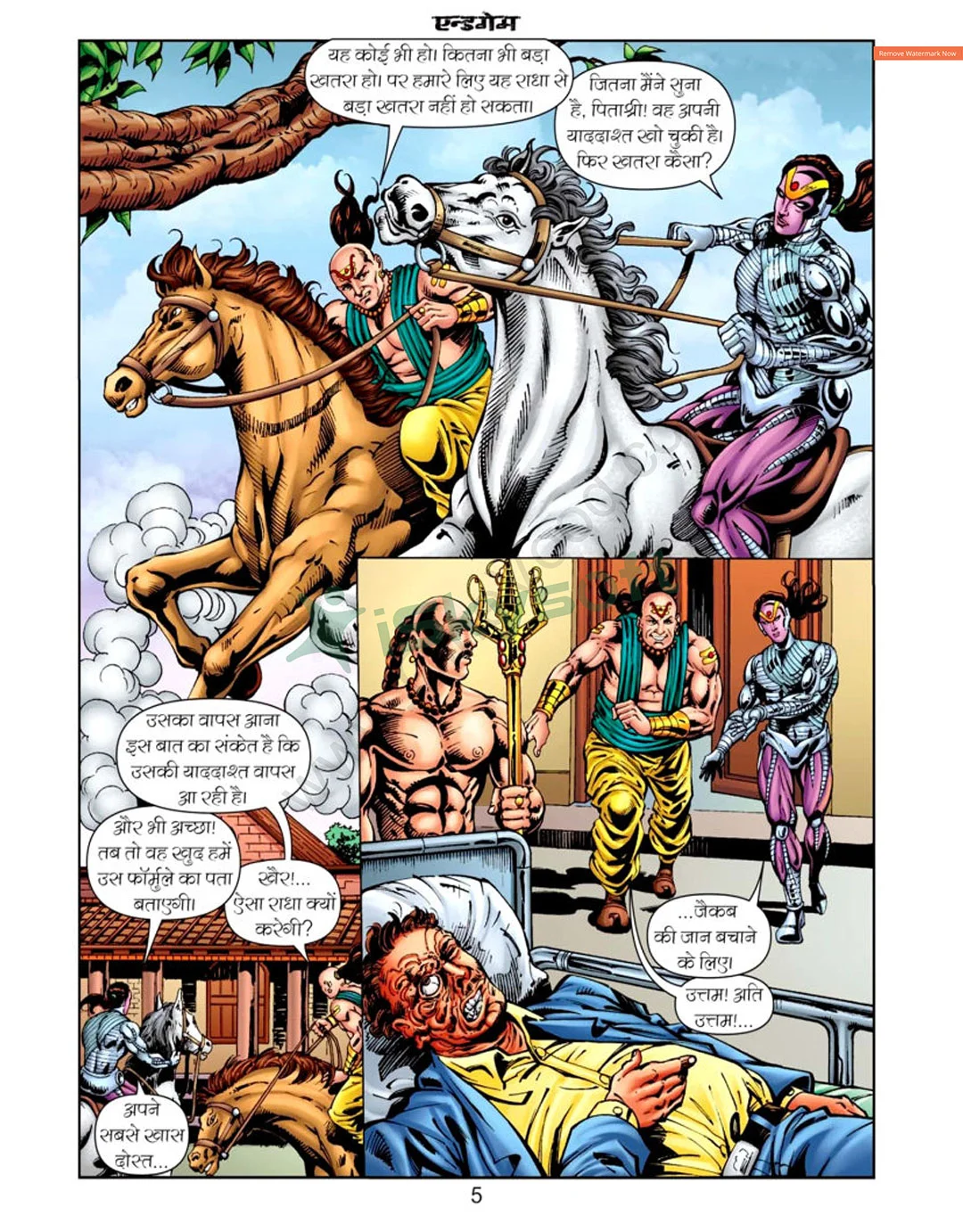
‘End Game’ starts from where all the secrets are at their peak. Radha has returned, but is she the loving mother Dhruv remembers? Or has she become someone’s weapon now? Hunters are looking for a special ‘formula’ that Radha has. This background lifts this comic from a simple action story to a deep and emotional thriller.
Plot Analysis
The comic itself begins with a bang scene that takes the reader from the very first page.
Radha’s return and paradox
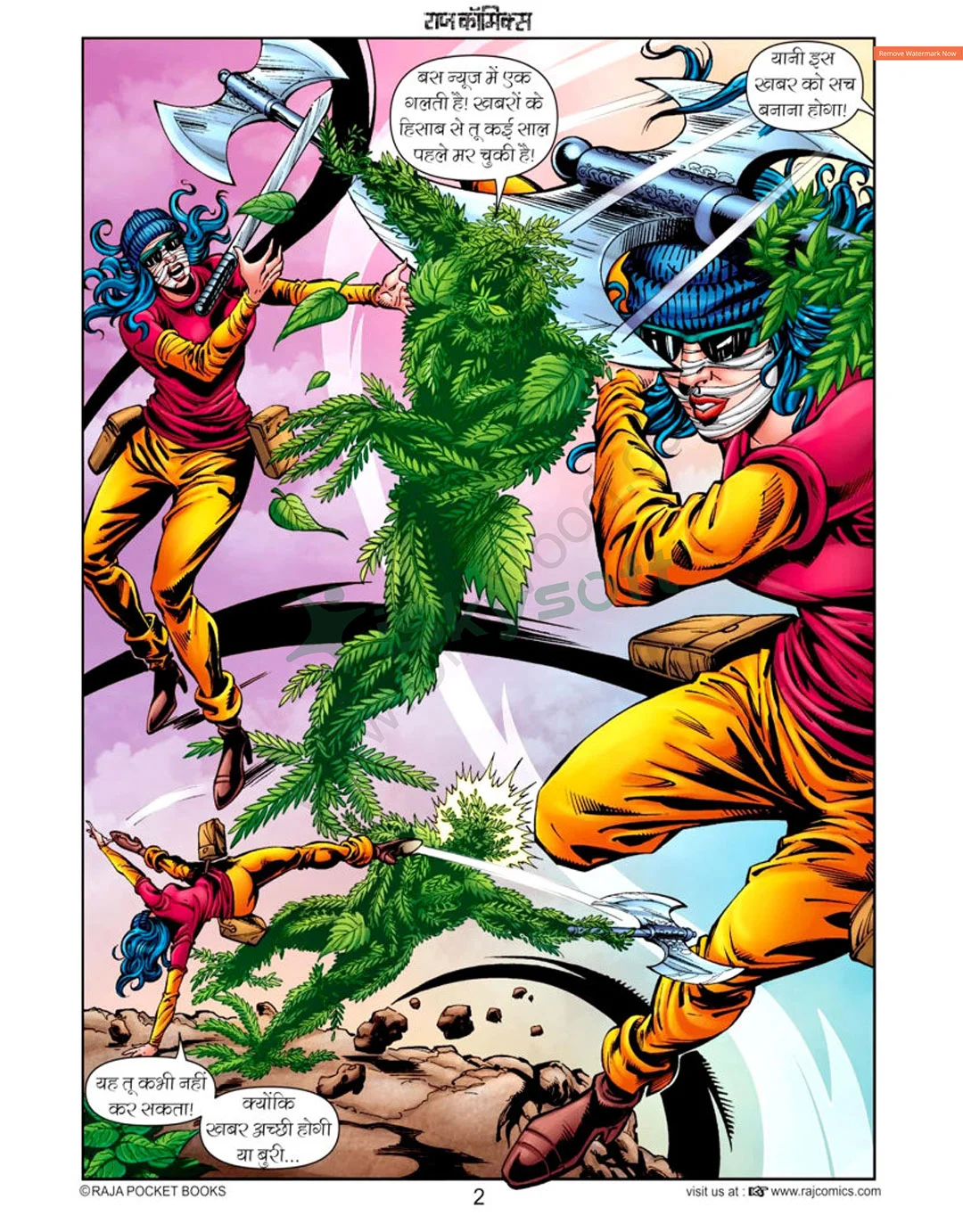
We see Radha in the very first scene of the story. But this is not the same old Radha who was just a trapeze artist. Here she has become a warrior. She is saving Mathesh—the same Mathesh who may later be Dhruv’s enemy or a pawn of the Hunters. Here Anupam Sinha presents a big moral dilemma (Moral Dilemma). Radha’s dialogue—”Mathesh’s life will remain where it is now while I am there!”—shows that someone’s life is worth more to Radha than enmity… or she is having a deep conversation in her mind.
In front stands a strange enemy—who looks made of leaves and vines and who has a huge mechanical axe in his hand. This entire scene shows the special world of Raj Comics where the mix of science and fantasy comes out in the most fun form. Radha’s avoidance of that big axe and deceiving that demonic enemy clearly shows that even though she has been missing for years, her ability and training have not diminished at all.
Conspiracy of villains
At the Hunters’ hideout, the interactions of their villains, both large and small, bring out their vicious thinking. Seeing Radha’s return, they plan to regain her memory and the special ‘formula’ she has. Their saying—”Formula from Radha we can get it instantly… because if she herself has come here, it is not a difficult task,”—shows that they rely more on Radha’s affection and her feelings towards Jacob, i.e., human weaknesses. This entire scene exposes the manipulation of the Hunters, who also use emotional blackmail as a weapon.

Cyme’s Twins (Siamese Twins) vs. Dhruv: The Game of Strategy
The funniest and exciting twist of the story comes when Dhruv faces ‘Simees Twins’—Tori and Mori. These characters are a great example of Anupam Sinha’s creative thinking. Two bodies, but intertwined; four arms and four legs. Dhruv, who is known for his wisdom and strategy more than his strength, is in a very difficult situation here. He is locked in a room, has no weapons, and in front stand enemies who can look and attack simultaneously in all four directions.
Here a dialogue of Dhruv matters a lot:
“Give up! Torimori… I thought you were a legend!”
This is Dhruv’s classic style—to talk to the enemy and divide their attention, tease them as well as understand their mental state.

The depiction of the battle (Choreography) is amazing. Twins say—”our brains are not two… the same mind is double,”—which tells their whole fighting style. They think together and strike together. Dhruv understands that these cannot be dealt with in a normal manner.
Dhruv’s strategy (Strategy) is worth a look here:
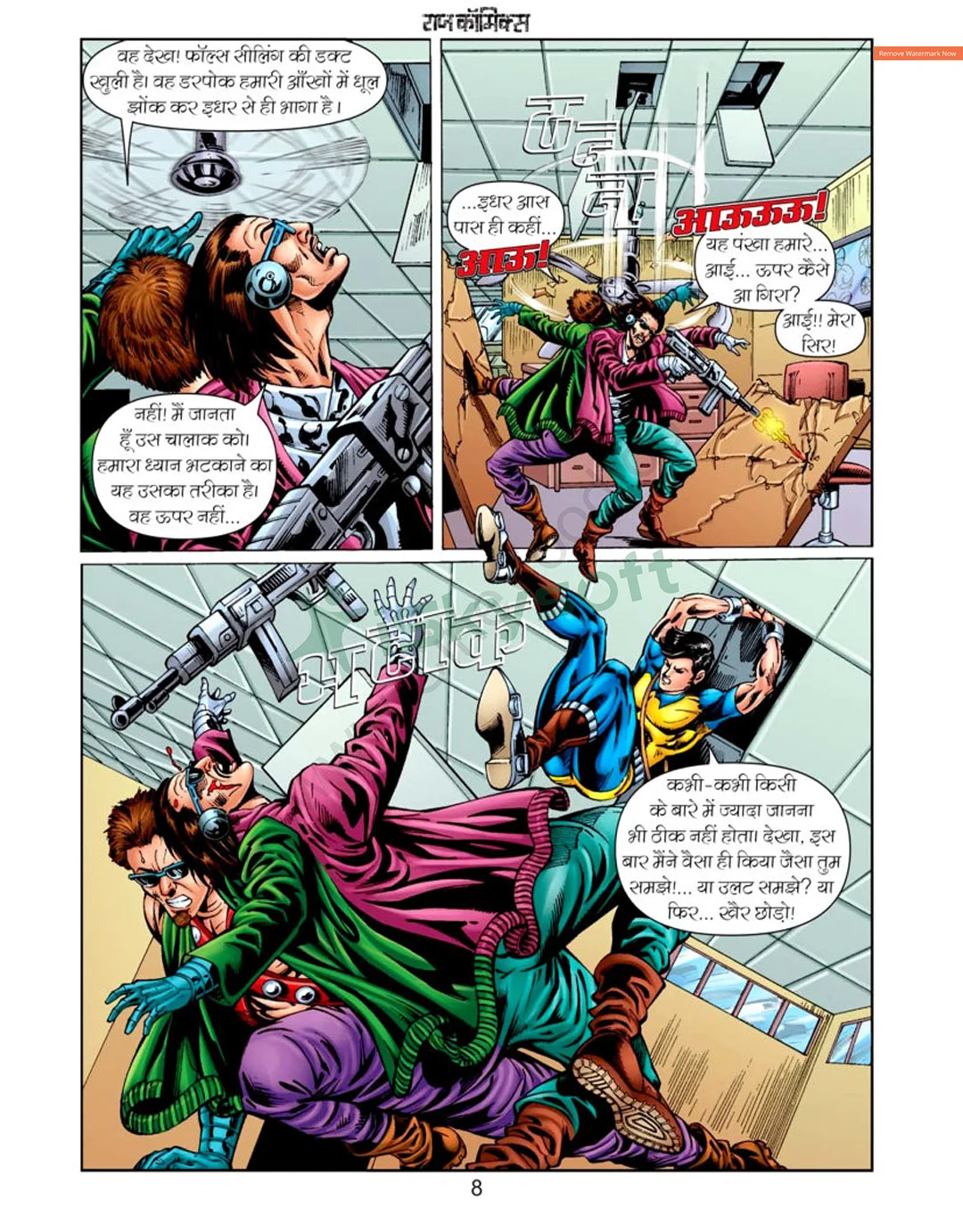
Dhruv makes tremendous use of the things around him. He quickly makes the table and chairs into shields and weapons. ‘Disorient’ (Misdirection) has a big role in his strategy—he cleverly opens the duct of the false ceiling to mislead the Twins that he has climbed up. This trick clearly shows that Dhruv can trick even clever enemies like the ‘Hunters’ in brain games.
The biggest moment of this mental game (Psychological Warfare) comes when the Twins are meditating upstairs, and Dhruv takes advantage of that one over-confident moment to strike from below. His saying, “Sometimes it is not right to know too much about someone,”—shows that he makes the strength of his opponents (their overconfidence and cunning mind) their weakness.
Character analysis
Super Commando Dhruv
In ‘Endgame’ Dhruv appears to be at his highest stage of development. He is no longer the little kid who used to do stunts in Jupiter Circus, nor is he just Rajnagar’s keeper. He is now a warrior who has lost everything and is now fighting to get his life and loved ones back.

In this comic, Dhruv’s image with ‘Phoenix’ has been further strengthened—a hero who rises from the ashes and shines again. In the battle with the Cymie’s Twins, we see Dhruv win without any gadgets, just using his wits and the things around him. This is the real specialty of Dhruv.
He is not dependent on gadgets or superpowers like Batman or Spiderman; his mind is his greatest strength. His compulsion, his uneasiness to meet his mother, makes him human. He’s a superhero, but first he’s a son—and that’s the feeling that gives him more depth.
Radha (Mother of Dhruv)
Radha’s character is the heart of the entire series. Anupam Sinha has shown her not just as a pity character, but as a strong fighter. In the very opening pages of the comic, her action avatar shows that Dhruv’s agility, courage and wisdom have come from her.
Radha is surrounded by a mystery—does she remember everything? Why is she protecting the Hunters’ formula? What is the reason for saving Mathesh? These questions give depth to her character.

Radha is not just ‘mom’, but the most important player of this whole story. Her presence makes the story both emotional and exciting.
The Cymie’s Twins (Tori-Mori)
It takes having a strong villain to shine a good hero, and Tori-Mori fit the case perfectly. They are visually scary—two heads, four arms, one body and one shared mind. This strange texture of theirs makes them a memorable and terrifying antagonist in comics.
Their overconfidence becomes their weakness, but their strength and speed pose a big challenge to Dhruv. They symbolize a dangerous, unique and deadly world just like the Hunters.
Portraiture and art style (Art and Visualization)
Anupam Sinha’s artwork has always been the hallmark of Raj Comics, and his art is at its peak in ‘Endgame’. He has brought the movement of the action sequences to life with extremely dynamic panel layouts and effective use of speed lines, allowing readers to clearly feel the speed of throwing tables and striking during the battle of Dhruv and the Twins.

This motion is further intensified by details of the background such as broken wood, flying paper, and room debris, which increase the intensity of the fight. His mastery of facial expressions is evident, where Radha’s tenacity, Mathesh’s fear, the Twins’ cruelty and Dhruv’s focus are beautifully depicted with a mixture of tension and concentration.
Finally, the color combination, attributed to Sunil Dasturia and others, is very vibrant; the harmony of green and brown colors used in flashbacks/jungle scenes and dark and bright colors in action scenes effectively establishes the atmosphere of the comics (Mood).
Dialogue and Screenplay
The biggest feature of Anupam Sinha’s writing style is his dialogues, which are in line with the personality of the characters and maintain a balance between drama and bluntness. Dhruv’s satire is proof of this; when he says, “There are two heads, four hands and that too which none of your gods has, four legs!” this statement not only reflects Dhruv’s calm mind and sense of humor even in a stressful situation, but also establishes that no matter how serious the situation is, Dhruv is under control.
At the same time, the villain’s philosophical style comes to the fore by saying that “the drowning man tries to escape by catching even the waves”, highlighting the Hunters’ philosophy of superiority. The dialogues are also used in creating mystery, such as the villains’ conversation on Radha’s arrival arousing curiosity in the minds of readers.

Moreover, Sinha’s script is extremely tight; on pages 8 and 9, the scene of Dhruv disappearing and then suddenly attacking is written in such a way that it gives a cinematic feel, in which first the readers see the deviation from the villains’ perspective (Misdirection) and then the attack is revealed from Dhruv’s perspective.
Thematic analysis
Additionally, an identity crisis (Identity Crisis) echoes throughout the story, where Dhruv is struggling to accept his new truth after the past has been changed—is he still the same Dhruv? This narrative intelligence versus force (Brain vs. Brawn) also depicts the everlasting duality; while the Cymie’s Twins and the Monster of the Jungle are symbols of brute power, Dhruv is a symbol of calm mind and correct strategy, establishing that the ultimate victory is always that of intelligence.
The ‘Endgame’ comics are not just an action-packed battle, but they encompass many deep themes. At the heart of the story is motherhood and sacrifice (Motherhood and Sacrifice), represented by Radha; her return is not only a mother’s physical return, but also marks the return of Dhruv’s lost childhood, which shows that a mother can go to any extent for the honor of her child and family.

Finally, the shadow of the past sends the message that we cannot run away from our secrets, and like Dhruv we have to face them.
Significance in the history of Raj Comics (Significance in Raj Comics History)
The year 2018 was a transition period for Raj Comics. The ‘Sarvanayak’ series and the ‘Balcharit’ series were attempts to keep Dhruv’s character relevant to new readers. ‘Endgame’ was successful in that it honored the memories (Nostalgia) of older readers (reminiscences of Radha and Jupiter Circus) as well as introduced modern action and storytelling to a new generation.
These comics are proof that the Indian comics industry still has the potential to tell stories that can compete with international graphic novels. Anupam Sinha proved through ‘Endgame’ that he is not just a creator but an experienced storyteller.
Conclusion
‘Endgame’ (Super Commando Dhruv) is a complete package that has emotions, secrets, and plenty of adrenaline-pumping action. The very opening pages seen in the PDF clearly show how grand and exciting the story ahead is going to be.
Positive Side (Positives)
The greatest strength of ‘Endgame’ is its gripping story—which keeps you engaged from beginning to end. Anupam Sinha’s fine art gives it more height; many panels really look like paintings.
Character development is also a strong part of this comic. The new, emotional and deep dimension that Dhruv and Radha’s relationship gets here makes this story special.
The action is also not just “direction-dishum”, but is based entirely on the mind, strategy and understanding of the situation—this is the specialty of Dhruv, and this is what makes this story different.
Drawbacks (Negatives)
It can be a little difficult for new readers to catch references, especially if they haven’t read previous comics (although editorial notes help).
In some places the dialogues are a bit long, making them feel “old school” compared to modern comics— but this is also part of the classic style of Raj Comics.
Last Verdict
Finally, ‘Endgame’ is a must-read comic. This is no less than a gift for Dhruv’s fans, and a precious gem for Indian comics literature. The cleverness with which Dhruv outwits the Cymie’s Twins sends the message that no matter how big the problem is, patience and intelligence can always win ‘Endgame’.
This comic proves that Super Commando Dhruv is not just a functional character—but an inspiration. This conclusion of the story (at least of this chapter) gives satisfaction and at the same time leaves one eager for the adventures to come.
Rating: ⭐ 4.5/5
