


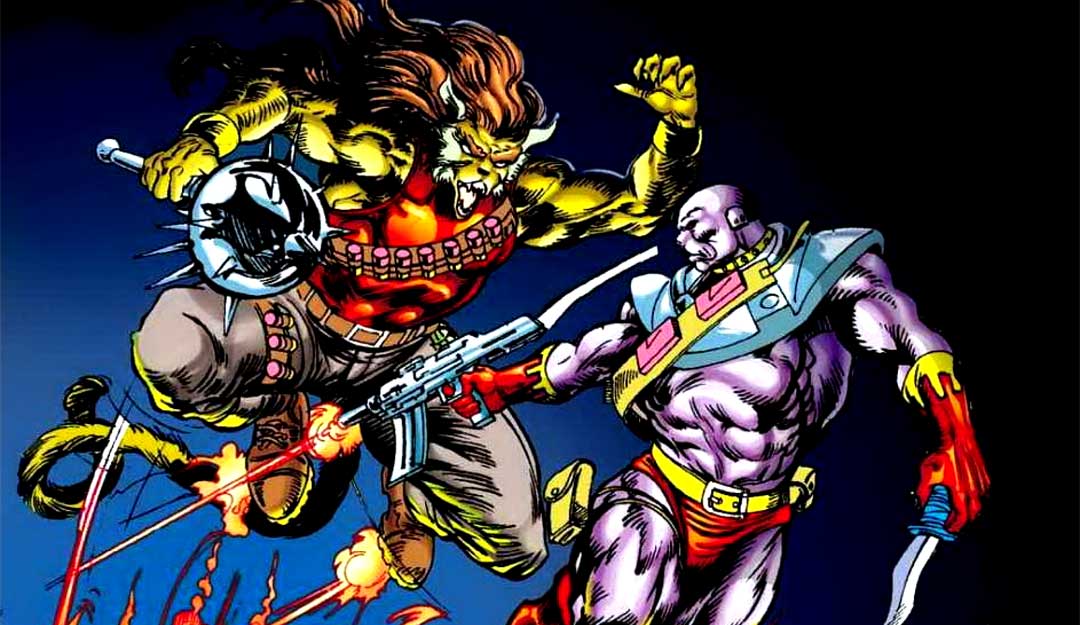
‘Crossover’ stories have their own special identity in the world of Raj Comics. When two big and powerful characters come face to face, the readers themselves get excited. “Gangwar” is also one such story. On one side is Doga, who walks the law in the dark streets of Mumbai and for whom justice means blood for blood. On the other side is Kobi, who is a fierce form of a wolf and a very powerful warrior from the dense forests of Assam. Kobi is wild, stubborn, and extremely strong by nature. When two such superpowers collide in the same story, readers already know that something big and explosive is about to happen. This comic has been edited by Sanjay Gupta, and the story has been written by Tarun Kumar Wahi, who is known for stories full of mystery and suspense.
Plot Expansion
The story of ‘Gangwar’ begins where Kobi, the more violent and powerful form of the wolf, leaves the forests of Assam and comes to Mumbai. In the fast-paced life of Mumbai and the world of crime here, Kobi quickly becomes famous on the basis of his power, and people start calling him ‘Kobi Bhai’. Meanwhile, he comes in contact with Mumbai underworld don ‘Old Brother’. The Old Brother is a cunning and dangerous criminal, who uses Kobi’s strength to eliminate his enemies and gradually traps him in his work.
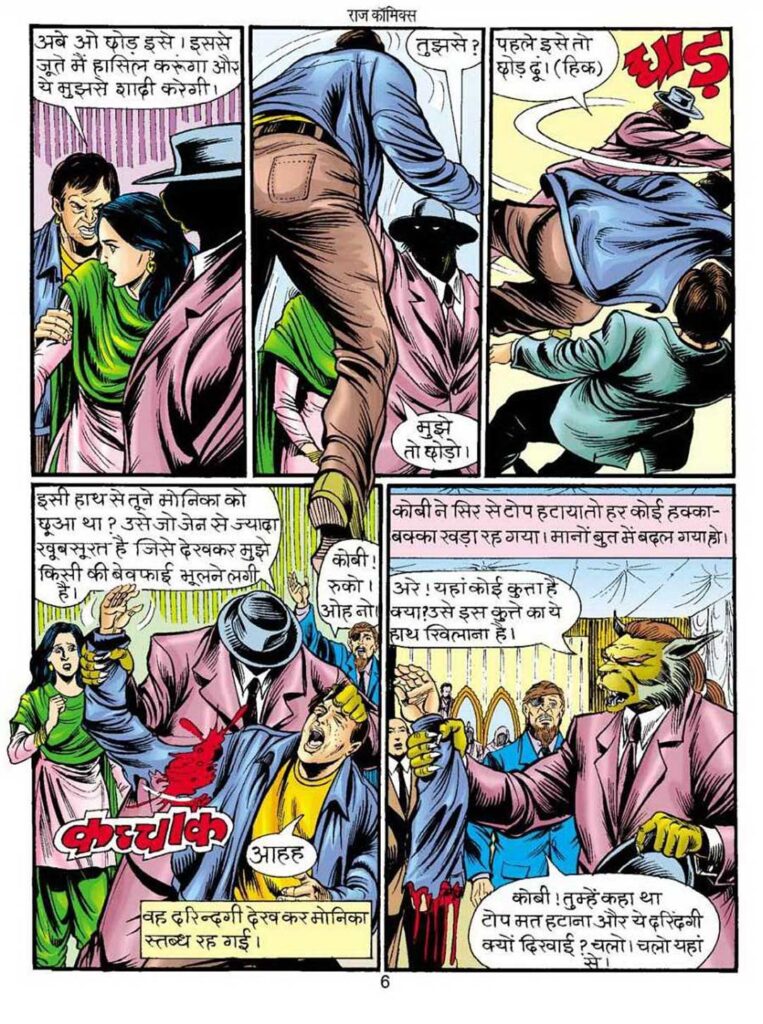
The second part of the story connects to Doga, i.e., Suraj. Suraj is a gym trainer in normal life, but as soon as he wears the mask, he becomes Doga—a scary name for criminals. When he discovers Kobi’s growing activities, he becomes seriously worried. Suraj knows that if an uncontrollable and powerful creature like Kobi commits crimes openly, it will be very dangerous for Mumbai.
The real twist in the story comes when some of the Old Brother’s trusted people—the Tiger, the Sweetie, and the Executioner—betray him. Their motive is clear: to take over the power of the underworld themselves by getting Kobi out of the way. Meanwhile, Kobi meets Monica, who is a social worker and also the girlfriend of Suraj, i.e., Doga. Kobi is so impressed by Monica’s beauty and strong personality that he wants to make her his ‘queen’.
Along with the story, another story also goes on. The wolf, who is the calm and understanding form of Kobi, arrives in Mumbai from Assam with Jane and Foojo. Their motive is to take Kobi back and put him on the right track. For this, they hide their true identities and disguise themselves as Tiger, Hangman, and Sweety so that they can stay with Kobi, protect her, and handle the situation.
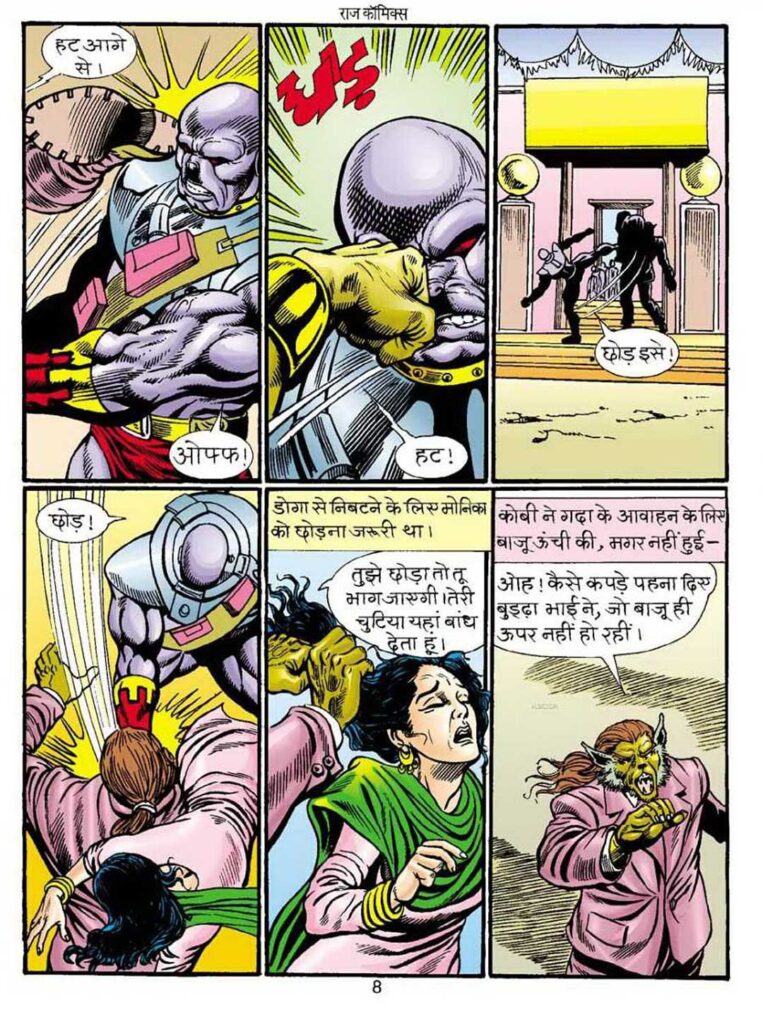
The climax of the story comes when the Old Brother’s younger brother makes a dangerous weapon called ‘Magnet’. This weapon is so powerful that nuclear missiles of the entire world can be controlled with it. Now the story starts going on two sides—on one side the clash between Doga and Kobi, and on the other side the struggle to save the entire city from a terrible disaster.
Analysis of Characters
DOGA (Suraj):
In this story, Doga is not just a bloody hero, but he emerges as a symbol of morality and justice. Here his character looks more responsible and like a protector than before. His compulsion as Suraj, when he cannot save Monica from Kobi, and his anger as Doga—these two aspects together humanize the story. Doga fighting Kobi is not just a clash of strength, but it is a battle being fought for the law and order of Mumbai and the safety of the common people.
Kobi (Mumbai’s new ‘brother’):
Kobi’s character is the greatest strength of this comic. He is simultaneously innocent and extremely violent. He does not have a full understanding of the city’s wiles, but his immense strength makes him arrogant. His attraction to Monica puts him in the villain’s line, yet readers know that the ‘wolf’ within him, that is, his calm and good nature, is not gone yet. Kobi falling in love and becoming ‘Majnu’ and then his fierce confrontation with Doga maintains the thrill and tension in the story.
Old Brother and Younger Brother:
The Old Brother is a traditional mafia boss. He looks tough and cruel on the outside, but also has some affection for his younger brother and Kobi on the inside. The younger brother is a new-age villain, who trusts his mind and technology more than his strength. His ‘Magnet’ project is an example of how Raj Comics made stories bigger by combining science and fiction.
Wolf, Jane, and Foozo:
The presence of these three adds mystery and depth of emotion to the story. Being around Kobi in disguise and revealing their true identity at the right time is a great bet in the story. Jane’s unselfish love for Kobi and Kobi’s misguided and coercive attraction to Monica combine to form an intriguing love triangle, further strengthening the story emotionally.
Dialogue and Language Style :
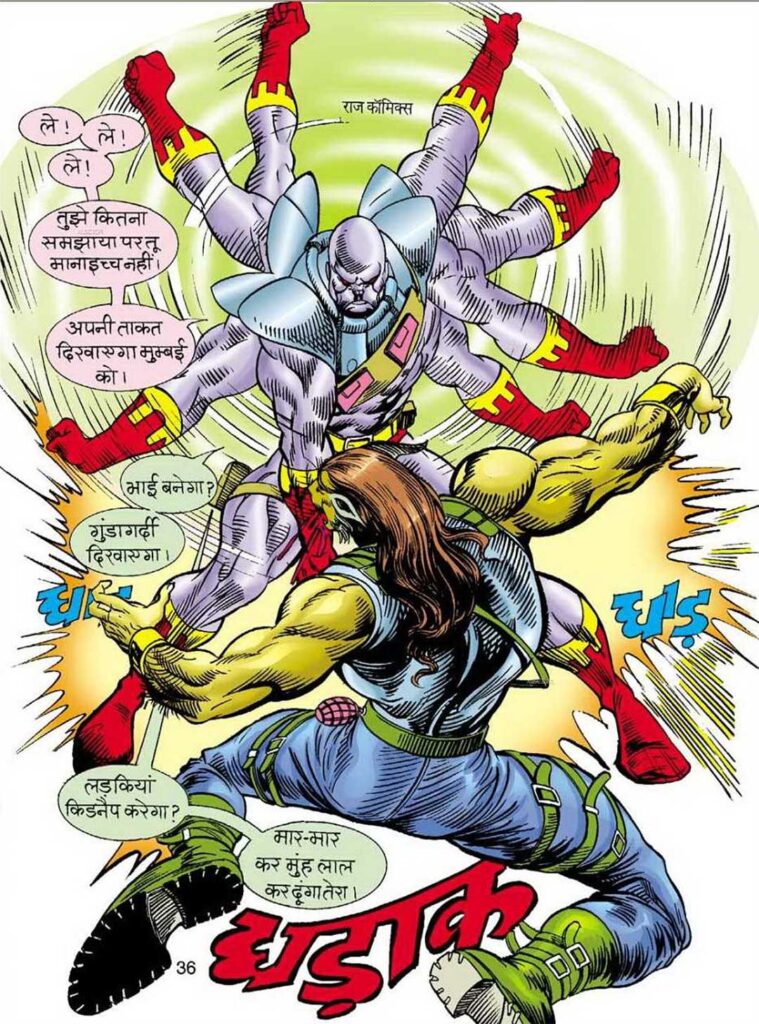
The dialogues in Sanjay Gupta’s comics have always been strong, and ‘Gangwar’ is no exception. In this comic, the language and slang of Mumbai have been used openly—like “apun”, “bidu”, “khallas” etc.—which make the atmosphere of the underworld more real and alive.
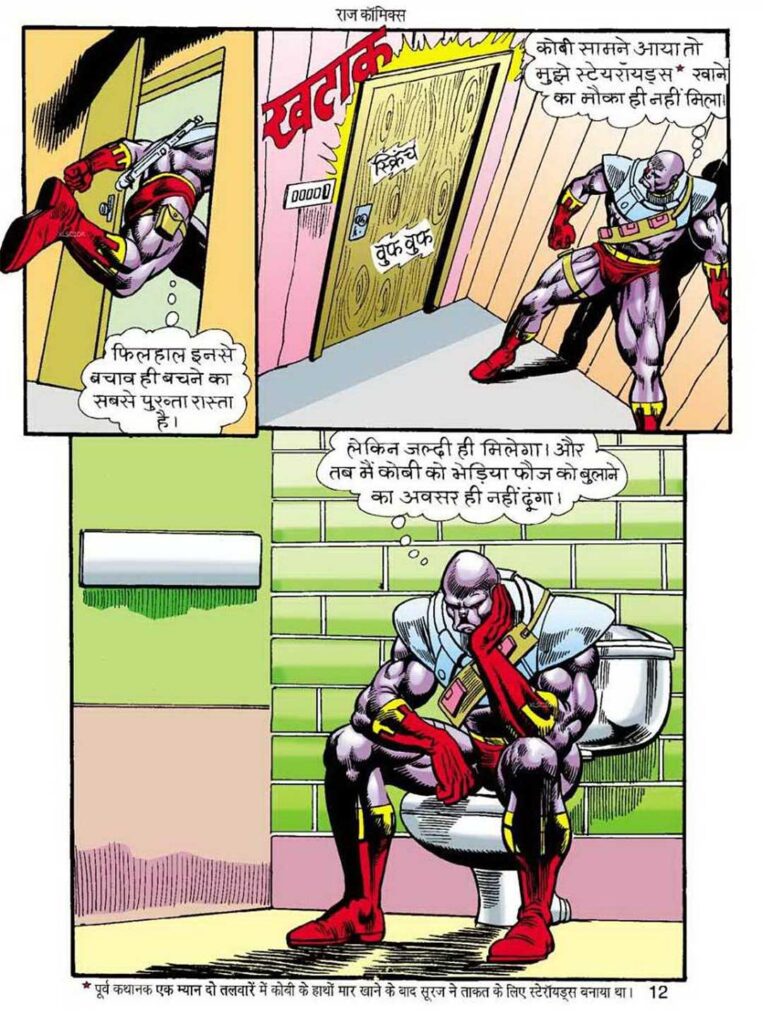
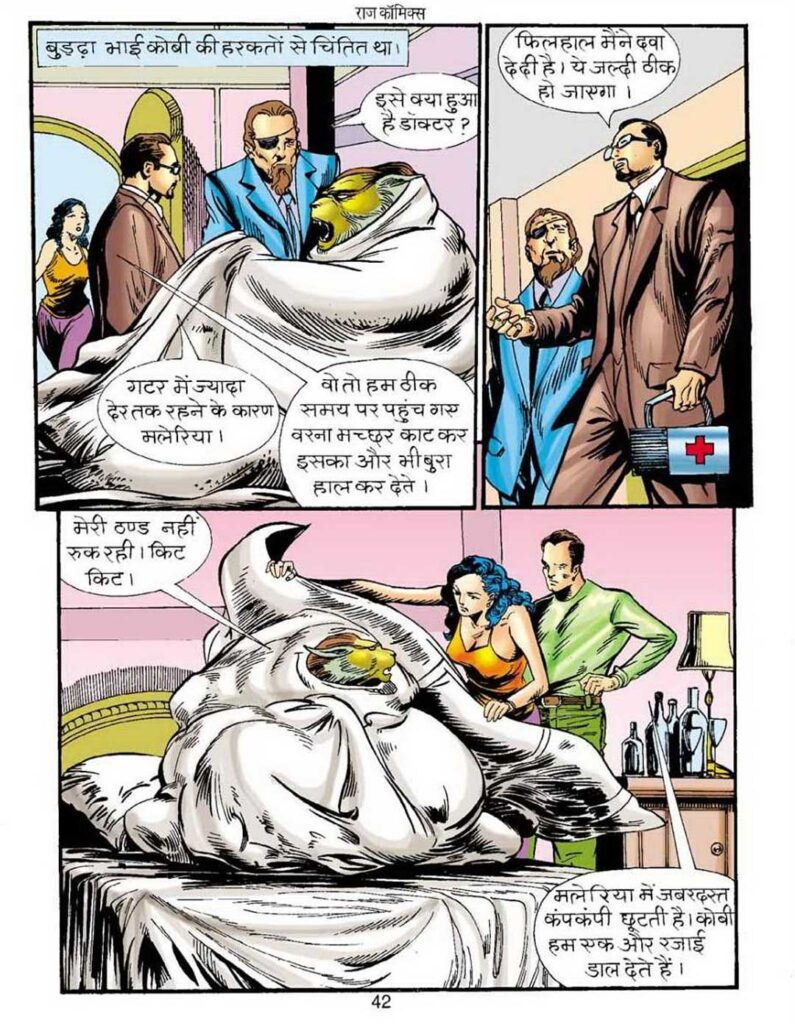
Doga’s dialogues are as strict, direct, and full of warning as ever—“Doga will be behind you like a shadow today, Kobi!” Whereas in Kobi’s dialogues, his wild nature and innocence, as he cannot understand the world of the city, are clearly visible. The comic also has lighthearted humor, especially in scenes where Kobi tries to adapt to new things in town, such as amenities like restrooms or hotels.
Art and Illustration
‘Gangwar’’s portraiture is the finest example of the art of the brilliant artists of that period. Tremendous speed and energy are felt in every panel. The action scenes between Doga and Kobi are particularly exciting, where Doga’s bouncing attack in the air and Kobi’s attack with his mace are shown very clearly and closely.
Special attention has been paid to the characters’ facial expressions, which convey Monica’s fear, Kobi’s terrible anger, and the burning revenge in Suraj’s eyes to the reader. The use of colors also deepens the atmosphere of the story—dark blue and black colors show the dark world of Mumbai, while the sharp use of red and yellow colors in fight scenes increases visual tension.
Key Scenes and Their Significance
Doga hiding in the toilet is not just a way to save his life, but also shows his wisdom and strategy. He knows that Kobi’s wolf-like sense of smell can catch him, so he hides in a place where the illusion of smell can be created. The dialogue between Monica and Kobi shows Monica’s courage, where she attacks Kobi’s pride without fear with her words.
The subplot of ‘Magnet’ does not allow the story to be limited to just one gang war, but turns it into a global threat, where the whole of Mumbai appears to be on the brink of a nuclear catastrophe. Finally, the final war between Doga and Kobi is the culmination of adventures for the readers, where Doga’s decision to send Kobi back to Assam and Kobi’s surrender give the story a strong and satisfying ending.
Social and Ethical Messages
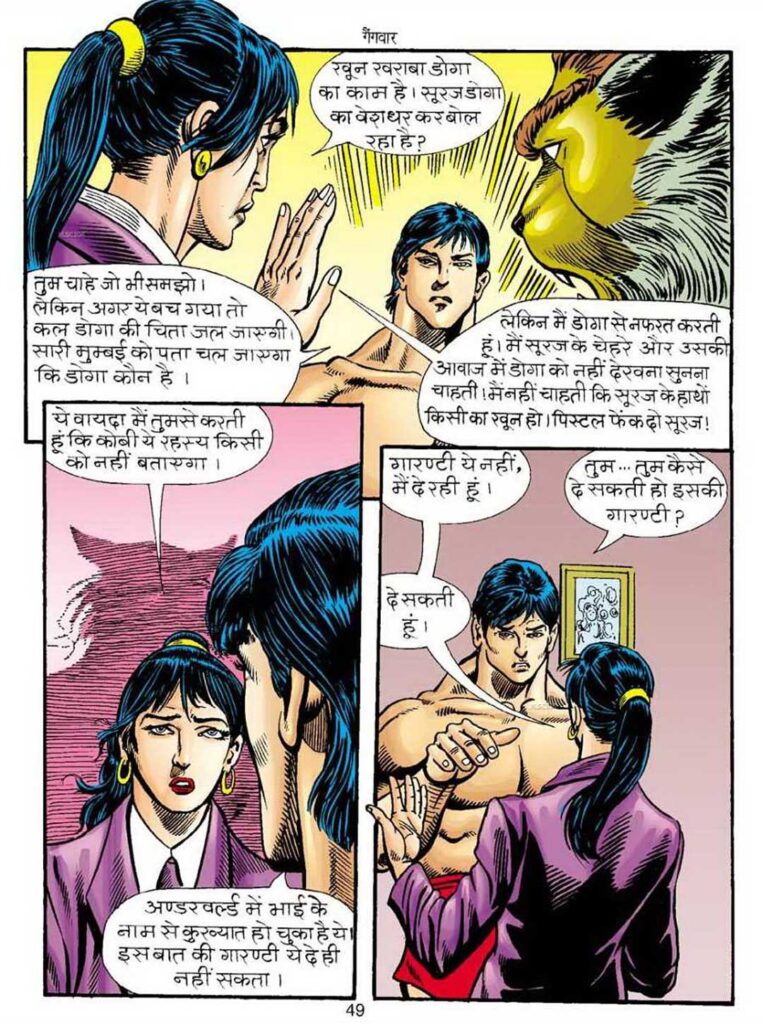
‘Gangwar’ is not limited to just entertainment, but has many deep social and moral messages within it. Kobi’s character clearly shows the collision of ‘jungle vs city’—how a powerful and free creature moves away from its natural environment and becomes just a pawn in the trickster streets of the city.
The story also shows the real definition of love. While Kobi’s dangerous infatuation with Monica, which is full of selfishness and coercion, Jane’s selfless dedication to Kobi shows true love. The ending of characters like Budha Bhai and Chhota Bhai teaches that no matter how bright the path of crime may seem, its outcome is always destruction. In the end, Doga’s defense of the entire city by staking out his personal love shows the selfless sacrifice of a true hero.
Critical Approach
Although ‘Gangwar’ is a very strong and memorable comic, some readers may still find that the number of characters in the story is a little high. Doga, Kobi, Wolf, Old Brother, Younger Brother, and the Trio of Traitors— the story seems a little confusing sometimes between so many characters. Especially the part with ‘Magnet’ seems somewhat abruptly finished at the end, which could have been expanded a little more.
Despite this, the screenwriter has added all the threads of the story very intelligently and neatly at the end. The internal conflict between Bhediya and Kobi and Doga’s strong presence combine to make this story one of the best ‘crossover’ stories in Raj Comics.
Conclusion
‘Gangwar’ Raj is a very important and proud chapter in the history of comics. This story reminds us again why characters like Doga and Kobi are still alive in our hearts even after so many years. The comic is a powerful tale of courage, cunning, deception, and ultimately the triumph of justice.
If you are a reader who likes vigorous action, fluctuating emotions, and strong and exciting stories, then ‘Gangwar’ must be in your collection. This comic teaches us that no matter how big the enemy is (like Kobi) or how vicious (like the Old Brother), he finally has to bow down to strong intentions and the right motive (like Doga).
Final decision: 4.5 out of 5 stars. This comic is a precious gem of the world of Indian superhero comics.
