


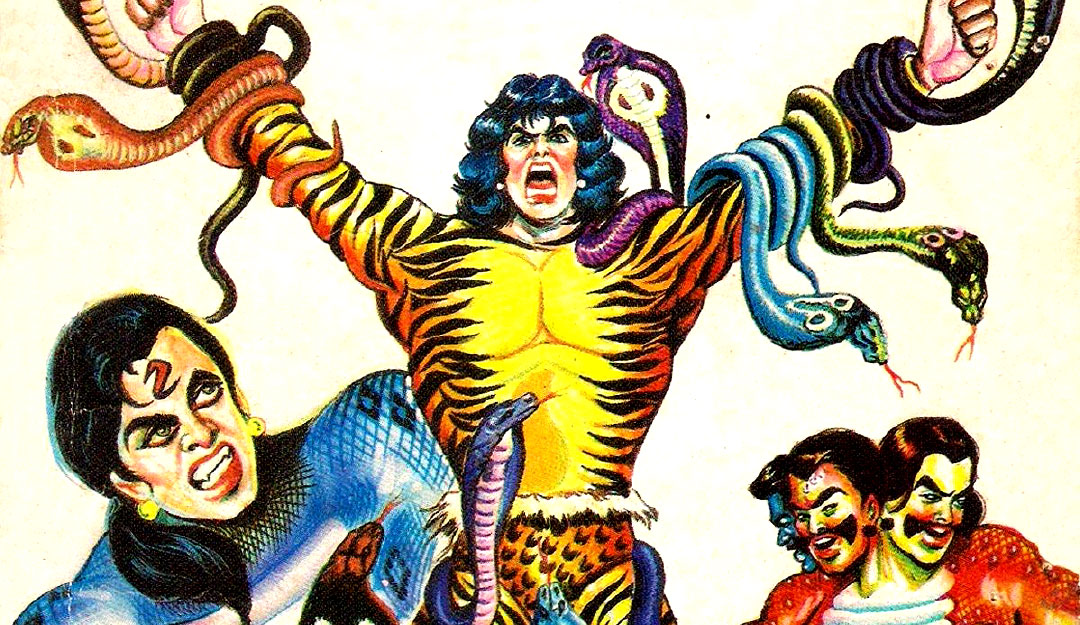
Durga Comics has had its own unique status in the history of Indian comics. While Raj Comics had superstars like Nagraj and Parmanu, Durga Comics gave us powerful and fighting heroes like Torah-Torah and Fighter Man. “Ichchadhari Nagon Ki Jung” of the Fighter Man series follows a familiar story of revenge, bravery, and massive devastation. The 32-page comic takes readers on a tremendously exciting journey—from the mysterious serpent folk to the high-rise buildings of the modern city.
Detailed analysis of the plot:
The foundation of the story rests on the conflicts of the previous episodes. Fighter Man has already defeated Black Cobra, the prince of Nag Lok, in a terrible battle in which he becomes crippled and blind. Seeing this condition of their prince, the emperor of the snake world and the entire snake race become sworn enemies of Fighter Man. The emperor’s general, Bhujang Dev, and the mighty Trimukhi, i.e., the three-hooded serpent, swear that they will capture Fighter Man and throw him at the feet of the serpent folk within 24 hours.

The story begins with Bhujang Dev’s arrival on Earth. He disguises himself as a human, reaches an expensive hotel in the city, and inquires about Fighter Man. When the hotel staff cannot provide any information, Bhujang Dev shows his true colors. He unleashes his serpent army inside the hotel. Within moments, the entire hotel is filled with chaos, and snakes start appearing everywhere. This scene is so terrifying that fear automatically settles in the mind of the reader.
The next day, an open warning from Bhujang Dev is published in the Durga Times newspaper. On the other hand, Fighter Man, who is sitting at a dhaba in normal clothes at that time, reads the news. Here comes a funny moment in the story, when Fighter Man sets out on his mission by “borrowing” a Sardarji’s motorcycle. The Sardarji yelling from behind—“Oye thief… took my motorcycle!”—adds a slight comic relief to the story.

As part of their plot, Bhujang Dev and Trimukhi attack a school picnic. They not only scare the children but also show extreme cruelty and hang teachers and children on trees with the help of snakes. All this is done deliberately to provoke Fighter Man. Fighter Man reaches the spot, and it is here for the first time that his tiger-print superhero look comes out in full glory.
War and display of powers:
The clash between Fighter Man and Bhujang Dev is the first big action scene of this comic. Bhujang Dev releases his poisonous hiss, but it has no effect on Fighter Man. Bhujang Dev himself is shocked to see how a human can survive his poison. Here, Fighter Man’s strong physique and his resistance to poison are clearly shown.

Bhujang Dev then takes the form of a giant serpent and traps Fighter Man in his coils. Fighter Man tries to free himself with all his might, but Bhujang Dev’s grip is extremely strong. Just when he is about to take Fighter Man to Nag Lok, Fighter Man releases a bright beam of light from his eyes. Bhujang Dev becomes blind due to this light and loosens his grip. Finally, Fighter Man cuts Bhujang Dev’s body into two parts with his giant chakra. The upper part is burned by the fire from his eyes, while the lower part mysteriously disappears.
Orgy of great destruction:
As soon as the news of Bhujang Dev’s death reaches him, Trimukhi becomes completely out of control. Now his aim is not just to kill Fighter Man, but to destroy the entire city. Trimukhi’s forces are far more dangerous than those of Bhujang Dev. He releases a venomous hiss across the city streets, creating piles of corpses. His stormy roar blows trees and people into the air, while fiery hissing causes high-rise buildings to catch fire.

The entire city appears no less than hell. A massive fire breaks out in a 22-story building where several children are trapped. This is where a different side of Fighter Man emerges—a hero who does not care about his own life while saving others. He breaks a window to enter the building, gives courage to the children, and jumps down by tying all the children to his body with the help of a rope. This scene delivers both thrill and emotion.
Final conflict:
Fighter Man realizes that fighting in the middle of the city will cause even more destruction. He lures Trimukhi to the seashore. On the beach, Trimukhi unleashes his full demonic power. He attacks using a deadly combination of storm, poison, and fire, but Fighter Man stands firm like a rock. Eventually, Fighter Man decapitates all three heads of Trimukhi with a single blow of his chakra and throws the pieces into the sea.

The story ends with a powerful message. Fighter Man gives a clear warning to the Nag Samrat that if he does not change his ways, Fighter Man himself will reach Nag Lok and destroy everything.
Character illustration
Fighter Man is a superhero with a perfect balance of strength and intelligence. His appearance is tough, but his heart is extremely soft when it comes to children. His eyes not only express anger but can also release deadly rays.
Bhujang Dev is a loyal commander, but his pride becomes his biggest weakness. He trusts his illusive powers more than technology.

Trimukhi is the most terrifying character in this comic. His three hoods symbolize destructive elements like wind, poison, and fire. His appearance makes him feel like an invincible monster.
Art and portraiture
Com-Mag Arts has truly brought this comic to life. The panel composition in action scenes is very precise. When Bhujang Dev grips Fighter Man, the panels feel so tight that the reader almost starts feeling suffocated.
Dark green and yellow tones add mystery to the serpent folk scenes, while red and orange shades in the burning city create a feeling of both heat and fear.
Language and dialogue:
Author D.D. Poshiwal’s dialogues are direct and effective. Pride and hatred are clearly visible in Bhujang Dev’s words, while Fighter Man’s dialogues reflect confidence and justice. Lines like, “Everything is fair in love and war, Bhujang Dev!” may sound filmy, but they add power and entertainment to the narrative.
Critical Comment:
“Ichchadhari Nagon Ki Jung” is not just a hero-versus-villain battle, but also a strong example of the imaginative comic writing of that era. At a time when modern comics aim for realism, this story openly embraces fantasy and action without hesitation.

Yes, logic is ignored at certain points—like Fighter Man instantly jumping to save children—but in the comic world, such impossible moments are what excite young readers the most. Bhujang Dev’s lower body disappearing and later merging with Trimukhi also works as an effective plot twist.
Conclusion:
This Durga Comics presentation is a true “rust”—just like its name suggests. Fighter Man’s character teaches children the values of bravery and helping the weak. The story ends on a suspenseful note, leaving readers eager for the next issue, “Fighter Man Ki Ranjatra.”
If you love classic Indian comics and enjoy superhero action mixed with mythological snake lore, this comic deserves a place in your collection. It takes us back to a time when the real joy of summer vacations was losing ourselves in the pages of brand-new comics.
