


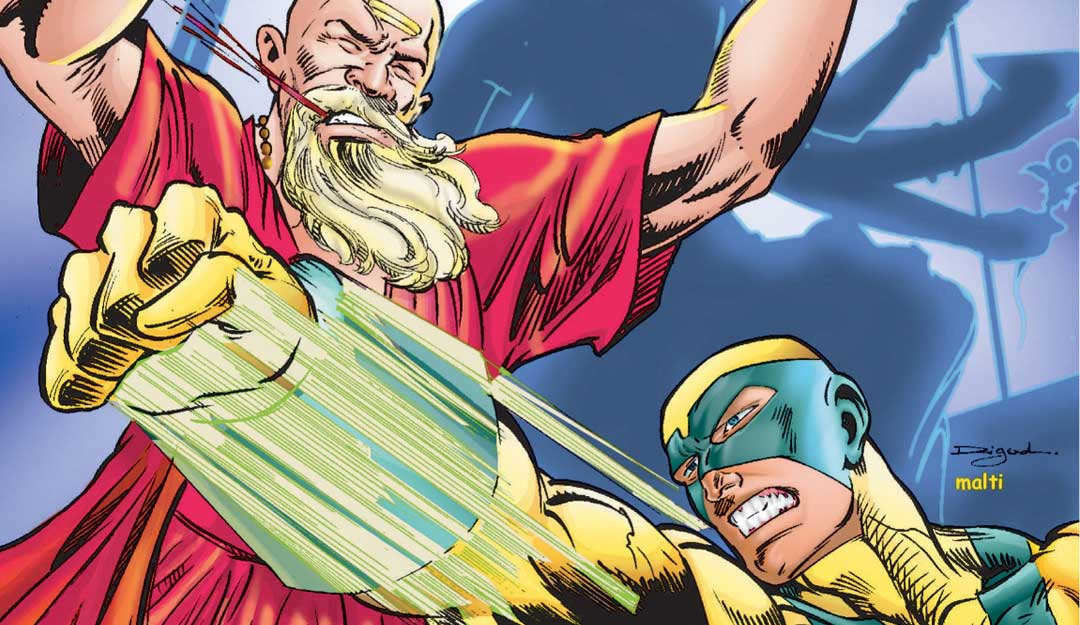
‘Parmanu’, one of the most popular heroes of Raj Comics, is known for his science-based powers and his detective skills like Inspector Vinay. “Jayakara Atom Ka” (Jaikara Parmanu Ka) is a story where Parmanu encounters not just a physical enemy, but an enemy with ideological and mind games. This story is not just an action story with “Dishum-Dishum”, but it directly attacks superstition, hypocrisy, and mob mentality deeply ingrained in Indian society.
The team of writer Tarun Kumar Wahi, artist Suresh Degwal, and editor Manish Gupta has woven a fabric in this comic where Parmanu is made a god so that he can be proved to be a devil.
The Plot
The story starts with a very sensitive and stressful scene. Durga Puja immersion is going on in Delhi. Devotees are raising slogans of “Durga Maiya Ki Jai” and “Jai Jagat Janani Ki Jai”. In this devotional atmosphere, Inspector Vinay (Parmanu) gets the news that terrorists have targeted the idol of the goddess.

Notorious terrorist Babban Afridi, disguised as a monk, is riding on the truck that is carrying the idol. Here the author has shown very beautifully how criminals carry out their plans in the name of religion. Atom gets there and captures Babban. Babban throws a bomb into the crowd, which Atom defuses by risking his life and taking it into the sky. The crowd, previously silent out of fear, now starts cheering for Parmanu and calling him “modern Hanuman” and “incarnation of God”.
It is from here that the real villain of the story, ‘Principal’ (Principal), enters. The Principal, who runs a ‘college of crime’, is a very cunning and vicious criminal. When he discovers that Parmanu has captured his cache of weapons, he is happy rather than angry. His argument is that if Parmanu is to be defeated, do not kill him, but lift him so high that when he falls, he will be shattered. He says, “People were cheering for Parmanu… Someone was saying that Parmanu is the incarnation of God”. The Principal decides to make this fetishism a weapon against Parmanu.

The Principal launches a fake Baba, “Garari Bapu”. Garari Bapu says that devotion works like a “garari” (gear) between man and God. He announces that Parmanu God will appear today. And in fact, using modern technology (laser beams and holographics), an image of Parmanu is shown there. After this, the real game of pretense begins. The Principal’s men, who are sitting in the crowd as devotees, begin to show false miracles:
• A lame boy starts walking and claims to be playing football.
• A blind man, blind since birth, begins to see through the “ghost” of Parmanu.
• A hunchback straightens.
These miracles spread like wildfire. The media, especially TV channels, make it an instant headline. Inspector Vinay (Parmanu) is shocked to see everything. He knows that he is just a student of science, not a god.
The most interesting part of the story is Vinay’s mental struggle. He knows it’s all a lie. He tries to convince his girlfriend Shipra (who is a journalist) and his fellow cops that it is “just superstition”, but no one listens to him. Even when he is in the police station, his fellow policemen are worshiping Parmanu Dev and also giving Prasad to Vinay. When Vinay opposes this and calls those “recovered” patients to the police station to find out the truth, those patients (who are actually the Principal’s henchmen) instead accuse Vinay of atrocities.

Parmanu eventually discovers with his scientific wisdom that it is all a game of laser beams and projections. He finds the source from where these images were being transmitted. Finally, at another rally, where the principal is about to land from a helicopter with a giant statue of Parmanu(which again has weapons hidden in it), Parmanuplays the real game. He transmits himself among the crowd and uses the villain’s technique against them. He proves that he is not God, and finally gets the principal and Babban Afridi arrested.
Main topics and social messages
This comic is not just entertainment, but it gives a clear message on the social issues of its time.
Superstition vs. Science

The center of the whole story is how people of a society leave logic and run after miracles. The character of Parmanu represents science (his name is ‘Parmanu’, which is the gift of science), while ‘Garari Bapu’ and ‘Principal’ represent the hypocrisy that misuses religion. Inspector Vinay says at one place:
“The word ‘Parmanu’ is the gift of science. If indeed a Parmanu god has appeared, there is a fraud in it.”
This dialogue is the essence of the entire comic.
Crowd mentality
The author has shown very well that the crowd does not have its own mind. When Parmanu flies with a bomb, they consider him God. When fake miracles happen, they are bent on killing a police inspector like Vinay as he speaks against “Parmanu Dev”. In one scene, the crowd becomes so mad that they overturn Vinay’s jeep. This shows that in religious frenzy, people ignore law and order as well.

There is also a dig at the role of media in the story. Shipra, despite being a journalist, publishes news of “Parmanu Dev” without investigation and shouts at Vinay as to why he does not believe. This shows that sometimes the media also gets involved in promoting superstition.
Character analysis
Parmanu (Inspector Vinay): In this comic, Parmanu appears in a very difficult situation. He is physically powerful, but cannot fight people’s blind devotion. When he is called “God”, he finds it like a slur because he knows it is an insult to his humanity and science. His character is very determined—he stands with the truth (science) even when he goes against the whole world.

Principal (The Villain): Principal Raj is one of the most underrated villains in comics. His plan was really a ‘masterstroke’. He knew that it was difficult to kill Parmanu, but it was easy to defame him. He made “Shraddha” a weapon. His laughter and confidence make him a memorable villain.
Shipra: Shipra represents the general public. She is educated and modern, but loses her reasonableness after seeing miracles. Her relationship with Vinay adds a personal and emotional layer to the story.
Art and Illustration
Suresh Degwal’s artwork is the life of this comic. Degwal ji was an expert in the style of 90’s Raj Comics.
The scene with Babban Afridi in the opening fight and finally the helicopter is very dynamic. The details of Parmanu flying poses and his gadgets are fantastic.
The expressions of blind devotion, anger, and madness have been depicted very closely on the faces of the crowd. When the mob attacks Vinay, the scene seems scary and surreal.

Sunil Pandey’s color combination is very vibrant for that time. Atom’s yellow and green costumes make him stand out in every panel. The use of light and aura in Garari Bapu’s court has been successful in looking magical.
Dialogue and Writing
Tarun Kumar Wahi is credited with writing the best story of Raj Comics. His dialogues in “Jaikara Parmanu Ka” are very sharp.
There is satire at many places in the comic. When Vinay says,
“If any information is received that any priest of any temple is a dreaded terrorist, I will believe him and take immediate action,”
it shows both his devotion to duty and the truth about society.
Despite being a serious subject, there is also light humor in between, such as the scene of policemen eating tea and pakodas in the police station, where they believe it to be “Parmanu Dev’s Prasad.”
Critical approach

While this comic is fantastic, there are some drawbacks. For example, Parmanu’s transmission and reach, and outsmarting holographic technology could have been made a little clearer. Sometimes “science” also seems like magic. Shipra’s easy fall for superstition seems a bit strange, although it was necessary for the story so that Vinay would appear alone.
Still, the flow (pacing) of the story is great and readers keep turning the pages. The concept of “Garari Bapu” was very unique; such a mixture of religion and machinery is rarely seen.
Conclusion
“Jaikara Parmanu Ka” is a great example of the golden age of comics. This shows that comics can be a mirror of society, not just for children. The story teaches us that:
• No miracle should be blindly believed.
• The powers of Parmanu are the gift of science, not divine.
• Criminals often take advantage of our faith, as Babban Afridi and the Principal did.
If you are a fan of Raj Comics, then it is important for you to read this special issue. It introduces Parmanu as a rational hero, not just a fighter. For 18 rupees of that time, it gives a blockbuster movie-like experience to those reading comics.
Final Decision: 4.5 out of 5 stars. A classic story that is still relevant today.
