


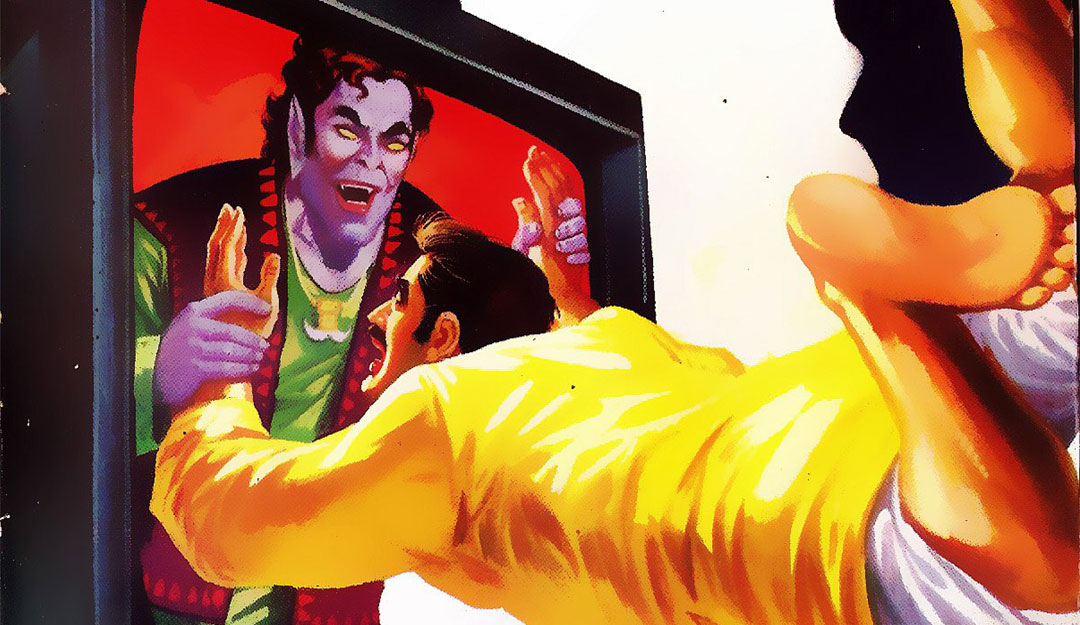
In the 90’s, Manoj Chitrakatha had a special and different place in the Indian comics world. While Raj Comics was famous for its superhero stories (Nagaraj, Doga), Manoj Comics remained people’s favorite because of its social, magical, scary, and mysterious (thriller/mystery) stories. The comic “Hunger” is also a great example of such stories. This comic is an anthology, consisting of three different stories: “Hunger”, “Time Gun”, and “Its Intoxication”. Its cover page itself causes shivers among readers—a man falling out of the TV screen and a devilish face laughing loudly on the screen.
Let us understand these three stories in detail one by one.
Story 1: The Humpback (Main Tale)
This is the main and most effective story of this comic. The whole story hits straight at the deepest demerit—greed—of human beings.
Plot:
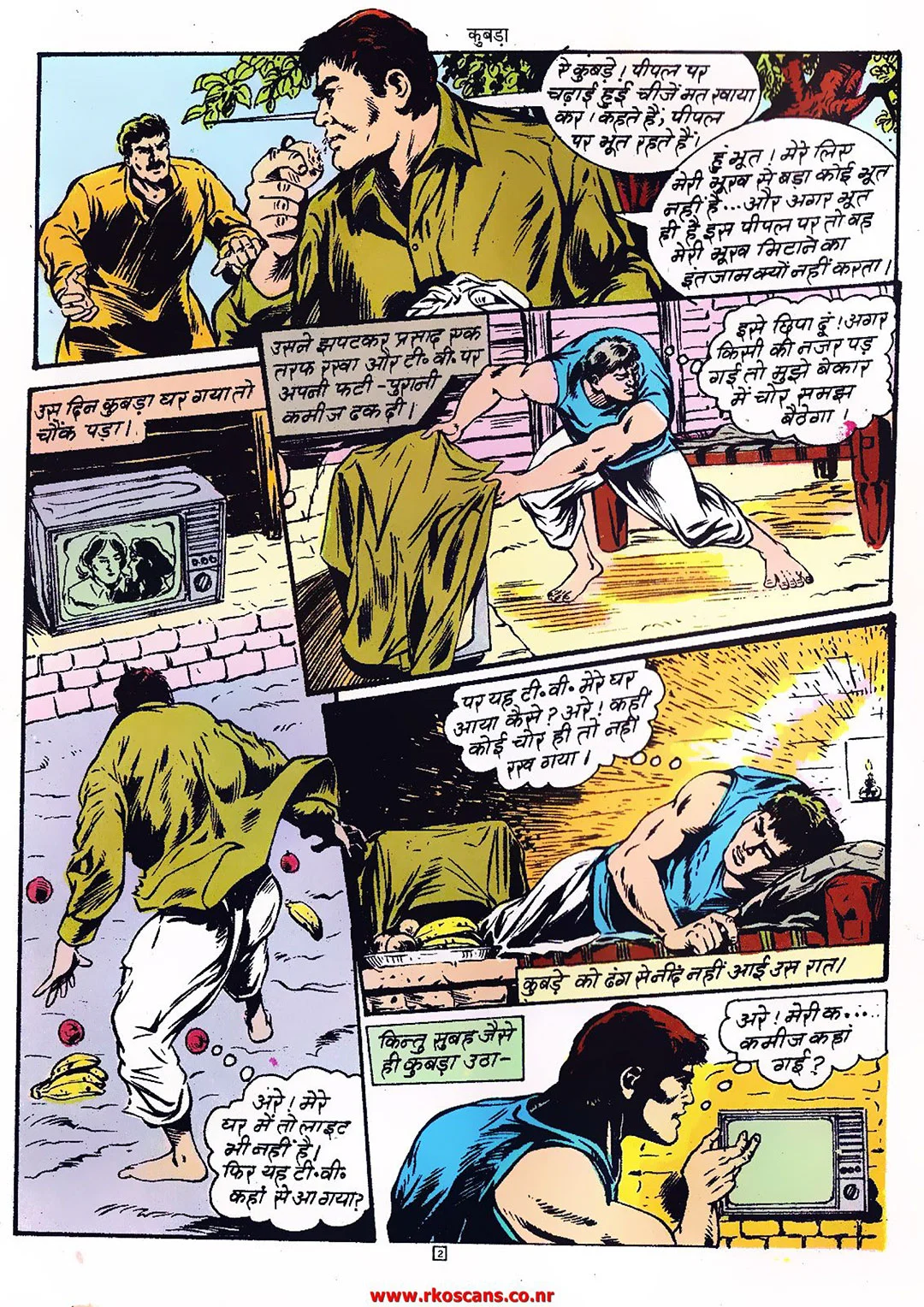
The main character of the story is a physically weak and leaning man, who is taunted by people as a “hunchback”. He is very poor, irritable, and broken while facing different problems of society. He earns his living by eating the prasad offered to the Peepal tree. One day he finds an old TV under the same tree, which he picks up and brings to his home. And this is where a mysterious and supernatural twist in the story begins.
The hunchback realizes that this TV is not an ordinary TV. There is a different world inside this TV, and there is a strange man (shown here as a magical being) present there. The man living inside the TV makes an offer to the hunchback—
“You’ll give me food and clothes from outside, and in return I’ll give you 100 times more gold than it costs.”
The hunchback goes to the world inside the TV, where there are heaps of gold and silver all around. He takes cheap food and old torn clothes from outside and returns with heavy jewelry and valuables in return. Gradually, the same poor hunchback becomes the richest man in the city, Seth Kubadadas. Now he has a big bungalow, cars, and even servants.
Climax and Tragedy
The ending of the story is heart-wrenching. After becoming rich, the hunchback’s greed increases further. He needs 15 lakhs immediately to buy a piece of land. He then goes inside the TV and pressures the magical man to give him 15 lakhs even if he has brought less food and clothing.
But that magic man sticks to his bet—“100 times price,” no more.
The hunchback, blinded by anger, kills him with a spade so he can take all the treasure.
He tries to get out of the TV with a treasure chest, but now the TV screen has become like a strong wall. On the other hand, the hunchback’s son Pappu is playing cricket outside. His ball hits the TV screen and the screen breaks. As soon as the screen breaks, the relationship between the world inside and outside the TV breaks forever.
The hunchback gets trapped alone in that other world (Dimensional Void) near the big pile of gold. He screams, asking for help, but no one can hear him. In the end, the same man who had suffered poverty all his life, and then was blinded by greed… dies in agony of hunger and thirst near the same gold heap.
Analysis:
Author Tikaram Sippy has beautifully shown how money changes a person’s thinking and his entire perspective. In the beginning, the hunchback was a person who was suffering himself, and seeing him creates sympathy for him in our minds. But as soon as he got the money, his behavior changed—he became cruel, stubborn, and arrogant.
The breaking of the TV screen is not just an event but a deep sign—the greed of the hunchback became his ruin. Dying of hunger near a pile of gold shows that the real meaning in life is not money, but food, freedom, and humanity.
Story 2: Time Gun
The second story is based on science fiction (Sci-Fi), and combines both the future and the past in an interesting way.
Plot:
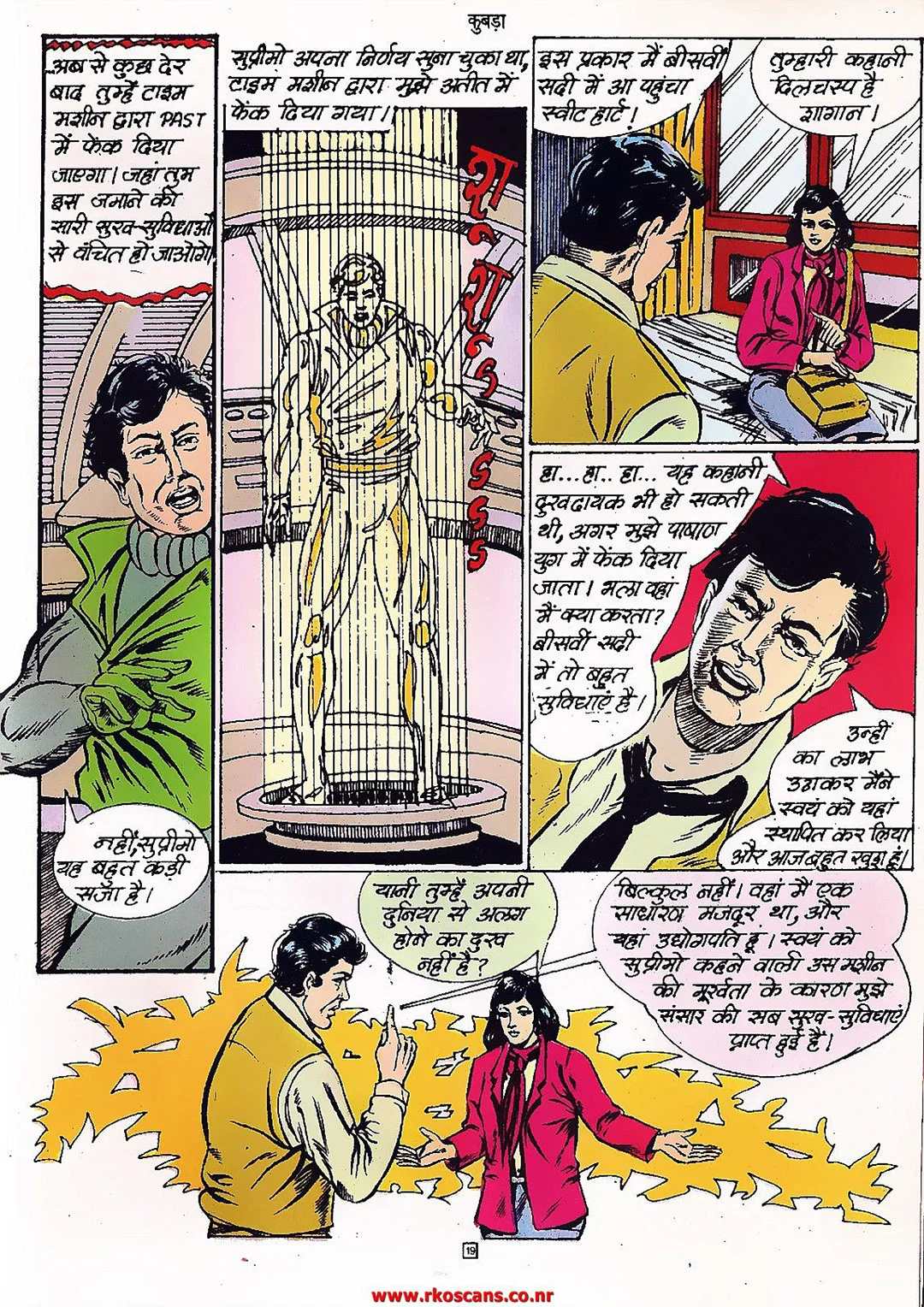
The protagonist of the story is Shagan, a rich man from Bombay, but deep down he is very troubled about his past. One day he bumps into a girl, brings her to his home, and expects her to be his life partner. He tells the girl his true secret.
Shagan is not actually a 20th-century figure at all. He is a man of the future, millions of years ahead. By that time, humans have made extraordinary progress, but emotions have no place in that world. Ruling all over the earth is a supercomputer named “Supremo”.
Shagan and his partners (Mucky, Keef) had rebelled against Supremo, but they were defeated. As punishment, Supremo sent Shagan through a time machine to the 20th century—an era considered almost like the Stone Age in his time, but where emotions were still alive.
It was here that Shagan was happy to have feelings and freedom.
Twist:
The biggest shock in the story comes when the girl, whom Shagan wanted to be his wife, shows her true self. She is also sent from the future and is Supremo’s agent. She explains that Supremo understood his mistake—by sending Shagan into the 20th century, he had found comfort, not punishment.
Therefore, now his new punishment has been decided.
The girl takes out a “time gun” and shoots Shagan. The rays of this gun remove Shagan from the 20th century and send him directly into the Stone Age—where there are dinosaurs, wild animals, and dangerous environments.
Shagan’s happy dream breaks here, and he gets his real final punishment.
Analysis:
The story seems to have the effect of dystopian stories like “Terminator” and “1984”. Author Ansar Akhtar has shown the conflict of “human vs machine” in a very interesting way.
The story also explains that no matter how much a person tries to run away, he cannot escape from his past or the wrong things he has done.
Mukesh ‘Bittu’’s artwork has been quite impressive in showing the world of the future, machines, and robots.
Story 3: This Is Nasha (Yeh Hai Nasha)
The third story is a light-hearted but sarcastic science fiction story, which sounds fun to read but leaves a deep message at the end.
Plot:
There is sudden chaos in an air traffic control room when a strange and very large plane asks for permission to land. This plane seems to have come from another world, but the pilot speaks human language.
The aircraft has run out of fuel, and they demand—“grain alcohol” (Grain Alcohol).
The commanders do not understand what kind of aircraft it is that is asking for liquor instead of petrol. They quickly send Corporal Ravi Singh to arrange for alcohol. Ravi Singh himself is a drunkard type of man. He thinks alcohol is just alcohol—whether it’s desi, cheap, or refined. On the way, he buys cheap and adulterated liquor from a country-made outlet and drinks some of it himself.
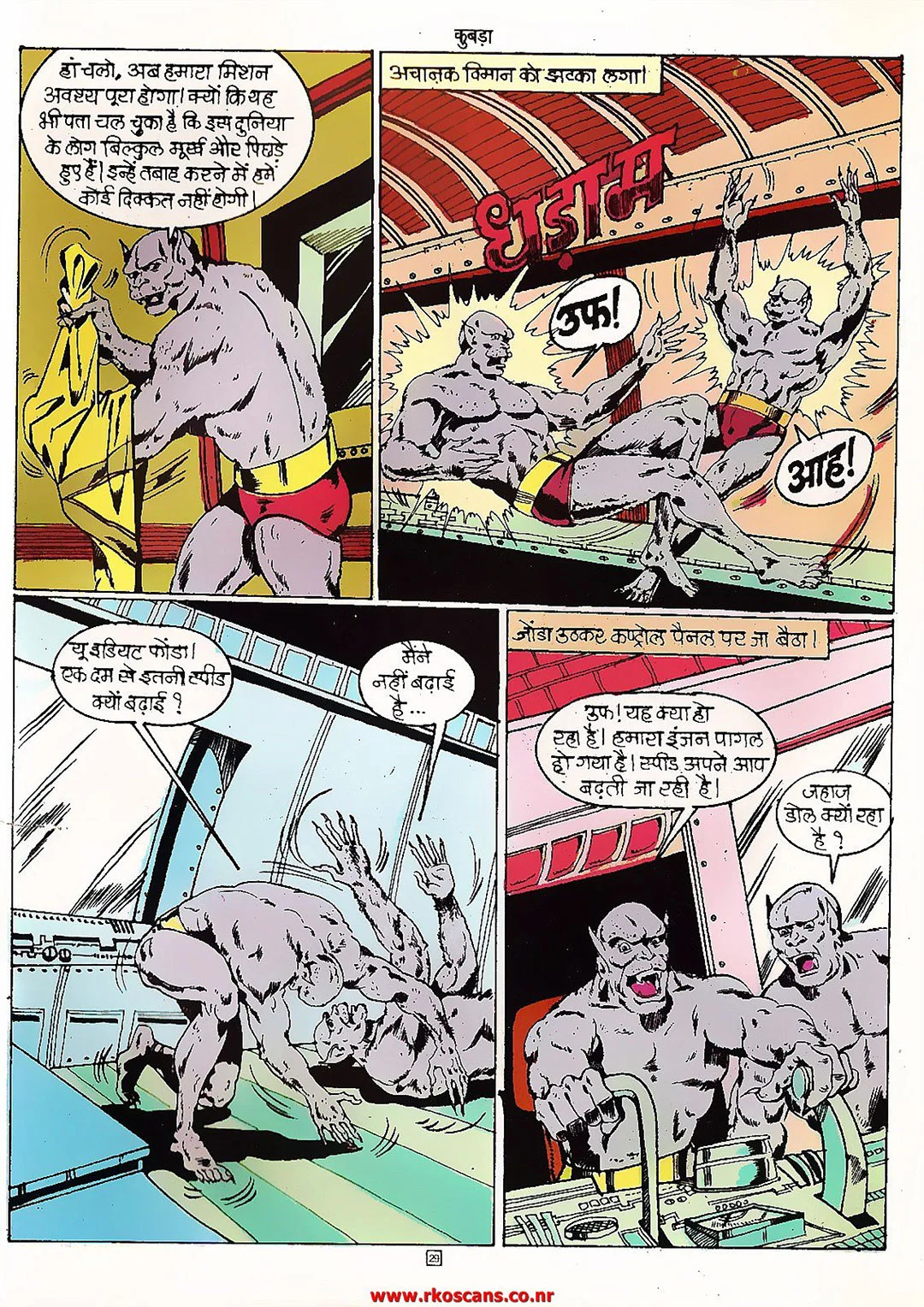
This liquor is filled in the plane. The plane takes off. The aliens (Jonda and Fonda) sitting inside come back to their true forms. Their intention was probably to attack or spy on the earth. But as they reach space, their ship begins to falter. The desi and bad wine causes the ship’s engine to become intoxicated and out of control. The result is that the aliens are forced to wander in space forever.
End:
Commanders on earth receive a warning that it was a UFO, but they take it like a joke and say “Delhiites are joking.” They do not understand that a small mistake (bringing cheap liquor) by drunkard Ravi Singh unknowingly saved the earth from a big alien threat.
Analysis:
This story shows a serious subject like ‘intoxication’ in a funny and ironic way. Usually, intoxication brings ruin, but here Ravi Singh’s intoxication and bad alcohol ruined the aliens. It’s a kind of ‘dark comedy’.
Overall Review:
Positive side (Positives):
Variety in stories: In this same comic you get the fun of magic (Fantasy), science of the future (Sci-Fi), and comedy—three. This was the specialty of Manoj Comics that they used to give complete “paisa vasool” entertainment in a single issue.
Moral education: The ‘hunchback’ story clearly teaches that “extreme everywhere verbiage”—meaning excessive desire or greed for something—always causes harm. This is worth learning for both children and adults.
Fast pace (Pacing): All three stories move very tight and at high speed. Nowhere does the story seem loose or boring.
Illustration (Artwork): Naresh Kumar and Mukesh’s artwork is a brilliant example of the 90’s comics genre. The depiction of the hunchback’s gestures, future robots, and the alien ship all suit the mood of the stories. The use of colors (especially the difference between the shine of gold and darkness in the hunchback story) is also quite impressive.
Downside (Negatives):
Technical flaws: In ‘It Is Intoxication’, the logic of science in the story seems a little weak. An alcohol-powered spaceship sounds like a bit of a childish idea, but since it’s comics, it’s not taken too seriously.
Dialogues: In many places, the dialogues seem very filmy and old-fashioned (like the repeated use of “sweetheart”).
The brutality of the Hump: The short-tempered nature of the hunchback has been shown to be very sharp from the beginning. If he was first shown to be a little soft-hearted or simple, and later his nature changed as soon as he got the money, his downfall would have been even more effective.
Conclusion:
Manoj Chitrakatha’s “Hunchback” is such a classic comic that it is fun to read even today. It doesn’t just entertain, it makes you think.
Was the hunchback writing his own destiny?
Will future machines (like Supremo) one day become enemies of humans?
How do small mistakes (like the wrong alcohol) sometimes avoid big dangers?
If you grew up reading 90’s comics, this comic will bring back a lot of memories. And for the new generation, this is a glimpse of how, at that time, even without superheroes, readers were kept tied on the basis of strong stories alone.
Rating: 4/5 (for story grip and end twist).
