


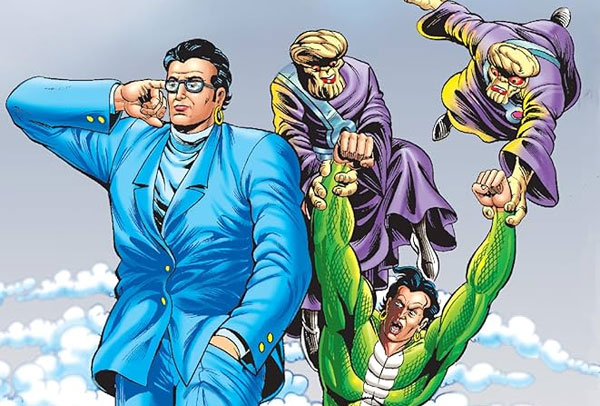
The place that Raj Comics has created in Indian pop culture is unforgettable. Especially Nagraj, who is not only the flagship character of Raj Comics but has also become synonymous with the Indian superhero genre. We get to see a great example of the height that the duo of Anupam Sinha and Sanjay Gupta took Nagraj to in “Kalachakra” (Kaal Chakra). This comic is not just a story of action, but it makes a sharp attack on the social and political circumstances of the period (late 90s and early 2000s), especially the problem of terrorism. “Kaalachakra” is a special issue that tests Nagraj’s physical powers as well as his mental toughness and morality.
The basis of the story and the promise of Nagraj
The story begins with a very philosophical and moral dichotomy. On the very first page of the comic, we find Nagraj in a very unusual situation. He is seeking advice from the immortal guardian of the universe. Nagraj here wants to do an experiment—he wants to see if he stops using his powers, can the human world solve its own problems? Nagraj gives himself a ‘convocation’ that he will not use his powers for a week. It’s a very powerful plot point, which makes the reader wonder whether a superhero’s true strength is his superpower or his willpower.
However, this experiment breaks down very quickly, which proves that being passive against evil is also a kind of crime. The patron warns Nagraj that he will not be able to stop himself from witnessing atrocities happening, and this forms the basic foundation of the story.
Social context: Kashmir and the role of media
The biggest feature of this comic is its realistic social context. The central point of the story is ‘Bharti Tower’, from where ‘Bharti News Channel’ is broadcast. Here, the character of ‘Bharti’ is that of a fearless journalist, who is raising the burning issues of Kashmir of that time.
The story shows that evening is the time of news for people, and the program called ‘Bharti Investigates’ is very popular. The authors have shown the Kashmir problem and the propaganda of terrorism very closely here. Bharti is interviewing a Kashmiri elder, ‘Baba Murshid’, in her program, which tells how terrorists have betrayed Kashmiris. Earlier, they used to call themselves soldiers of freedom, but now they are oppressing the general public and forcing boys to open fire.
This illustration shows the maturity of Raj Comics. They were not just creating imaginary villains, but were pitting the real demons of society (terrorism) in front of their superheroes. The terrorists are upset that Bharti’s program has distanced the common Kashmiri people from them, so they send a ‘martyr squad’ (suicide bombers) to get her out of the way.
Character analysis: Contradiction of Bharti and Pahleja
The story features two major human characters who represent two different ideologies:
Bharti: She is a symbol of courage and truth. She receives threats like ‘Lam-e-Qayamat’, yet she is not afraid. She clearly says that one cannot stop working out of fear of danger. She keeps a ‘faceless’ dress in her office, which shows that she herself is ready to fight against injustice.
Mr. Pahleja: This character is a mixture of capitalism and fear. He is a 51% partner in Bharti Communications and is more concerned about the financial loss of the company than Bharti’s life. When the attack occurs, his timid nature is revealed. He talks about making a will for Bharti and tries to hide as soon as the attack occurs.
The tension between these two characters adds a human drama to the story. Pahleja’s statement, “it’s about money,” speaks to the bitter truth where business overrides morality.
Action and intervention of Nagraj
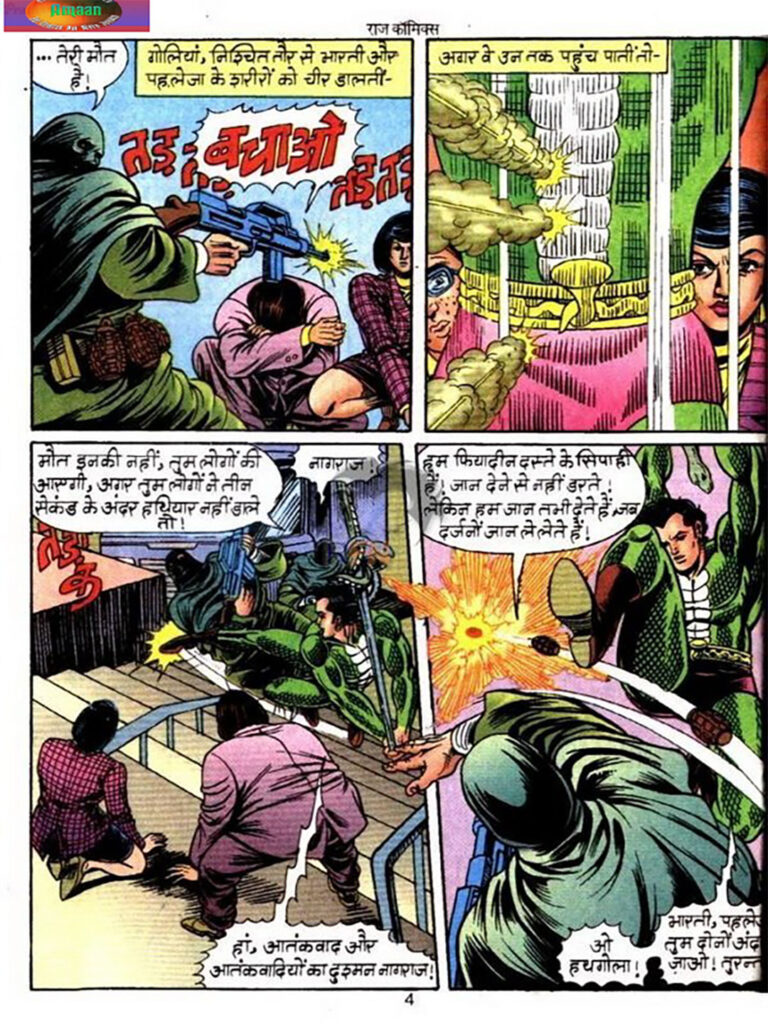
The action in the story begins when terrorists enter Bharti Tower. Here, Anupam Sinha’s drawings and Jolly Sinha’s story do wonders. The terrorists open fire indiscriminately, and Nagraj enters.
Nagraj’s first action sequence shows his intellectual and hypnotic power. He confuses the terrorists instead of fighting them directly. He warns them to lay down their arms within three seconds. When the terrorists boast about the strength of their guns and say they have ‘anti-tank’ grenades, Nagraj uses his special power, ‘Hawthorn’ or ‘hypnosis’.
This scene is very entertaining. The terrorists are under the illusion that their guns have become water sprayers and that they themselves have become children who are tied to pegs by their grandmothers. This scene cements the image of Nagraj as someone who does not just use force, but plays with the mind of the criminal. However, this confusion lasts only for a while, as Nagraj knows that if he had attacked directly, heavy explosives could have caused harm to the entire building and innocent people.
Lift view: Stress and physical ability
One of the most exciting parts of the comic is when Bharti is in the elevator and the elevator wires are broken or cut. Nagraj learns from sound vibrations that the elevator is rapidly falling down.
Here, the artist has carved motion on paper in a very excellent manner. The weight of the elevator multiplies due to the speed of the fall. Nagraj uses his ‘Nagarassi’ and tries to hold the lift. Nagraj’s physical strength is tested in this scene. He stops the elevator from hitting the bottom and controls it while running on the wall. The scene feels like a stunt from a blockbuster Hollywood movie.
But the twist comes when the broken elevator wires start connecting on their own and taking on a new form. This is a sign of the entry of the main villain of the story.
Villains: Supremo Head and technical challenge
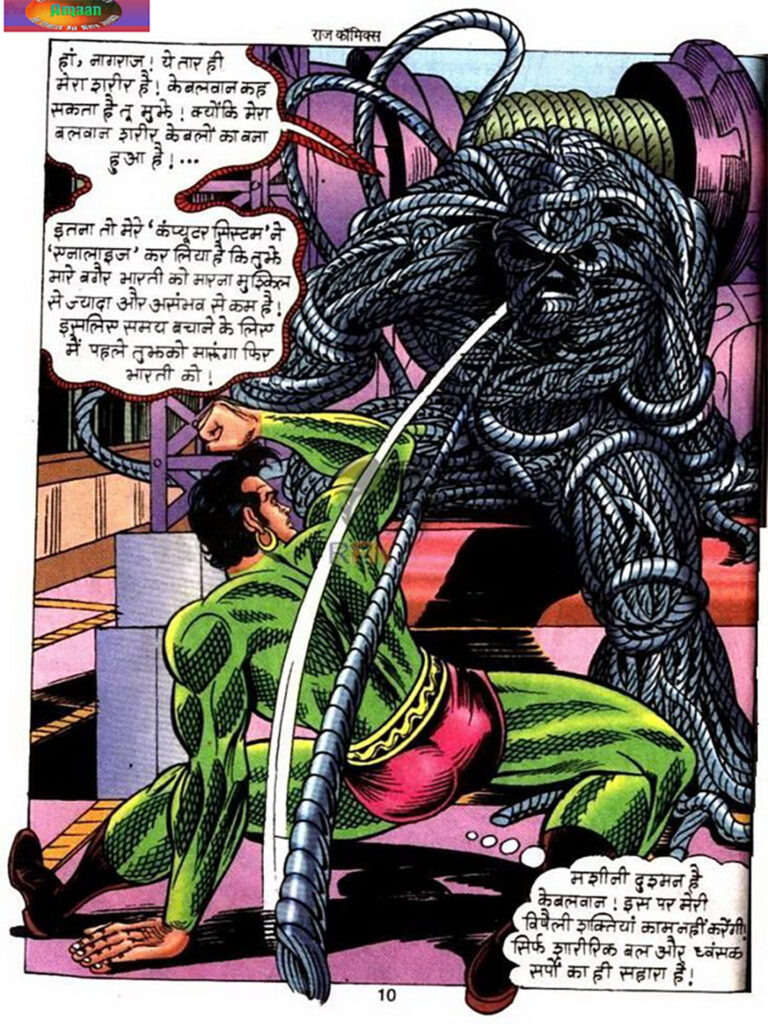
The main villain of “Kaalachakra” is not an ordinary human being. He is a mechanical monster made of cables and wires, controlled by the ‘Supremo Head’. As Nagraj saves the lift, he gets caught in a web of cables. This villain knows the breakdown of Nagraj’s powers.
The villain says that he has woven a special web for Nagraj. He tells Nagraj, “Your body is hundreds of times softer than a tank.” When Nagraj tries to use his serpent powers, he discovers that the villain’s body is made of cables, which are not affected by poison or snakes. The villain has placed filters in his nose so that Nagraj’s poisonous hiss has no effect.

Nagraj is held in a machine that serves to absorb or analyze his powers. This shows that Nagraj’s enemies are no longer just using brute force, but are trying to defeat him through science and technology. The villain tells Nagraj, “You’re in a hurry to break… by the way, now I will hang you.”
Plot twists and science versus nature
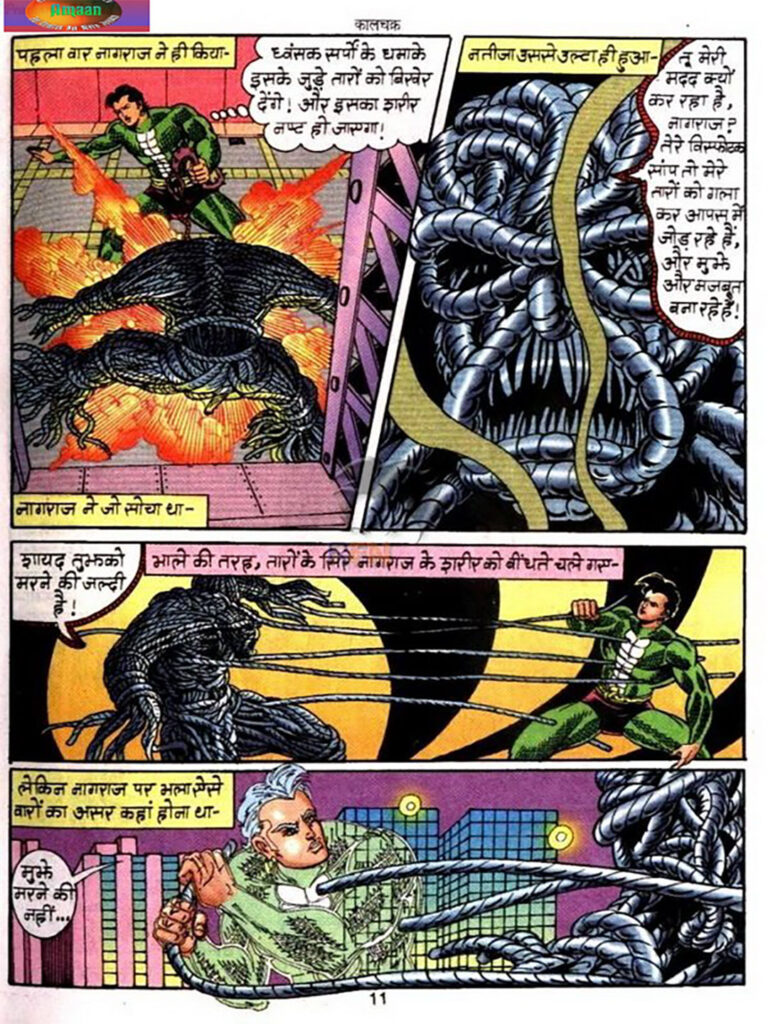
Nagraj is basically a symbol of nature and biological forces (snakes, poison, willpower), while the villain of “Kaalachakra” is completely artificial and technological (cables, plastics, remote controls). This is a battle of nature versus machine.
When Nagraj is imprisoned, he tries to take a subtle form using his ‘wishful power’, but the villain has prepared for this as well. He uses plastic and insulated cables that limit Nagraj’s powers. The villain tells Nagraj that he has studied every move of Nagraj and has made complete preparations to defeat him.
Nagraj’s struggle here becomes more intellectual than physical. He has to use the right combination of willpower and physical force to escape his captivity. When he breaks the machine and comes out, it is proof of his indomitable will.
Climax and the final battle
The climax of the story turns into a high-speed chase and fight on the streets. The villain attacks Nagraj using a special vehicle, which resembles a train or tank, along with his cable suit.
Nagraj learns that this mechanical monster is being operated through a remote control and that there is a human behind it, known as the ‘Supremo Head’. Nagraj changes his strategy. Instead of fighting the robot directly, he tries to locate its source—the control panel or remote system.

Nagraj understands that the terrorists want to keep him busy while carrying out their real objective: murdering Bharti. Finally, Nagraj tracks the remote signal. During the battle, Nagraj is unable to use his hiss or snakes, as the villain has covered himself with plastic and glass. Ultimately, Nagraj uses his physical strength and serpent-mental waves to disrupt the remote control system and trace the people operating the machine.
An interesting aspect is that the main villain, who is operating the machine, believes he has defeated Nagraj, but Nagraj returns every time. In the end, Nagraj captures the criminals and rescues Bharti. However, the story ends with a mystery—who sent these criminals? This unresolved question forms the true mystery of “Kaalachakra”, possibly pointing toward a sequel or a larger conspiracy.
Art and Presentation
Anupam Sinha’s art is as high-class as ever, with detailed work on machinery, cables, and Nagraj’s physical anatomy. In particular, the scene of the elevator breaking and the cables turning into monsters is extremely detailed and frightening. The action choreography is dynamic, allowing readers to feel the movement of Nagraj running on walls and leaping into the air.
The characters’ facial expressions add emotional depth to the story, such as Bharti’s determination, Pahleja’s fear, and the cruelty visible on the terrorists’ faces. The hypnotized, childlike expressions of the terrorists are also clearly portrayed. Finally, the coloring by Sunil Pandey establishes the mood of the story, using dark shades for tense moments and bright green to represent Nagraj’s powers.
Dialogue and writing
Jolly Sinha and Manish Gupta (editors) have kept the dialogues tight and effective. The dialogues not only move the story forward but also highlight the characters.
Nagraj: “Death will not be theirs; it will be yours if you do not lay down your arms within three seconds!” This dialogue reflects Nagraj’s confidence.

Terrorist: “We are soldiers of the Fiyadin squad, not afraid to give up our lives…”. This highlights fanaticism.
Humor: Amid serious scenes, when Nagraj turns terrorists into children, the dialogues become very funny—“Our grandmothers have tied us like buffaloes to a peg!”—providing excellent comic relief and reducing tension.
CONCLUSIONS AND FINAL CONSIDERATIONS
“Kaalachakra” is a masterpiece from Raj Comics that successfully blends superhero fiction with real-world thriller elements.
Positive side:
This comic is not limited to a traditional good-versus-evil battle but offers narrative depth by addressing issues such as terrorism, the role of media, and morality. The villain is portrayed as intelligent and well-prepared, having thoroughly studied Nagraj’s weaknesses and presenting him with a genuine challenge. Additionally, Nagraj’s decision to renounce his powers at the beginning of the story establishes him as a thoughtful and humane protector rather than an omnipotent figure, allowing readers to emotionally connect with him.

Downside (if any):
The ending feels slightly rushed, as readers expect the revelation of the main mastermind, but the conclusion is limited to henchmen and remote operators. Additionally, the technical explanation of the ‘Supremo Head’ remains vague; the self-connecting cables forming a lifelike monster feel somewhat fantastical and slightly inconsistent with the otherwise realistic themes, such as terrorism, explored in the story.
Overall judgment:
This was a period when Raj Comics was at its creative peak, with stories that combined action and social relevance. Nagraj emerges not just as a fighter, but as a protector and strategist. The combination of Anupam Sinha’s artwork and storytelling keeps readers engaged from beginning to end.
This comic reminds us that no matter how modern evil becomes—whether terrorism or technological monsters—it ultimately bows before good and willpower. “Kaalachakra” is not just the wheel of time, but the unending cycle of Nagraj’s bravery.
Rating: 4.5/5
