


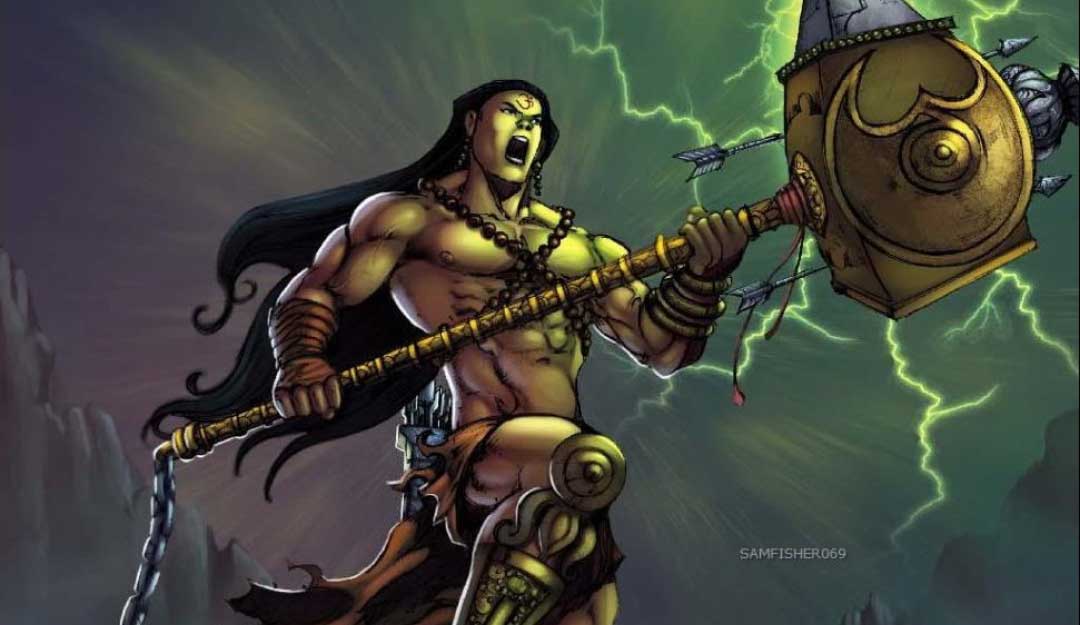
Presented comic ‘Suryansh’ (Suryansh), which is the second part of the Warrior Series, carries forward the story that started in ‘Beginning’. This comic is not just an action-fantasy entertainment, but also shows the eternal struggle between destiny, values, religion, and unrighteousness, which comes to the fore in some form or another in every era. Writer Tarun Kumar Wahi and editor Sanjay Gupta have laid the foundation of such a hero in this issue—one who creates his own identity while fighting circumstances, and whose fate forces him to walk on a difficult path.
Plot expansion and flow:
The story begins right where the previous part ended. Shiromani—later known as Suryansh—is born under a deep conspiracy. He was the ‘superior seed arising from the womb of the godmother Aditi’, but due to the cunningness of the demon guru Shukracharya and Diti’s insecurity, the embryo is transferred to Diti’s womb. At the very beginning of the story, readers come face to face with the irony that the one who was destined to become the protector of the gods and a great hero of the universe is now being taught demonic qualities among the demons.

The comic is grouped into two parallel streams:
Teachings of Devguru Brihaspati: Where the sons of Aditi, i.e., the gods, are taught the lesson of balance between knowledge and power.
Teachings of Daityaguru Shukracharya: Where only power, victory, and selfishness are considered supreme for the sons of Diti.
Key developments and their analysis:
Terror of the air circle and the rise of wind
The opening pages of the story feature an attack by a massive, airtight air circle. This incident brings out the teaching style of Guru Brihaspati very beautifully. When the air circle attacks the gods, even powerful children like Indra get trapped in its terrible cyclone. At such times, instead of taking up arms, Brihaspati emphasizes ‘self-realization’. He inspires Pavana (Vayuputra) to recognize the hidden power within himself. Pavana, taking the form of a cyclone, breaks the protective shield of the air circle and then ends it with Anal (Agniputra), proving that true knowledge is the greatest weapon. This scene not only creates excitement but also strongly highlights the importance of teamwork in the story.
Shiromani’s conflict and opposition to unrighteousness
The most effective part of the comic is where Shiromani is seen standing among his demon brothers. In one context, when Shukracharya questions the center of the land, Shiromani’s argument and his reverence for Narayana (Vishnu) completely separate him from the other demons. When the giant children hunt innocent deer for food, Shiromani calling it ‘unrighteous’ and refusing to eat non-vegetarian food clearly exposes the ‘divine DNA’ present within him. His statement—“There is no greater sin than killing any creature”—shows the depth of his character and makes it clear that values do not come from one’s birthplace, but from the qualities of the soul.Abandonment by Shukracharya:
Shiromani performing Yagya and blowing away the demons’ non-vegetarian food through a storm makes Shukracharya angry. He clearly understands that he will never be able to make Shiromani a cruel demon. Here, Shukracharya’s form emerges as a strict and ruthless guru, who does not compromise at all with his principles. Sending Shiromani back to his mother and his eventual arrival at the refuge of Guru Brihaspati completes the destiny cycle that the gods had already fixed.
Cataclysm and ‘Earthquake’ origin:
Raj Comics’ approach to cosmology has always been interesting. The story of the ‘first cataclysm’, narrated by Jupiter, is also similar in tone. Millions of years ago, God sent an extremely powerful character called ‘Earthquake’ and his 10,000 sons for the destruction of giant creatures like dinosaurs. But this story also shows that when ego is associated with power, that same power becomes the cause of destruction. The pride of Earthquake sets him against God, resulting in his imprisonment in the womb of the Earth. This incident, despite being mythological, presents a wonderful combination of science and fantasy.Character illustration

Shiromani / Sunyansh
He is the focal point of this whole saga. His character is that of a child who, despite living among demons, is calm, thoughtful, and almost Buddha-like. His unknown attraction towards his real mother Aditi and his devotion to Narayana make him a kind of tragic hero. In this issue, he displays more moral strength than physical strength.Jupiter:
He is shown as an extremely patient and visionary guru. He already knows that Shiromani is the link that will protect the entire universe in the future. His teaching is not limited to fighting skills alone, but he also introduces his disciples to the deep secrets of creation.Daityaguru Shukracharya:
He is cunning and hard-working, yet remains completely firm in his principles. For him, knowledge means only that which can make his dynasty victorious. His arrogance and disregard for sage Kashyap maintain constant tension in the story.Mountain Powder (Parvatchur):
A new and frightening character. This giant monster, which eats snakes, is cursed for breaking ‘Bambi’, due to which he sleeps most of the time. This character creates a different atmosphere of mystery and fear in the story.Portraiture and art side

Nitin Mishra’s drawing gives ‘Suryansh’ a gorgeous and cinematic experience. The battle and cyclone scenes around the air circle are so vibrant that the movement and energy on the pages feel very clear. The design of the characters shows profound differences—the cruelty of the demons is accentuated by making them huge and terrifying, while the faces of the gods reflect both brightness and peace. The peaceful scenes of the ashram and the burning forests of the cataclysm in the background deepen the mood of the story. Additionally, Sushil Ram Sharma’s coloring—especially in the fire and lightning scenes—adds a modern feel to the comic, and the choice of colors creates great synergy with the emotions of the characters.
Dialogue and language style:

Tarun Kumar Wahi has used very balanced and mature language in ‘Suryansh’. There is frequent use of elevated words in the dialogues, which lends mythological dignity to the story. Lines like—“Knowledge of what is not known is scripture!”—directly provoke thought in the reader. There is a serious and steady flow in the language throughout the comic, which has been a hallmark of Raj Comics. Here, dialogues are not just a means of moving the story forward, but they also clearly define the moral level and thought process of each character.
Ethical and philosophical aspects:

These comics raise many deep questions—Is a person bound by the circumstances of his birth, or can he choose his own path? Can the flame of righteousness be lit even while staying in the school of unrighteousness? The arrogance of power and its downfall have been shown very effectively through the context of Earthquake. Shiromani’s struggle is actually the struggle of every person who wants to choose the path of truth despite a wrong environment or flawed upbringing. In the end, this comic teaches us that a true ‘hero’ is formed not just by strength, but by the courage to accept the truth and stand firm on it.
Critical appraisal
Features:
‘Sunyansh’ is extremely strong in world-building. The narratives of the cataclysm, the different clans of dinosaurs, and giants give this fictional universe an epic scale. The level of suspense in the story is also quite high—the mystery of Parvatchur and the upcoming schemes of Shukracharya keep the readers curious till the end. At the same time, the emotional and mental connection between Shiromani and Aditi adds a soft and sensitive layer to the story, which is depicted very well.Drawbacks:
Introducing several new characters such as Mallaka, Parvatchur, and Earthquake in a single issue can be slightly confusing for some readers and may distract from the main storyline. Furthermore, while the philosophical discussions add depth to the narrative, at certain points their excess slows down the pace a bit, making the flow of action and adventure feel reduced for a short while.Conclusion:
‘Sunyansh’ (Warrior – Part 2) commemorates the golden age of Raj Comics. This story takes readers on an exciting journey toward the birth of a modern superhero while reconnecting them with mythological roots. It is not just a story of war or confrontation, but a journey of a soul moving towards ‘divinity’.
Even if you read comics purely for action, it will not disappoint you. But if you seek depth, emotions, and philosophy, this comic is nothing less than a masterpiece. Suryansh’s sacrifice of his thumb in the previous part and his renunciation of unrighteousness in this issue place him among the great heroes of Indian comics history.
This comic points toward a massive war—one where retribution from Shukracharya will stand on one side, and truth led by Shiromani on the other. The next part will focus on the awakening of ‘Mountain Powder’ and the crisis that will befall creation—something every reader will eagerly await after finishing this issue.
Final decision:
This comic should be read by every reader who wants to experience a powerful combination of strong writing and brilliant art in Indian graphic novels. Raj Comics has once again proved that it possesses a treasure trove of stories that even future generations will remember.
Rating: 4.8/5
