


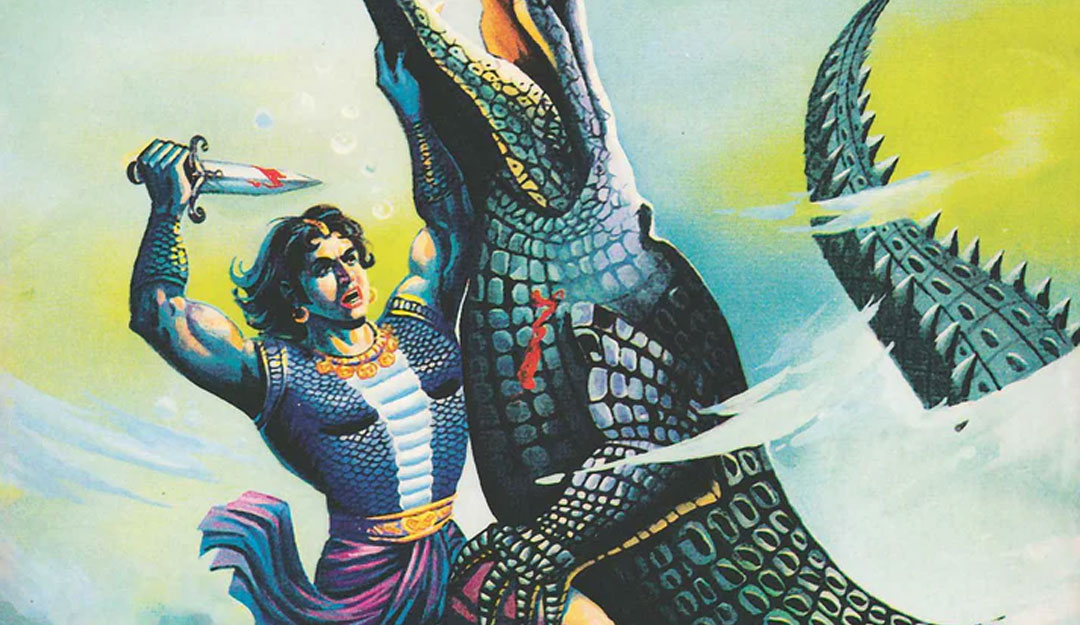
Tausi, who is a wishful serpent, was a unique juxtaposition of Indian mythology and modern superhero stories. While Nagraj (Raj Comics) was a superhero based on science and poison, Tausi is a different kind of superhero based entirely on Tantra-Mantra, Shiva Bhakti and mythological powers. The comic “Tausi and Sheshnag” (number 302) we are talking about today is one of Tausi’s most exciting and mysterious journeys. This comic is not just a story of fighting, but it shows a deep test of intelligence, courage and morality. This is a kind of classic “quest” story, where the hero has to cross many difficult stages (Levels) to reach his destination.
In this review we will understand well every part of this comic—story, dialogue, art and its message.—
The Beginning of an Adventure
The story begins with a big and spectacular celebration. The annual festival of Sarpadesh is going on on ‘Aakhet Parvat’, and this atmosphere immediately takes the reader to a fantasy world. But just as peace doesn’t last long in every superhero story, something similar happens here too. King ‘Turksain’ of Kalpadesh, who is Tausi’s enemy, prepares to spoil the festival. He sends his magician ‘Munda’.
The story takes a real turn when Tausi has to go on a special mission. Nagbaba explains that Tausi must reach the ‘Trilok Gate’. This is not a common journey. Tausi has to acquire a special weapon there from ‘Sheshnag’—i.e., the bed of the king of snakes and Lord Vishnu.
Here writer Rituraj has made the story very interesting. Tausi has to give up his old weapons like Brahmastra etc. in the temple of Lord Shiva. It is a kind of symbolic scene—old weapons and ego have to be given up to get new power or new knowledge. Tausi disarms and sets out on a journey to the ‘Trilok Gate’, which passes through a mysterious basement.
The Test of Ethics: The First Door and Questions
When Tausi reaches the first gate, he is stopped by the strong flames of fire. Here only strength was not going to work, here Tausi’s intelligence and his judgment were being tested. The gate asks Tausi a question, and this part becomes the most effective and memorable part of this comic.
Story within story (The Story within the Story):
The gatekeeper tells Tausi a story—of ‘Ashwam’, a soldier of ‘Makardhwaj Desh’. Ashwam was a son who obeyed everything his father said. His father had taught him “never to hit a running enemy or his back.” The enemy army took advantage of this lesson during the war. They turned their backs and formed a large line and surrounded Ashwam and his army as they followed. Ashwam was defeated because he followed his father’s teachings (not to attack from the back).
But when Ashwam came back home, his father called him ‘kuputra’ and even talked about giving him a death sentence.
The gatekeeper asks Tausi: “Tell, was the punishment given by the Brahmin (father) right or wrong?”
Tausi’s answer:
Tausi’s answer clearly shows his entire personality. He says the punishment was right. For “the defence of the land is above the father’s command.” Ashwam placed his personal religion (obeying his father) before the national religion (defense and victory of the country), which was not good for a soldier or commander.
This conversation shows that Tausi is not just a fighting warrior, but a thoughtful and policy-oriented hero. **The merit of 90’s comics was—**they did not just entertain, but also taught children about moral confusions (Moral Dilemmas).
The maze of seven gates: action and adventure
This journey of Tausi looks exactly like the levels of video games, where the ‘boss’ found on each level is stronger than the previous one. Here the author has made excellent use of his imagination. Tausi faces a total of 6–7 main challenges. Let us understand these one by one:

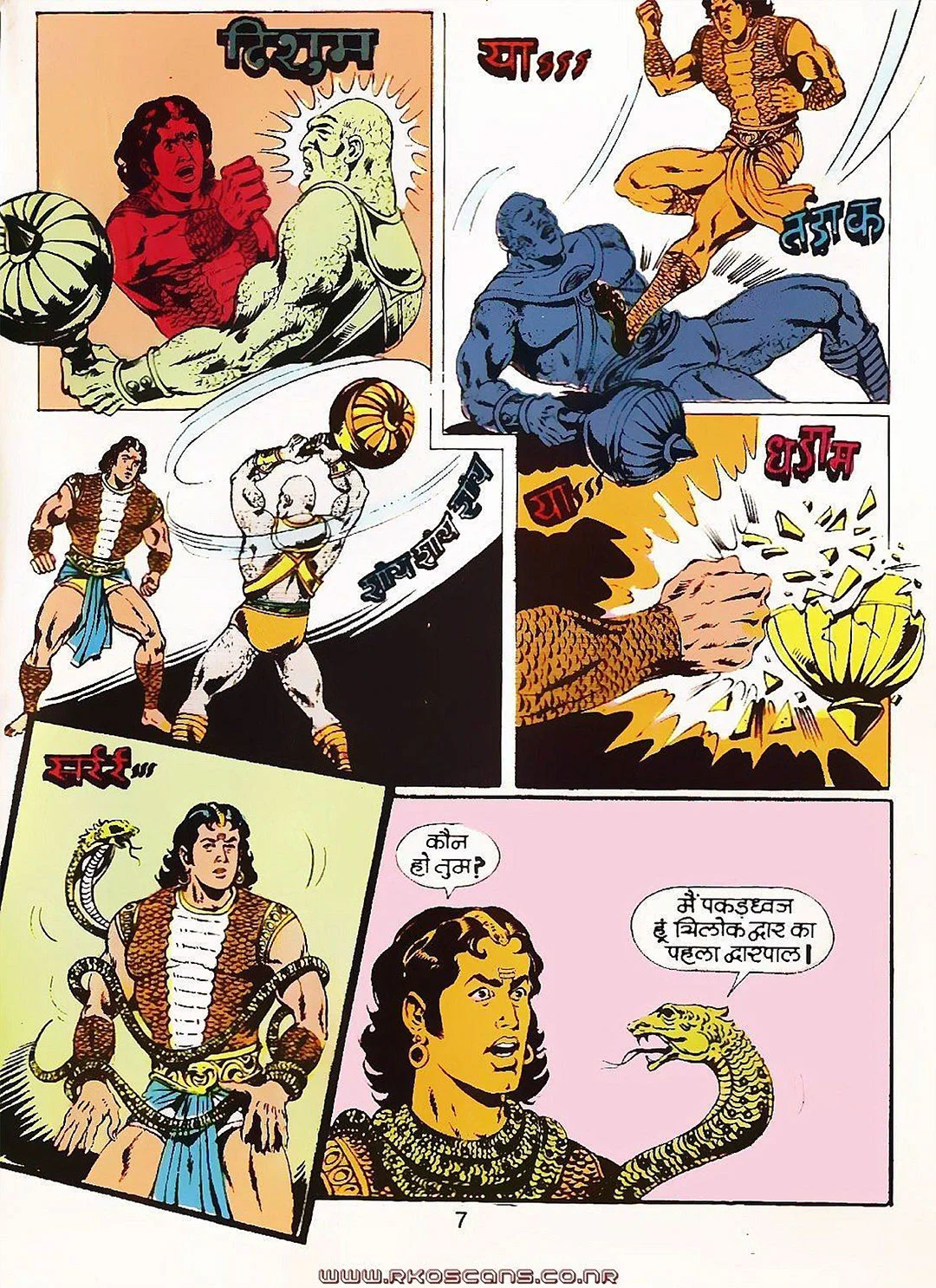
Gripflag (The Gripper)
The first protector is ‘Gripflag’. Its strength is that whatever comes into its hands can never escape. He can increase or decrease his size, but due to some curse or promise he is still in human form.
Struggle: There is a fierce wrestling match between Tausi and Pakdhwaj. Tausi here uses not only his strength but also his wisdom. He knows how the powers of wishful serpents work.
Solution: Tausi suppresses the tail of the Gripflag (which was also in its human form). The rule of wishful serpents is that they cannot change their shape when their tails are pressed. For this reason Tausi defeats him.
Result: After losing, the Pakdhwaj transforms into a small snake and gets absorbed into Tausi’s body. This concept was very new at that time—not to eliminate the enemy, but to make his power a part of your inventory.
Panidhwaj (The Water Guardian)
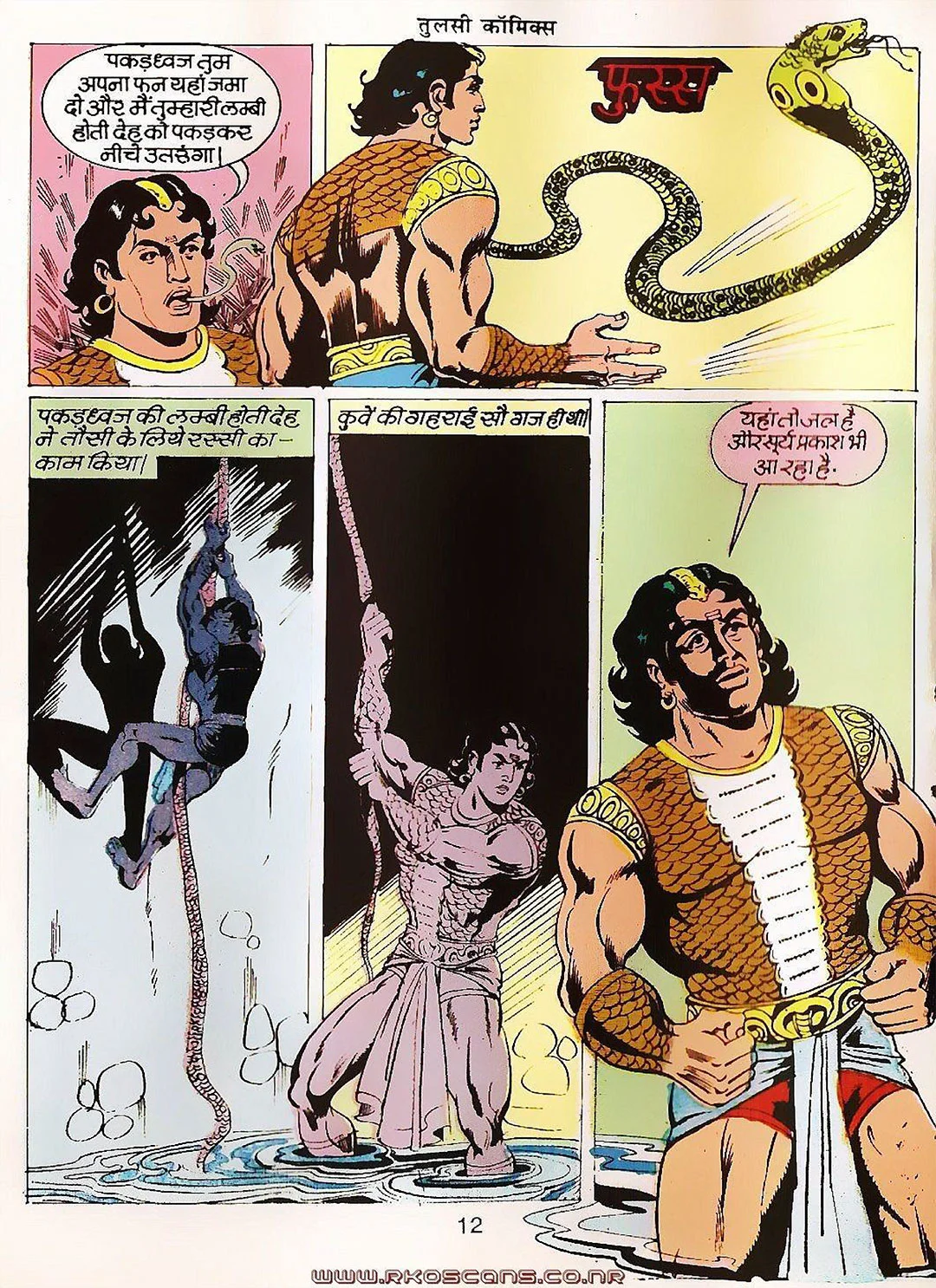
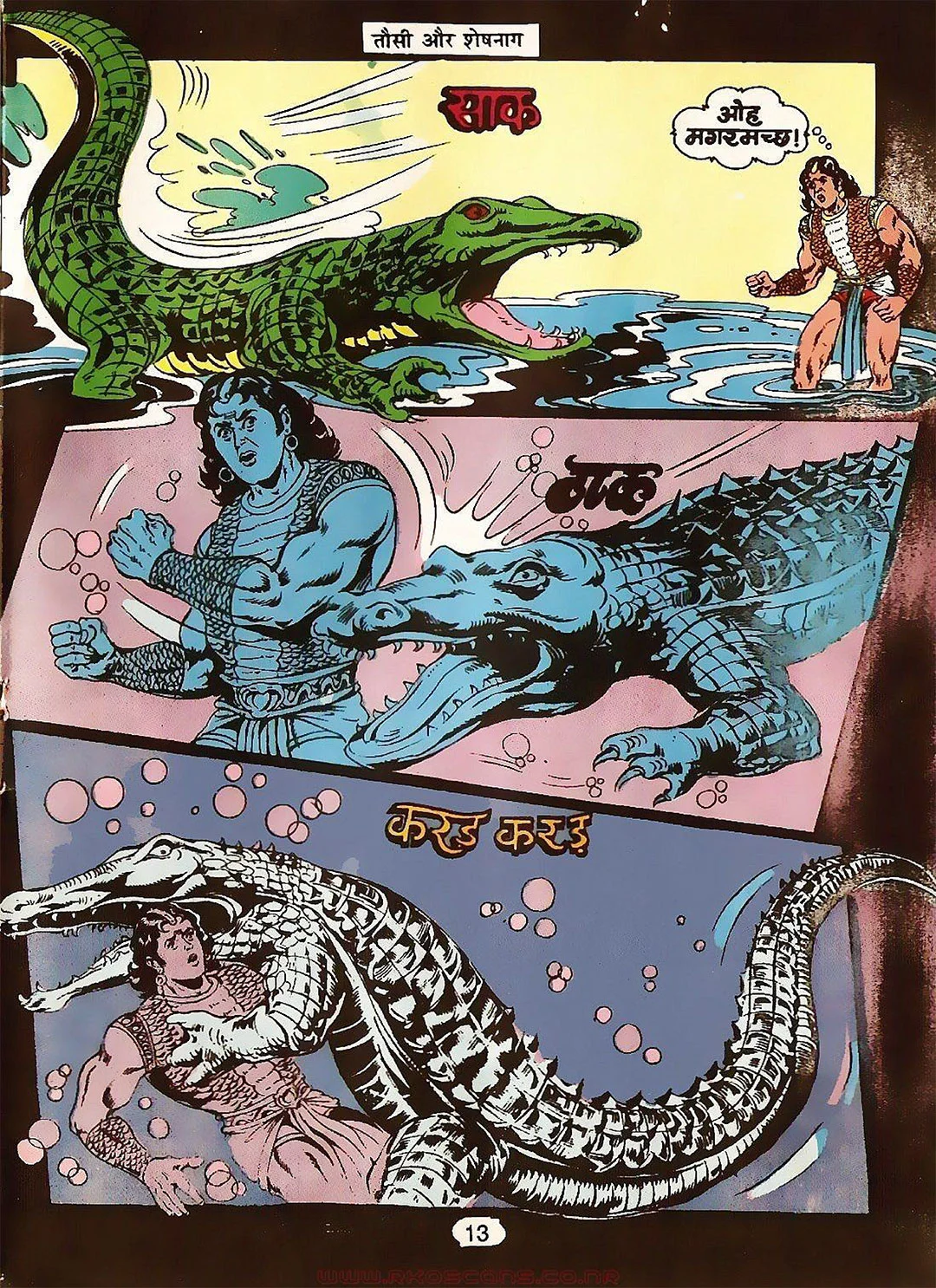
The second gate is like a large, deep well filled with water. Its protector is a huge crocodile.
Struggle: Tausi jumps straight into the water. The crocodile i.e., Panidhwaj, is very powerful underwater. He traps Tausi by creating a large vortex in the water with a technique like ‘water churn’.
Dialogue: “One should not hate crocodiles while living in water.” This old saying fits perfectly here.
Solution: Tausi understands that it is very difficult to win a battle in water without weapons. Here he uses his understanding, his training and his previous ability (the power of grip/control) at the right time. The comic shows Tausi using both his mind and body in a balanced way.
Result: Panidhwaj also takes the form of a snake after losing and gets absorbed into Tausi’s body. Now Tausi has the ability to stop, divert or control water.
InvisibleFlag (The Invisible Guardian)
The third protector is invisible. He is not visible, but his punches throw Tausi into the air.
Conflict: Confrontation with an enemy you can’t see—that’s the biggest problem.
Solution: Tausi guesses his steps and movement from the waves of water and the pressure of the wind (Movement), and catches him at the right moment.
Result: Even the Invisible Flag loses and becomes a part of Tausi.
The Tridhwaj (The Illusionist)
At the fourth gate, three identical warriors stand in front simultaneously.
Challenge: Only one of these is real, while the other two are his shadows. If Tausi had attacked any one, his hand would have gone through.
Solution: Tausi used the power of ‘InvisibleFlag’ (which is now within him). Invisible, he went to the three, touched them, recognized the real body, and defeated him by throwing him to the ground.
Analysis: Here it appears that this story is not limited to just moving forward, but is based on ‘accumulation’. Tausi uses the new power he has found in each level in the next level. This is what makes this plot very strong and fun.
Magnetflag (The Magnetic Guardian)
The fifth protector is like an iron man, whose body has magnetic strength.
Challenge: He pulls the opponent towards him and crushes him with just his magnetic power, without moving.
Solution: Tausi either uses the power of ‘Tridhwaj’ or else dodges it with his willpower. When the Magnetflag could not pull Tausi towards itself, he accepted Tausi’s bravery.
Result: He also loses and gets absorbed within Tausi.
Ashtadhwaj (The Eight-Armed Guardian)
The sixth protector is eight-armed and rotates quickly like a circle.
Challenge: He was spinning at such a fast pace like Sudarshan Chakra that going near him means getting himself cut.
Solution: Tausi used the magnetic power of ‘Magnetflag’. He pulled the Ashtadhwaj towards himself while rotating with his power and held him in his arms. He gave up as soon as his speed stopped.
Portrayal and art side (Art & Visuals)

The depiction by Rahi Kadam and Darshana Thigale is a special identity of Tulsi Comics. It features Tausi as very muscular, reflecting the influence of heroes such as He-Man and Arnold Schwarzenegger from the 90’s. Bright colors—yellow, red, green and blue—have been used a lot in the pictures. The background is often kept simple to focus on action.
‘Speed lines’ and sound indicator words (such as — spat, dhad, fass) have been used extensively to show speed in fight scenes. The design of monsters and defenders (such as ‘Octodhwaj’) is quite interesting. Whereas the depiction of Sheshnag is extremely gorgeous—behind him the divine light (Aura) is shown which makes the scene even more spectacular.
Dialogue and Writing Style (Writing Style)
Rituraj’s writing style is very dramatic and makes a lot of use of Sanskrit-oriented, heavy Hindi words. This gives the story a mythological and serious tone. Words such as “kadap”, “ready”, “attack”, “toxic”, and “idealistic” are commonly found in dialogues.
One special thing about this genre is that the characters say things directly. They do not twist their powers and intentions—it was a famous ‘trope’ of comics of that period. Even villains used to tell their own weaknesses and strengths, such as Gripflag saying, “I can’t change shape when my tail is pressed.” It was a good way to explain the rules of the story to readers of the time in a simple way, even if it seems a little unique today.
Critical vision
Comics may be masterpieces, but the job of a reviewer is to do a little ‘voyeurism’ to see where there was room for improvement. And here too some small shortcomings are visible:
Repetition of patterns
The structure of the story becomes a little predictable. A kind of fixed formula goes on:
Tausi goes into room → protector meets → collision → protector loses → Tausi moves forward.
And this whole cycle repeats about 6 times.
It’s okay to do it once or twice, but again and again the same formula creates a little monotony.
Lack of villain
At the beginning of the story, Turksain and Munda make a very nice entry. Looks like they’ll make a big bang…
But as the story progresses, the entire focus shifts to Tausi’s trials and the main villains are pushed to the side.
Ye thoda sa natak sure— but maybe all this would have been done intentionally to set up the next comic “Tausi in Magic”.
Convenient Wins Some protectors even tell their own weaknesses to Tausi!
And sometimes Tausi makes a perfect guess without much struggle as to who to beat.
Had there been a little more tough challenge, the fun would have doubled.
Conclusion: Why read these comics?
‘Tausi Aur Sheshnag’ is a great work from Tulsi Comics that offers a wonderful confluence of fantasy, action and Indian mythology. The biggest quality of this comic is that it is not just an action story, but a true ‘quest’ where the hero gains new lessons, threats and experiences at every step. Tausi’s moral duality, his dilemma and finally the solution, reflecting his character development, proves him to be a more mature hero than just a fighting warrior.
The unique end of the story—where weapons are replaced by ‘living powers’—is a very original and brilliant idea, which is a testament to the creativity of Tulsi Comics. The comic evokes exciting childhood memories for 90’s kids, while showing new readers that Indian comics were not just entertainment, but a treasure trove of deep, imaginative and thought-provoking stories.
In the end, this story teaches that a true warrior is one who knows how to use his intelligence more than a sword, and sometimes the greatest bravery is to move forward with your enemy as your power.
Rating: 4/5 🌟🌟🌟🌟
