



Among veteran characters like Nagraj, Dhruv, and Doga, a hero also came whose aim was not only to catch criminals but also to protect the unity and integrity of the country. That hero’s name is— Tiranga. Today, we are going to review and analyze in detail the first comic of Tiranga, ‘Riot’.
‘Tiranga’ is a patriotic superhero who is colored in the colors of the national flag of India and is always seen fighting the internal and external enemies of the country. The comic ‘Riot’ is not just a simple action story, but it hits straight and sharp at India’s most serious social problems—communalism and riots.
Author Hanif Azhar has tried to show clearly through this story that riots in the name of religion are often not related to religion, but are political tricks, the purpose of which is only to gain power and profit. Even today, the thinking and message of this comic seem as accurate and important as they were at that time.
Plot Analysis
The story begins in the corridors of power in Delhi, where some corrupt politicians and white-collar people are sitting in a luxurious room and plotting their dirty politics. Their plan is clear—to take advantage of the situation by creating riots in Delhi. For this purpose, they use a dreaded criminal, the Nigger. The Nigger is taken out of jail illegally for just four hours so that he can instigate riots in Bharat Nagar Colony.
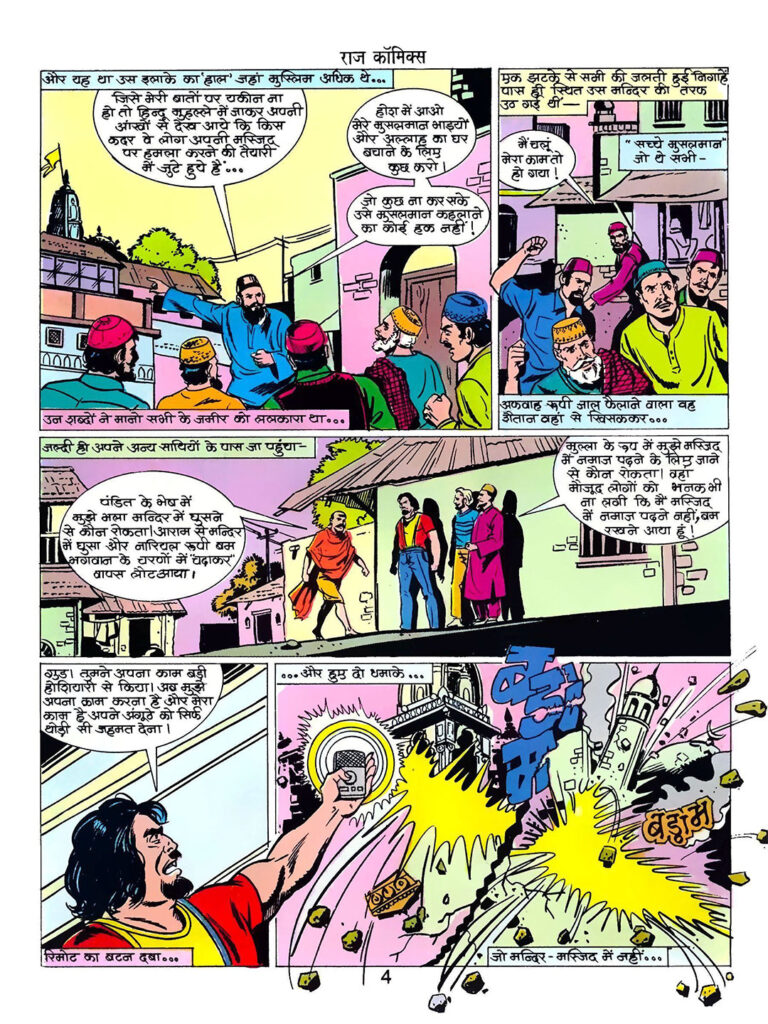
The strongest part of the story is that it shows very clearly how riots start. The Nigger and his men begin spreading rumors. On one hand, Hindus are told that Muslims are going to attack their temple, and on the other hand, Muslims are instigated that their mosque is in danger. These scenes make readers think about how quickly the crowd believes rumors without knowing the truth.
The Nigger cleverly goes to the temple once in the guise of a Pandit and the second time enters the mosque in the guise of a Mullah. There, he places bombs in the form of coconuts and other items. Remote blasts occur, and as he planned, humanity loses and religious frenzy wins. Within no time, Bharat Nagar starts burning in fire.
A very emotional and bitter aspect of this story shows the role of the police. Two different faces of the police are seen here. On one side are corrupt Inspector P.O. Palakumar and his associates, who are sitting in the police station playing cards, while the entire area outside is burning. On the other side is the dutiful Havildar Ramnath, who performs his uniformed duty with complete honesty.
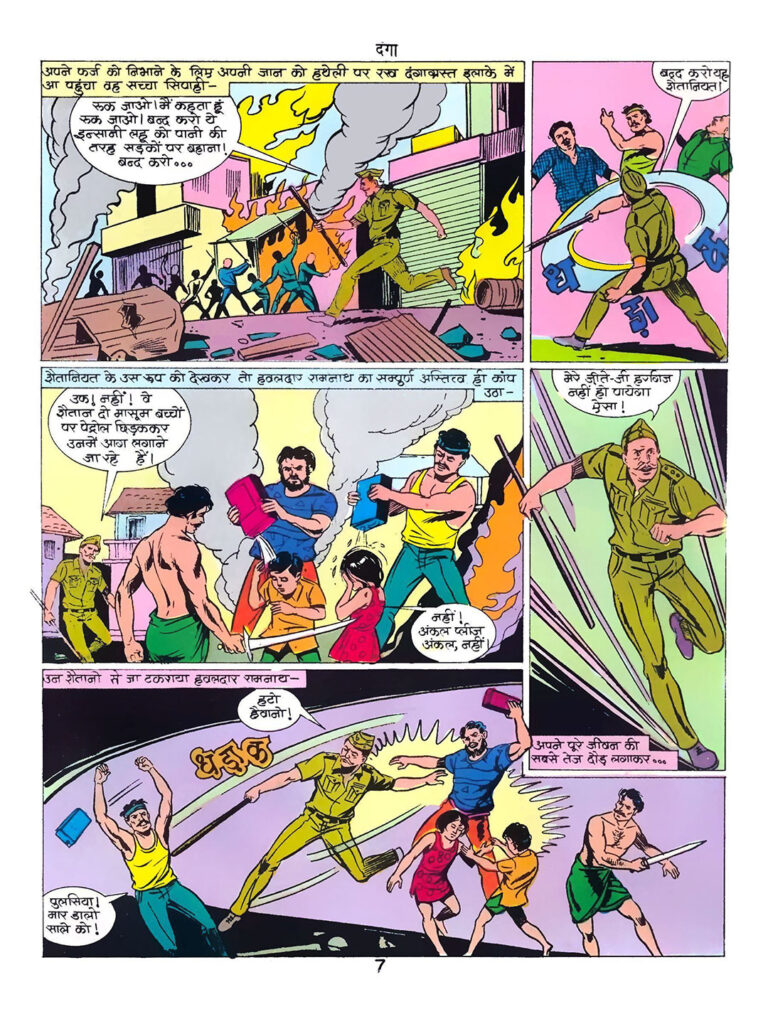
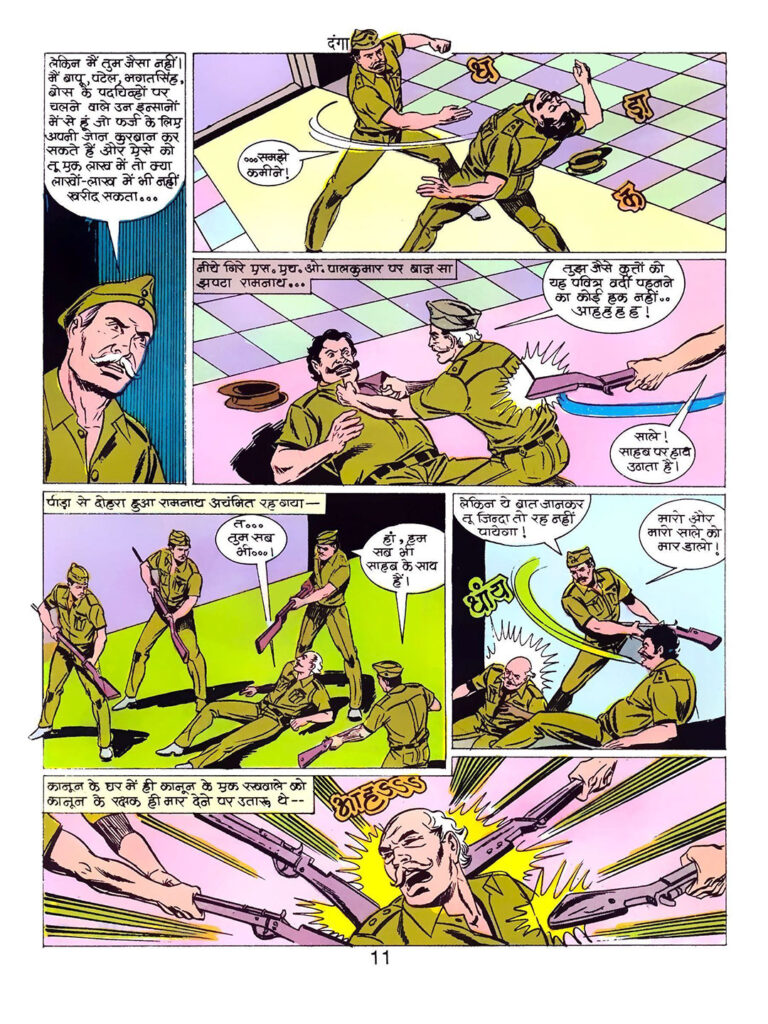
Ramnath’s character is definitely small, but its impact is very deep. He single-handedly confronts the rioters who are trying to burn children alive. He screams with anger and pain—“Stop spilling human blood on the streets like water!” But alas, he faces more deception from corrupt people in his own department, i.e., Palakumar and Habshi, than from the rioters. Ramnath’s brutal murder becomes the biggest turning point of the story, filling the reader’s heart with anger against the system.
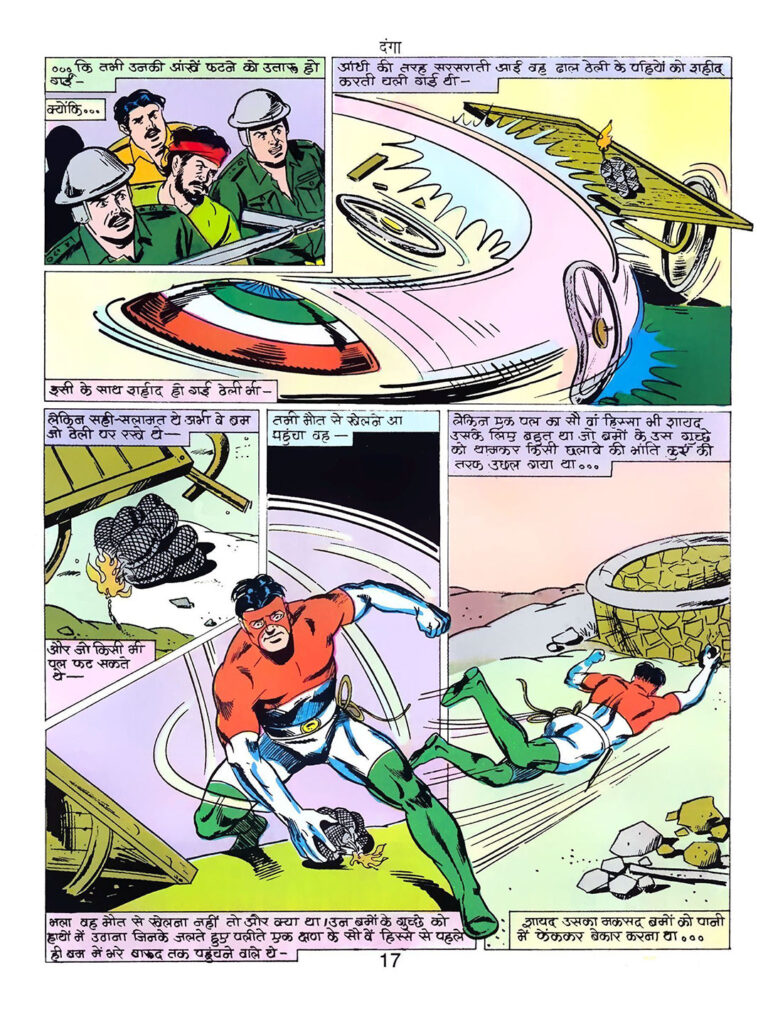
When the situation becomes completely out of control, the entry of the great Tiranga takes place. Tiranga comes to the fore when the Nigger tries to bomb an entire mansion in which hundreds of people are hiding. Using his shield, Tiranga stops the cart full of bombs and averts a terrible accident.
After this, Tiranga not only fights the goons but also awakens the sleeping humanity of the people. He stands among the rioters and asks, “Who are you—Hindu or Muslim?” And the answer comes—“Human!”
Characterization
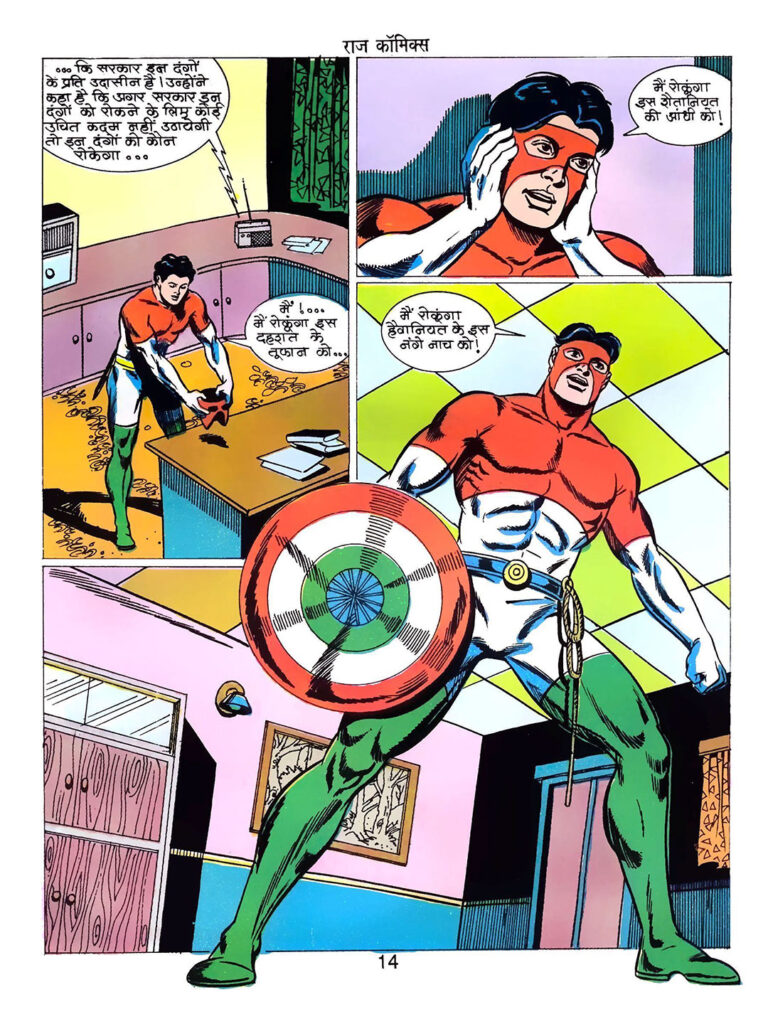
Tiranga: In this comic, Tiranga is not just a powerful fighter, but he is also an explainer, guide, and protector. His dialogues are full of patriotism. He explains to the rioters that the color of blood is the same for everyone and that religion teaches us to protect, not to kill. The character of Tiranga completely reflects the feeling of “unity in diversity” of India. He teaches the Nigger and his goons a lesson without discrimination.
Havildar Ramnath: Ramnath is the real soul of this comic. He is a symbol of the common man and the honest policeman who does not give up his morality even amidst the rot of the system. His dialogue—“I’m not like you… I’ll keep the shame of this sacred uniform”—directly touches the heart. His martyrdom does not go in vain, because in the end, Tiranga definitely takes revenge.
Villains (Habshi and Palakumar): The Nigger is a criminal who is only concerned with money and destruction. He has no religion; he is just a hired goon. At the same time, Palakumar is the face of the rotten system and administrative corruption that protects criminals. Palakumar’s ending gives satisfaction to the readers when Tiranga exposes him and he is punished for his actions.
Dialogue and Writing
Hanif Azhar’s writing is very well done and effective. He has approached a very sensitive subject with great balance, without openly supporting one side. The dialogues definitely have the weight of comics of that era and a little filmy style, but this style makes the story more effective.
There are many dialogues in the comic that directly impact the heart and mind and strongly put forward the message of the story.
“He who cannot do anything has no right to be called a Muslim!”
(This dialogue is used to inflame the crowd and shows how dangerous the misuse of words can be.)
“How painful it is when blood breaks the bonds of nerves and is free!”
(This dialogue by Havildar Ramnath reflects his sensitive thinking and humanity.)
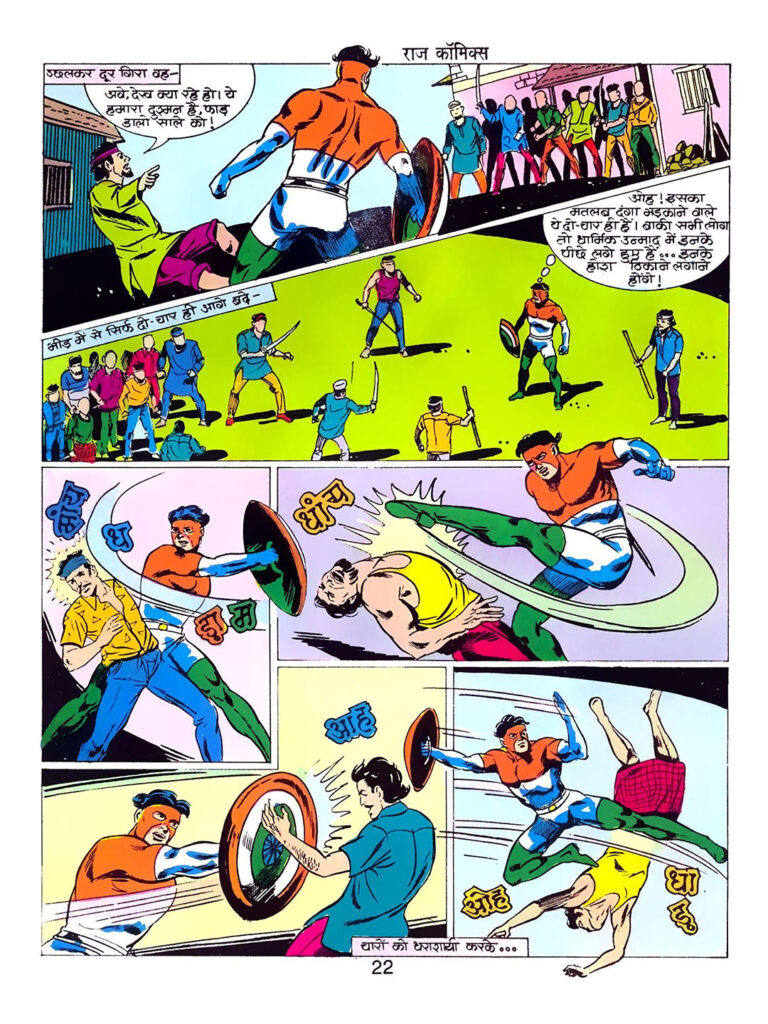
“No religion teaches that knives and swords should be picked up to protect it; innocent blood should be shed.”
(This dialogue from Tiranga becomes the basic message of the entire comic.)
“Who are these Hindus and Muslims, Baba? Masterji says we are all Indians?”
(This innocent question of a child raises questions about the foundation of the whole riot.)
All these dialogues convey the main message of the story to the readers in a very simple but strong way.
Art Side
The drawing done by Gopal and Rahul is in perfect accordance with the seriousness of the story. They have shown the scenes of riots, burning houses, running crowds, and chaos all around in a very lively and effective manner. Especially the scene on pages 17–18, where Tiranga throws his shield to stop a cart full of bombs, has become very dynamic and powerful. In that scene, tremendous speed and tension are felt through the panels.
Red, orange, and black colors have been used extensively to create fear and restlessness in the atmosphere, which makes the effects of fire and smoke more real. At the same time, the violence shown in scenes like Ramnath’s murder does not seem excessive, but makes the subject of the story and its seriousness felt more deeply.
Social Messages
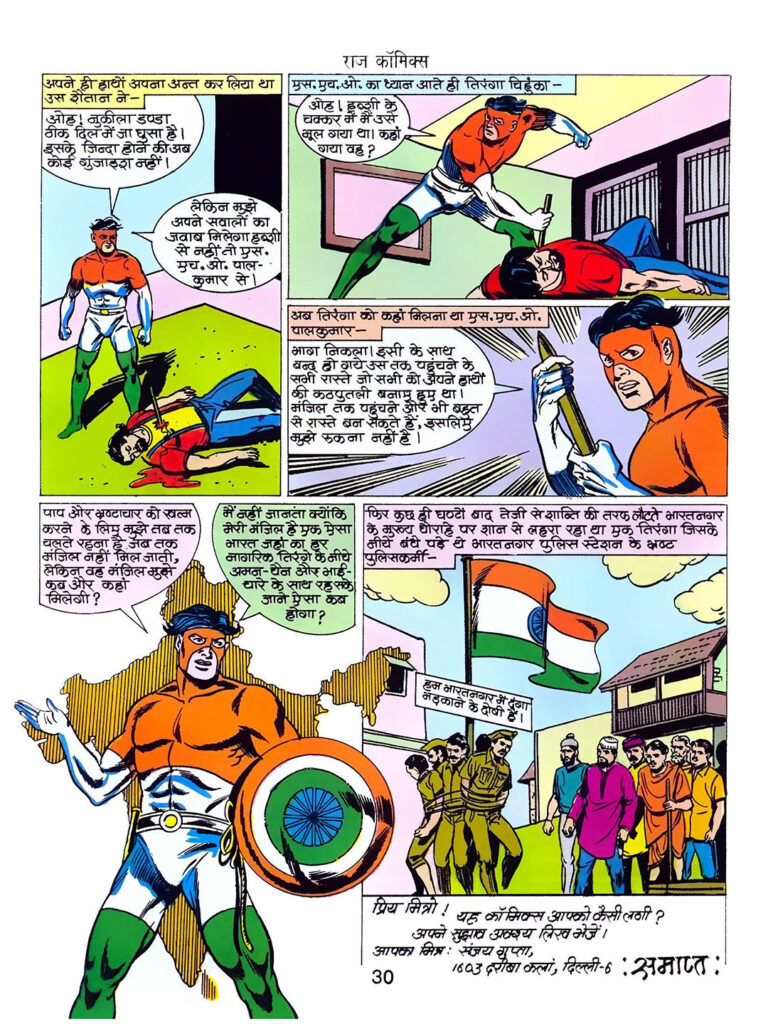
The greatest strength of the “Riot” comic is its deep social message. This clearly explains to the readers that riots are often built on the foundation of lies, rumors, and fear. The story brings out the bitter truth that ordinary people are reduced to mere pawns, while the real game is always played by white-collar people sitting behind the scenes.
The end of the comic proves humanity to be the greatest religion, where Hindus and Muslims together form a human chain and choose the path of peace. Especially Tiranga’s statement that behind the riots are those people who sit in air-conditioned bungalows surrounded by security personnel and hatch false conspiracies is not only the essence of the story but is also a precise and harsh taunt on today’s politics.
Deficiencies
Although “Riot” is a fantastic comic, there are a few things to consider as a reviewer.
The crowd’s heart changes very quickly at the end of the story. In real life, it is not as easy to calm down a crowd that has once erupted, as shown by a speech by Tiranga. This part looks a little too filmy.
Also, at the end of the story, Habshi and Palakumar get punished, but what happened to the leaders who hired Habshi, whose glimpse we get on page 5? Their outcome is not clearly shown, making the story seem a bit incomplete.
Conclusion
Overall, “Danga” is a very important and memorable comic in the history of Raj Comics. It is not limited to just action, but also gives a message to the readers, especially children and teenagers, to become responsible citizens.
In this story, Tiranga appears not just as a superhero, but as a “national conscience,” i.e., national consciousness. Havildar Ramnath’s sacrifice brings tears to the eyes, while the justice done by Tiranga gives peace to the mind.
Rating: 4.5 / 5
Recommendation: If you are a fan of Raj Comics or want to understand Indian superhero comics that deal with social issues, “Danga” is a must-read comic. It reminds us again and again that our greatest identity is not Hindu nor Muslim, but “Indian.”
As written on the cover page—
“Now the Holi of sin will not be played.
Now the Ganga of blood will not flow.
With your shrouds tied on your head,
The Tiranga has become the protector.”
