


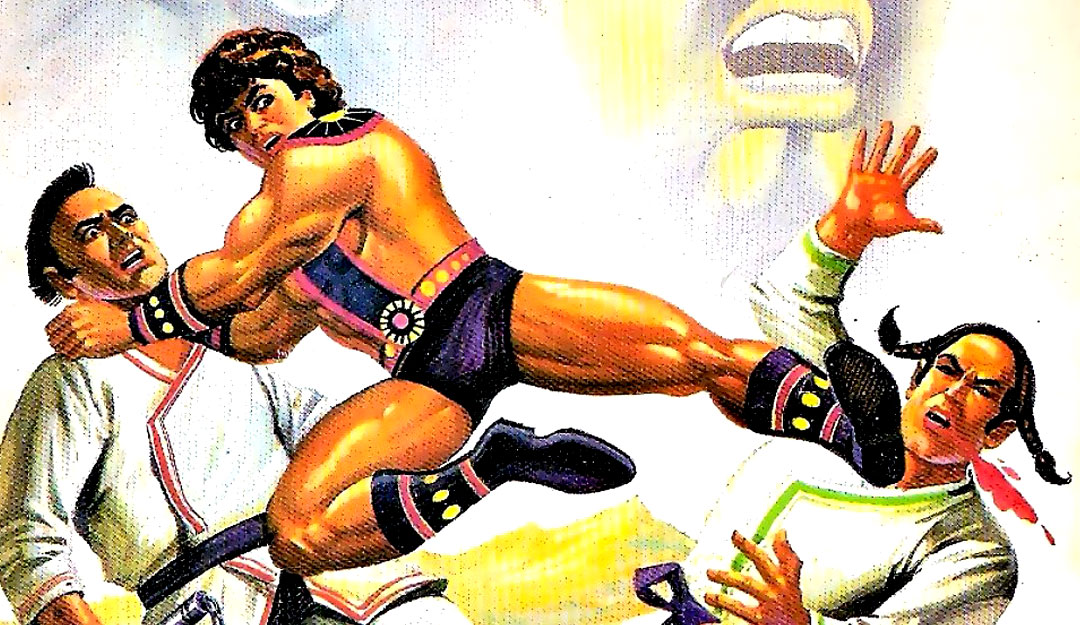
After ‘Cataclysmic Yosh’ and ‘Yosho’s Jung’, the third episode of this series, ‘Yosho Earth Folk(Yosho Prithvi Lok Mein)’ (number 545), brings a new and exciting twist to the story for readers. This comic also becomes special because here the hero, for the first time, leaves his place of birth, the ‘Solar Planet’, and steps onto his father’s homeland, Earth. In this 31-page comic, writer Rituraj and artist Sanjay Shirodkar together have created a story that is not limited to tremendous action alone, but also clearly presents the struggle, confusion, and fire of revenge going on in the mind of the hero.
Detailed analysis of the plot:

The story starts with a powerful and scientific atmosphere. ‘Yosho’, who is the son of the Sun’s princess ‘Shaurya’ and Earth’s human ‘Yograj’, comes to Earth via spacecraft in search of his father. His vehicle lands in the snow-covered hills of the Himalayas, i.e., the Nilambar Mountains. Here, the author wisely lays the foundation of Yosho’s character. Yosho is not just a mighty warrior; he is a combination of the powers and cultures of two different planets.
Introduction to the Himalayan struggle and powers:
In the opening pages of the comic, we see Yosho sitting in the caves of the Himalayas, reading about the history of the Earth and its great personalities, like Ram and Krishna. During this time, he is attacked by wild animals, especially bears and wolves. This scene is very effectively designed to showcase Yosho’s powers. Flames burst out of Yosho’s body, and beams shoot out of his eyes like bullets. He defeats the animals easily, but at the same time realizes that the animals on Earth are not as dangerous as humans.
Mysterious meeting with Beard Baba:

Yosho then meets a mysterious friar named ‘Beard Baba’. This is where a strong touch of magical realism is found in the story. Beard Baba’s long beard is not just hair, but is as strong as iron chains, which grip Yosho tightly. Yosho and Baba have a short but fierce bout, where Yosho impresses Baba with his fire power. Beard Baba becomes the link that gives Yosho the first concrete information about his father, Yograj. He explains that Yograj went missing near the ‘Cross Line’ and that Yosho must meet a person named ‘Sarang’ to find him.
City trip and commotion at ‘Hotel Sarang’:

Descending from the mountains, Yosho now steps into the modern city. Here, he clearly sees the difference between his advanced civilization and the backward technology of the Earth. He reaches ‘Hotel Sarang’ directly and creates a tremendous commotion to meet Sarang. He burns the hotel register by crushing it in his fist and single-handedly dusts off the entire contingent of warriors who are adept in martial arts. This display of his aggression and strength finally forces Sarang to come out of his room.
Sarang’s betrayal and ‘Operation Red Line’:
Sarang, who appears to be a senior detective agency officer, welcomes Yosho. He tells him that Yograj’s vehicle had sunk into the dangerous ‘Cross Line’ area of the Pacific Ocean, from where no one has returned alive to date. Sarang then sends Yosho on a mission called ‘Operation Red Line’. From here, the story takes a new turn. The reader gradually begins to understand that Sarang is not as reliable as he initially appears.
Climax and suspense:

Yosho is transported by helicopter to a ship in the middle of the ocean. From there, he enters the dangerous terrain of ‘Red Line’. Under the sea, he has to fight blood-sucking vines and finally reaches a mysterious islet. There, a huge mechanical bird captures him. The story ends on a powerful cliffhanger, where Sarang’s real face is revealed. It now becomes clear that he either wants to eliminate Yosho like his father or use him as a pawn for his own cause.
Portrayal of characters:
Yosho: In this part, Yosho emerges as both a seeker and a warrior. He carries anger and resentment toward his father, yet remains serious about his duties. The combination of science and spirituality in his powers makes him different and special from other heroes.
Beard Baba: He adds mystery and a magical atmosphere to the story. Portraying his beard as a weapon is a very unique and memorable idea. He comes across as a mentor and guide to Yosho, although his ambiguous nature toward the end gives the story further depth.
Sarang: He resembles a classic spy boss—slick, opportunistic, and full of secrets. His desire to exploit Yosho’s powers for his own benefit clearly highlights his selfish and manipulative nature.
Portrayal and art side (Art & Visuals):

The art side by Sanjay Shirodkar and Rohit is really praiseworthy. The juxtaposition of snow whiteness and blue skies in the Himalayan scenery creates a serene yet gorgeous atmosphere. Action scenes show battles with bears and wolves in a very lively manner, where sound indicators like ‘tad-tad’, ‘tadam’ and ‘sai’ bring life to the pages. Yosho’s craft, helicopter, and undersea scenes are depicted with modern technology to maintain the story’s scientific credibility. Also, the texture of the characters is closely worked out—Yosho’s black and pink suit makes a strong impression, while Beard Baba’s facial expressions and the details of his long beard are beautifully carved.
Critical Comment:

The story of ‘Yosho Prithvi Lok Mein’ has been carried forward by writer Rituraj with great understanding and balance. He has divided the entire plot into three important levels—conflict with nature (Himalaya), conflict with spirituality (Beard Baba), and encounter with modern science (City and Red Line). Because of these three levels, the story does not move in a single direction, but offers a new experience at every turn. The pace of the story is quite fast, due to which the reader’s interest remains intact till the last page. In particular, when Yosho uses the word “makkar” for his father Yograj, it clearly reflects the deep mental pain and anger hidden within him. This emotional aspect takes this comic beyond a simple superhero story into the journey of a son, where hatred and duty go hand in hand.
Positive side:
Yosho’s fire powers and bullets from his eyes (Eye Bullets) are used in this comic to great effect, clearly distinguishing him from the rest of the superheroes. The character of Beard Baba is not only interesting within the story, but also presents a unique combination of mystery and guidance, which strengthens the overall narrative. The different settings—from the snowy peaks of the Himalayas to the depths of the ocean—at the visual level provide readers with a grand and exciting experience. Leaving the story on a powerful cliffhanger at the end proves to be a successful move by the author, further intensifying the desire to read the next issue.
Downside:
Yosho’s behavior in the city seems overly aggressive in some places, such as burning the hotel register, which may come across as slightly unbecoming of a prince’s dignity. Furthermore, the story ends quite quickly, making it feel more like a build-up or the beginning of a much larger storyline.
Conclusion:
This presentation by Tulsi Comics can be considered a great ‘cross-over’ story of its era. It establishes Yosho not just as a warrior from another planet, but as a hero whose story connects directly to Earth. ‘Yosho Prithvi Lok Mein’ reminds us that 90s Indian comics were not limited to mere entertainment, but were reaching imaginative heights where science and Indian culture, such as yoga and the sadhu tradition, intermingled seamlessly. This was truly a sign of the times.
If you want to read a revenge-filled story of espionage, maritime secrets, and an extremely powerful warrior, then this comic can prove to be a memorable experience for you.
Rating: 4.5/5
