


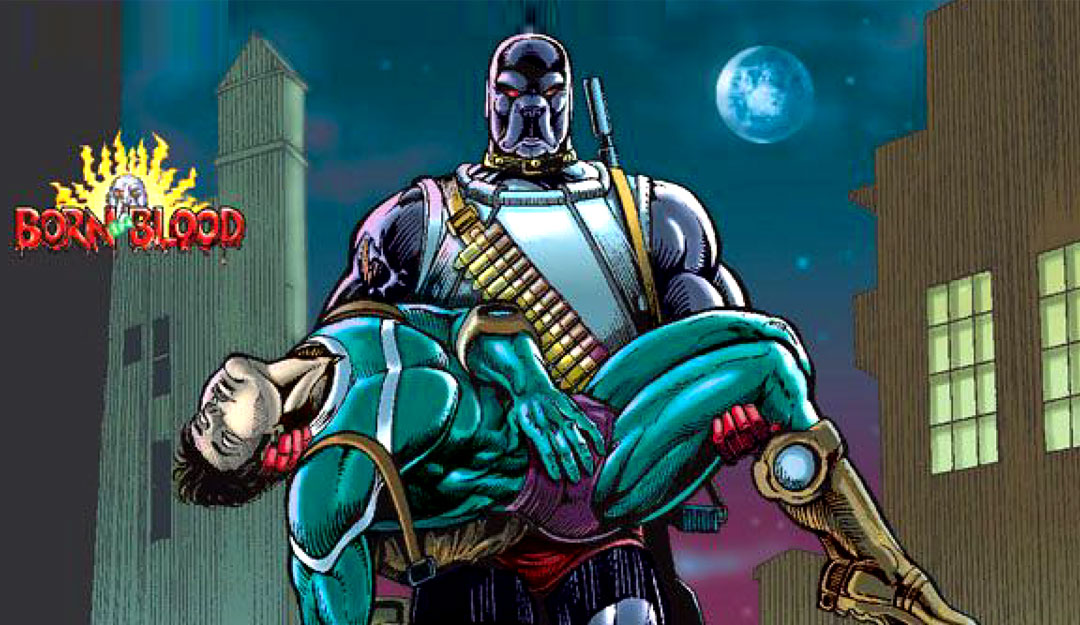
‘Doga’ in the universe of Raj Comics is not just a superhero, but a thinking being. That is such a reaction against that rotten system, which is not able to give proper justice to the common man. ‘Canker Dog’ is one such powerful story of Sanjay Gupta and Tarun Kumar Wahi. These comics not only make you enjoy fighting, but also make you think: how does one become a criminal? Is it bad to be born a human being, or is it our society and its “correction” places that push him on the wrong path?
This comic not only shows the inner pain and strong emotions of Doga’s character, but also tells the sad story of a young man named Sameer, who was forced by circumstances. The story takes you to that thin, blurry line between “crime” and “justice” where it becomes difficult to differentiate.
This comic is the sequel (Sequel) to the previous special issue “Doga Tere Kaaran”. In the previous story, we had seen how Doga’s haste, his indiscriminate justice, and the corruption of the police system had pushed an innocent student ‘Sameer’ behind bars. “Nasoor Doga” is the story of the same seed becoming a tree — a tree whose roots are poisoned by hatred and whose branches bear the fruits of crime. This story is not just a superhero’s victory story, but it is a journey of the defeat of a system and the self-guilt of a protector.
Plot (Storyline): Confluence of Past and Present
The story begins with Doga’s classic entry, but before that we get a glimpse of Doga’s past (Suraj). This flashback gives goosebumps.
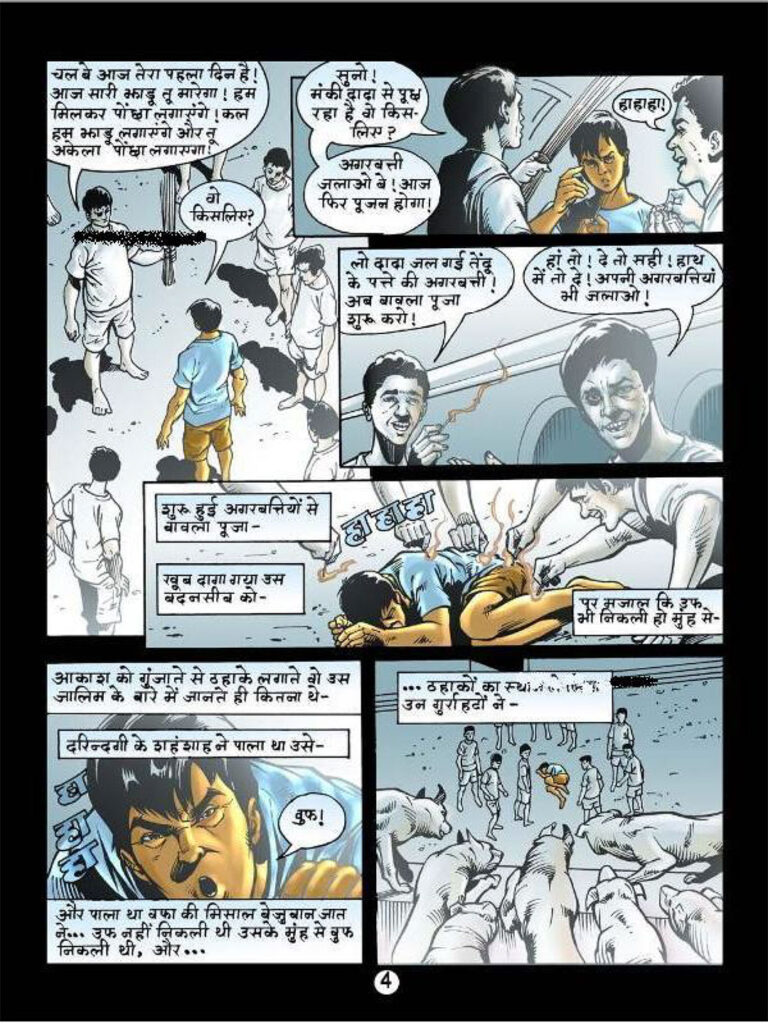
Cruelty of the Children’s Correctional Home (flashback):
The opening pages of the story take us to those days of Suraj (i.e. Doga’s childhood) when he lived in a ‘juvenile home’. The warden here ‘Sher Singh’ is an extremely cruel human being, who beats children like animals in the name of improving them. One of his dialogues, “sent me here as a warden of stray dogs,” clearly shows his thinking and anger.
He torments Suraj inhumanely every day. The authors have shown in a very precise way how a ‘correctional home’ actually becomes a factory of crime many times. Suraj running away from there and keeping the fire of revenge suppressed within himself lays the foundation for the formation of Doga in the future. The part of the girl named Sonika also brings out Suraj’s innocence and the soft part of his heart.
Sameer and Doga clash:
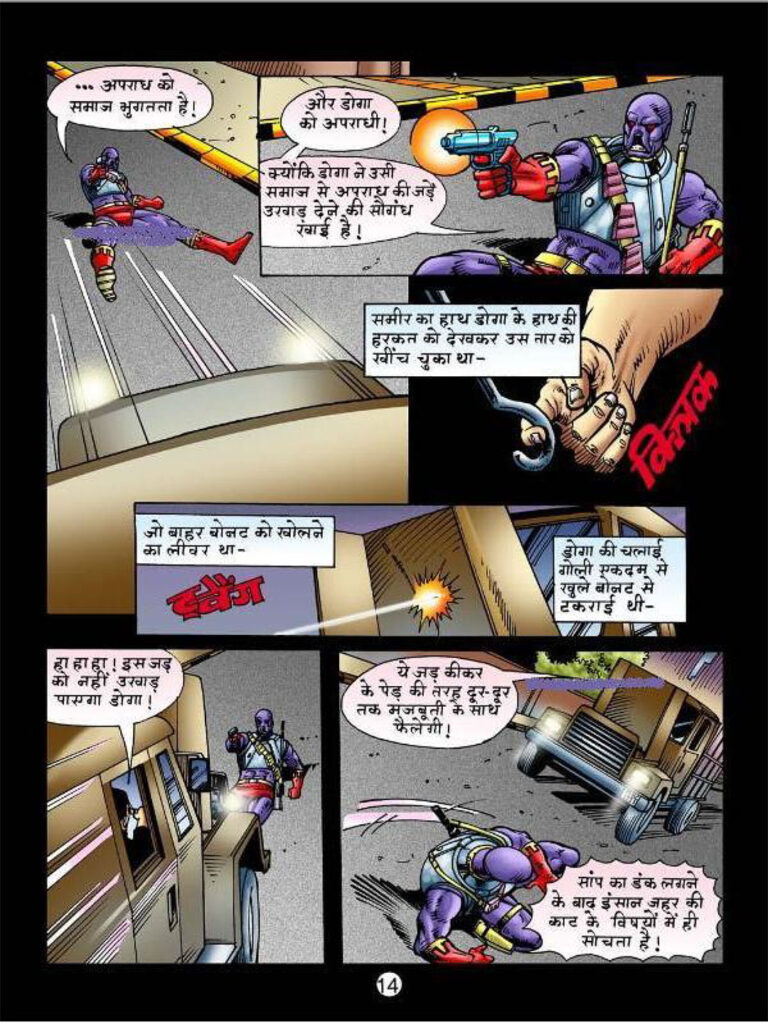
In the present, the story begins with the scene where Doga stops a truck. Sameer is driving this truck. From outside, it seems to be a government ration truck which is going to jail, but Doga catches with his sharp gaze and sense of smell that beedis, cigarettes, and drugs are being smuggled into the jail by hiding them among the packets of pulses.
The conversation between Doga and Sameer is very important here. Sameer does not seem to be a big criminal. Compulsion and fear are clearly visible in his eyes. Doga explains to him that this path is wrong, but Sameer says that he is forced to live his life.
When Doga searches the fuel tank of the truck, he finds refill mobile (or illegal mobile phones — unclear original term), drugs, and other illegal things. Seeing this, Doga runs to catch Sameer, but by then Sameer runs away with the truck. Seeing this, blood comes out in Doga’s eyes.
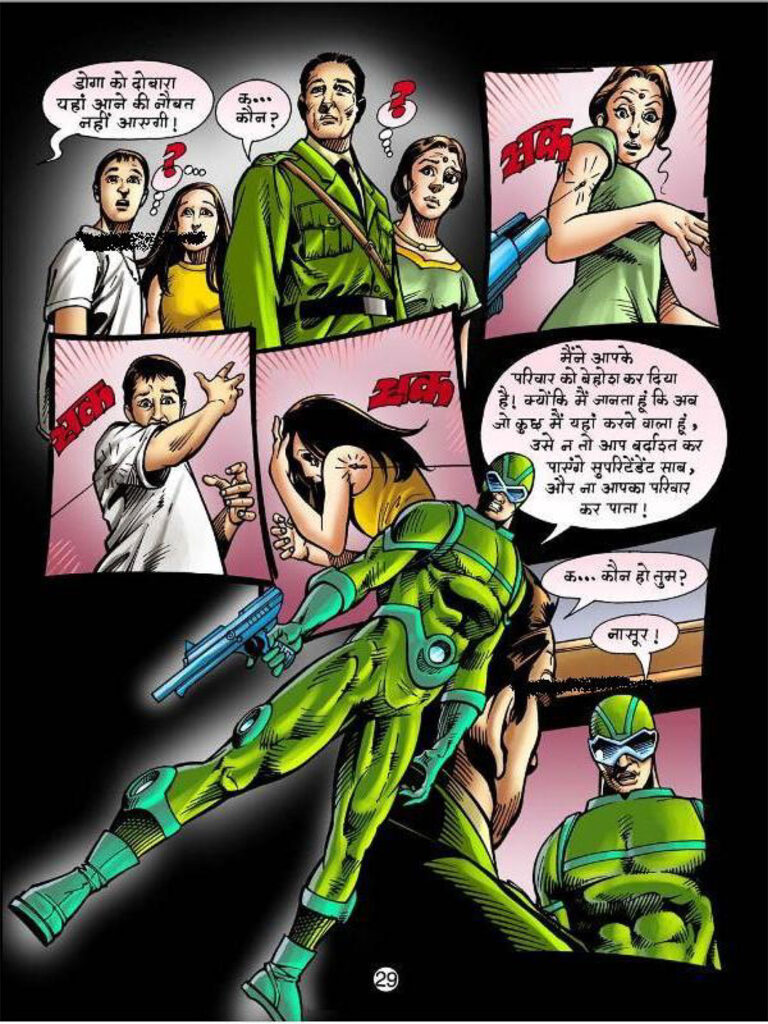
This is where the new twist in the story comes from. A new ‘vigilante’ (judge in one’s own way) is born in the city. This person in a green suit calls himself “Canker”. His method is a little different, but his target is the same people—corrupt executives and people selling the system.
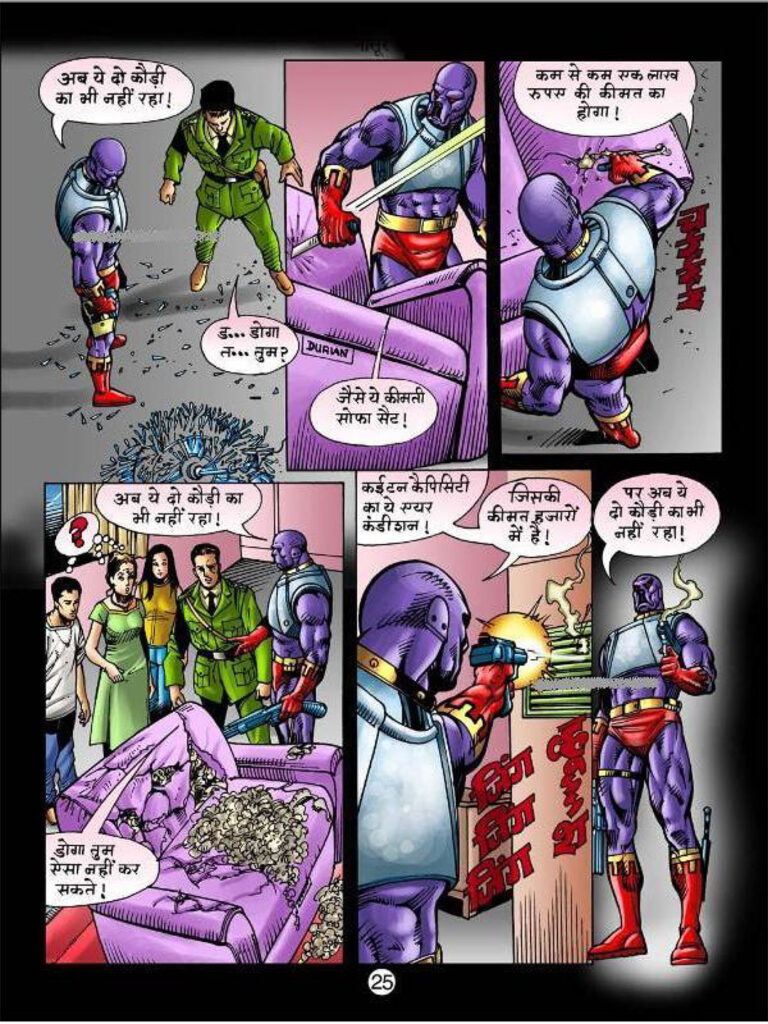
The scene in the comics where Doga enters the jail superintendent’s house is very powerful. He does not kill the superintendent, but breaks his precious things that he has bought with money earned from bribes—expensive crystal chandelier, couch of 50 thousand, imported car of 14–15 lakhs.
Doga’s argument is clear:
“I want to prove don’t dress your family with the wealth earned from corruption… Otherwise, the day even a blow of fate hits, these people will not be worth even a penny.”
Reading this form of Doga gives a different kind of satisfaction, because it hurts corrupt people where they feel the most pain — their money and their pride.
Sameer’s tragedy:
As the story progresses, we learn that Sameer is actually Canker. Sameer’s old life was exactly like that of a common middle-class boy. But a minor road accident completely reversed his life. He was sent to jail. And there he realized that the prison world was darker and scarier than the world outside.
In prison, goons like ‘Body Dada’ and ‘Nepali Maestro’ rule. These people are running their own separate empire with the connivance of the jail administration.
As soon as Sameer steps into jail, he is welcomed not with flower garlands but with kicks and punches. Body Dada and his henchmen beat him mercilessly. Sameer, an educated and respectful boy, is forced to clean the dirty toilets of the jail.
The most disturbing moment comes when he has to stand with Body Dada’s slippers on his head and bow down to him. Whenever Sameer protests or tries to escape, ‘Monkey Dada’ and the rest of the prisoners burn him with incense sticks. This scene really shocks.
It becomes clear here that the simple person inside Sameer had died inside these four walls of the jail. The place that was supposed to improve him makes him a hard, broken and angry person inside. The hell Sameer endured in jail completely changed him.
When he comes out of jail after completing his three-month sentence, his entire world is found scattered. His sister has gone missing. The house has been lost. And instead of adopting him, the society stares at him, taunts him, scolds him. Sameer now has neither home, nor family, nor hope. It is in this dark time that he meets ‘Big Boss’, a big underworld don. Big Boss recognizes the burning hatred inside Sameer and thinks of using it for his own benefit.
Climax (Climax):
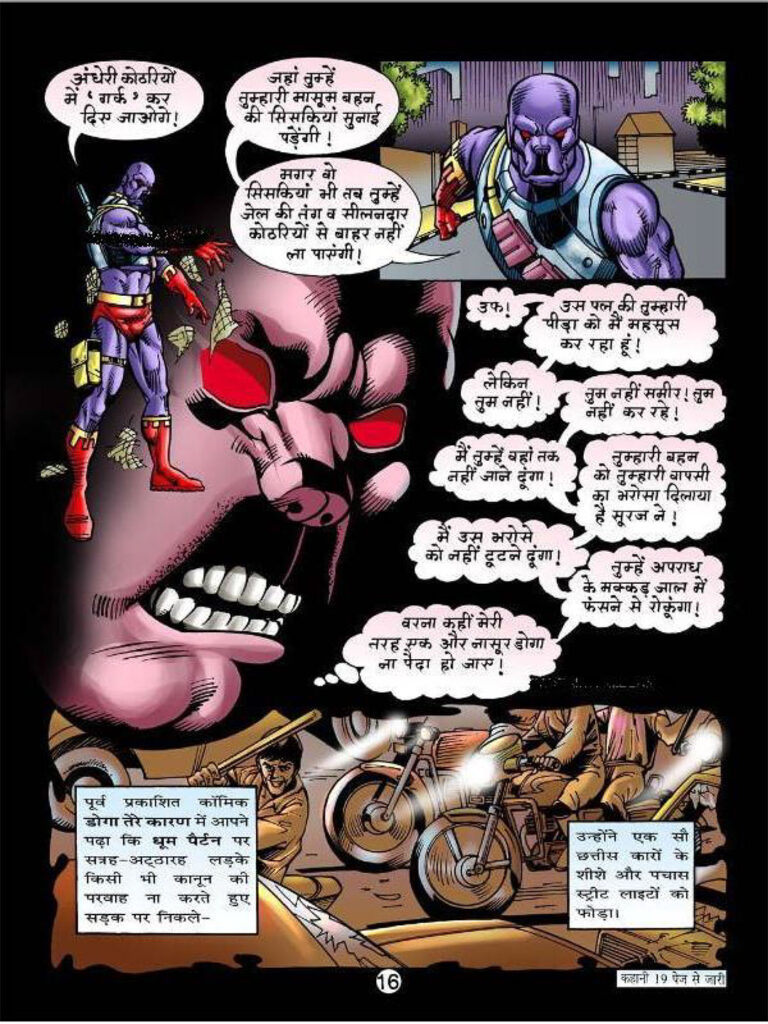
Finally, Big Boss finds out that Sameer has broken his trust — because he killed Killi, Cat and Chilli. After this, both Doga and Sameer (who has now become Canker) fight with Big Boss’ people together.
Doga wants Sameer to stay within the law, but for Sameer the law is long dead.
In the climax, a tremendous attack takes place from a helicopter. Sameer gets badly injured in the fight. Doga, who was also fighting him and trying to stop him, finally saves him and takes him to the hospital.
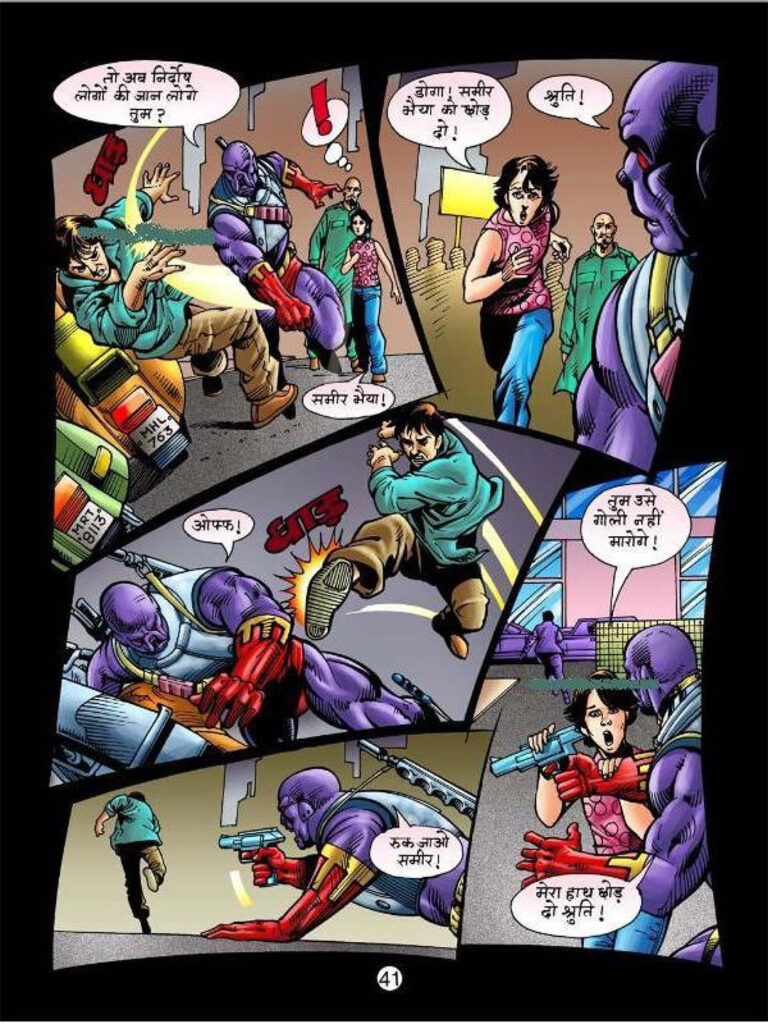
Here the story takes a very emotional turn. Sameer’s sister Shruti sees Doga in the hospital. She assumes that Doga is responsible for her brother’s condition. She curses him and vows revenge.
Doga is misunderstood as always. Without saying anything to anyone, he quietly leaves from there. He knows that he has made another enemy, when his intentions were just to help.
Character analysis
DOGA (Suraj):
A very grit-laced and sensitive form of Doga can be seen in these comics. He is not just a fighter who fires bullets, but he also understands the pain of humans. When he catches Sameer in the truck, he does not try to kill him immediately. He tries to convince him first. Doga understands that Sameer is not actually a born criminal, but a victim of circumstances and the system. This dialogue of his — “Crime is suffered by society and Doga is the criminal… because Doga has sworn to uproot the roots of crime from the same society” — further clears his thinking and his mission.
Sameer (Nasoor):
Sameer is the deepest and most painful character in this story. He is an anti-hero — he didn’t want to be bad, but life and the system pushed him down that path. ‘Canker’ as his anger does not seem wrong, but just. He shows the mirror to the society that when a good person breaks down, he himself can take a dangerous form. Sameer’s love for his father, concern for his sister and the sensitivity hidden inside him make him human and relatable.
Villains (symbols of the system):
The villains of the story — Warden Sher Singh, Body Dada, Big Boss and the corrupt prison superintendent — are not just bad people, but they symbolize the rotten system that has broken from within. The superintendent being exposed in front of his own family is a powerful moment in the story. It shows how civilized and moral corrupt people pretend to be in their homes, but how hollow they actually are inside.
Topics and social messages
‘Canker Dog’ is not just an action comic, but it is like a document that reveals a social truth. Many such issues have been raised in it which show the bitter reality of our society.
The condition of juvenile homes is clearly revealed in this story — how wardens like Sher Singh spoil the lives of children instead of improving them. The story asks: are we putting children on the right path or pushing them deeper into darkness?
The matter of prison reform has also been shown in great depth. The comic shows that prison has now become a school of crime, not a place to reform humans, where even simple humans are forced to live an animal-like life just to save their lives.
The cycle of corruption emerges at many places in the story. Bigg Boss’ father’s story shows that honesty sometimes becomes extremely expensive; an inspector even lost his life for not paying a bribe of Rs 2 lakh. This is the most bitter truth of the failure of our system.
Doga breaking valuables is not just a display of anger, but it is a loud message — that the glitter earned from corruption is not sustainable and has no moral value.
Drawing and Art (Artwork)
Manu’s artwork is the real strength of this comic.
Action scenes — Doga and Canker clash, and finally the helicopter scene — are made in a very powerful and fast-paced manner.
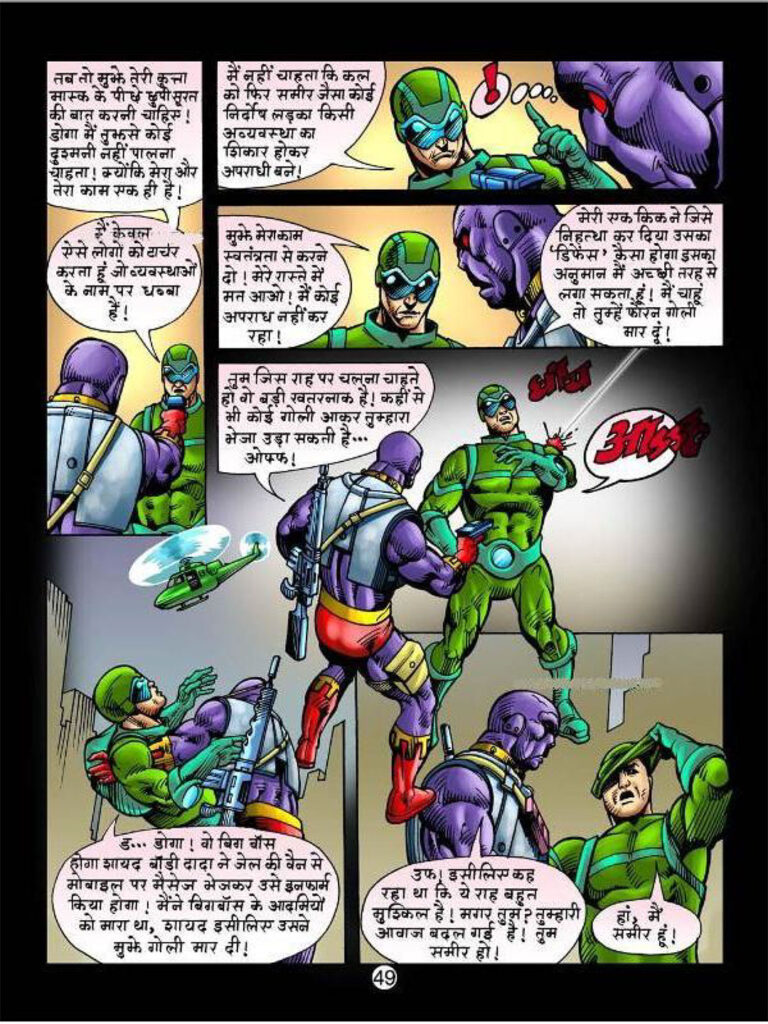
The facial expressions are shown so vividly that you can feel Sameer’s helplessness and anger and Shruti’s fear and hatred.
The atmosphere of the entire comic — the inner darkness of the prison, the truck scene, and the depiction of the streets of Mumbai at night — matches perfectly with the noir mood of the story.
Colors have also been used very thoughtfully. The different tones for the flashbacks, the current dark colors, and the green suit of Canker set him apart from the violet-yellow palette of the visually iconic Doga.
Dialogue and Writing
The pair of Sanjay Gupta and Tarun Kumar Wahi has done an excellent job. The dialogues are tongue-in-cheek and heavy-handed. Some memorable dialogues:
“If a thorn pricks the foot, it has to be removed immediately, otherwise it turns the wound into a canker, which hurts all its life!”
“The tongue doesn’t get words to tell lies honestly!”
“It is true that death takes away all his thinking rights from a person! But one has to think to survive!”
These dialogues are not just lines, but the essence of the entire story. The authors put Sameer’s psychological state into very good words.
Critical Analysis
Positive side:
This is one of those Doga stories where there is a strong emotional connection, not just a fight. Sameer’s character arc is very strong. Readers are able to feel his pain. By not giving the ending a ‘happy ending’ and starting a new conflict (Shruti hating Doga), the story becomes realistic.
Downside (if any):
The flow of the story (Pacing) may seem a bit slowed down in the middle when Sameer narrates his entire flashback story, but it was essential for character creation. Moreover, the character of Big Boss could have been developed a little more; he seemed like a normal villain.
Conclusion
“Nasoor Doga” is recorded as a great story in the history of Raj Comics. It establishes Doga as a defender who not only kills criminals, but also exposes the system’s shortcomings.
Why did Sameer become ‘Nasoor’? This question keeps resonating in the minds of readers after reading the entire comic. “Nasoor” is not just Sameer’s codename, but it symbolizes the “corruption” that is eating away at our society from within. Doga can fight criminals from outside, but this “nasoor” is very difficult to treat.
In the end, Shruti misunderstanding Doga shows how difficult it is to be a superhero. Sometimes you become a villain even after saving everyone’s life.
Rating: 4.5/5
Recommendation: If you are a fan of Doga, or want to read a comic that has a deep social message and emotional drama along with action, “Nasoor Doga” is mandatory for you (Must Read). You will remember this story for a long time.
This comic proves how high the level of stories can be in the Indian comics industry. This is serious literature not just for children, but for mature readers.
