


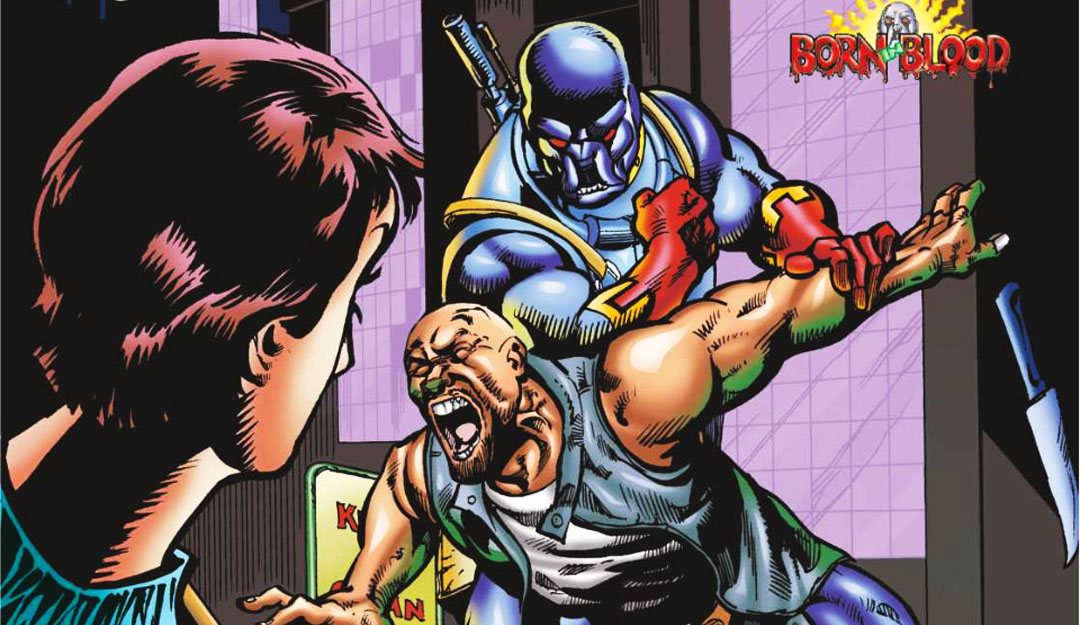
‘Doga’ is a character in the Indian comics world that we know as a true ‘anti-hero’. He acts with more mind and strength than law and order. He doesn’t fall into any courtroom, he does justice directly. And the way to judge him sometimes seems very strict and scary— “rooting out crime.”
But what happens when this harsh method of Doga ruins the entire life of an innocent person? What happens when a promising, straight guy becomes a dangerous criminal because of one mistake by Doga?
“Doga Tere Karan” comic is one of those most deep, emotional and thought-provoking stories from comics. It’s not just action and violence comics— it hits hard on the dual behavior of Doga’s character, our justice system and society. This story itself puts Doga in the dock and asks him—
“Are you God? Can’t you make a mistake?”
When the protector becomes the cause of destruction
Doga’s place in Indian comics has always been completely different from other superheroes. While Nagraj and Dhruv work within their limits, within the law, Doga is a hero who is walking with anger and pain. He is such a protector of the streets of Mumbai who does justice not by the books of law, but by the rules of ‘ammunition’. He has the same principle—
“Crime to be uprooted, criminal to be eliminated.”
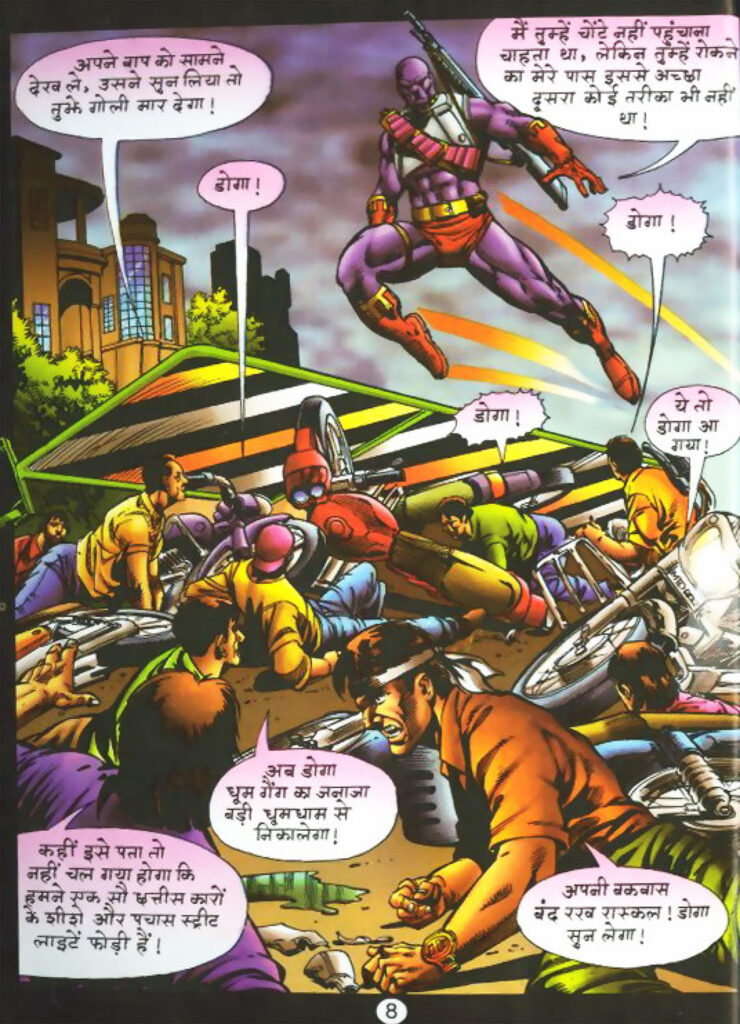
But “Doga Tere Karan” raises a big question on the same principle. This comic is not just action, but a deeply psychological story, which shows that when justice goes blind, it can become more dangerous than injustice.
What happens when Doga’s anger destroys an innocent life?
This comic brings out the same pain, regrets and the tragic journey of an innocent becoming a criminal. This comic is reminiscent of that ‘golden era’ of comics which affects the hearts of readers.
Kathasar (Storyline): An innocent journey to become a criminal
The story begins with a nightmare of Doga’s ‘sun’ form, reflecting the traumas of his past. But the real story starts on the streets of Mumbai.
Dhoom Gang and Doga’s havoc:
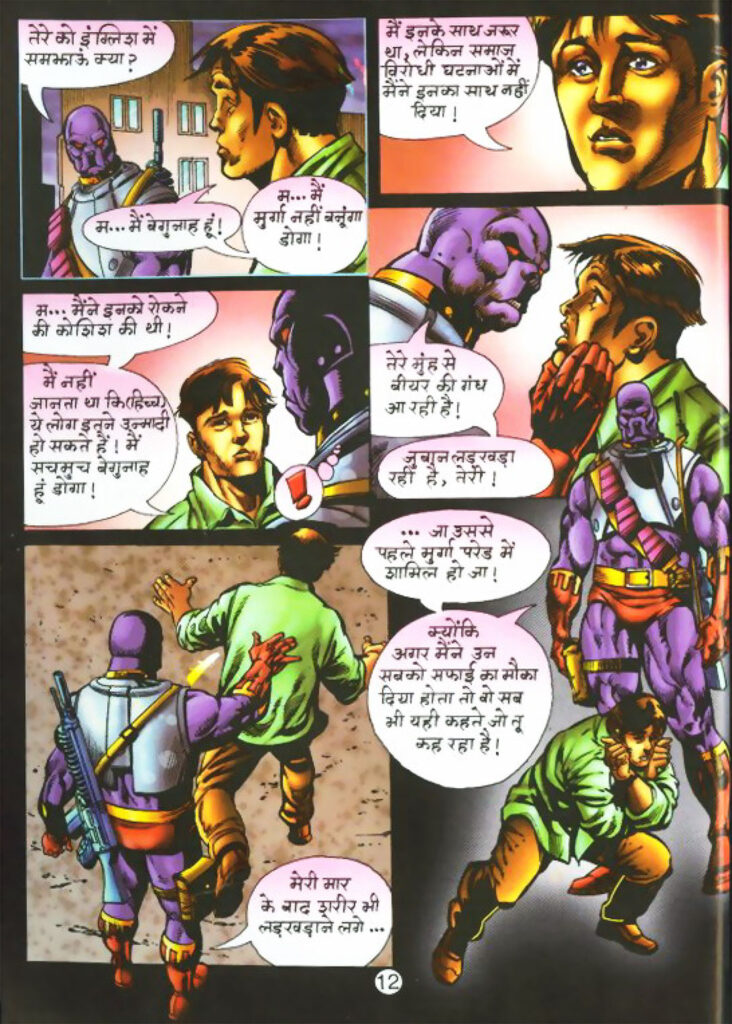
A group of boys in the city, the ‘Dhoom Gang’, go out performing stunts on their expensive bikes, damaging public property and harassing the general public. Doga, who has a strong hatred for indiscipline and hooliganism, comes and threatens to stop them. As usual, Doga wreaks havoc on them without listening to anyone’s arguments. He breaks their bikes and beats them badly.
Sameer’s tragedy:
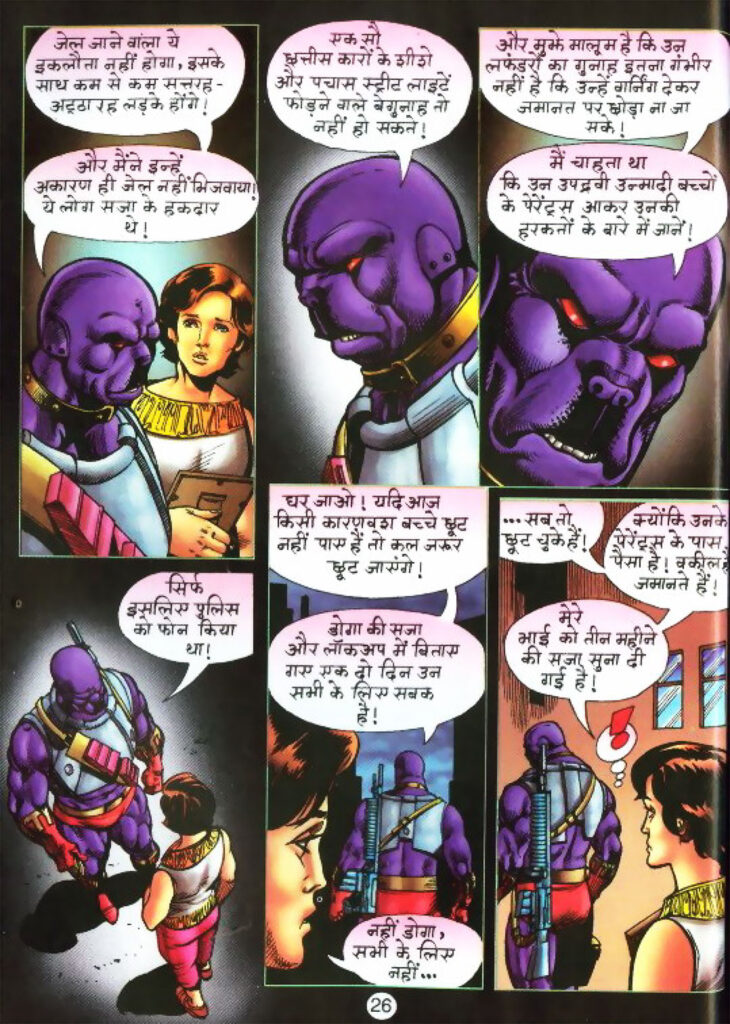
There is a boy among these rich people, Sameer. Sameer is a middle-class, promising and decent boy. He was definitely part of that crowd, but he did not participate in any vandalism. He repeatedly pleads to Doga, “I’m innocent, I didn’t do anything, let me go.” But Doga, who was at the peak of his anger at that time, does not listen to Sameer. Doga believed that “the wheat grinds with the weevil” and that one living in bad company is also a criminal. Doga hands everyone over to the police.
The naked truth of the system:
The most bitter truth of the story comes out in the police station. Rich fathers rescue their spoiled sons within a few hours on the basis of money and influence. Inspector Dattani, who is a symbol of corruption, does not spare Sameer. Sameer is an orphan who is the only support of his younger sister Shruti. He doesn’t have money for bail. His sister breaks her piggy bank and brings coins, but they are not enough.
As a result, the real culprits are freed and the innocent Sameer is sent to jail.
Prison: University of Crime:
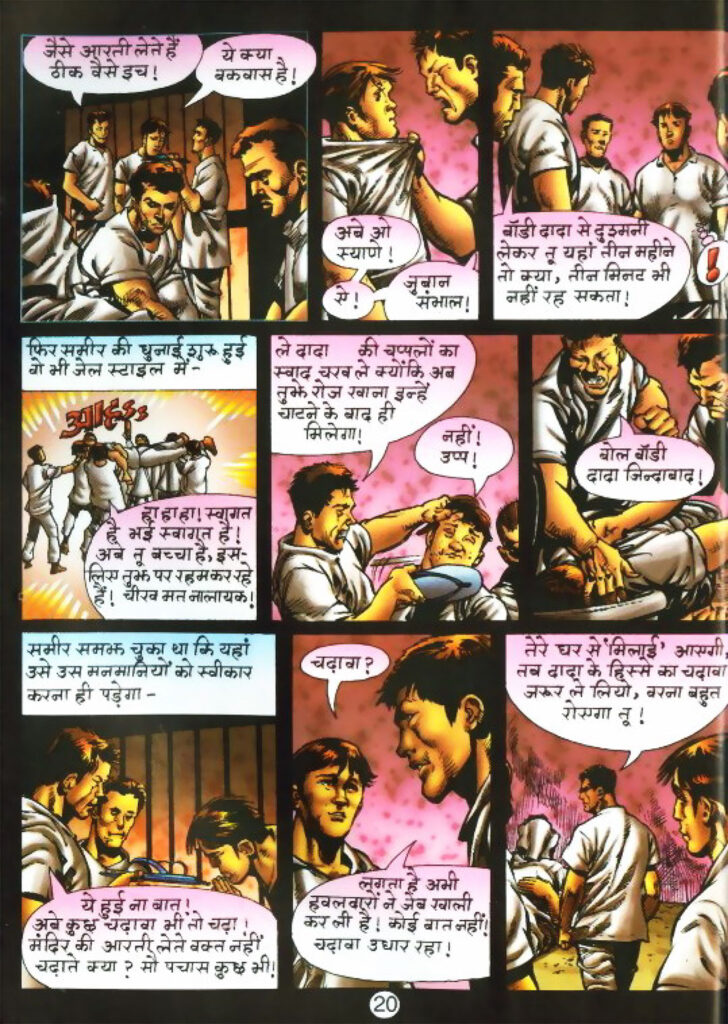
What happens to Sameer in jail is a stain on the forehead of any civilized society. There he is tortured by ‘Body Dada’ and other prisoners. He has to clean toilets, get beaten and be humiliated every moment. This three-month imprisonment kills the ‘human being’ inside Sameer and gives birth to an ‘animal’.
Return and Revenge:
When Sameer is released from jail, the society does not accept him. The landlord has thrown him out of the house. His sister has disappeared. Desperate and angry Sameer is left with only two ways— to eliminate himself or the system that made him this. He chooses the other path. He enters the world of crime by joining a gang called ‘Hulchaliya’. He holds Doga responsible for his ruin and is determined to take revenge on him. He has only one slogan— “Doga because of you!“
Character analysis
The transformation of the characters and their emotional journey in this comic is really amazing.
DOGA (Suraj):
In this story we see Doga at his weakest and most human— not physically, but mentally and morally. Doga always considered himself a kind of ‘god of justice’, but the whole incident of Sameer shakes him from within.
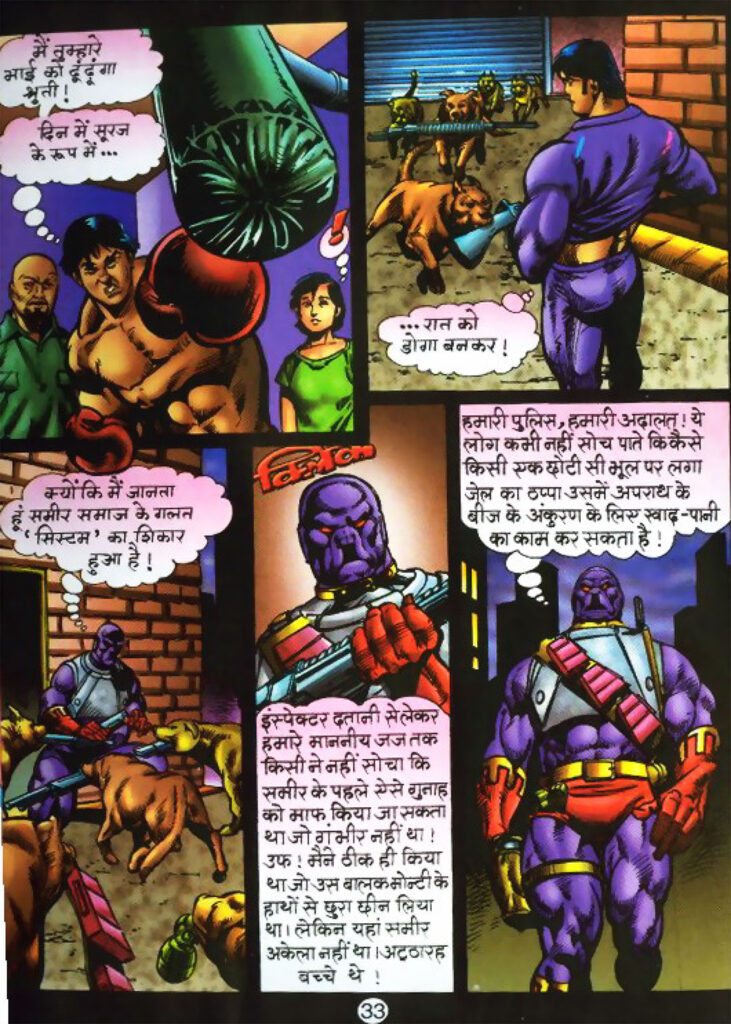
When Sameer tells him about his sister’s loss and being an orphan himself, Suraj remembers his childhood— same pain, same loneliness. He realizes that he also did what happened to him— without hearing he crushed an innocent person.
This regret of Doga makes him more human. He finds his mistake so overwhelming that he wants to fix it somehow, no matter how difficult.
Sameer:
Sameer’s character is a complete tragedy. He was an educated, intelligent and good boy, but circumstances pushed him on the path of crime.
His becoming a criminal was not a hobby or fun— he was a product of compulsion, pain and anger against the system.
The author shows through Sameer that criminals are not born, they are made by circumstances, systems and wrong decisions.
Sameer’s anger seems more justified than Doga at many places, and that is why the reader’s sympathy is drawn not towards the hero but towards the anti-hero in this story.
Inspector Dattani and System:
The story also takes a strong dig at the police and our justice system.
Inspector Dattani is the face of the part of society that flatters the rich and takes out all the anger on the poor.
The whole atmosphere of the prison shows that our prisons have become not reform-houses, but “training centers” where a simple human being gradually becomes a criminal.
Social and psychological aspects
‘Doga Tere Karan’ is not just a comics story, but it is a story standing very close to the truth of Indian society.
It shows how our justice system makes different rules for different people— for the poor the law becomes a spider’s web, in which they get trapped immediately, while the rich easily get away with it.
Sameer’s going to jail and the easy escape of other rich people brings out this bitter reality.
The story also shows how fatal a quick “immediate judgement”, without complete information, can be. This threat of vigilantism is the real message of this comics.
Sameer’s anger feels like the anger of today’s youth— not getting a job even after studying, not getting respect even after honesty… All these together light a slow fire inside.
Finally, the psychology of prison is shown in a very lifelike way.
Sameer has to walk with ‘Body Dada’s’ slippers on his head— this scene feels like the death of his self-respect.
This is the moment when a common, simple boy breaks down from within and turns into a tough criminal.
Art side and portraiture
Manu’s portrayal is the life of this comics. He has made the entire story even more effective through the faces, body language and atmosphere of the characters.
The innocence and fear that initially appears on Sameer’s face later turns into hatred and revenge, and this change is very beautifully shown.
Doga’s mask also shows his regret-like expressions, which Manu has shown in a very subtle way.
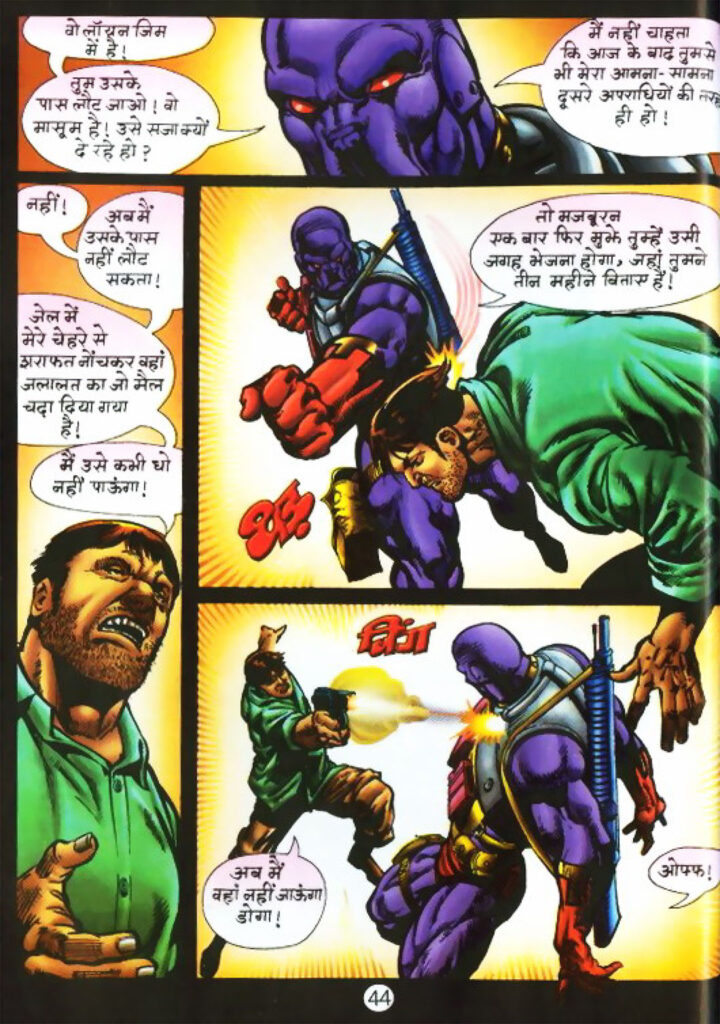
Action scenes are very smooth and dynamic, be it the hijack part or the confrontation between Doga and Sameer.
The paneling is so great that every scene keeps pace and thrill.
Small, tight panels in the prison scenes add to the feeling of suffocation, while wide panels in the larger action scenes allow the story to breathe freely.
And talking about colors, Sunil Pandey’s colors give a dark, serious and emotional tone to the entire story. Especially the night and flashback scenes have become very beautiful.
Dialogue and Writing
Tarun Kumar Wahi’s story and the dialogues written by him are the backbone of this comics. Even after reading many of his dialogues, they keep resonating in the mind.
“Doga’s law is— eye for eye! Hand for hand! Life for life!” This is the line that clearly shows Doga’s anger and his ego.
“I was neither a goon, nor am I now! I had been telling you too that I am innocent! Where I am today, in whatever situation I am, Doga, I am only because of you!” — Sameer’s painful rebuke shakes the whole heart.
“If a child does mischief, his parents also punish him!” — This dialogue reflects Suraj’s thinking, but also how unsuccessfully he was trying to prove his mistake right in front of himself.
The author did not let the story loose anywhere. Every next page brings a new tension, a new emotion or a new confusion.
The scenes between Sameer and his sister are so emotional that even the toughest reader takes a deep breath after pausing for a while. Through these scenes the story makes a place in the heart.
Deficiencies
These comics are really great, but as a reviewer it becomes necessary to point out some small things.
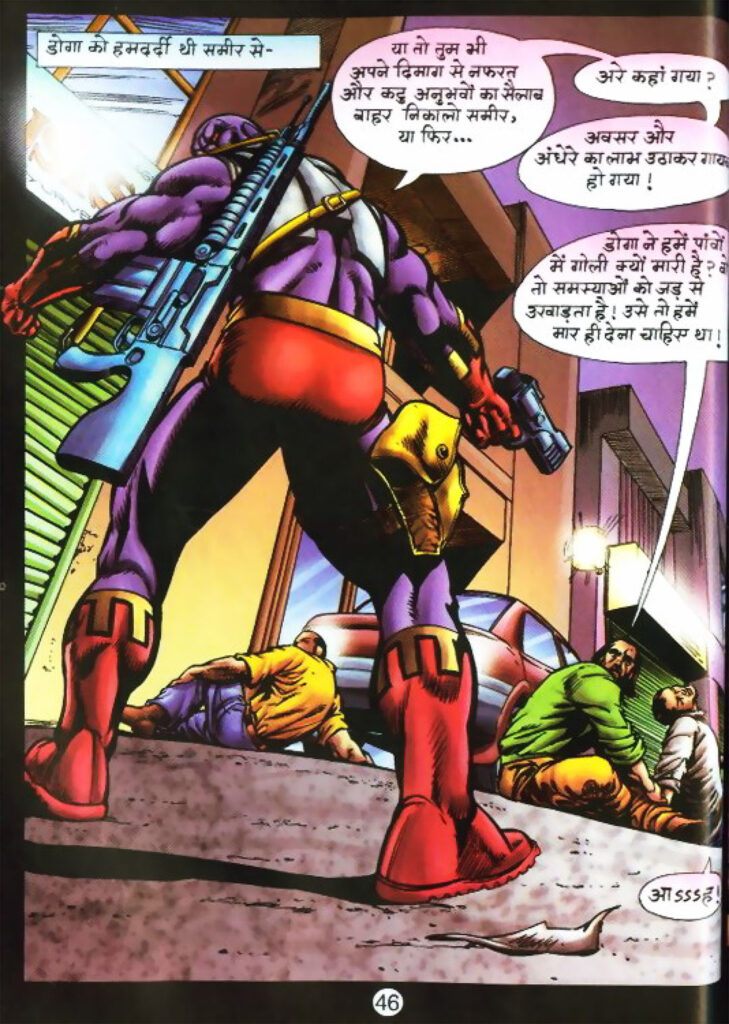
The opening part shows Doga as a bit too stubborn and not listening to anyone. It was necessary according to the story, but still a professional character like Doga, who is expert in reading people’s body language and nerves, could not sense Sameer’s truth at all, it seems a bit strange.
In the end, Sameer jumping into the bus with a bomb and Doga coming to save him seems like a film to some extent. Yes, emotional effects definitely arise, but according to logic this part becomes a little lighter.
Yet all this does not reduce the impact of the story— comics completely holds.
Conclusion
“Doga Tere Karan” is one of those special stories of Raj Comics which not only entertains but also makes one think. This is a milestone where the superhero himself makes a mistake and the boy called ‘Villain’ actually turns out to be the victim.
The story tells that as easy as it is to find strength, it also brings with it a greater responsibility.
These comics are essential for Doga fans, and can also be a great study for those who are interested in society, psychology, and crime stories. It makes it clear that comics are not just children’s time-pass, they can also be a mirror of society.
The story ends on a tremendous cliffhanger— Sameer lies injured and Doga is broken with regret. This ending lays a strong foundation for the next part “Nasoor Doga” and leaves the reader eager to read further.
Final decision:
If you want a story that has powerful action, raw emotions, pricks of truth and creates silence in your mind after reading, then “Doga Tere Karan” is made for you only. It deserves 5 out of 5 stars without a doubt.
Rating: ⭐⭐⭐⭐⭐ (5/5)
Readability: Excellent
Impact: Deep and thought-provoking
