


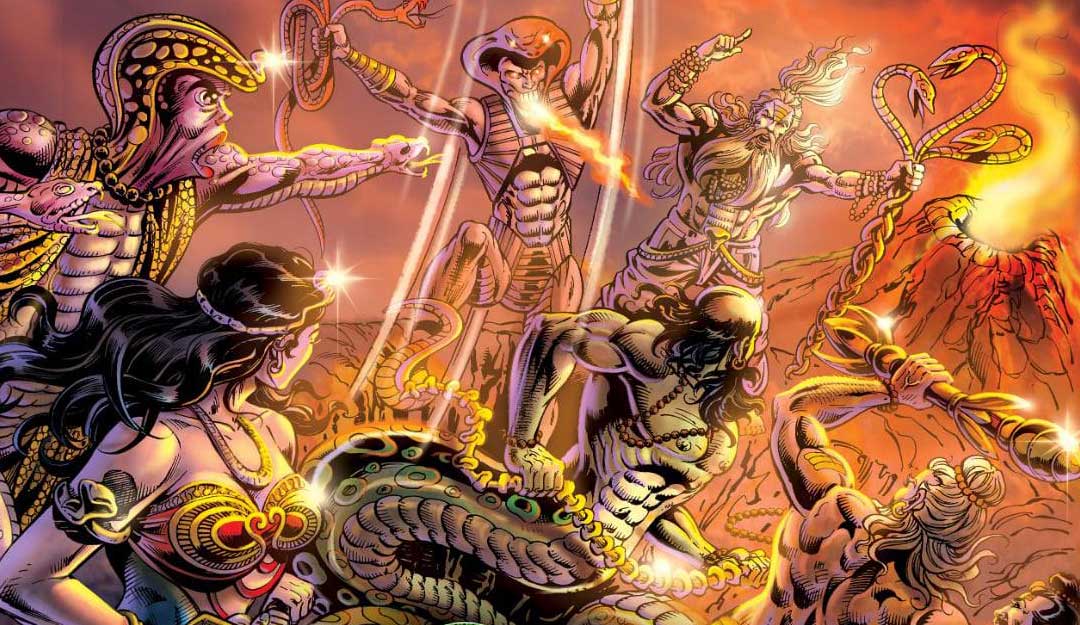
‘Sarpasatras’ presented by Manoj Gupta and composed by veteran storyteller Anupam Sinha is a landmark ‘Mahasangram’ series from the Indian comics world, reviving memories of the golden age of the 80s and 90s in a modern storytelling fashion. The main attraction of this series is the coming together of Raj Comics’ Samrat Nagraj and Tulsi Comics’ Mahabali Tausi on the same ground, which showcases the biggest confrontation and union ever between two different comic universes. Through parts like Sarpasatra, Sarpdwandwa, Sarpyagya, and Sarpayuga, the story not only weaves tremendous action and adventure but also brings out deep global conspiracies, emotional wounds, and misunderstandings between the heroes. Finally, the closing issue of this saga, ‘Sarpkaal,’ brings all these entanglements and mysteries to a logical and grand end. The entire series is a ‘renaissance’ in the history of Indian comics, making the dream of millions of readers come true, where their two most beloved superheroes are seen standing united against a common crisis.
Sarpsatra

“Sarpasatra” presented by Manoj Gupta and written by Anupam Sinha is a very ambitious ‘Mahagatha’ of the Indian comics world. The story is based on the tremendous clash between the universes of Nagraj and Tausi. ‘Sarpasatra’ means the destructive ritual of snakes, indicating its dangerous plot.
The story begins with a legendary cataclysm, rooted in events of the present. Nagraj enters the metropolis during the ‘Sarpat’ attack on Advocate Tirumala, who is shown here weak and struggling with an infection. Meanwhile, powerful warriors like ‘Garla’ and ‘Trimund’ come forward. The story takes a big turn when the powerful snake-man Tausi reaches Earth to wreak havoc in search of his lost wife, ‘Shri’.
Nagraj’s emotional and physical struggles are deeply visible in the portrayal of the character, while Tausi emerges as a powerful ‘anti-hero’. Anupam Sinha’s stunning artwork and subtle details bring the action scenes to life. Tausi’s anger and Nagraj’s helplessness have been highlighted very well through colors. The dialogues have a great blend of science and mythological imagery.
The comic also touches on darker themes such as tampering with nature and the devastating consequences of misunderstanding. Its biggest feature is its continuity with old stories and excellent pacing. However, the plethora of characters may make it a bit complicated for new readers, and the story ends on a larger ‘cliffhanger’. In conclusion, “Sarpasatra” is a new birth of Indian superhero culture, presenting a story at the level of Marvel or DC. This is a ‘must-read’ collector’s item for fans.

When it comes to “Mahasangram” in Indian comics, “Sarpdwandwa” stands out as an example. This is not just a comic, but the saga of two powerful universes—the great union of Nagraj and Tausi. Anupam Sinha has not only created excitement but has also touched emotional depth by bringing these two legends onto one platform.
The background of the story is tense. The protector Nagraj is on his way to death due to infection from “Patal Vish”, while the Patal Emperor Tausi is furious over the disappearance of his wife, Sri (Apsara). Due to misunderstandings, Tausi feels that Nagraj is hiding his wife. Meanwhile, a legal battle is going on between Advocate Tirumala and Nagraj in the metropolis. Visarpi suspects that Tirumala is the Apsara who has lost her memory. When she attempts to learn the truth from the “sceptre”, things get worse.
In characterization, Nagraj’s illness makes him look more human and helpless. Meanwhile, Tausi emerges as an “anti-hero”, whose love is the reason for his anger. Visarpi accompanies Nagraj as a skilled strategist, while Tausi’s robotic companion G-18 adds to the thrill.
At the art level, Anupam Sinha has proved why he is called the “Godfather”. The battle scene atop the subway train gives a lively, movie-like feel. The modern combination of colors highlights the mystery and tension of the story very well. The mythological dignity and vigor of the superheroes are clearly visible in the dialogues.
This comic is a fantastic ‘nostalgia’ for 90s readers. However, it may be a little difficult for new readers to understand without reading the previous part, ‘Sarpasatra’. In conclusion, “Sarpdwandwa” marks the renaissance of Indian comics. It is a dichotomy between two heroes, not just of power, but also of decorum and principles.
Sarpyagya

After ‘Sarpasatra’ and ‘Sarpdwandwa’, “Sarpyagya” takes this Mahagatha to a new peak. Anupam Sinha here not only shows the clash of heroes but also opens a layer of mystery and conspiracies, which succeeds in binding the readers. This part focuses more on mental and strategic warfare than on action.
There are two main ends of the story: Nagraj, infected with underworld poison, is saving his life while trapped in the illusion of ‘Maya Darpan’, while Tausi, on the other hand, is distracted in search of his wife, Apsara. Visarpi has imprisoned Tausi and made him stand in the ‘Nag Adalat’, where the mystery of Advocate Tirumala is deepening. The center of the story is the ‘Yagya’ that Vedacharya is performing to stop the destruction, while villains like Kalachakra and Miss Killer are playing their tricks behind the scenes.
From the point of view of character development, Nagraj’s bravery further improves amidst his helplessness. Tausi’s character is that of a warrior burning in the ‘fire of love’, whose haste traps him. Visarpi emerges here as a just ruler who maintains order even in the absence of Nagraj. G-18’s dedication to Tausi adds emotional depth to the story.
Anupam Sinha’s magic remains intact in art and painting. The fire of the ‘Yagya’, the imagination of the underworld, and the scary scenes of the Maya world are very vivid. The dialogues have a unique confluence of mythological dignity and modern science, like— “Yagya is not just a game of fire, but a sacrifice of will.”
Raj Comics has paid special attention to its printing and packaging, making it a ‘collector’s item’. However, the excess of characters can confuse new readers, so it is necessary to have knowledge of the previous parts. In conclusion, “Sarpyagya” is a glorious journey of love, jealousy, and duty that paves the way for the next part, ‘Sarpayuga’, with a big ‘cliffhanger’. This is an essential experience for Indian comics lovers.
Sarp Yug

The story of ‘Sarp Yug’ is woven between two parallel streams: the mystery of the past and the great war of the present. It depicts the tragic end of the sacred love of Apsara (Shri) and Tausi, where the conspiracy of the villain Jabbar fills Apsara’s mind with hatred for Tausi. This flashback gives the story a strong emotional foundation, connecting readers to the characters’ pain.
At present, the metropolis remains a fierce battlefield, where Tausi and the mysterious ‘Kaaldoot’ face a thrilling encounter of ‘Ashtadhwaj’ powers. On the other hand, Nagraj is struggling with his inner pain and the illusion of ‘Maya Darpan’. Here, his real enemy is not an external villain, but his own infected body and doubt. The ideological clash of sages like Vedacharya and Nagababa adds philosophical depth to the story.
In the characterization, Tausi resembles a ‘Greek tragedy’ hero, who is unwittingly a victim of conspiracy. Apsara’s lost memories are the most important link in the entire series, while Nagraj’s dialogue with Doctor Karunakaran offers a unique confluence of science and fantasy. In the end, the entry of ‘Nagu’ and the ‘fragmentation’ of Nagraj is such a shocking turn that it raises questions about the very existence of the hero.
The pairing of Anupam Sinha and Sanjay Sulania has done wonders in the field of art. The polygonal form of Kaaldoot and the detailing of Tausi’s serpents are amazing. Manoj Gupta’s editing is tight, maintaining a balance between flashbacks and the present. However, the main protagonist, Nagraj, occasionally moves into the background due to the excessive number of characters. In conclusion, ‘Sarp Yug’ is a great achievement in Indian comics that provides a magical experience of love, revenge, and magic. This part leaves tremendous curiosity for the next chapter, ‘Sarpakaal’.
Sarpkaal

‘Sarpkaal’ is the grand finale of this mahagatha, which moves the story forward with the shocking twist of ‘Sarpayug’. While Nagraj has been dismembered as ‘Nag’, Tausi is burning in the fire of anger due to the search for his son Tani and the confusion he has regarding his wife, Apsara. The real player on this whole chessboard is ‘Tantr’, which has turned heroes into enemies through villains such as Kalachakra and Miss Killer.
This final issue not only contains gruesome combat but also resolves emotional aspects such as identity crises and memory loss. Talking about characterization, Nagraj here plays the role of a ‘world protector’ with his intelligence despite his physical weakness. He gives Tausi a sense of truth by sheltering Tausi’s son Tani within his body. Tausi’s character moves from anger to self-realization, offering a mixture of regret and heroism. Tani emerges as the ‘trump card’ of this story, making his mark as a future hero.
In the field of art, Anupam Sinha has once again proved that his pencil creates magic. The depiction of Cobra Valley’s battlefield, flowing lava, and Nagraj’s fragmented form gives a Hollywood blockbuster feel. The color combination by Bhakta Ranjan and Praveen gives depth to the mood of the story, with the fiery red of war and the blue of mystery. The dialogues have the same weight that a grand finale should have; especially the balance of Vedic mantras and scientific thinking (nano chips) during ‘Sarpsatra Yajna’ makes it unique.
The biggest feature of this issue is the logical resolution of all the secrets of the last four parts, the identification of nymphs, and the purpose of the ‘Mechanism’. Nagraj and Tausi fighting side by side is the biggest ‘fan moment’ for readers. The high quality and agile editing of the publication by Manoj Gupta make it a premium experience. However, some readers may find the end of the main villain, ‘Mechanism’, a little brief, but it does not reduce the brilliance of this masterpiece. In conclusion, ‘Sarpkaal’ is a powerful sign of the return of the golden age of Indian comics.
