


Raj Comics gave Indian readers heroes and stories that were completely desi, original, and extremely entertaining. While Nagraj, Super Commando Dhruv, Doga and Bhediya made their mark in the world of superheroes and action, the same publication did a unique and spectacular experiment like the ‘Tilism Dev Series’. In this series, a combination of fantasy, witchcraft, old-time empires and divine powers is seen, which was rarely seen in Raj Comics. There is a very effective and scary part of this special series—’Executed Prince’ (GENL-0269).
The 32-page comics were created by the fine team of writer Meenu Wahi, illustrators Dilip Kadam and Jaiprakash Jagtap, and editor Manish Chandra Gupta. Even today, these comics seem like a window showing not just a story, but a glimpse of the creativity and outspoken storytelling of that era. The name ‘Hanglad Rajkumar’ reflects the full meaning of the story, which is a tremendous confluence of cruelty, magic, and finally emerging bravery.
This review is an attempt to analyze the plot, characters, art, and its deep impact of these comics. So come, let us open the layers of this scary magic.
From passion to genocide
The villain of the story, Prince Digvijay Singh of Dibrugarh, is surrounded by a strange and dangerous passion—an obsession to get a grand fort. “Wherever that fortress is in the world, I will take it,” he says clearly. Because of this passion, he sends a threatening order to Ashvapratap Singh, the peaceful king of Makardhwaj. The special thing is that Digvijay tells about the authority of his ancestors over this fort, which is later accepted by Tilism Dev also. Due to this, the story becomes not just a fight between good and bad, but a contest between right and wrong.

After the king’s refusal, Digvijay’s real ‘executioner’ form comes to the fore. First, he slaughters the common people on a flying horse, and then the next day he kills the army by riding a giant winged flying serpent. In the story, these attacks create an atmosphere of ever-increasing fear, where ordinary fighting skills appear helpless in front of magic and mayhem.
The height of betrayal and terror
When human efforts fail, Princess Divyaprabha takes a wise step, sending a wooden horse like the Trojan Horse as a gift of peace. But Digvijay’s thinking is something else. He sets the horse on fire and also destroys the king’s last hope.
After this, whatever he does gives him the title of ‘Hanglad Rajkumar’. With the corpses of soldiers who died in battle, he erects a “wall of corpses” at the door of the fort. This scene is one of the most remembered and scary moments in the history of Raj Comics. Finally, he forms a magical “ice mound” and holds the entire kingdom captive and imprisons Princess Divyaprabha inside it.
Justice of Tilism Dev and revenge of the heroine
When bravery, cunning, and every human effort go in vain, then divine power intervenes. King Ashvapratap Singh calls his family deity ‘Tilism Dev’. Usually, Tilism Dev only guides, but this time he himself comes forward to end injustice.

Tilism Dev does not send a new hero, but gives a portion of his powers to the imprisoned princess Divyaprabha. This twist completely changes the story. Divyaprabha becomes an extraordinary warrior after breaking her prison—“echo of this storm”—and single-handedly confronts Digvijay’s entire army. This part reflects the same Indian tradition in which women take the form of power in times of crisis.
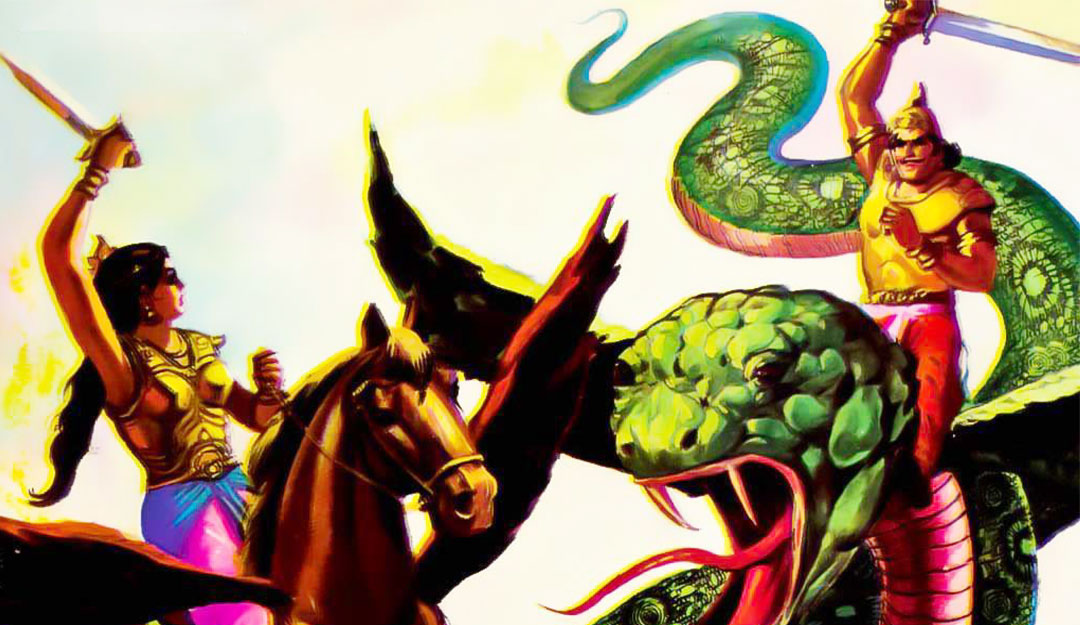
The final climax of the story takes place in the sky. Divyaprabha sits on Tilism Dev’s flying horse, and Digvijay sits on his flying serpent and fights a magical great war. Divyaprabha wounds Digvijay by striking “Himshila” and finally hands him over to Tilism Dev. Tilism Dev puts an end to Digvijay, and peace returns to the kingdom.
Characterization: Good, Evil and Divinity
Rajkumar Digvijay (Executed Prince): He is the main villain of the story—and what a tremendous villain he has been created! He is not just a simple villain. He has a reason (to get back the fort of his ancestors), which may have justified him a bit, but the way he accomplishes his purpose is what makes him a real ‘hangman’. He is ruthless, arrogant, and also armed with magical powers. His character creates both fear and hatred in the mind of the reader, and this is his biggest strength.
Princess Divyaprabha: She is the real heroine of this story. She is not just a ‘Damsel in Distress’, i.e., a weak princess in distress. She is intelligent, courageous, and she also made a plan like the Trojan Horse. And when she gets power, she fights her own battles and takes her own revenge. Giving such an important role to a female character in the 90’s and making her the hero of the final battle of the story shows the forward thinking of writer Meenu Wahi.

King Ashvapratap Singh: He is a simple, noble, and peace-loving king. He loves his subjects and is ready to do anything for them. His helplessness and sadness bring an emotional depth to the story, allowing readers to automatically connect with him.
Tilism Dev: He is like the guiding force of the entire series. He’s a kind of ‘Deus Ex Machina’—a character that suddenly appears and brings a solution. However, he does not jump straight into battle, but gives strength to the heroes and encourages them to fight on their own. His character is reminiscent of the sages and gods of Indian mythology, who show the right direction to protect religion and justice.
Art and Painting: The Magic of Dilip Kadam
The art of Dilip Kadam and Jaiprakash Jagtap is the real life of this story. This work shows in all splendid fashion that particular style of the 90’s of Raj Comics, where action panels come alive with fun and loud sound-effects like “Muchchaak”, “Dhadak”. The scenes of fencing, fighting, and massacre are shown without any hesitation, with full intensity, especially the horror of the “wall of corpses” leaves a different impression in the comics.

The spectacular design of flying horses and especially winged flying snakes deepens Digvijay’s scary image. Emotions like anger, fear, sadness, and bravery are engraved on the faces of the characters in a very clear and impressive manner—Digvijay’s cruel smile and King Ashvapratap’s helplessness have been captured brilliantly by the artist. Bright colors like red, blue, and green give the whole story a strong fantasy atmosphere, seeing which the same old comics magic is felt again.
Writing and dialogue: The wonder of Meenu Wahi’s pen
Meenu Wahi’s writing is the backbone of this comics. The biggest thing is that the pace of the story does not slow down even for a second. While a 32-page story, it contains passion, warning, attack, counter-move, betrayal, and the magical war of the end, all in a very fast and effective way.
The short, fast, and powerful dialogues of the story add to its thrill—
“Threats scare cowards”,
“If I don’t find the fort, I will come again tomorrow”,
And
“Get out! No one can save you from my hands today!”
Such dialogues give a completely cinematic feel to the story.
The author showed no hesitation in showing violence and cruelty, killing innocent people, burning soldiers alive, and building a wall of dead bodies… All this was quite bold for that time. The same things give the story the appearance of a true ‘dark fantasy’.
Conclusion: A classic that is still relevant today
‘Jallad Rajkumar’ is such a Kohinoor from the treasury of Raj Comics which is a little covered with the dust of time, but its shine has not diminished even today. This story is straightforward and simple, but leaves an impact so deep that the reader remembers it for a long time. It also explains to us that no matter how good the motive is, if the way to get it is wrong, the human becomes not a hero, but an ‘executioner’.
In this comics, Princess Divyaprabha comes across as a strong female character—who fights for her kingdom and her honor herself. The divine intervention of Tilism Dev gives this story the color of a beautiful Indian fantasy, as found in our mythological stories.
Overall, ‘Jallad Rajkumar’ is not just a 32-page reading, but a sign of the creative energy and imagination of the 90’s that gave Indian comics its own identity. This is a story that you read once and then cannot leave till the end. If you are a fan of Raj Comics, or interested in Indian fantasy stories, then these comics must be in your collection. It’s truly a timeless classic.
