



Here is a detailed review of the exciting comic “Kalkoot” by Raj Comics’ veteran hero Bhokal. This review has been written keeping in mind the story, illustrations, characters and its mythological significance.
Comic Review: Kalkoot (Bhokal) – Raj Comics, Publisher: Raj Comics, Series: Mahabali Bhokal
Author: Sanjay Gupta, Editor: Manish Gupta, Illustration: Dilip Kadam, Publication Year: 1997 (Double Action Year)
Beginning of a great story
The comic “Kalkoot” we are talking about today is one of those classic stories of Bhokal which is a brilliant mix of mythology, fantasy and tremendous action. The comic, which came out in 1997, not only shows Bhokal’s heroism but also reveals that when evil reaches its peak, the divine powers also accompany truth and justice. Writer Sanjay Gupta and artist Dilip Kadam have done amazing work in this comic.
Mountain of Destruction
The story begins with a very grand and thought-provoking scene. The creator of the universe, the gods themselves, are discussing who is the “best” among the millions of people on earth. The eyes of the gods finally stop at Bhokal. According to them, courage, mind and right behavior in Bhokal are a perfect combination of all three. That’s why they consider him the possessor of divine weapons.
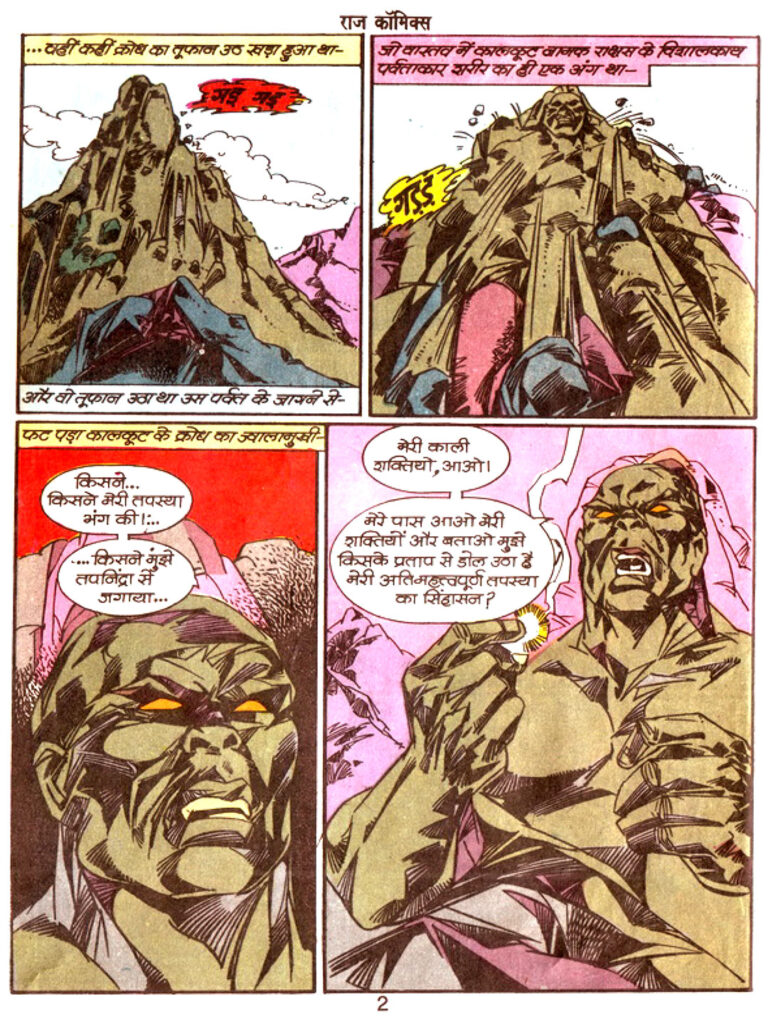
But as soon as the gods bless Bhokal, a new trouble awakens on earth. A quiet, huge mountain suddenly comes alive. This form made of stones and rocks is not a simple thing, but a terrible great-monster named “Kalkoot”. Kalkoot’s awakening is not an ordinary incident, but the result of his anger. Someone has broken his penance of thousands of years, and now he is burning in the fire of revenge.
The first major turning point of the story comes when Kalkoot starts showing his strengths. He is not just a giant stone demon; he has the power to change nature as per his wish. He can create storms, shake the earth and create scary creatures.
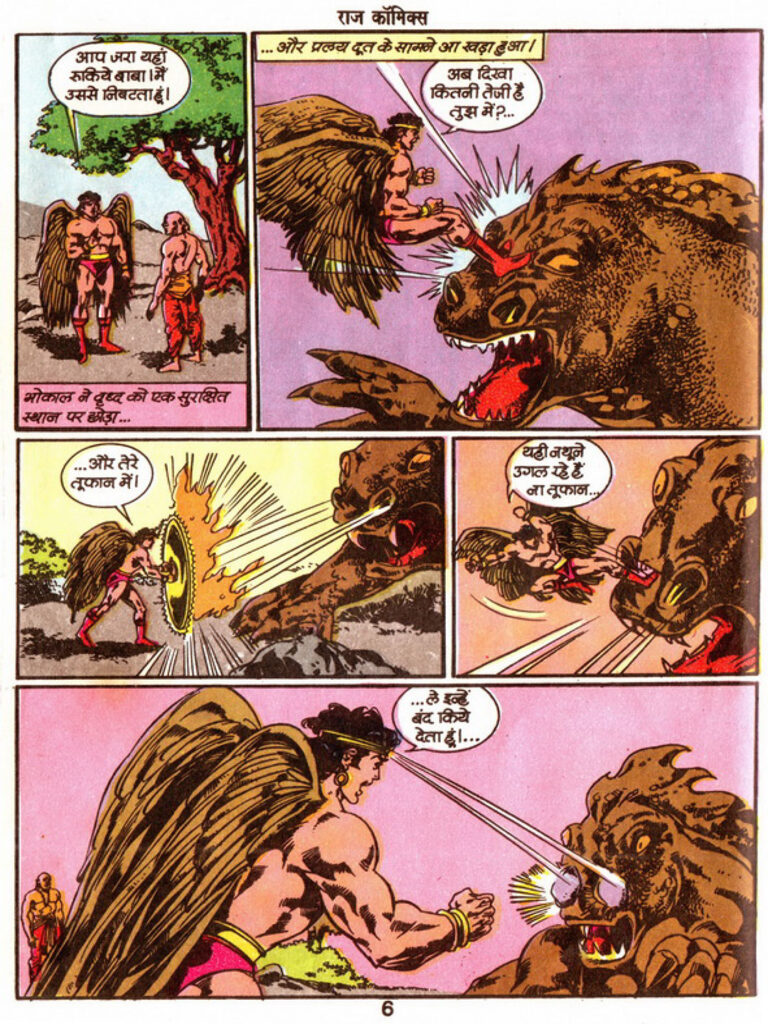
On the other hand, Bhokal, who is protecting the Bhil clan in the nearby forest, sees the devastation caused by Kalkoot. Bhokal’s first encounter with Kalkoot makes him understand that this battle cannot be won by sword and shield alone. The size and power of Kalkoot are many times more than those of Bhokal. Apart from this, Kalkoot also has dangerous help like ‘Kalbhujang’ (flying snake-monster) and ‘Kal Kankar’ (stone soldier), which makes him almost invincible.
Another turning point of the story comes when a mysterious old monk — Pavanacharya — comes to help Bhokal. This sage tells Bhokal that Kalkoot has received a boon from the severe penance of Mother Kali, due to which his body has become unbreakable like a thunderbolt.
The thrill of the war increases when Kalkoot turns the forest river poisonous. Due to this, more innocent tribespeople and animals start dying. Here the author has made very beautiful and emotional use of Indian mythology. When things start to get out of Bhokal’s control, Mahabali Hanuman is invoked. The arrival of Hanuman ji and the mention of the Sanjeevani herb give a different spiritual height to the story.
Ultimately, after a tremendous and exhausting battle in which Bhokal has to make full use of both his understanding and strength, he puts an end to Kalkoot and his demonic powers.
Character analysis
Mahabali Bhokal:
In this comic, Bhokal is shown not just as a warrior, but as a true protector and devotee. When he realizes that his physical strength is falling short in front of Kalkoot, he does not show stubbornness or pride. He listens to Pavanacharya and remembers Hanuman ji in times of crisis. This shows his humility.
He also has the power to fly (which here seems to be associated with some magical shoe or feather) and a sword like ‘Prahara’, but his real power is his “never-say-die” stubbornness and courage.
Kalkoot (villain):
Kalkoot is one of the most unique villains of Raj Comics. He is not a flesh-and-bone man, but a living mountain. His character creates fear. His arrogance and anger make him even more destructive. Instead of just making him look bad, the author has also explained that penance gave him powers, but he misused them.
His attacks are also of different types, such as throwing mud from the mouth, raining stone balls, and changing the weather.
Supporting characters (Pavanacharya and Hanuman):
Pavanacharya is a symbol of knowledge and experience in the story. He shows the right path to Bhokal. Whereas the entry of Lord Hanuman is like a “trump card” in the story. Only when it seems that everything can end now, the arrival of Hanuman ji gives new hope. This moment further strengthens the religious connect of Indian readers.
Illustration and art (Artwork and Illustrations)
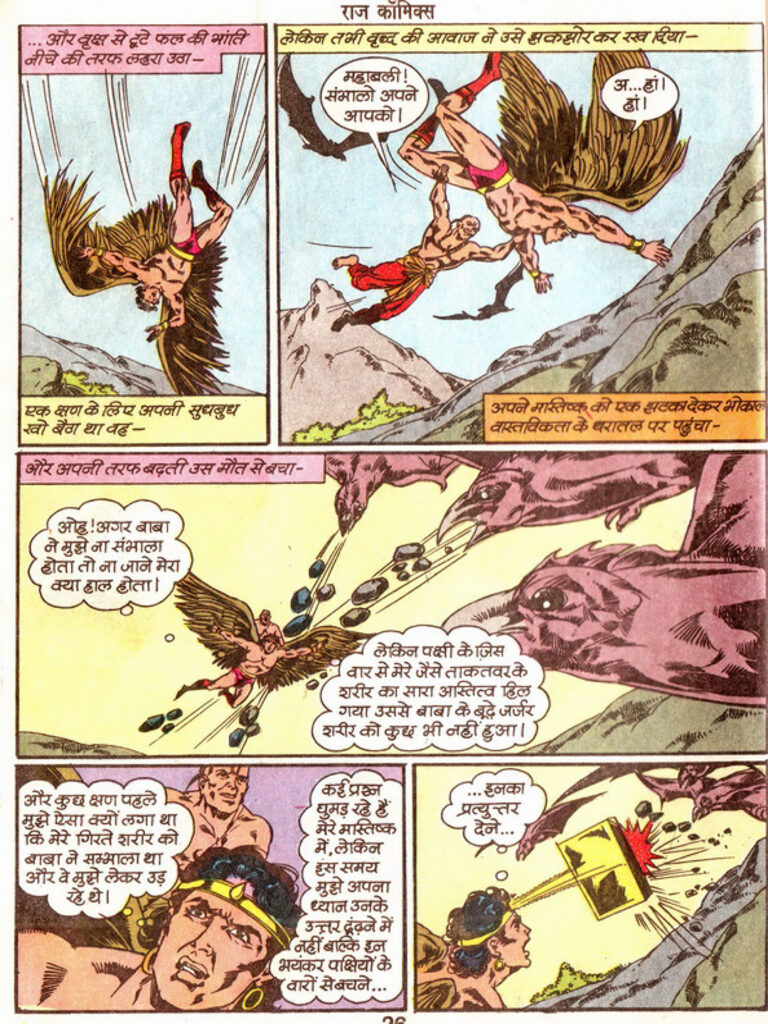
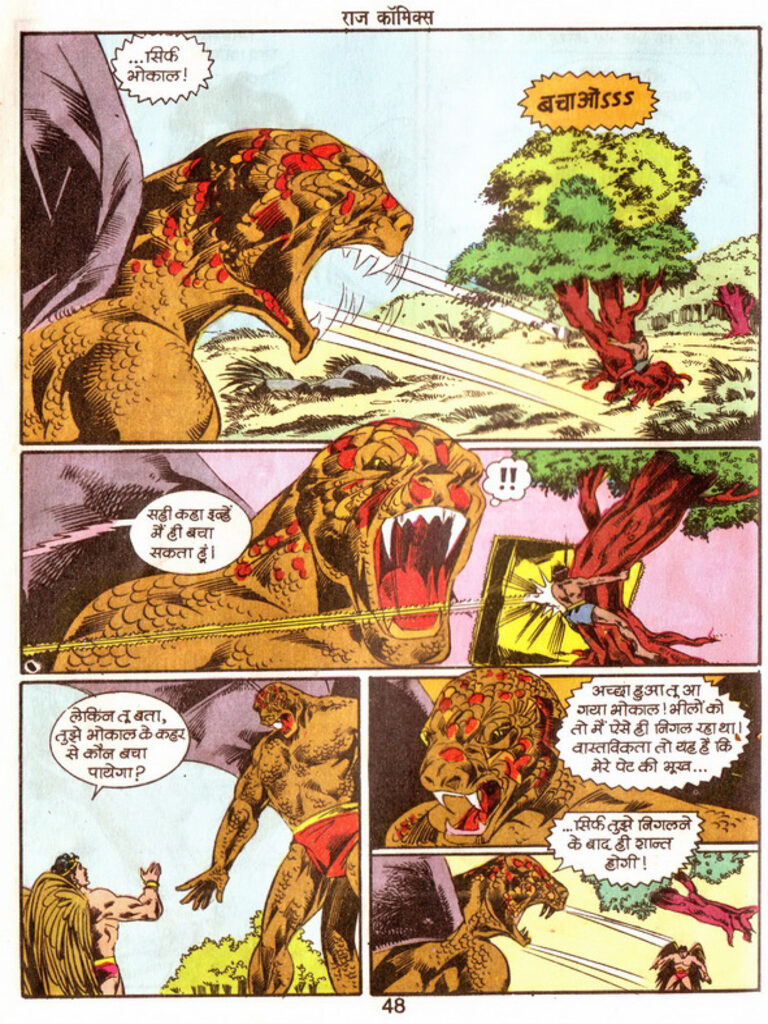
The scenes of the fight between Bhokal and Kalkoot are amazing. On pages 25–28, when Bhokal avoids Kalkoot’s blows in the air and immediately counterattacks, you really feel the movement. It seems like the panels are moving. Dilip Kadam has used spectacular angles to show the huge size of Kalkoot. When Kalkoot stands in front of Bhokal, Bhokal really looks like a small ant. Due to this, both the danger and strength of the villain are felt many times more.
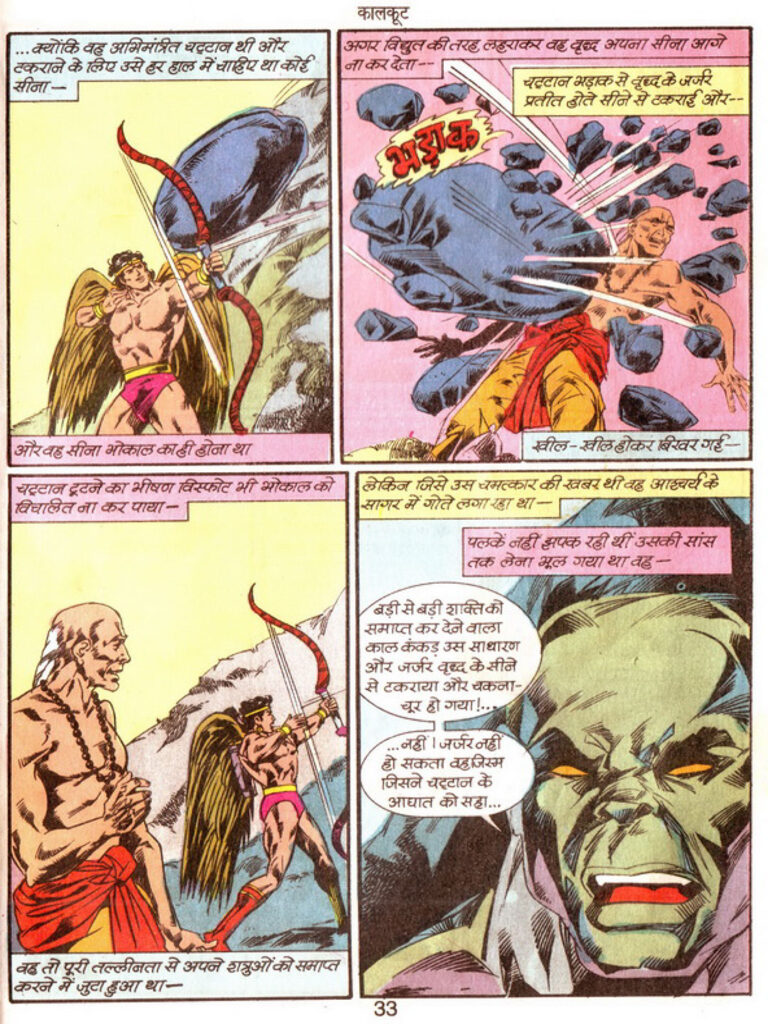
The colors are very bright and nice for the 1997 printing. Kalkoot is shown in muddy and brown colors, while Bhokal is given more bright colors, which makes the difference between the two characters instantly understandable. The views of forests, mountains and sky are also very detailed. The confidence on Bhokal’s face, the fear on the faces of the Bhils, and the cruelty on Kalkoot’s face — all these are shown in a very lively manner with lines and shading.
Writing and Dialogue
Sanjay Gupta’s writing has always been tight and effective.
Dialogues:
The dialogues in this comic seem a bit dramatic and heavy, which was typical of comics of that period. Like Kalkoot’s dialogue — “Who broke my penance? Who woke me up from my trance?” — directly creates fear in the reader. Bhokal’s dialogues are full of bravery and confidence.
Narrative Flow:
The pace of the story is great. There is a fun dash of mystery and action from the beginning and it lasts till the end. Nowhere does the author let the story slow down or get boring. After a few pages, a new problem, such as a hemisphere-like creature or poisonous water, comes to the fore, which keeps the reader continuously connected.
Incorporation of mythology:
Adding elements like ‘Brahma’, ‘Kali’, ‘Sanjeevani Booti’ and ‘Hanuman’ to the story was a smart move. With this, the story not only remains fiction, but also becomes deeply connected to Indian culture and mythology.
Critical vision
Positive side:
Unique Villain: Making an entire mountain a villain was a very creative idea. It felt completely different from ordinary monsters.
Religious touch: Hanuman ji’s arrival gives a great twist to the story like ‘divine intervention’, which is very much liked by Indian readers.
Action: The whole comic is full of nonstop action. Sword fighting, air combat and magical forces have been used extensively.
Downside:
Lack of logic: In some places logic seems weak. Like Kalkoot was so powerful that he could have finished everything in a moment if he wanted, but instead of killing Bhokal, he keeps scaring him or giving long speeches. It sounds like classic villain syndrome.
Dependence of Bhokal: In the middle of the story, it seems that Bhokal is more dependent on external help (the sage and Hanuman ji) than on his own strength. Although in the end he proves his ability, in between he looks a little weak and helpless.
Conclusion
“Kalkoot” is a very important part of the history of Raj Comics. This was the period when comics were being written not just for children, but for people of all ages. Dilip Kadam’s excellent artwork and Sanjay Gupta’s tight story make it really a ‘must read’.
This comic also teaches that pride in power brings destruction (Kalkoot), while using power with humility (Bhokal) does good to people. It also assures that even a big crisis can be avoided with patience, courage and devotion.
If you’re a fan of 90s comics, this comic will leave you nostalgic. And if you are a new reader, it will show you how strong and culturally deep the roots of Indian superheroes are.
Final decision:
It is a powerful, action-packed story with the right mix of fantasy and mythology. This is a collectible issue for Bhokal fans.
Rating: 4.5 / 5
