


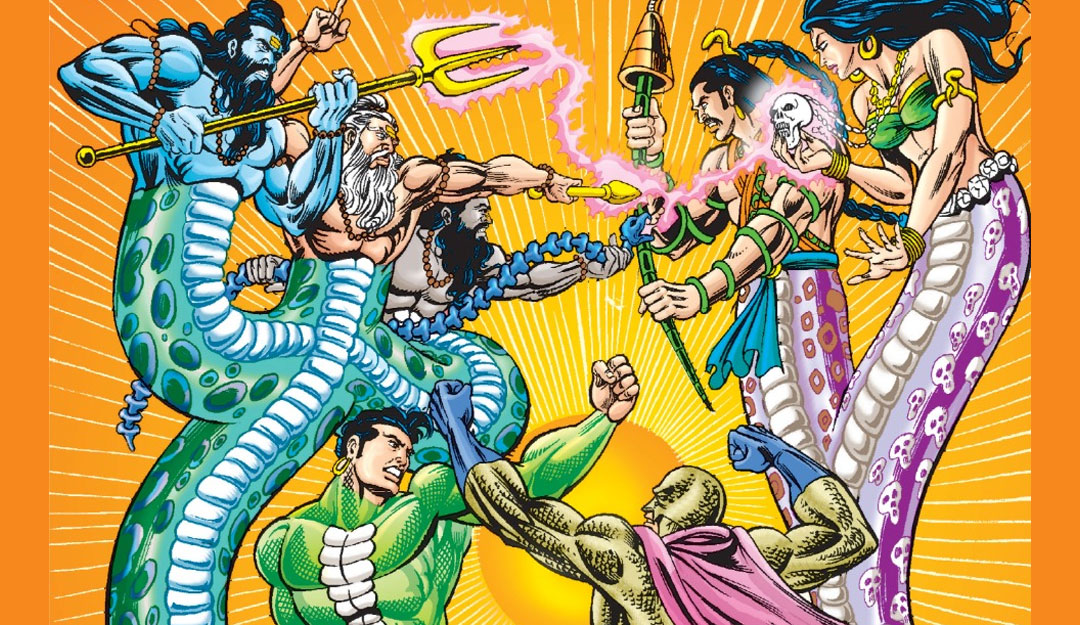
Raj Comics’ ‘Treasure’ series three issues – ‘Death Penalty’ (#202), ‘Nagdweep’ (#206), and ‘Trifna’ (#211) – followed by ‘Mahayudh’ (#213) is the last and most important part of this entire mahagatha. At the end of ‘Trifna’, the king created by Nagpasha was thrown into a future in an old and weak condition by Triphna using the power of the Trikal gems, where the destruction of the post-nuclear war had spread. The story of this issue starts from there. Here Nagraj has to fight his aging body and weakness on one hand, and also confront future enemies armed with high-tech weapons and Triphna who has disturbed the balance of time.
Writer Jolly Sinha has put this climax at the highest stake. This comic is not just a physical battle of Nagraj, but a tremendous confrontation between the journey of time, mythological elements, Tantra-vidya and science. Anupam Sinha’s artwork touches a new level here. He shows the mythological ‘Mortalok’ and a ruined ‘future’—two completely different worlds—with amazing grandeur and detail. This issue is also memorable in the Indian comic world because here a superhero wins not with his power, but with his wisdom, intelligence and sacrifice.
Future destruction and old Nagraj’s mental struggle
The great war begins in a broken, radiation-ruined future world. Nagraj, with his age and almost exhausted powers, is surrounded by enemies carrying high-tech weapons. He understands that he cannot defeat them with force, so he uses his brain.
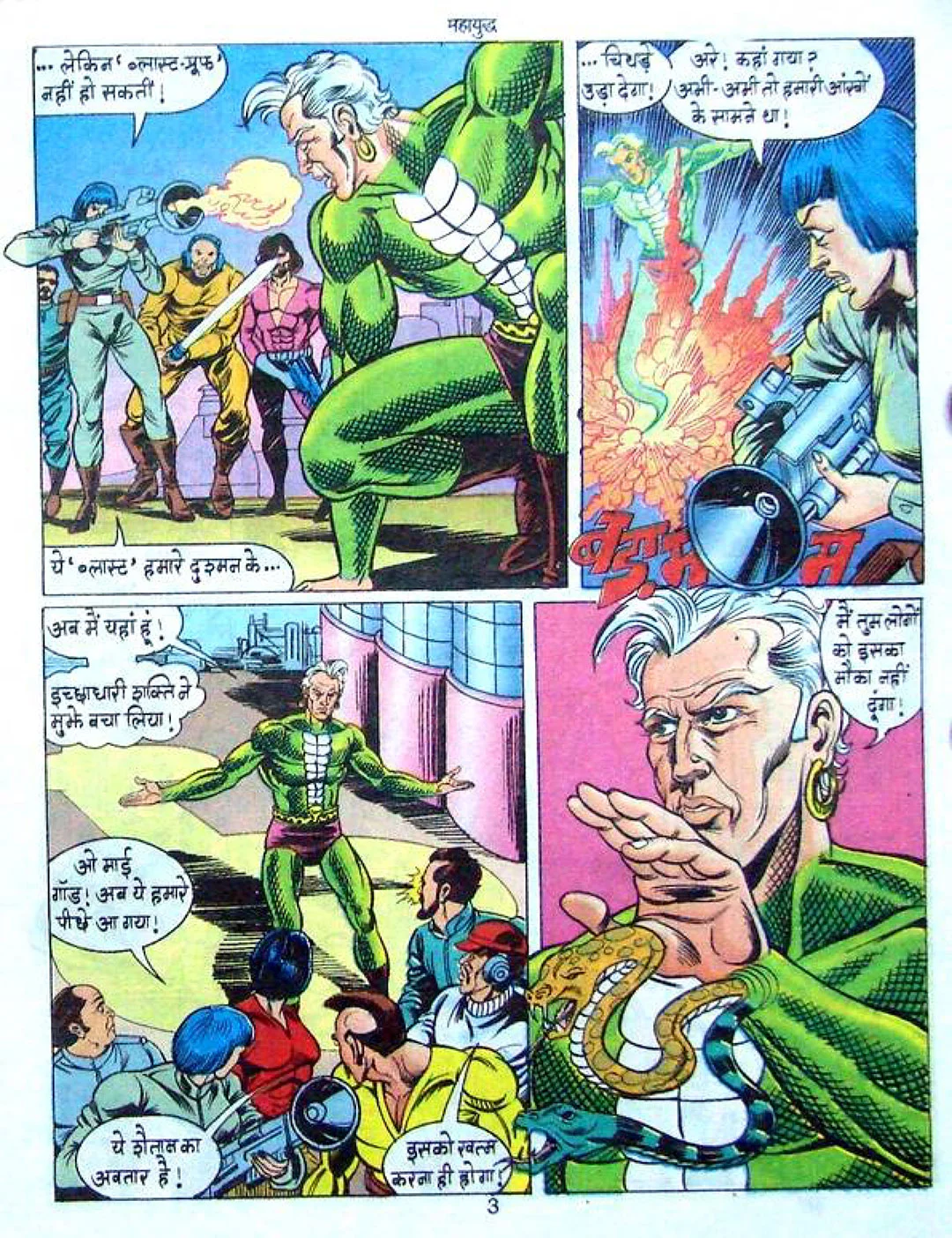
Understanding of weapons: The enemies’ ‘cutting-beam’ (Cutting Beam) he turns against them, and takes advantage of their weapons not being ‘blast-proof’ so that they themselves get killed.
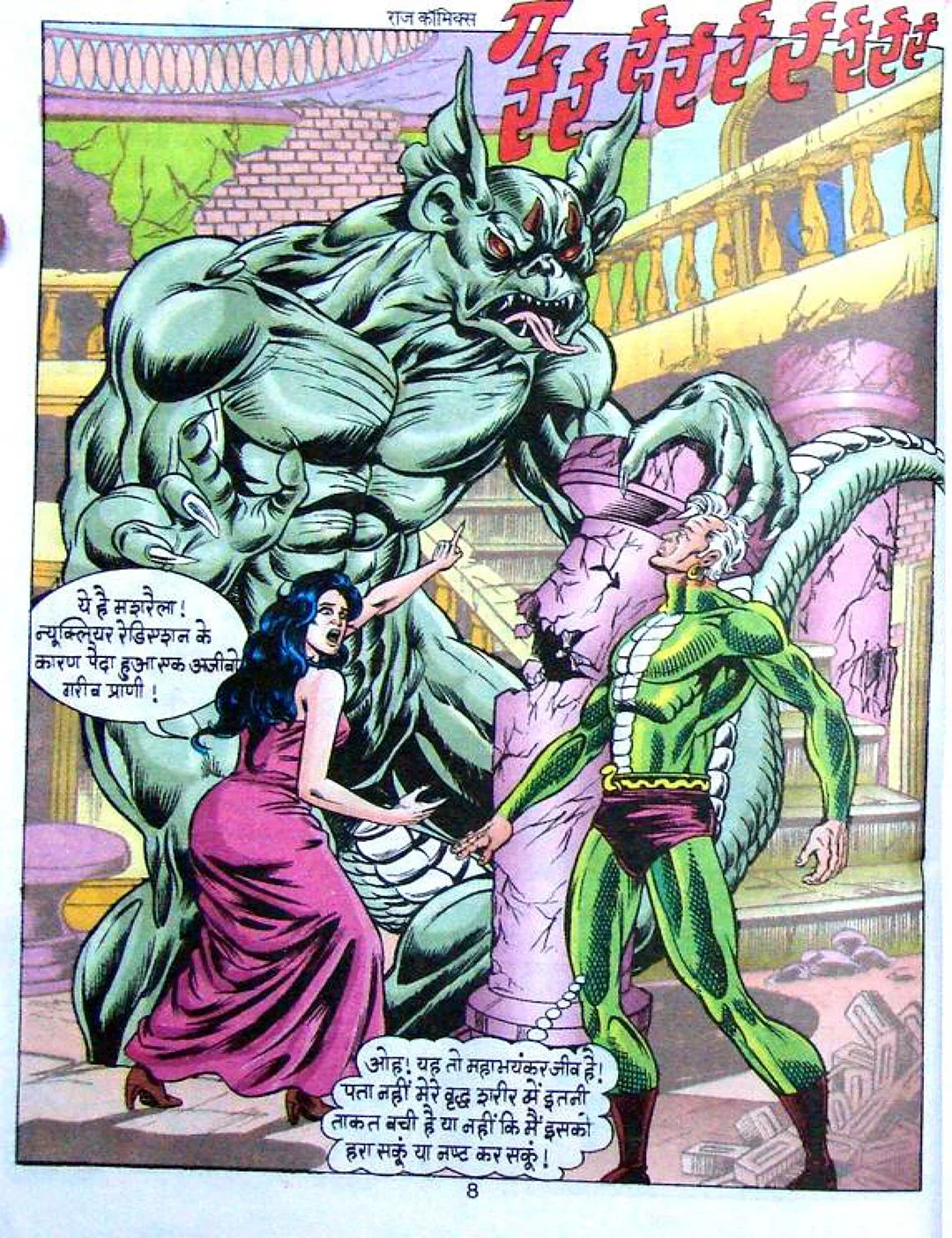
Mashrela panic: Nagraj learns that this future world is terrorized by a demon born from radiation named ‘Mashrela’. People sacrifice themselves every day to pacify this demon. Nagraj decides that he will eliminate Mashrela, even if he loses his life.
Use of particle power: Nagraj cannot kill Mashrela with his normal snake powers. So he uses his willpower for the last time to turn himself into particles and enters inside Mashrela’s body. There he discovers that Mashrela’s blood cells are filled with nuclear energy, slowly burning his particles.
The End of Mashrela: The Victory of Science and Sacrifice
Nagraj does not give up even after getting trapped inside Mashrela’s body. He confuses the giant and delivers a direct and final blow to his heart with his hawthorn serpent (Naagphani Sarpa). Just at that moment Mashrela ends. As soon as he dies, future people consider Nagraj an ‘avatar’ and start worshiping him.
But this victory of Nagraj does not last long. The missile with a neutron bomb sent into space by Gurudev and Nagpasha returns and now its target is the remaining civilization of this future. Nagraj is unable to stop it due to his infirm state.
Nagpasha’s deceit and Triphna’s balance
The main root of the story is to fix the balance of Triphna, which Nagpasha (who has now become the emperor of all three periods) has upset due to his ambitions. Nagpasha plans to seize the power of the gods by controlling Triphna (p. 49).
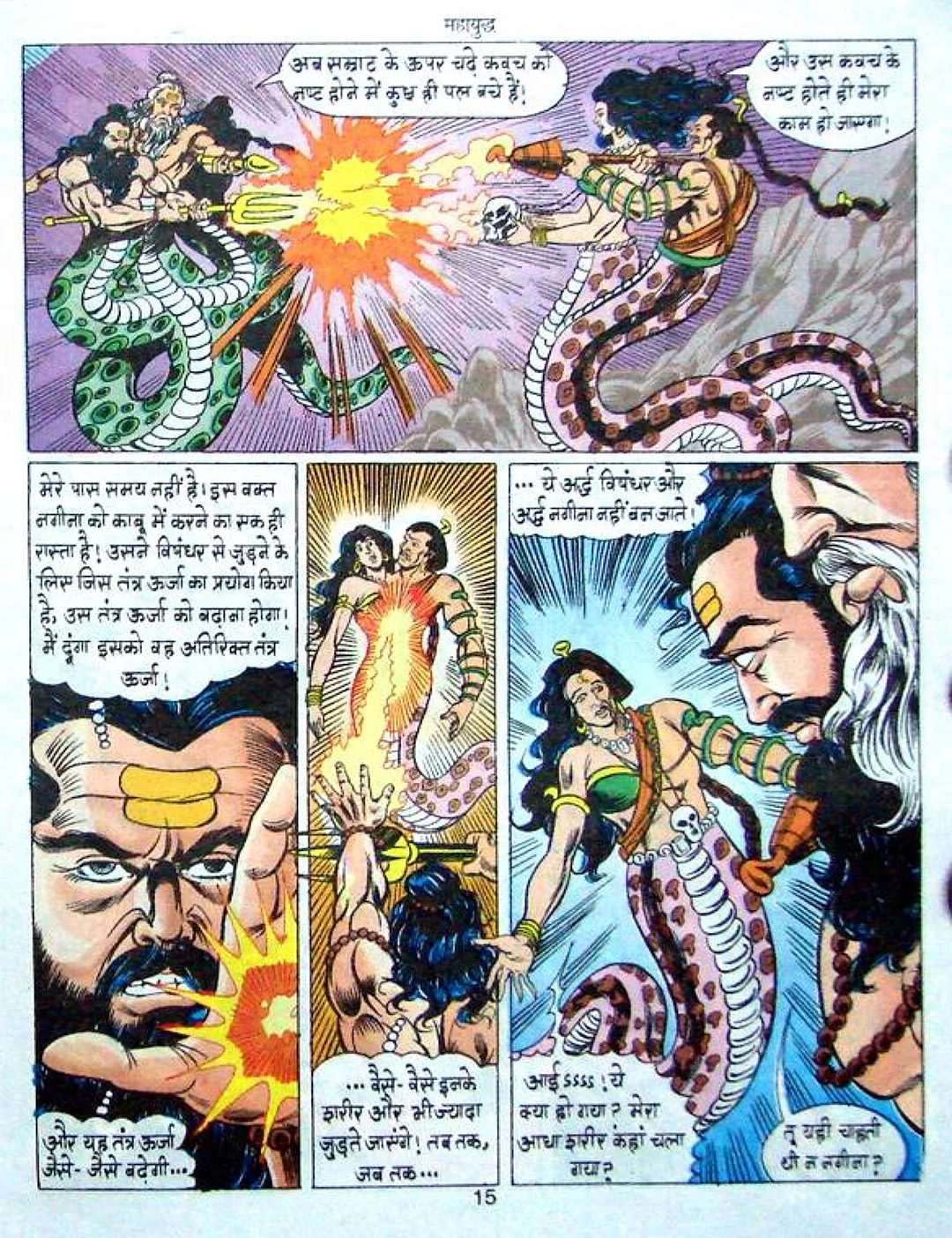
Triphana (the power of time) is connected to Nagapasha and Kaaldoot (which is now under Nagapasha’s control). Nagraj learns from his Gurudev that only the ‘future-mani’ can cut Triphana, which is installed on the forehead of ‘Honi Sarpini’ (p. 54).
Honi Sarpini and the journey of time:
Nagraj, with the help of Honi Sarpini, travels to the mortal world, where he has to work beyond the rules of time—past, present and future—(p. 38). In the mortal world he encounters ‘Death’, which swallows hungry souls. With the guidance of Honi Sarpini, Nagraj controls Death.

The biggest secret of this journey of Nagraj comes to light when he realizes that the balance of Triphana can be brought back only when the future-mani and the past-mani collide (p. 57). Both these gems are on Triphana’s head only. Nagraj uses his willpower and collides the two gems. This causes a kind of ‘short circuit’ and blows the fuse of Triphana (i.e. the flow of time).
Final results and restorations:
Nagraj and the missiles are absorbed into the time-stream as Triphana is deactivated and then return to the present (p. 37). Nagpasha’s entire plan collapses and he is forced to lay down his arms in front of Nagraj.

The story ends with a quiet but deep learning:
• Nagraj accepts his ‘aged’ form as a warning of the future.
• He understands that the real power lies in courage and intelligence, which takes him out of the trap of ‘Triphana’ i.e. time.
• Nagraj ‘becomes beyond time’, which means he is not bound by the laws of time until Triphana is active (p. 49).
Importance of characters and themes
Triphana (time):
Triphana is not just an object here, but a symbol of the power of time and its extremely delicate balance. The entire creation was in danger due to the misuse by Nagpasha.

Mashrela (immortality/destruction of science):
Mashrela is a symbol of nuclear energy and uncontrolled science, which ultimately brings destruction to humanity. Nagraj’s victory over him shows that ancient knowledge and discipline can overcome even uncontrolled science.
Nagpasha (ego and greed for power):
Nagpasha symbolizes ego and hunger for power, who wants to rule over the gods by controlling time. His fall teaches that excessive greed always leads to destruction.
Honi Sarpini and Death:
Honi Sarpini (symbol of the future) makes Nagraj travel to the mortal world, where he understands the impermanence of existence. It is only after defeating Death that he gains the ability to transcend time.
Picturing and visual hypothesis (Artwork and Visualization)
Anupam Sinha is counted among the biggest artists in the Indian comics world, and his work in ‘Mahayudh’ is really amazing.

Portrayal of the future:
The way he has shown the city of the future creates fear and at the same time feels very real. Broken high buildings, flying ships, laser-gun soldiers—all together create a kind of ‘cyberpunk’ atmosphere. The combination of colors (which Sunil Pandey has done) gives more strength to these scenes. The frames of the future have more cold, faded colors (Grey, Blue), which show the sadness and ruin of that world.
Action scenes:
Nagraj jumping on flying vehicles, striking in the air and escaping through explosions—all of which have so much speed that every frame feels moving. The layout of the panel is also such that the gaze goes from one scene to the next without getting stuck.
Look of old Nagraj:
The grayness in Nagraj’s hair, wrinkles on his face and still the same old sparkle in his eyes—Anupam ji has shown him to be old but not weak. There is fatigue in his body language, but there is no feeling of defeat.
Plot and Dialogue
Jolly Sinha’s script is very catchy. The story moves at such a fast pace that the reader does not get a chance to stop. One moment we are watching the politics of Nagdweep, the next moment we reach the midst of a devastating future war.
Depth in dialogues: Dialogues are not just about giving information, but also tell the feelings and state of mind of the characters.
Nagraj’s dialogue: “Nagapasha has sent me into my own future… Hundreds of enemies behind me now… How will I win this great war?” — this line instantly creates both thrill and fear.
Nagpasha’s dialogue: “Now Nagraj will die, Gurudev!” — shows his pride and confidence.
Scientific and tantric mixture: The story also has scientific aspects such as ‘cutting beam’, ‘beam-proof suit’ and also tantric and mythological elements such as ‘Trifna’, ‘Incineration’, ‘Kaaldoot’. Jolly Sinha has combined the two worlds very beautifully without any conflict.
Thematic Analysis
‘Great War’ is not just entertainment, it also says many serious things.
Environment and future warning:
The world of the future is shown in the comics without greenery. Only snakes are left in the zoo. This is a clear warning that if we continue to misuse nature and nuclear power, our future can also be similar.
The real source of power:
When Nagraj’s physical powers seem to be almost gone, he uses his intelligence and willpower. The message is clear — real strength lies in the mind, not just in the body.
Karma and Destiny:
Nagapasha dreams of conquering time to make himself a god, but the story tells that nothing can change destiny and karma. The reason for his downfall also becomes the same one against whom he was fighting — Nagraj.
Critical Approach
Although ‘Mahayudh’ is a very brilliant comic, it still becomes necessary to pay attention to some things from the point of view of a reviewer.
Complexity:
Time travel and flashbacks have been used extensively in the story. For new readers who have not read the previous comics of the ‘Trifna series’, it can be a little challenging to understand. To understand many events and characters, it is important to know the context before.
Technical explanation:
The effect of ‘comic book logic’ is sometimes felt more in the weapons of the future and Nagraj’s ways of escape. Like — it seems a little incredible for an army armed with so many sophisticated weapons to not be able to kill an old, almost unarmed (even if he’s a superhero) man immediately. But such things are common in superhero genres and readers accept them as part of the story’s adventures.
Foreshadowing the end:
Since this is a special issue and also a part of a larger series, the reader has a premonition somewhere that Nagraj will win in the end or at least survive. The fun here is in how he gets out of this situation, not in whether he will survive. The thrill of the story lies in his journey.
Conclusions: A Daring Sci-Fi Puranic Epic
“Mahayudh” special issue is such a brilliant Sci-Fi Puranic Epic from Raj Comics, which took Nagraj’s journey to a new and deeper level. The author has beautifully combined mythological elements (like Honi Sarpini, Kaaldoot) with the concepts of science fiction (like nuclear energy, time-stream). This story is not just of Nagraj’s victory, but also of his awakening of self-knowledge and self-confidence — where he learns from his own future aged form that his true power lies in his experiences, thinking and determination.
By bringing back the balance of Triphana, Nagraj saved not only time, but also humanity from a terrible and uncontrolled future. For this reason “Mahayudh” is considered one of the most memorable, thought-provoking and classic specials of Raj Comics.
