


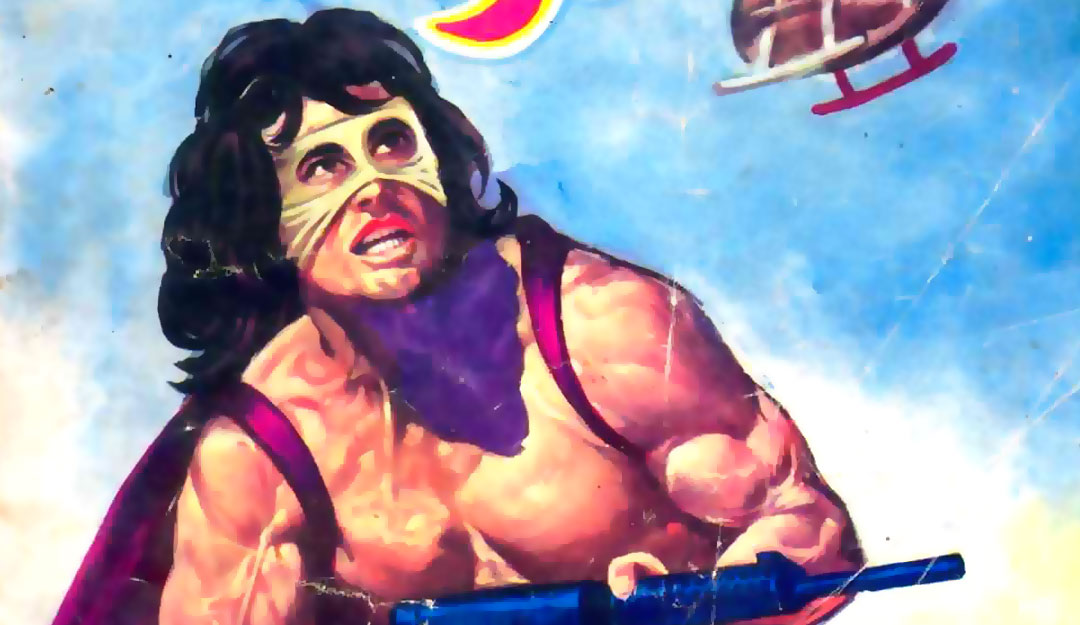
‘Nutan published by ‘Raka di Great’ (Raka the Great) Comics, is a creation that has made a special place in the hearts of readers because of its powerful story and different style of hero. This comic, written by Abid Rizvi and illustrated by Vishnu-Pawan, is not just a story of bravery, but also brings out the social thinking and patriotic spirit of that period. This exciting 32-page journey introduces us to a hero who grew up in the mountains and stands like a rock against evil.
Detailed analysis of the plot:
The story begins in the hills of ‘Shamral’, where at first everything seems calm, but suddenly things worsen. A very cruel criminal named Coral (Monga) is spreading terror in the area through his goons. These goons not only steal animals and goods, but also brutally beat and kill innocent people. The savagery of Coral’s goons is shown on the very opening pages of the story, where they escape after snatching a mother’s baby from her lap. The scene shakes the reader’s heart and immediately arouses hatred for the villain and hope for the hero to arrive.

At this moment, our hero ‘Raka’ enters. Raka is shown as a strong, stocky-bodied hero, wearing a mask and riding his trusty white horse ‘Tiger’. Raka is not just a symbol of strength, but also has two special companions—his horse Tiger and his predatory eagle ‘Shera’. Raka’s entry is exactly like that of a film hero, who arrives at the last moment to save the child and beats up the goons fiercely. He ties the injured goons to their own horses and sends them to Coral, which is clearly an open challenge to him.
The second part of the story shows the character of Coral and his intentions in more depth. Coral is not a minor robber. He runs a hidden underground base inside the hills, filled with modern machines, labs, and weapons. Coral is shown as a one-eyed villain who, along with foreign agents, seeks to smuggle drugs and illegal weapons into the country. Here, the story does not remain just an action comic, but gradually takes the form of a detective thriller. Coral’s statement that only Coral will rule the “hills” clearly shows his arrogance and dictatorial thinking.

The story takes a big turn when Coral attacks Raka with his modern helicopter ‘Tadpa-2’. This scene is one of the most exciting scenes in the comic. The encounter between the helicopter armed with a machine gun and Raka riding on horseback below seems like a collision between old and modern forces. During this time, Raka’s hawk ‘Shera’ shows his wisdom and loyalty. He distracts the helicopter pilot by swooping down on him, causing Coral to miss his machine-gun shots. Raka then performs a feat that seems almost impossible—when he is pulled up from the helicopter after being trapped in a net, he cuts the net with his dagger and jumps onto Tiger’s back in mid-air. This scene gives tremendous thrill, especially to the imagination of children.
In the climax, Raka single-handedly attacks the Coral base where the smuggled cargo is about to arrive. He dusts off international smugglers like ‘Mr. Hag’ and ‘Mr. Khan’ and hands over smuggled goods worth crores to the police. Finally, Coral sends his four most dangerous fighters—‘Kill Master Bag’, ‘Don Master Miki’, ‘Champion Margaret’, and ‘Gun Master Stanley’—to eliminate Raka. Raka and Sanga face all of them together. Coral tries to escape by helicopter, but Raka precisely aims at the helicopter using the special gun of Master Stanley. The helicopter crashes into Coral’s explosive reservoir, and with a massive explosion, his entire empire is destroyed. The story ends with peace returning to the hills of Shamral and the end of evil.
Analysis of characters:

Raka: He is a perfect hero. Courage, justice, and love for nature are clearly visible in him. He truly seems to be the son of the mountains. His mask makes him mysterious. Raka’s greatest strengths are his animal companions—Tiger and Shera—which show how strong the relationship between man and nature can be.
Coral: He is an effective and dangerous villain. He has money, technology, and foreign contacts—everything. His covered eye seems to symbolize his incomplete and ill-conceived personality. He is also ruthless to his own companions, which deepens his cruelty.
Sanga: He is a character who is on the wrong path in the beginning but chooses the right path in the end. His transformation gives the message that a person can return from a wrong path at any time.
Tiger and Shera: They do not speak, but their importance throughout the story is equal to that of the hero. Tiger’s speed and Shera’s sharp gaze make Raka even more powerful.
Art and portraiture:

Vishnu-Pawan’s art style was a special identity of the New Picture Story. The artwork in this comic is quite lively and full of energy. Elements like body movement, muscle strength, and sound effects such as ‘dhishoom-dhishoom’ or ‘dhadam’ in action scenes give the real fun of comics of that period. The choice of colors, especially Raka’s blue mask and red nappy, gives him a distinct identity from the rest of the characters. The hills and Coral base are depicted in such detail that the reader begins to feel part of the same atmosphere. The helicopter crash and fire scenes were quite impressive for their time.
Literary and social significance:

‘Raka di Great’ is not just entertainment, but the messages hidden in it still matter today. This comic highlights the importance of patriotism and national security. Through a foreign agent like Coral, the story teaches that it is the responsibility of every citizen to protect the country from external threats. Along with this, children are made aware of dangers by showing serious issues like smuggling and drugs. Raka’s deep relationship with his animals conveys a message of love for animals and sensitivity toward nature, while the ending firmly presents the eternal truth of the victory of good over evil.
Critical Commentary

Positive aspects:
The pace of the story is so fast that the reader remains connected from beginning to end. Every page increases curiosity to read the next one. The story’s greatest strength is its strong hero-villain balance. A villain as clever and powerful as Coral further enhances Raka’s bravery. The combination of traditional heroism and modern technology makes the story different and memorable.
Areas for improvement:
A little more could have been told about Raka’s past. More light could have been shed on how he became the son of the mountains and what his true source of strength was. The confrontation with the four special Coral fighters also ends a little early and could have been given more space.
Conclusion:
Overall, ‘Raka di Great’ is a strong offering from the New Picture Story series. It reminds us of a time when stories were straightforward yet heart-touching. Heroes like Raka teach us that difficulties surely come on the path of truth, but ultimately, truth wins. This comic is worth preserving even for today’s generation, as it connects readers to the rich heritage of Indian comics. The storytelling of Abid Rizvi and the art of Vishnu-Pawan together have truly made Raka “great”.
This comic is not just an old memory, but a lesson in courage and loyalty that every generation should read. Raka’s promise—“I will come again when you remember!”—still resonates in the hearts of his fans.
